


Arizona Facial Paralysis Birth Injury Lawyer
Facial paralysis after birth can leave families facing uncertainty about what happened during labor and delivery and what the future may hold. The condition can result from pressure on the facial nerve, including from forceps or vacuum extraction, and outcomes can range from temporary weakness to permanent impairment. Careful review of delivery records, fetal monitoring, and clinical decisions can help clarify whether the standard of care was met and whether a preventable error played a role. If you or a loved one were harmed or worse due to facial paralysis birth injury in Arizona, contact Hastings Law Firm for a free, confidential case review.

Last Updated: September 24, 2026
Trusted Legal Advocacy for Infants and Families in Arizona
When your newborn shows signs of facial paralysis after delivery, the questions come fast. What happened? Will my child recover? Could this have been prevented? These are painful questions, and you deserve honest answers.
Facial nerve injuries during birth can result from preventable mistakes made during labor and delivery. If your child suffered this type of injury, you may be wondering whether medical negligence caused the injury.
Understanding what went wrong, and whether the medical team met the expected standard of care, requires a careful review of the delivery records. We also examine fetal monitoring strips and clinical decisions made in the final hours before birth.
At Hastings Law Firm, we focus exclusively on medical malpractice cases. Our team includes in-house nurses and former defense attorneys who know how to investigate birth injuries and identify where care fell short. If you have concerns about your child’s delivery, contact an Arizona Facial Paralysis Birth Injury Lawyer at our firm for a free, confidential case evaluation to help you understand your options.

Was Your Child’s Facial Paralysis Preventable During Delivery
Facial paralysis in newborns is often caused by traumatic pressure on the facial nerve during labor, frequently resulting from the improper use of forceps or vacuum extractors. These medical tools are sometimes necessary but must be handled with extreme care. When used correctly and in appropriate circumstances, they can help guide a baby through the birth canal.
When misapplied or used with excessive force, these tools can compress or stretch the delicate facial nerve. This can lead to temporary or permanent damage. Operative vaginal delivery, a procedure where forceps or a vacuum extractor assists in delivering the baby, carries documented risks.
Research published by PubMed Central on maternal and neonatal trauma confirms that these interventions can lead to significant birth trauma and nerve injury. The decision to use these tools should follow strict protocols, and the medical team must weigh the risks against the benefits in each individual situation.
One common scenario involves cephalopelvic disproportion (CPD), a condition where the baby’s head is too large to pass safely through the mother’s pelvis. When CPD is present or suspected, the standard of care may require a cesarean delivery rather than a prolonged attempt at vaginal birth. Doctors must accurately estimate fetal weight and pelvic size before proceeding.
Continuing with instrument-assisted delivery despite clear signs of disproportion can place dangerous pressure on the baby’s head and face. This significantly increases the likelihood of nerve compression. While not every difficult delivery involves negligence, parents often notice immediate signs that something went wrong.
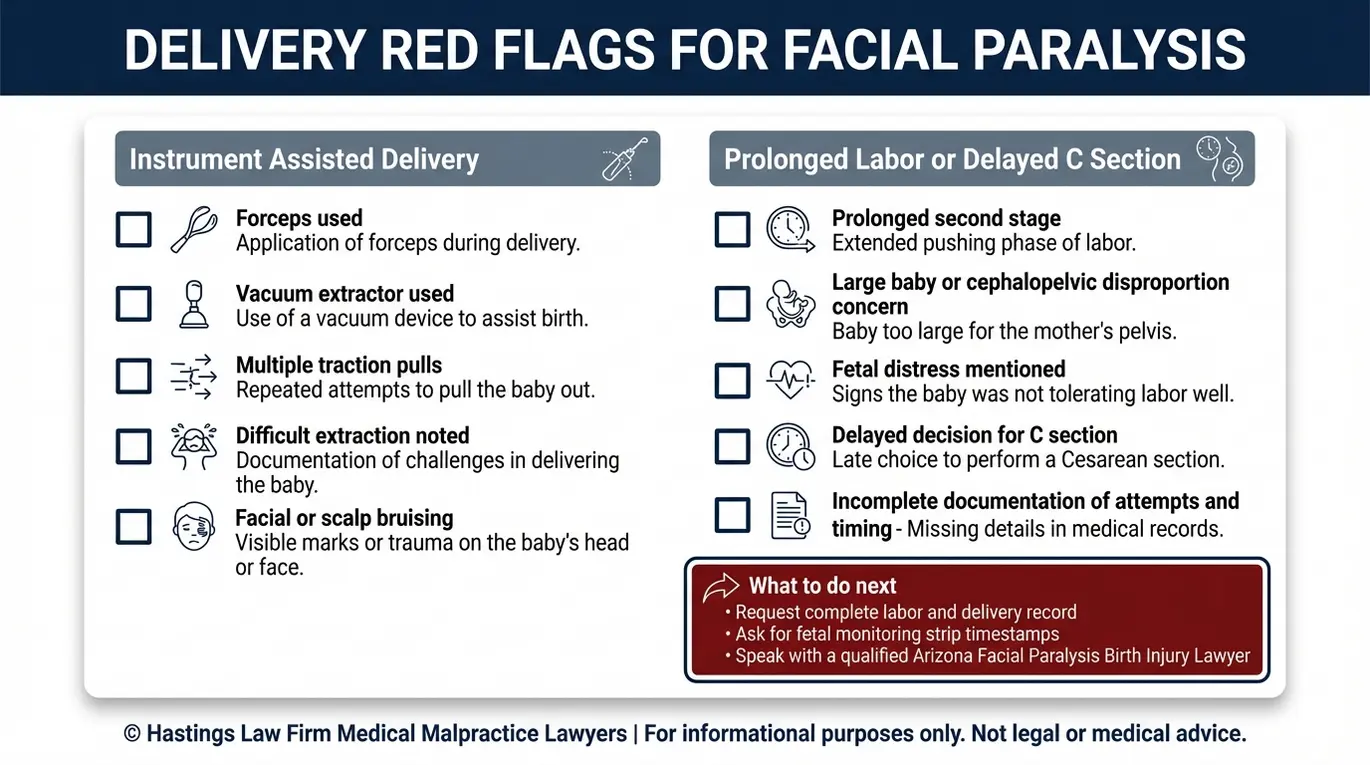
Red Flags That May Suggest Negligence:
- Visible bruising or marks on the baby’s face or head immediately after delivery
- Multiple or prolonged attempts at forceps or vacuum extraction
- Documentation of difficult or traumatic extraction
- Prolonged second stage of labor without reassessment
- Known risk factors for CPD that were not addressed
- Failure to escalate to cesarean delivery despite signs of fetal distress
If any of these factors appear in your child’s case, a detailed review of the delivery records can help determine whether the medical team’s actions fell below the accepted standard of care. An Arizona facial paralysis birth injury lawyer can coordinate this review with qualified medical experts who specialize in obstetric care.
Understanding Cranial Nerve VII and Long-Term Prognosis
The seventh cranial nerve, also known as the facial nerve or CN VII, controls the muscles responsible for facial expressions. This nerve allows a baby to close their eyes, smile, and create the movements needed for nursing. When this nerve is damaged during delivery, the effects can range from mild weakness to complete paralysis on one side of the face.
According to Kenhub’s anatomical overview of the facial nerve, CN VII travels through a narrow bony canal in the skull, making it vulnerable to compression injuries. The severity of the damage determines whether recovery is possible without intervention.
Neuropraxia, a mild nerve injury where the nerve is stretched or bruised but remains structurally intact, typically allows for spontaneous recovery. In these cases, the nerve can often heal on its own within weeks to months as the inflammation subsides. More severe injuries, where the nerve fibers are partially or completely torn, may require surgical repair and extensive physical therapy.
| Injury Type | Description | Typical Prognosis |
|---|---|---|
| Neuropraxia | Nerve stretched or bruised; structure intact | Spontaneous recovery within weeks to months |
| Axonotmesis | Nerve fibers damaged; outer sheath intact | Partial recovery possible; may need therapy |
| Neurotmesis | Nerve completely severed or avulsed | Permanent without surgical intervention |
The first few months after birth are critical for assessing prognosis. If a baby shows no improvement in facial movement within three to six months, the injury is more likely to be permanent. The location of the injury along the nerve path also influences the outcome.
Early evaluation by a pediatric neurologist can help establish a baseline and guide treatment decisions. A lawyer for newborn facial nerve damage can help ensure your child’s medical needs are properly documented. This becomes essential if the injury was caused by preventable medical errors.
Differentiating Birth Trauma from Congenital Defects
Not all cases of facial palsy in newborns result from birth trauma. Some infants are born with congenital facial palsy, a condition that develops during pregnancy due to abnormal formation of the facial nerve. Facial nerve hypoplasia, a condition where the nerve itself is underdeveloped, is one such form.
Distinguishing between birth trauma and a developmental defect is essential for determining whether a malpractice claim is viable. Imaging studies such as MRI can help identify structural abnormalities that would indicate a developmental cause rather than a delivery injury. Our medical team reviews these diagnostic findings alongside the delivery records to determine the most likely cause of your child’s condition.
The Hastings Law Firm Difference
Results matter, but what truly sets us apart is how we achieve them. Every verdict, every settlement, and every Arizona courtroom victory comes from one guiding promise: To treat each client’s fight for justice as if it were our own.
This balance of skill, experience, and empathy reflects our core philosophy that justice should not only compensate the injured, but also make health care safer nationwide.

Diagnosing Nerve Injury and The Role of EMG Imaging
Definitive diagnosis involves physical examination alongside electromyography (EMG) and a nerve conduction test to measure the extent of nerve damage and muscle response. These tests provide objective data about how well the nerve is functioning and whether it is capable of recovery.
Electromyography (EMG), which measures the electrical activity in facial muscles, uses small electrodes to detect whether the muscles are receiving proper signals from the nerve. A nerve conduction study (NCS), which evaluates how quickly electrical impulses travel along the nerve, helps identify where the damage occurred and how severe it is.
According to research published in the Annals of Rehabilitation Medicine, electroneuronography has significant prognostic value in severe cases of facial palsy. This test measures nerve electrical activity to help clinicians predict whether spontaneous recovery is likely or if surgical intervention is necessary.
Immediately after birth, the focus is typically on observation and supportive care. EMG and nerve conduction test results are more accurate several weeks later, once acute swelling has resolved and the results reflect the underlying nerve damage.
Additional imaging, such as MRI or CT scans, may be ordered to rule out other causes of facial weakness. Once the diagnosis is confirmed, treatment options range from conservative approaches like eye patching and steroids to reduce inflammation, to physical or speech therapy, and even surgical procedures.
An Arizona birth injury attorney can help ensure that diagnostic records and treatment plans are preserved as evidence. This documentation is critical for proving the full extent of your child’s injury.
Establishing Liability for Birth Related Facial Palsy in Arizona
Liability is established by proving the medical provider deviated from the accepted standard of care, such as failing to perform a C-section or misusing delivery tools, directly causing the nerve injury. The standard of care is the level of care a reasonably competent medical professional would have provided under similar circumstances.
Establishing negligence involves reviewing whether the delivery team appropriately used fetal monitoring to watch for signs of distress. We also assess whether they correctly evaluated the need for a cesarean delivery and used delivery instruments properly.
Arizona courts require expert testimony to establish the standard of care and prove that it was breached. A recent Arizona Supreme Court opinion reinforces the role of qualified medical experts in validating malpractice claims. Without credible expert support, these cases cannot move forward.
Fetal distress requires immediate attention. When distress is present, the standard of care may require immediate intervention, including emergency cesarean delivery. A delayed C-section, or the failure to perform a timely delivery in the presence of clear warning signs, can support a negligence claim.
Potentially Liable Parties in Birth Injury Cases:
- Obstetricians and attending physicians who made delivery decisions
- Nurses responsible for monitoring fetal heart tones and reporting changes
- Midwives or nurse practitioners who managed labor
- Hospitals and birthing centers (for staffing, training, and protocol failures)
- Anesthesiologists if anesthesia complications contributed to the injury
An Arizona facial paralysis birth injury lawyer works with medical experts to reconstruct what happened during delivery. Our team at Hastings Law Firm includes former defense attorneys and in-house medical staff who understand how to build these complex cases. If you are searching for a malpractice lawyer in Phoenix, we can evaluate your situation and explain your options.

Calculating Damages for Permanent Facial Disfigurement
Compensation in birth injury cases covers current and future medical bills, therapy costs, and non-economic damages for disfigurement, pain, suffering, and loss of enjoyment of life. These non-economic damages represent the personal impact of the injury on your child’s quality of life.
Types of Compensation Available:
- Medical expenses: Past costs for surgeries and future medical costs for nerve grafts and corrective operations
- Rehabilitation costs: Ongoing physical therapy, occupational therapy, and speech therapy
- Assistive devices: Items needed to support daily functioning
- Non-economic damages: Compensation for physical pain, emotional distress, and social stigma
- Loss of future earning capacity: If the injury affects your child’s ability to work as an adult
According to the Centers for Medicare and Medicaid Services (CMS) NHE Fact Sheet, healthcare costs continue to rise significantly each year. Projecting these costs over a child’s lifetime requires careful analysis.
Life care planning is a process where medical and economic experts estimate the total cost of caring for an injured child through their expected lifespan. This plan details every anticipated expense, from routine check-ups to replacement of adaptive equipment. A facial paralysis birth injury settlement should account for all of these projected expenses.
Our firm works with life care planners and economists to document the true scope of your child’s future needs. This thorough approach helps ensure that any recovery reflects the actual cost of the injury.
Contact the Arizona Birth Injury Attorneys at Hastings Law Firm Today for Help
No amount of money can undo what happened to your child. But compensation can provide the resources necessary for the best possible medical care, therapy, and support throughout their life. It can also bring accountability to a system that failed your family.
If you believe your child’s facial paralysis was caused by preventable errors during delivery, we encourage you to reach out for a free consultation. Our team will review your situation, answer your questions, and explain whether you may have a valid claim. You will speak with professionals who understand both the medicine and the law.
Tommy Hastings, our founder, is a Board Certified trial attorney. He is Board Certified in Personal Injury Trial Law by the Texas Board of Legal Specialization, a distinction held by less than 2% of attorneys in the state. Our firm operates on a contingency fee basis, which means you pay no attorney fees or costs unless we recover compensation for you.
Contact an Arizona facial paralysis birth injury lawyer at Hastings Law Firm today. Let us help you find the answers you deserve.
Frequently Asked Questions About Facial Paralysis Birth Injury in Arizona


This content was researched and written by the Hastings Law Firm editorial team, which includes attorneys, medical professionals, and experienced researchers. Our writing is informed by internal knowledge and practical experience, and we cross-check critical details against authoritative sources cited throughout. Every piece undergoes human-led fact-checking and legal review. Because legal and medical information can change, if you spot an error, please contact us. Learn more about our content standards and review process on our editorial policy page.

Tommy Hastings, founder of Hastings Law Firm, is a board-certified personal injury trial lawyer (by the Texas Board of Legal Specialization) dedicated exclusively to healthcare injury cases. Since 2001, he has represented injured patients and families in litigation against major hospital systems, pharmaceutical companies, and negligent healthcare providers nationwide. He has handled numerous high-profile cases that have drawn national media attention and resulted in multi-million dollar recoveries.
