


Arizona Erb’s Palsy Birth Injury Lawyer
Erb’s palsy is a brachial plexus birth injury that can leave an infant with arm weakness or paralysis after a difficult delivery. The condition is often linked to shoulder dystocia and delivery room errors such as excessive traction, improper use of pressure, or forceful extraction attempts. The article also discusses how Pitocin related hyperstimulation can increase urgency and raise the risk of harmful techniques, and how injury severity affects recovery and long term needs. If you or a loved one were harmed or worse due to Erb’s palsy birth injury malpractice in Arizona, contact Hastings Law Firm for a free, confidential case review.

Last Updated: September 24, 2026
Trial-Ready Erb’s Palsy Malpractice Attorneys in Arizona
Learning your child has Erb’s palsy can feel overwhelming. You trusted your medical team to deliver your baby safely, and now you are left with questions, concerns about your child’s future, and perhaps a sense that something went wrong in the delivery room. Those feelings are valid. Many families in Arizona contact an Arizona Erb’s Palsy Birth Injury Lawyer after noticing their newborn’s arm hangs limp or moves differently than expected.
At Hastings Law Firm, we focus exclusively on medical malpractice. Our team includes former defense attorneys who once represented hospitals and nurses with direct clinical experience. This background allows us to identify exactly where care may have fallen short. We understand both the medical science and the emotional weight you carry.
If you believe your child’s injury could have been prevented, we are here to listen and help you understand what happened. Contact us for a free, confidential case evaluation.

Understanding Brachial Plexus Injuries and Erb’s Palsy
Erb’s palsy is a birth injury caused by damage to the brachial plexus nerves in the neck and shoulder, often resulting in weakness or paralysis of the infant’s arm. The brachial plexus nerves are a network of nerves that originates from the spinal cord in the neck and extends through the shoulder to control movement and sensation in the arm and hand. When these nerves, particularly the C5 and C6 nerve roots located in the upper neck, are stretched or torn during delivery, the result can range from temporary weakness to permanent disability.
The injury typically occurs when excessive pulling force is applied to the baby’s head and neck during a difficult delivery. This traction puts intense stress on the delicate nerve roots. According to MedlinePlus, brachial plexus injuries in newborns often happen when the infant’s shoulders become lodged during birth.
Common Signs of Erb’s Palsy in Newborns:
- Limp or motionless arm on one side
- Arm held against the body with the elbow bent
- Inability to move the shoulder or bend the elbow
- Absent or weakened Moro reflex (startle response) on the affected side
- Hand grip present but no arm movement
- Loss of sensation in the arm or hand
Early recognition of these symptoms is essential for beginning treatment and for preserving evidence if negligence occurred. Parents observing these indicators should consider speaking with an Arizona Erb’s Palsy Birth Injury Lawyer to review the circumstances of the delivery.
Common Causes Involving Shoulder Dystocia and Delivery Room Errors
Most Erb’s palsy cases occur when a doctor uses excessive traction force to dislodge a baby stuck behind the mother’s pelvic bone instead of using safe, established maneuvers. This obstetrical emergency, known as shoulder dystocia, happens when the baby’s head emerges but the shoulders remain trapped behind the pubic bone.
When shoulder dystocia occurs, providers must act quickly but correctly. The McRoberts maneuver, which involves flexing the mother’s thighs back toward her abdomen to widen the pelvic outlet, is considered a first-line response. According to the NCBI Bookshelf, this technique, combined with suprapubic pressure, resolves most cases without injury.
| Safe Maneuvers (Standard of Care) | Negligent Actions (Potential Malpractice) |
|---|---|
| McRoberts maneuver | Excessive downward traction on the head |
| Suprapubic pressure | Fundal pressure (pushing on top of uterus) |
| Rotating the baby’s shoulders | Forceful pulling before shoulders are free |
| Delivering the posterior arm | Repeated forceful extraction attempts |
| Emergency cesarean section | Failing to call for timely C-section |
When risk factors such as macrosomia (a larger-than-average baby) or maternal diabetes are present, the standard of care may require planning for a cesarean delivery. This avoids a high-risk vaginal birth involving forceps or vacuum extraction. An Erb’s palsy lawyer in Arizona can review these decisions to determine if malpractice occurred.
Pitocin Induced Hyperstimulation as a Contributing Factor
Pitocin, a synthetic form of oxytocin, is commonly used to induce or strengthen labor contractions. But improper dosing can cause uterine tachysystole, a condition defined as more than five contractions in ten minutes, potentially depriving the baby of oxygen. This can stress the baby and compress delivery into a rushed timeframe where errors are more likely. When medical staff fail to monitor Pitocin administration properly or ignore signs of fetal distress, the resulting urgency can lead to the forceful delivery techniques that cause a birth injury. This failure often constitutes medical negligence.

The Hastings Law Firm Difference
Results matter, but what truly sets us apart is how we achieve them. Every verdict, every settlement, and every Arizona courtroom victory comes from one guiding promise: To treat each client’s fight for justice as if it were our own.
This balance of skill, experience, and empathy reflects our core philosophy that justice should not only compensate the injured, but also make health care safer nationwide.

Classification of Nerve Injuries from Neurapraxia to Avulsion
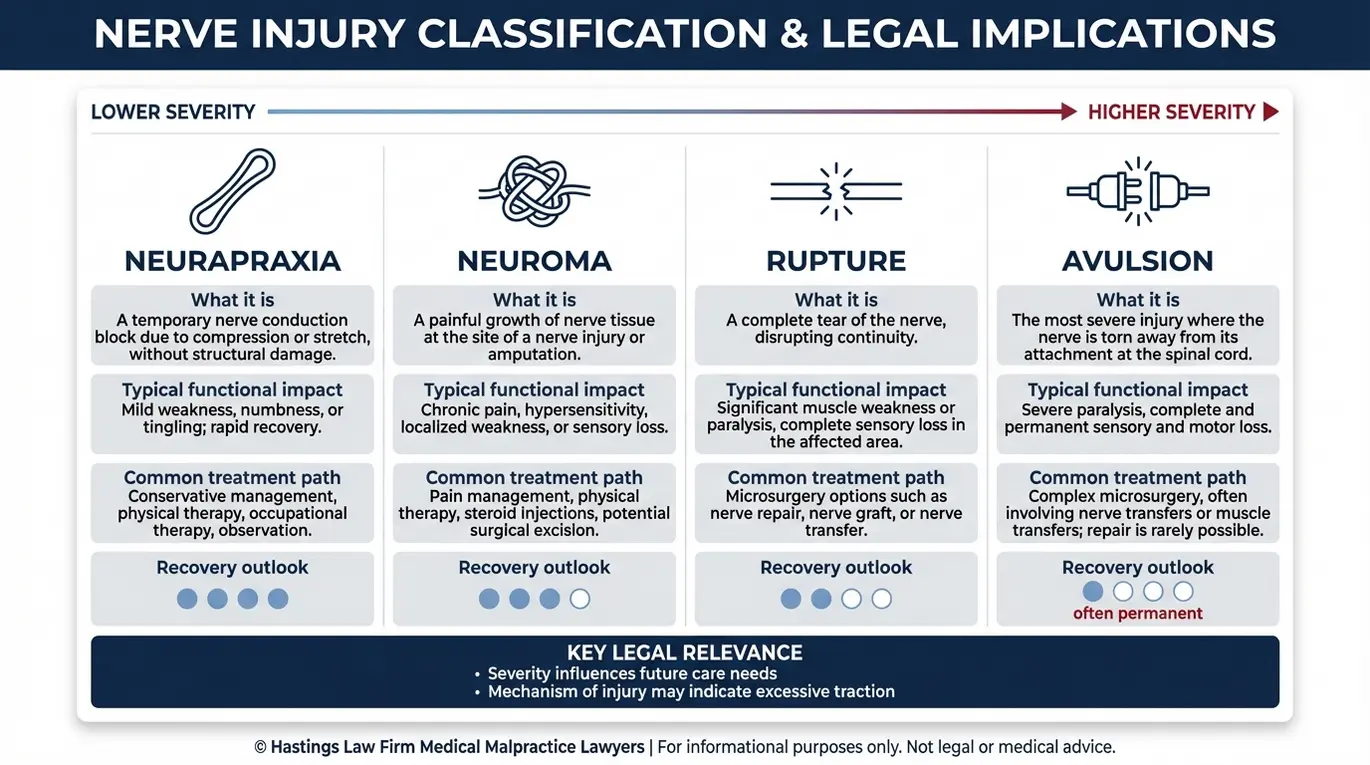
Nerve injuries range from mild stretching (neurapraxia) to complete tearing from the spine (avulsion), with severity dictating the potential for recovery. Nerve damage classifications help determine the level of surgery or therapy required for recovery. Understanding the extent of nerve damage and the type of injury your child sustained helps clarify both the treatment path and the long-term prognosis.
| Injury Type | Description | Typical Outcome |
|---|---|---|
| Neurapraxia | Nerve stretched but not torn; temporary shock | Often heals within 3 months with physical therapy |
| Neuroma | Scar tissue forms around damaged nerve fibers | Partial recovery; may require therapy or surgery |
| Rupture | Nerve torn but not at the spinal cord | Requires surgical repair (nerve graft) |
| Avulsion | Nerve root torn from the spinal cord | Most severe; may require nerve transfer surgery |
Neurapraxia, the mildest form, involves nerve stretching that temporarily disrupts signals but usually resolves on its own. Avulsion, where the nerve is completely torn from its attachment to the spinal cord, represents the most severe injury and typically requires complex microsurgery such as nerve transfers. The NCBI Bookshelf details these injury classifications.
An Arizona Erb’s Palsy Birth Injury Lawyer works closely with medical experts to document the specific injury type and connect it to the events during delivery.
Proving Malpractice and Establishing Liability in Arizona
Establishing liability requires proving that the medical provider deviated from the accepted standard of care and directly caused the infant’s permanent nerve damage. Liability involves legal responsibility for harm caused by medical errors.
Our team approaches each case investigation by reconstructing the delivery minute by minute. We review fetal monitoring strips, nursing notes, physician orders, and delivery room documentation. Our in-house medical staff, including nurse practitioners and Board Certified Patient Advocates, assist in case evaluation by identifying charting inconsistencies.
Sometimes nursing documentation reveals details about force or positioning that contradict the physician’s notes. These inconsistencies are important when our team of medical experts evaluates whether the standard of care was met.
If you feel hesitant about questioning your doctor’s decisions, you are not alone. Many parents struggle with what we call the “White Coat Effect,” years of conditioning that says medical professionals always know best. But when your child has a preventable injury, asking questions is not disrespectful. It is your right. An Arizona birth injury attorney can help you understand whether the care your child received met the standard, or fell short.

Recovering Comprehensive Damages for Long Term Care
Compensation in an Erb’s palsy case covers past and future medical expenses, therapy costs, pain and suffering, and the long-term impact on the child’s earning capacity. Arizona law allows families to seek full recovery for both economic and non-economic losses. An Arizona Erb’s Palsy Birth Injury Lawyer ensures every potential cost is calculated.
Economic Damages:
- Past and future surgical procedures, including nerve grafts and transfers
- Ongoing physical therapy and occupational therapy
- Adaptive equipment and home modifications
- Life care planning costs for future care needs
Non-Economic Damages:
- Physical pain and suffering
- Disfigurement and physical impairment
- Diminished quality of life and loss of enjoyment
- Emotional distress
One often-overlooked consideration is secondary growth abnormalities. Research published in PubMed documents how brachial plexus birth injuries can lead to glenohumeral dysplasia, a condition where the shoulder joint develops abnormally due to muscle imbalance. These skeletal changes may not appear until years after the injury, which is why working with experts in life care planning through organizations like the International Association of Rehabilitation Professionals is essential for projecting your child’s true lifetime needs.
Contact the Arizona Birth Injury Attorneys at Hastings Law Firm Today for Help
If your child was diagnosed with Erb’s palsy after a difficult delivery, you deserve answers. At Hastings Law Firm, we believe that holding negligent providers accountable is about more than compensation. It is about preventing the same harm from happening to another family.
Led by board-certified trial attorney Tommy Hastings, a 2025 ABOTA inductee, our firm focuses solely on representing families affected by medical negligence. We have former defense attorneys who know how hospitals and insurers approach these claims, and we have medical professionals on staff who can analyze your child’s records with clinical precision. Every case we accept is prepared from day one as if it will go to trial.
There are no fees unless we recover compensation for your family. As experienced Arizona Erb’s Palsy birth injury lawyers, we are ready to advocate for your family. Contact Hastings Law Firm today for a free, confidential case evaluation with a patient advocate. Let us help you find the answers you deserve.
Frequently Asked Questions About Erb’s Palsy Birth Injury in Arizona


This content was researched and written by the Hastings Law Firm editorial team, which includes attorneys, medical professionals, and experienced researchers. Our writing is informed by internal knowledge and practical experience, and we cross-check critical details against authoritative sources cited throughout. Every piece undergoes human-led fact-checking and legal review. Because legal and medical information can change, if you spot an error, please contact us. Learn more about our content standards and review process on our editorial policy page.

Tommy Hastings, founder of Hastings Law Firm, is a board-certified personal injury trial lawyer (by the Texas Board of Legal Specialization) dedicated exclusively to healthcare injury cases. Since 2001, he has represented injured patients and families in litigation against major hospital systems, pharmaceutical companies, and negligent healthcare providers nationwide. He has handled numerous high-profile cases that have drawn national media attention and resulted in multi-million dollar recoveries.
