


Arizona Epidural Injection Injury Lawyer
Written by: Hastings Law Firm | Reviewed by: Tommy Hastings | Updated: July 27, 2026
Spinal injections such as epidurals are intended to reduce pain, but errors during placement, monitoring, or medication delivery can lead to serious complications. Warning signs like radiating leg pain, new weakness, loss of bladder or bowel control, severe positional headache, fever, or persistent numbness can signal nerve injury, bleeding, or infection that needs urgent care. Understanding how these injuries happen and how negligence is evaluated can help clarify what went wrong and what losses may follow. If you or a loved one were harmed or worse due to an epidural injection injury in Arizona, contact Hastings Law Firm for a free, confidential case review.

Trusted Arizona Medical Attorneys for Spinal Injection Injuries & Malpractice Claims
What You Should Know About Spinal Injection Malpractice Claims in Arizona:
- Permanent injury risk can increase when red flag symptoms after an epidural are not recognized and treated promptly.
- Long term mobility and function can be affected when needle placement is incorrect and the spinal cord or nerve structures are contacted.
- Severe complications can follow when sterile technique is not maintained and bacteria enter the epidural space.
- Recovery can be reduced when medication selection or dosing errors cause chemical irritation or nerve toxicity.
- Liability can still exist even with a signed consent form when the procedure is performed carelessly.
- Options can be lost if filing time limits are missed even when the underlying evidence is strong.
- Case viability can depend on early expert support because Arizona requires expert validation before a claim can proceed.
- Disputes often focus on what the procedure notes and imaging show about technique, monitoring, and the timing of symptoms.
- Compensation can cover medical bills, lost wages, disability, and pain and suffering, and Arizona does not allow caps on jury awards for personal injury damages.
- Comparative fault can reduce compensation when responsibility is assigned to the patient even if recovery remains available.

A Healthcare Focused Law Firm
An epidural injection is supposed to relieve pain, not cause it. If you or a loved one experienced nerve damage, infection, or other serious complications after a spinal injection, you may be dealing with the physical consequences of a medical error while struggling to get clear answers about what went wrong.
At Hastings Law Firm, we focus exclusively on medical malpractice. As an experienced Arizona epidural injection injury lawyer, Tommy Hastings is Board Certified in Personal Injury Trial Law by the Texas Board of Legal Specialization. Our team of attorneys, nurse consultants, and medical experts has the specialized knowledge to evaluate what happened during your procedure and determine whether the care you received fell below the accepted standard.
Contact us for a free, confidential case evaluation. There is no fee unless we recover compensation for you.
Identifying Signs of Epidural Malpractice & Nerve Damage
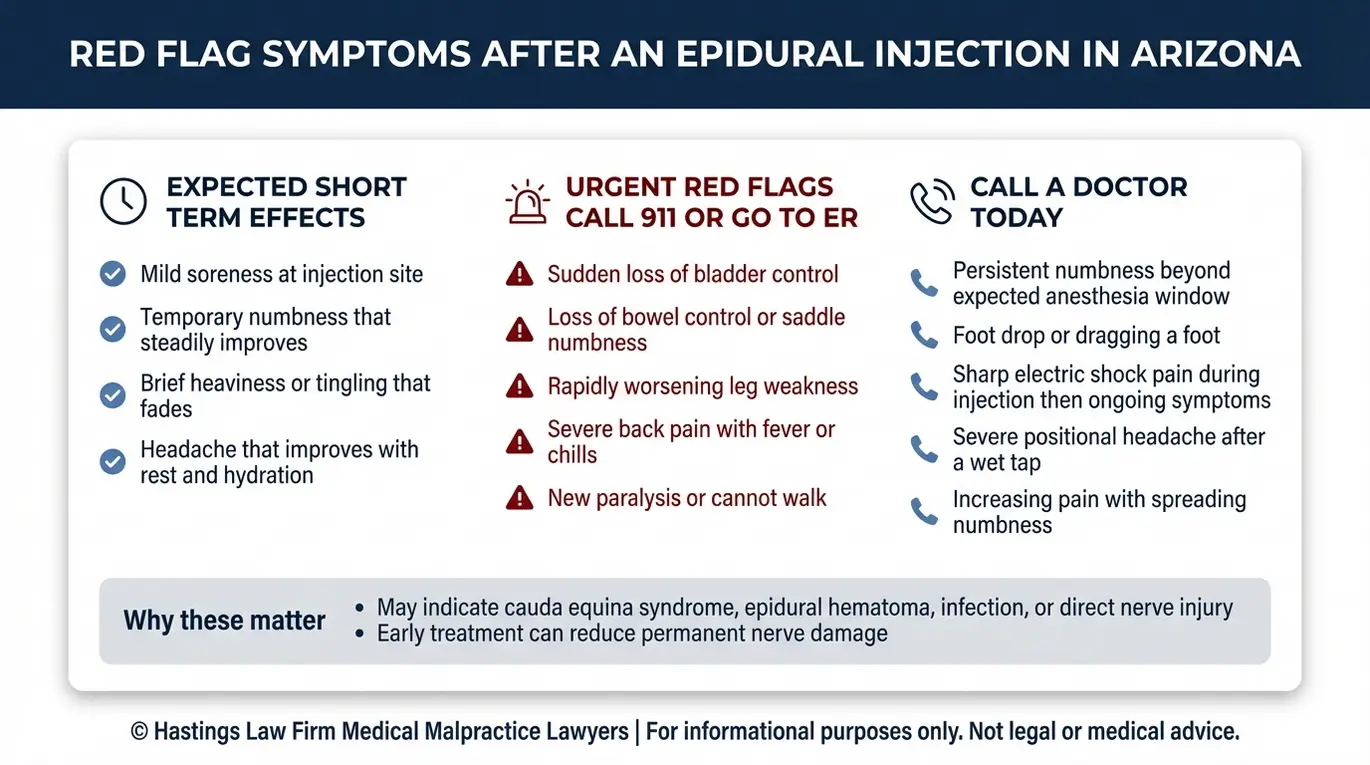
Epidural malpractice is often indicated by immediate sharp pain during the injection, sudden loss of bowel or bladder control, or persistent neurological deficits like numbness or “foot drop” that last well beyond the expected anesthesia window. An epidural is a common procedure used to block pain in specific regions of the body. Recognizing these warning signs early can be the difference between a treatable complication and a permanent injury.
Some soreness at the injection site is normal after an epidural. That tenderness typically fades within a few days. What is not normal is radiating pain down one or both legs, progressive weakness, or any sudden change in bladder or bowel control. These neurological symptoms may point to damage at the spinal nerve root level, and they demand immediate medical attention. An experienced epidural injury attorney knows that recognizing these warning signs early is critical for both your health and your legal rights.
One of the most serious conditions linked to epidural errors is Cauda Equina Syndrome (CES), a condition where the bundle of nerves at the base of the spinal cord becomes compressed. According to a practical guide to CES definition and classification published in PubMed Central, CES can present with bladder dysfunction, saddle numbness, and progressive leg weakness. Without emergency surgical intervention, the damage can become permanent, including paralysis.
Another dangerous complication is an epidural hematoma, where a blood clot forms in the epidural space and presses against the spinal cord. Symptoms often develop gradually over hours, starting with increasing back pain and progressing to leg weakness or numbness. A foot drop, the inability to lift the front part of the foot, is another red flag that may indicate nerve damage from a misplaced needle or spinal cord compression.
Red Flag Symptoms to Watch For:
- Sudden, shooting pain radiating down one or both legs during or after the injection
- New or worsening numbness, tingling, or weakness in the legs
- Loss of bladder control or inability to urinate
- Loss of bowel control
- Numbness in the groin or inner thigh area (“saddle anesthesia”)
- Foot drop or difficulty walking
- Severe headache that worsens when sitting or standing (may indicate a spinal fluid leak)
- Fever, chills, or increasing back pain days after the procedure (possible signs of infection)
If you experienced any of these symptoms after an epidural injection, an Arizona epidural injection injury lawyer can help you determine whether your provider’s actions fell below the standard of care. Our in-house medical staff, including nurse practitioners and Board Certified Patient Advocates, review clinical records to identify exactly when warning signs appeared. As the University of Toledo’s epidural steroid injection overview explains, proper technique and monitoring are essential to preventing these complications.
Common Errors: How Epidural Injections Cause Spinal Injury
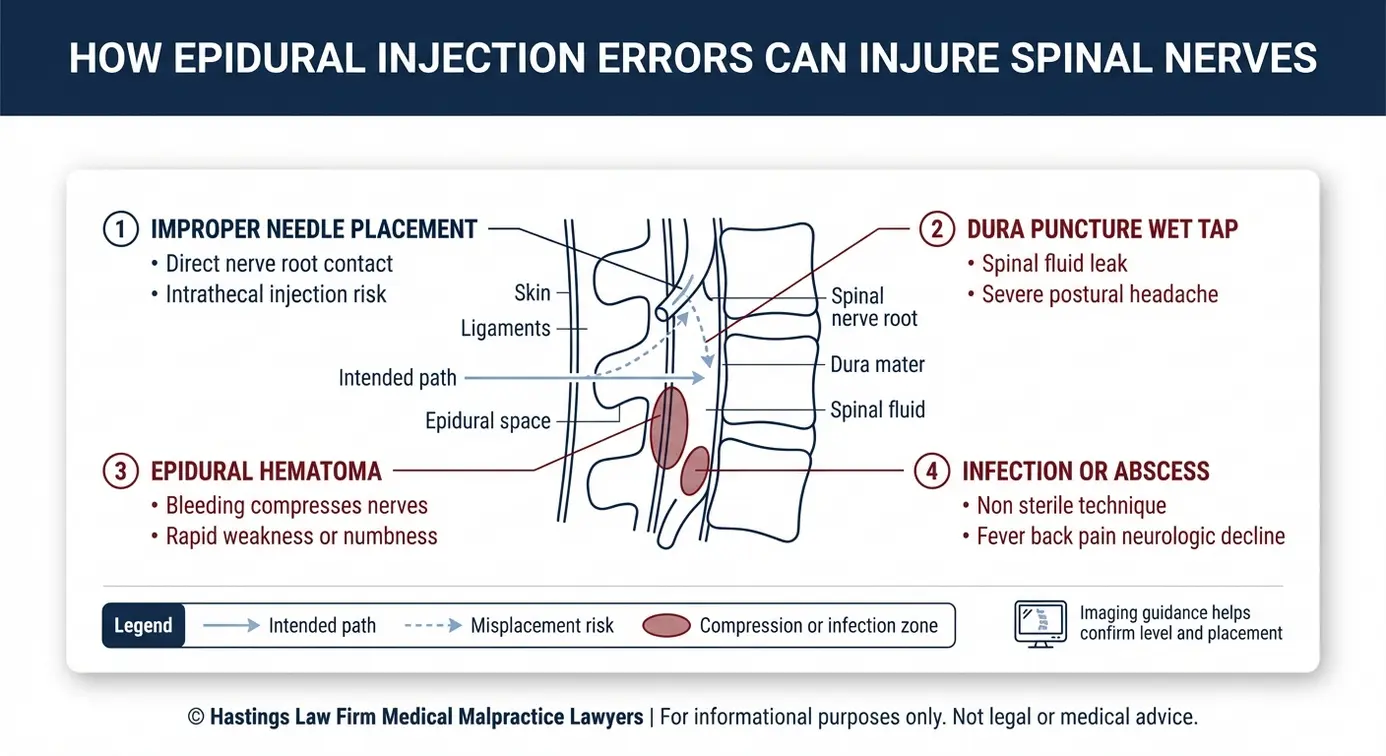
Injuries frequently occur when a provider fails to use fluoroscopy, or live X-ray guidance, correctly, ignores patient complaints of sharp pain indicating nerve contact, or injects medication directly into a blood vessel or the spinal cord itself. Understanding these errors is essential to recognizing whether your injury may have been preventable, and a spinal injection attorney can help you investigate. These procedures often involve inserting a needle into the space near the spinal cord to deliver medication.
Improper Needle Placement
The most direct cause of epidural injury is incorrect needle placement. The epidural space is the narrow area surrounding the spinal cord’s protective membranes, and it is measured in millimeters. When a needle advances too far or deviates from the correct path, it can contact or damage the spinal cord or surrounding nerve structures. This is why proper imaging and technique are not optional; they are fundamental to safe practice.
Dura Mater Puncture
A dura mater puncture, commonly called a “wet tap,” occurs when the needle penetrates the tough membrane surrounding the spinal fluid. The dura mater is the tough, outermost membrane that protects the spinal cord. This puncture allows a spinal fluid leak, often causing a severe positional headache that worsens when sitting upright. While a wet tap can sometimes occur even with proper technique, failure to recognize and treat it promptly, or repeated punctures from poor needle handling, may constitute negligence.
Infection Risks
Spinal infections after an epidural can be devastating. Failure to maintain sterile technique during the procedure can introduce bacteria into the epidural space, leading to a spinal abscess or meningitis. A spinal abscess is a collection of pus that can press against the spinal cord. Research published in a PubMed Central study on complications after lumbar spine epidural steroid injections documents infection as a recognized complication that proper sterile protocols are designed to prevent.
Medication Errors
Injecting the wrong steroid, the wrong concentration, or the wrong volume into the epidural space can cause chemical irritation or direct nerve toxicity. This involves delivering the wrong drugs or doses into the spinal area. These errors may stem from pharmacy compounding mistakes, mislabeled vials, or a provider’s failure to verify the medication before administration.
Labor Epidurals vs. Pain Management Injections
Not all epidural procedures carry the same risks or follow the same protocols. The standard of care varies depending on the clinical setting and the type of injection being performed.
| Labor Epidural | Pain Management Steroid Injection | |
|---|---|---|
| Setting | Hospital Labor & Delivery unit | Outpatient pain clinic or surgical center |
| Provider | Anesthesiologist | Pain management physician or anesthesiologist |
| Purpose | Continuous pain relief during childbirth | Targeted anti-inflammatory treatment for chronic pain |
| Procedure Type | Catheter placed for ongoing medication delivery | Single epidural steroid injection (ESI) into the epidural space |
| Common Risks | Wet tap, blood pressure drops, prolonged numbness | Nerve damage, infection, spinal fluid leak, hematoma |
| Monitoring Standard | Continuous fetal and maternal monitoring required | Post-procedure observation; fluoroscopy often expected |
If you experienced a complication from a labor epidural or a pain management injection, a lawyer for epidural injuries can evaluate whether the provider met the standard of care. At Hastings Law Firm, our team includes former defense attorneys and hospital nurses who understand how healthcare facilities document these procedures. This gives us a strategic advantage when identifying gaps in the clinical record.
The Hastings Law Firm Difference
Results matter, but what truly sets us apart is how we achieve them. Every verdict, every settlement, and every Arizona courtroom victory comes from one guiding promise: To treat each client’s fight for justice as if it were our own.
This balance of skill, experience, and empathy reflects our core philosophy that justice should not only compensate the injured, but also make healthcare safer nationwide.

Proving Negligence in Arizona Spinal Injection Claims
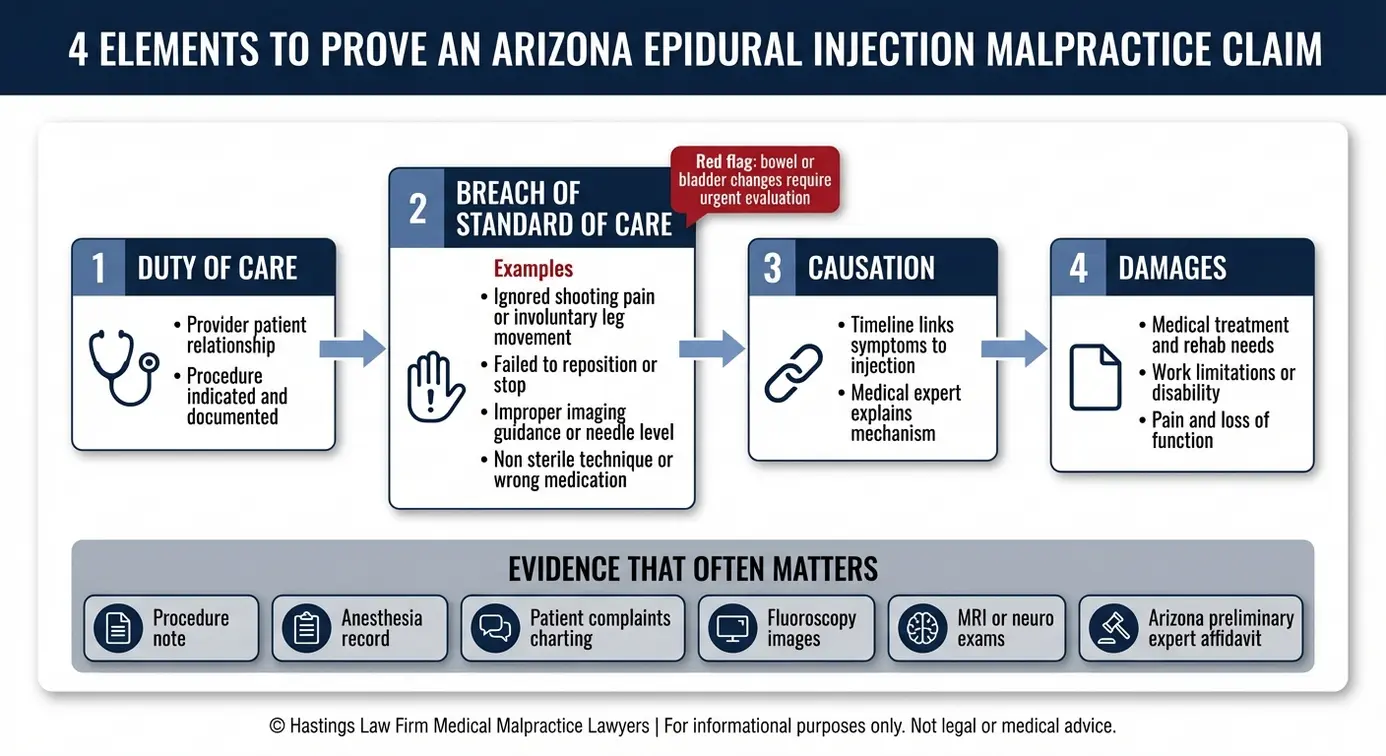
Proving negligence requires demonstrating that the physician deviated from the accepted medical standard of care, such as failing to reposition a needle after a patient reports shooting pain, and that this deviation directly caused the injury. The medical standard of care is the level of care a competent professional would provide in similar circumstances. A signed consent form or a known risk of the procedure does not automatically shield the provider.
An Arizona epidural injection injury lawyer must establish four elements to build a successful claim: a duty of care existed, that duty was breached, the breach caused the injury, and the injury resulted in measurable damages. Here is what that looks like in practice for spinal injection cases.
Evidence we examine to build your case:
- Medical records and imaging: Procedure notes, fluoroscopic images, and post-procedure assessments that reveal whether proper technique was followed
- Involuntary movement documentation: If a patient’s legs jerked or moved involuntarily during the injection, that is a critical warning sign that the needle contacted a nerve; the standard of care typically requires immediate repositioning
- Timing of symptoms: Whether neurological symptoms appeared during or immediately after the procedure, which can establish a direct causation
- Informed consent documents: What risks were disclosed versus what actually occurred
- Staffing and protocol records: Whether the facility followed its own procedures for monitoring and emergency response
- Expert medical opinions: Independent analysis from qualified specialists confirming that the standard of care was breached
One issue unique to injection injury cases involves involuntary leg movements during the procedure. When a patient’s body reacts this way, it often signals that the needle has contacted a spinal nerve root. A competent provider should recognize this immediately and adjust. Continuing to inject medication after this warning sign can cause direct and lasting nerve damage.
Arizona law also requires early expert validation through a Preliminary Expert Opinion Affidavit. As outlined in A.R.S. § 12-2603 from the Arizona Legislature, a qualified medical expert must certify that the standard of care was breached before the case can proceed. Our firm maintains a national network of top-tier medical experts who provide objective reviews and credible expert testimony for these cases.
Signing an informed consent form does not excuse medical negligence. Informed consent means your doctor explained the known risks and you agreed to the treatment. It does not give a provider permission to perform the procedure carelessly. If your injury resulted from an epidural hematoma or a spinal epidural abscess (SEA), these conditions may reflect a breach of the standard of care.
A medical malpractice lawyer who understands both the medicine and the law can connect the clinical evidence to the legal standard and present it clearly to a jury.
Compensation for Epidural Injuries in Arizona Courts
Patients who suffer spinal injection malpractice in Arizona can recover damages for past and future medical bills, lost wages, permanent disability, and pain and suffering, with no constitutional cap on the amount a jury can award.
Recoverable Damages in Arizona
To secure full injection injury compensation, we must account for every impact the injury has had on your life. Recoverable damages typically include:
- Economic Damages: These are the measurable financial losses tied to your injury. They include costs for corrective surgery, ongoing physical therapy, medications, assistive devices, and any income you lost while recovering.
- Future Medical Care: For patients with permanent nerve damage, economic losses may also include reduced future earning capacity and the comprehensive cost of future medical care, including in-home assistance or long-term rehabilitation.
- Non-Economic Damages: Spinal injection injuries often affect every aspect of daily life. These damages account for physical pain, emotional distress, loss of enjoyment of activities you once valued, and the strain an injury places on your closest relationships.
Arizona’s Advantage: No Damage Caps
Unlike many states that limit how much a jury can award in medical malpractice cases, Arizona’s constitution protects your right to full compensation. Article 2, Section 31, as documented in The Arizona Constitution compiled by the Center for American Civics, prohibits the legislature from placing caps on damages in personal injury cases. This means a jury can award whatever amount it believes fairly reflects the harm you suffered.
This protection is vital for catastrophic injuries, but it also applies to less severe complications. Even a severe spinal headache from a fluid leak that requires an epidural blood patch (EBP), a procedure where a doctor injects your own blood near the puncture site to seal the leak, can result in significant medical costs and missed work. These injuries are compensable when they result from a provider’s negligence.
As your Arizona epidural injection injury lawyer, we work with medical and financial experts to document the full scope of your losses. By rigorously analyzing the long-term impact of your injury, we ensure that any settlement or verdict accounts for your needs years down the road.
Arizona Statutes & Filing Deadlines for Injection Injury Lawsuits
In Arizona, medical malpractice lawsuits must generally be filed within two years of the date the injury occurred or was discovered, though specific exceptions apply for minors and hidden injuries. Missing this deadline can permanently bar your claim, regardless of how strong the evidence is.
The two-year statute of limitations is set by A.R.S. § 12-542. For most epidural injury cases, the clock starts on the date of the procedure. But nerve damage and infections do not always reveal themselves right away. An abscess may develop days or weeks later, and progressive weakness may not be linked to the injection for months.
The discovery rule addresses these situations. If the injury or its connection to the epidural was not immediately apparent, the two-year period may begin when you knew, or reasonably should have known, that the injection caused your condition. This exception exists because it would be unfair to penalize a patient for not recognizing a hidden injury before symptoms fully manifest.
Exceptions for minors are also relevant, particularly in labor epidural cases involving birth injuries. Arizona law may extend the filing deadline for children injured by medical negligence, but these rules have specific conditions. Managing these differing filing deadlines requires legal precision. Reaching out to an Arizona epidural injection injury lawyer as early as possible is the best way to protect your rights.
Contact the Arizona Healthcare Malpractice Attorneys at Hastings Law Firm Today for Help
An epidural injection injury can change the course of your life, leaving you with pain, lost mobility, and unanswered questions about what went wrong. You deserve clear answers and a legal team that understands both the medicine and the law.
Hastings Law Firm focuses exclusively on medical malpractice. Our team includes attorneys, nurse consultants, and medical experts who work together to evaluate your care and build the strongest possible case on your behalf. We prepare every case as if it is going to trial, which allows us to negotiate from a position of strength.
There is no cost to speak with us. We work on a contingency fee basis, meaning you pay no attorney fees or costs unless we recover compensation for you.
If you or a loved one suffered a spinal injection injury in Arizona, call our Phoenix office or request a free case evaluation online. Let us review what happened and help you understand your options.
Frequently Asked Questions About Epidural Injection Injury in Arizona


This content was researched and written by the Hastings Law Firm editorial team, which includes attorneys, medical professionals, and experienced researchers. Our writing is informed by internal knowledge and practical experience, and we cross-check critical details against authoritative sources cited throughout. Every piece undergoes human-led fact-checking and legal review. Because legal and medical information can change, if you spot an error, please contact us. Learn more about our content standards and review process on our editorial policy page.

Tommy Hastings, founder of Hastings Law Firm, is a board-certified personal injury trial lawyer dedicated exclusively to healthcare injury cases. Since 2001, he has represented injured patients and families in litigation against major hospital systems, pharmaceutical companies, and negligent healthcare providers nationwide. He has handled numerous high-profile cases that have drawn national media attention and resulted in multi-million dollar recoveries. He draws on that experience in his writing, helping readers understand how these cases work and what options may be available to them.
