


Arizona Ectopic Pregnancy Misdiagnosis Lawyer
Written by: Hastings Law Firm | Reviewed by: Tommy Hastings | Updated: July 27, 2026
An ectopic pregnancy that is missed or diagnosed late can escalate quickly and leave lasting physical and emotional harm. When warning signs are dismissed or testing is not interpreted correctly, a patient may face emergency surgery, internal bleeding, loss of fertility, and other life threatening consequences. Understanding how diagnostic breakdowns happen in emergency rooms and hospitals can help clarify why outcomes can change so fast. If you or a loved one were harmed or worse due to ectopic pregnancy misdiagnosis in Arizona, contact Hastings Law Firm for a free, confidential case review.

Trusted Arizona Medical Attorneys for Ectopic Pregnancy Negligence Claims
What You Should Know About Missed Ectopic Pregnancy Diagnosis Claims in Arizona:
- Life threatening outcomes can follow when an ectopic pregnancy is not identified before rupture and internal bleeding occurs.
- Fertility can be permanently reduced when delayed diagnosis leads to removal of a fallopian tube or the uterus.
- Treatment options can narrow sharply when early intervention is missed and emergency surgery becomes the only safe path.
- Disputes often focus on whether timely testing and interpretation would have prevented rupture and organ loss.
- Responsibility may extend beyond one clinician when emergency discharge decisions, imaging reads, and hospital communication failures contribute to a missed diagnosis.
- Recovery can include both financial losses and personal harm such as pain, emotional distress, and loss of fertility.
- Compensation in Arizona is not limited by a damages cap for personal injury claims.
- Options can be lost if legal time limits are missed, which can restrict the ability to pursue a claim.
- Early case viability can depend on having diagnostic materials that show symptoms, lab trends, imaging findings, and discharge instructions.
- Causation is often the most contested issue because defense arguments may claim the rupture would have happened regardless of earlier care.

A Healthcare Focused Law Firm
An ectopic pregnancy that goes undiagnosed can change your life in a matter of hours. If a doctor failed to identify your ectopic pregnancy before it ruptured, you may be dealing with emergency surgery, the loss of a fallopian tube, and serious questions about your future fertility. The confusion, fear, and frustration you feel right now are completely understandable.
At Hastings Law Firm, our legal and medical team works together to determine whether the care you received fell below the standard your doctor owed you. Our founder, board-certified trial lawyer Tommy Hastings, ensures our team investigates every case with the precision needed for a jury trial. As an Arizona ectopic pregnancy misdiagnosis lawyer team with in-house nurse consultants and a national network of medical experts, we know how to trace exactly where the diagnostic process broke down and who is responsible.
If you or a loved one suffered harm from a missed ectopic pregnancy, we are here to review what happened and explain your options. The consultation is free, confidential, and there are no fees unless we recover for you.
How Ectopic Pregnancy Misdiagnosis Occurs in Arizona Hospitals
Misdiagnosis typically happens when a doctor fails to correlate elevated Beta-hCG levels with an empty uterus on ultrasound, dismisses a patient’s pain as normal early-pregnancy cramping, or discharges the patient without ruling out ectopic implantation.
An ectopic pregnancy develops when a fertilized egg implants outside the uterus, most often in one of the fallopian tubes. The National Center for Biotechnology Information (NCBI) notes that ectopic pregnancies are a leading cause of first-trimester maternal mortality. Since these pregnancies cannot survive, early detection is critical.
The standard of care requires that when a patient presents with early pregnancy symptoms alongside pelvic pain or vaginal bleeding, ectopic implantation must be actively ruled out. A transvaginal ultrasound (TVUS) is the primary tool for this evaluation. If no gestational sac, the fluid-filled structure that surrounds an embryo in early pregnancy, appears inside the uterus, the clinical investigation should intensify, not stop.
Common diagnostic failures in ectopic pregnancy cases include:
- Misreading or under-reading ultrasound images, causing the radiologist or physician to miss signs of a tubal pregnancy
- Failing to order serial hCG blood tests to track whether hormone levels are rising appropriately
- Discharging a patient too early from the emergency room without arranging follow-up imaging or blood work
- Attributing symptoms to other conditions like urinary tract infections, ovarian cysts, or gastrointestinal problems
Any one of these errors can allow a dangerous ectopic pregnancy to progress undetected. As an ectopic pregnancy lawyer in Arizona, we examine each of these decision points in the medical record to determine whether the failure to diagnose fell below the accepted standard.
The hCG Discriminatory Zone and Diagnostic Thresholds
A critical concept in these cases is the hCG discriminatory zone. Beta-hCG (human chorionic gonadotropin) is a hormone produced during pregnancy that doctors measure through blood tests to monitor how a pregnancy is progressing. The discriminatory zone refers to the hCG level, generally between 1,500 and 2,000 mIU/mL, at which a gestational sac should be visible on transvaginal ultrasound if the pregnancy is developing normally inside the uterus.
When a patient’s hCG levels reach or exceed this threshold and no intrauterine pregnancy is seen, the standard of care treats this as an ectopic pregnancy until proven otherwise. A doctor who does not act on this information, whether by failing to order the blood draw, failing to repeat it, or ignoring the results in context, may have breached the duty owed to the patient.
Warning Signs and Symptoms Often Overlooked by Doctors
Critical symptoms of an ectopic pregnancy include sharp, one-sided abdominal or pelvic pain, vaginal bleeding, and dizziness or lightheadedness. Despite how well-recognized these warning signs are in medical literature, doctors too often attribute them to other, less dangerous conditions.
Pain from an ectopic pregnancy may start as a dull ache on one side of the pelvis and gradually intensify. Vaginal bleeding can range from light spotting to heavier flow, and it may not match the pattern a doctor expects with a typical miscarriage. According to the American College of Obstetricians and Gynecologists (ACOG), symptoms may appear as early as the first weeks after a missed period. When providers fail to consider the full clinical picture, they risk sending a patient home with a life-threatening condition.
A ruptured ectopic pregnancy, meaning the fallopian tube has torn open due to the growing embryo, is a surgical emergency. Rupture can cause hemoperitoneum, the accumulation of blood in the abdominal cavity, leading to hemorrhagic shock. At that point, what could have been treated medically becomes a fight to save the patient’s life.
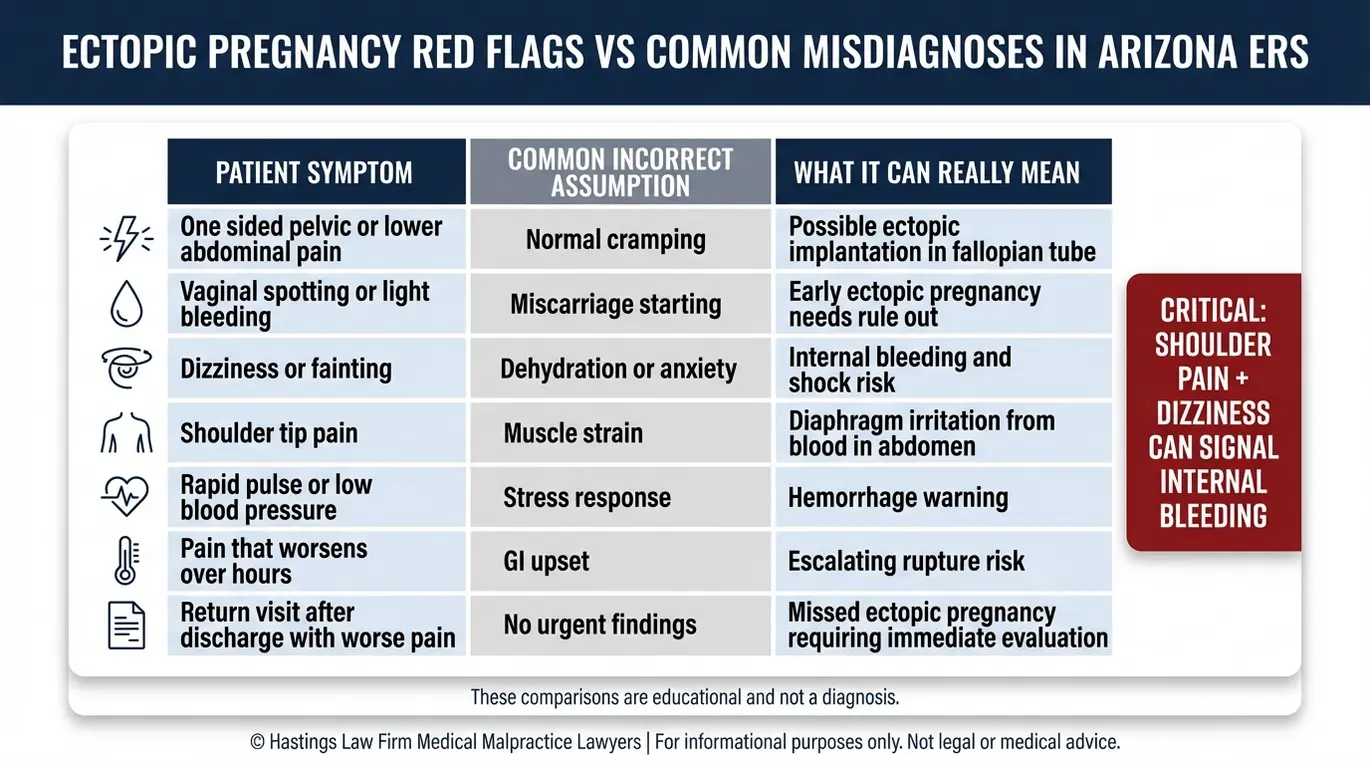
The following table illustrates how common symptoms are frequently misattributed:
| Patient Symptom | Doctor’s Incorrect Assumption | Actual Cause |
|---|---|---|
| Sharp, one-sided pelvic pain | Ovarian cyst or miscarriage | Tubal ectopic pregnancy stretching or rupturing |
| Vaginal spotting or bleeding | Normal early-pregnancy bleeding | Ectopic implantation with abnormal hormone response |
| Shoulder pain | Muscle strain or tension | Referred pain from diaphragmatic irritation caused by internal bleeding (Kehr’s sign) |
| Dizziness or fainting | Dehydration or anxiety | Hypovolemia from internal hemorrhage |
| Nausea with abdominal tenderness | Gastrointestinal illness | Peritoneal irritation from blood in the abdomen |
Referred Shoulder Pain as a Critical Red Flag
Shoulder pain in an early-pregnancy patient is not a musculoskeletal complaint to be dismissed. This symptom, known as Kehr’s sign, results from irritation of the phrenic nerve, which runs along the diaphragm. When blood from a ruptured ectopic pregnancy pools in the abdomen and contacts the diaphragm, the brain interprets the signal as shoulder pain. This referred shoulder pain is a specific clinical indicator of internal bleeding and possible rupture.
General practitioners and ER physicians who are not thinking about ectopic pregnancy may overlook this symptom entirely. An Arizona ectopic pregnancy malpractice attorney examines whether the treating physician recognized, or should have recognized, this red flag and acted accordingly.
The Hastings Law Firm Difference
Results matter, but what truly sets us apart is how we achieve them. Every verdict, every settlement, and every Arizona courtroom victory comes from one guiding promise: To treat each client’s fight for justice as if it were our own.
This balance of skill, experience, and empathy reflects our core philosophy that justice should not only compensate the injured, but also make healthcare safer nationwide.

The Devastating Consequences of a Missed Diagnosis
When a diagnosis is delayed, the fallopian tube can rupture, leading to massive internal hemorrhage, the need for emergency surgery, potential loss of fertility, and in the most severe cases, maternal death.
The treatment window matters enormously. An ectopic pregnancy caught early can often be treated with methotrexate, a medication that stops cell growth and allows the body to reabsorb the pregnancy tissue without surgery. Methotrexate is effectively a chemotherapy agent that dissolves the pregnancy. While it avoids surgery, it requires strict monitoring.
If this window is missed due to a doctor’s hesitation, the non-invasive path is closed. According to the JAMA Network’s overview of ectopic pregnancy, early intervention may also allow for a salpingostomy, a tube-sparing surgical procedure. Both options preserve the fallopian tube and give the patient the best chance of maintaining her natural fertility.
When a misdiagnosis causes the pregnancy to progress to rupture, those options disappear. A salpingectomy, the surgical removal of the affected fallopian tube, often becomes the only life-saving option. In some cases, the damage is so severe that a partial or full hysterectomy is required. Losing a fallopian tube or the uterus directly reduces a woman’s ability to conceive naturally, and future pregnancies may require costly assisted reproductive treatments like IVF.
Beyond the physical consequences, patients who survive a ruptured ectopic pregnancy often carry deep emotional trauma. The experience of nearly dying, waking up from emergency surgery, and learning that your fertility has been permanently altered is devastating. Many patients experience PTSD, grief over lost reproductive potential, and lasting anxiety about future pregnancies.
The psychological impact extends to partners as well, creating a ripple effect of distress. In the most tragic scenarios, families may need to file a wrongful death ectopic pregnancy claim. As an Arizona ectopic pregnancy misdiagnosis lawyer, we account for every dimension of the harm caused by the delay.
Proving Medical Negligence in Ectopic Pregnancy Cases
Proving negligence requires demonstrating that a competent physician in similar circumstances would have identified the ectopic pregnancy through proper testing, including ultrasound and serial hCG monitoring, before rupture occurred.
Arizona medical malpractice claims follow a defined legal framework. Under Arizona Revised Statutes § 12-563, a plaintiff must establish each of the following elements:
- Duty: A doctor-patient relationship existed, creating a legal obligation to provide care that meets the accepted medical standard.
- Breach: The physician deviated from the standard of care. In ectopic pregnancy cases, this may involve failing to order a transvaginal ultrasound, not monitoring hCG levels appropriately, or discharging a symptomatic patient without ruling out ectopic implantation. We also look for “anchoring bias,” where a doctor decides on a benign diagnosis like a UTI and ignores contradictory evidence like spotting. This cognitive error is a frequent cause of malpractice.
- Causation: The breach directly caused the harm. This means establishing that a timely diagnosis would have prevented the rupture, tube loss, or other injury. Defense experts often claim the tube was already damaged. We counter this with evidence showing the rupture was preventable. The key question is whether the outcome was avoidable with proper care.
- Damages: The patient suffered measurable physical, emotional, and financial harm as a direct result of the delayed or missed diagnosis.
Our approach as an Arizona ectopic pregnancy misdiagnosis attorney team is to reconstruct the clinical timeline from the moment of first contact with the healthcare system. We review ER intake records, lab results, imaging studies, nursing notes, and discharge paperwork. Our in-house medical staff identifies exactly when the diagnosis should have been made and what treatment should have followed.
We then work with qualified medical experts who can confirm whether the standard of care was breached and whether that breach caused your injuries. Establishing causation is often the most contested element in a failure to diagnose ectopic pregnancy case. Defense attorneys may argue the rupture would have occurred regardless. Building the clinical timeline with precision, supported by credible expert analysis, is the best way to address those arguments.

Liability for Ruptured Ectopic Pregnancies in Arizona
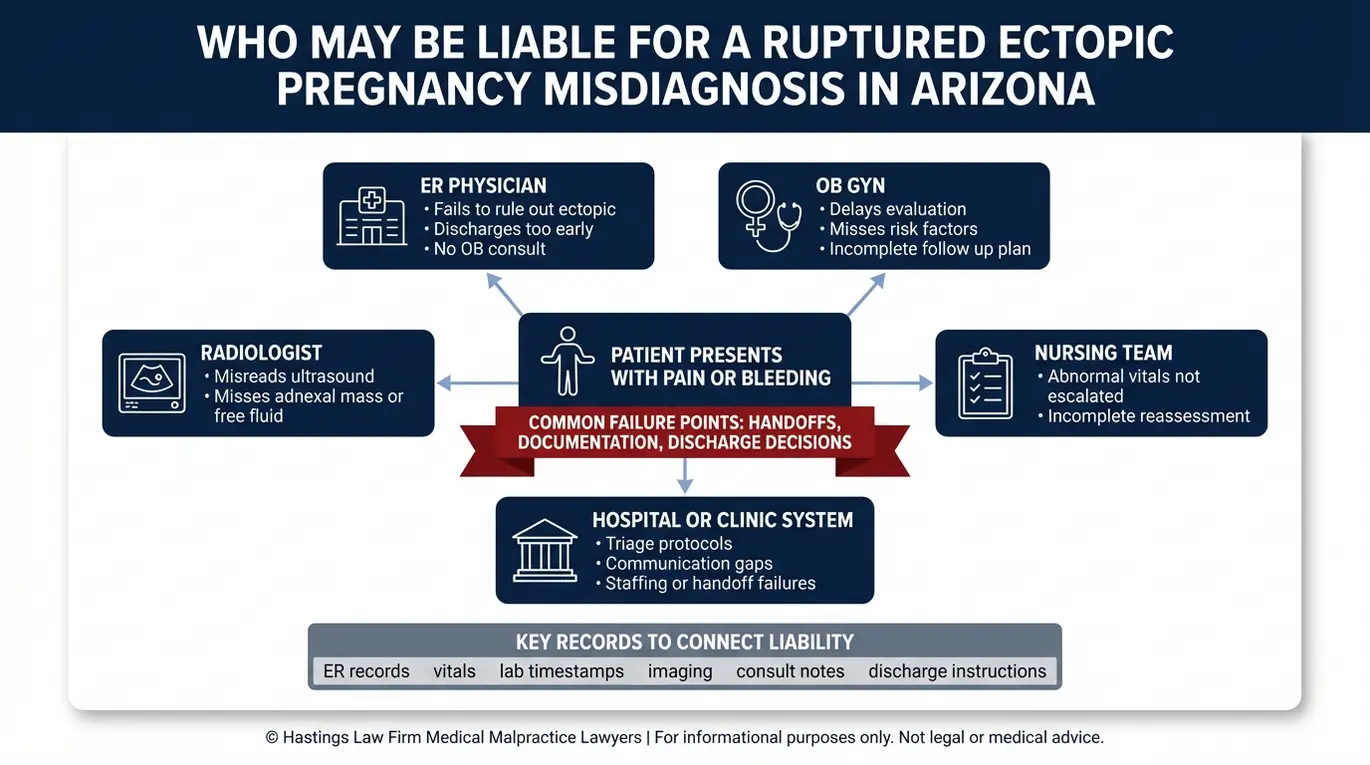
Liability often extends beyond the treating OB-GYN to include emergency room physicians who discharged the patient prematurely, radiologists who misread imaging, and hospitals responsible for systemic failures in protocols or communication.
As noted by the National Academies of Sciences, Engineering, and Medicine in their report on Improving Diagnosis in Health Care, diagnostic errors frequently involve breakdowns across multiple points in the care chain. In ectopic pregnancy cases, several parties may share responsibility:
- Emergency room physicians who failed to consult an OB-GYN or order appropriate imaging before discharging a patient with pelvic pain and a positive pregnancy test
- Radiologists who missed signs of an adnexal mass (a growth near the uterus), free fluid in the cul-de-sac (the area behind the uterus), or other ultrasound findings suggesting ectopic implantation. Radiologists work in dark rooms and may read dozens of scans an hour; fatigue or speed can cause them to miss the subtle “ring of fire” sign of an ectopic pregnancy.
- Nursing staff who failed to escalate abnormal vital signs, such as tachycardia (a rapid heart rate) or dropping blood pressure, which may indicate internal bleeding and impending shock
- The hospital or facility that may bear institutional liability for hospital negligence due to inadequate diagnostic protocols, staffing gaps, or communication failures between departments
As a hospital negligence lawyer team, we investigate every handoff, every order, and every clinical decision documented in the record. We scrutinize Emergency room (ER) records, shift handoffs, and nursing notes to find these gaps. Our former defense attorneys understand exactly how hospitals and their insurers build their arguments, and we prepare each case to address those defenses from the start.
Compensation and Damages for Ectopic Pregnancy Injuries
Patients harmed by a missed ectopic pregnancy diagnosis may recover economic damages for medical bills and lost wages, as well as non-economic damages for pain, suffering, loss of fertility, and emotional distress. Arizona places no cap on these damages.
Economic damages in a lawsuit for ectopic pregnancy injuries can include the cost of emergency surgery, hospitalization, follow-up care, and future fertility treatments such as IVF. Lost income during recovery, as well as any long-term impact on earning capacity, is also recoverable. Future medical costs may also include the price of surrogacy or adoption if the negligence resulted in total sterility.
Non-economic damages reflect the human cost of what happened. This includes physical pain from surgery and recovery, the psychological impact of a near-death experience, grief and emotional distress over the loss of fertility or reduced reproductive options, and the lasting effect on quality of life and intimate relationships. Compensation for fertility loss recognizes not just a medical outcome, but a deeply personal one.
The Arizona Constitution prohibits the legislature from imposing caps on damages in personal injury cases. This means that a jury can award the full value of your suffering without an artificial limit. In cases involving maternal death due to a ruptured ectopic pregnancy, surviving family members may also pursue a wrongful death claim.
Contact the Arizona Healthcare Malpractice Attorneys at Hastings Law Firm Today for Help
If you lost a fallopian tube, underwent emergency surgery, or suffered a life-threatening rupture because a doctor failed to diagnose your ectopic pregnancy, you deserve clear answers about what happened and why.
Hastings Law Firm is ready to investigate your case with the same medical precision and legal preparation we bring to every matter we handle. Our in-house medical staff reviews your records, our attorneys build a detailed clinical timeline, and we work with qualified experts to determine whether negligence caused your injuries. You do not have to sort through this alone.
We charge no fees unless we recover for you. Contact us today for a free, confidential consultation. Let us review what happened and help you understand your path forward.
Frequently Asked Questions About Ectopic Pregnancy Misdiagnosis in Arizona


This content was researched and written by the Hastings Law Firm editorial team, which includes attorneys, medical professionals, and experienced researchers. Our writing is informed by internal knowledge and practical experience, and we cross-check critical details against authoritative sources cited throughout. Every piece undergoes human-led fact-checking and legal review. Because legal and medical information can change, if you spot an error, please contact us. Learn more about our content standards and review process on our editorial policy page.

Tommy Hastings, founder of Hastings Law Firm, is a board-certified personal injury trial lawyer dedicated exclusively to healthcare injury cases. Since 2001, he has represented injured patients and families in litigation against major hospital systems, pharmaceutical companies, and negligent healthcare providers nationwide. He has handled numerous high-profile cases that have drawn national media attention and resulted in multi-million dollar recoveries. He draws on that experience in his writing, helping readers understand how these cases work and what options may be available to them.
