


Arizona Dystonia Disorder Lawyer
Dystonia linked to a medical error can bring lasting involuntary movements, pain, and uncertainty about what went wrong. Some cases are acquired after a specific medical event, while others are genetic or develop without a clear cause, so the timeline and clinical record often shape how the injury is understood. The article discusses how birth related complications, surgical nerve damage, and medication related harm can lead to dystonia and why careful evaluation of causation matters. If you or a loved one were harmed or worse due to dystonia malpractice in Arizona, contact Hastings Law Firm for a free, confidential case review.

Last Updated: July 27, 2026
Trusted Arizona Medical Attorneys for Dystonia Malpractice Claims
Living with dystonia that resulted from a medical error can feel overwhelming. The involuntary movements, the pain, the uncertainty about the future, and the lingering question of whether your care fell short can weigh heavily on you and your family. You deserve answers, and you deserve a legal team that understands both the medicine and the law behind what happened.
As an Arizona dystonia disorder lawyer team, Hastings Law Firm focuses exclusively on medical malpractice. Our attorneys, in-house nurse consultants, and patient advocates work together to investigate whether a preventable medical error caused your condition. If you believe negligence led to a dystonia diagnosis for you or a loved one, we are here to review what happened and explain your options in a free, confidential consultation.

Understanding Dystonia Injuries Caused by Medical Negligence
Dystonia caused by medical negligence occurs when a healthcare provider’s error, such as birth trauma, a surgical mistake, or improper medication use, damages the basal ganglia, a group of structures deep within the brain that help coordinate movement, or surrounding nerves, resulting in permanent involuntary muscle contractions. Dystonia is a neurological movement disorder characterized by these involuntary contractions. Unlike genetic forms, this type of movement disorder, defined by repetitive or twisting motions, is preventable.
Not all dystonia originates from a medical error. Some forms are genetic or idiopathic, which means they develop without a clear external cause. Early onset isolated dystonia is one example of a hereditary form linked to gene mutations. The legal distinction matters: a malpractice claim requires showing that the dystonia was acquired through negligence rather than a naturally occurring condition.
Dystonia disorder attorneys in Arizona focus on this distinction during the investigation phase. We evaluate whether the onset of symptoms aligns with a specific medical event. This might include a difficult delivery, a surgical procedure involving the neck or spine, or the start of a new medication regimen.
That timeline is often the strongest early indicator of an acquired injury. We look for a clear correlation between the medical intervention and the sudden appearance of motor control issues, which stands in stark contrast to the gradual progression often seen in hereditary cases.
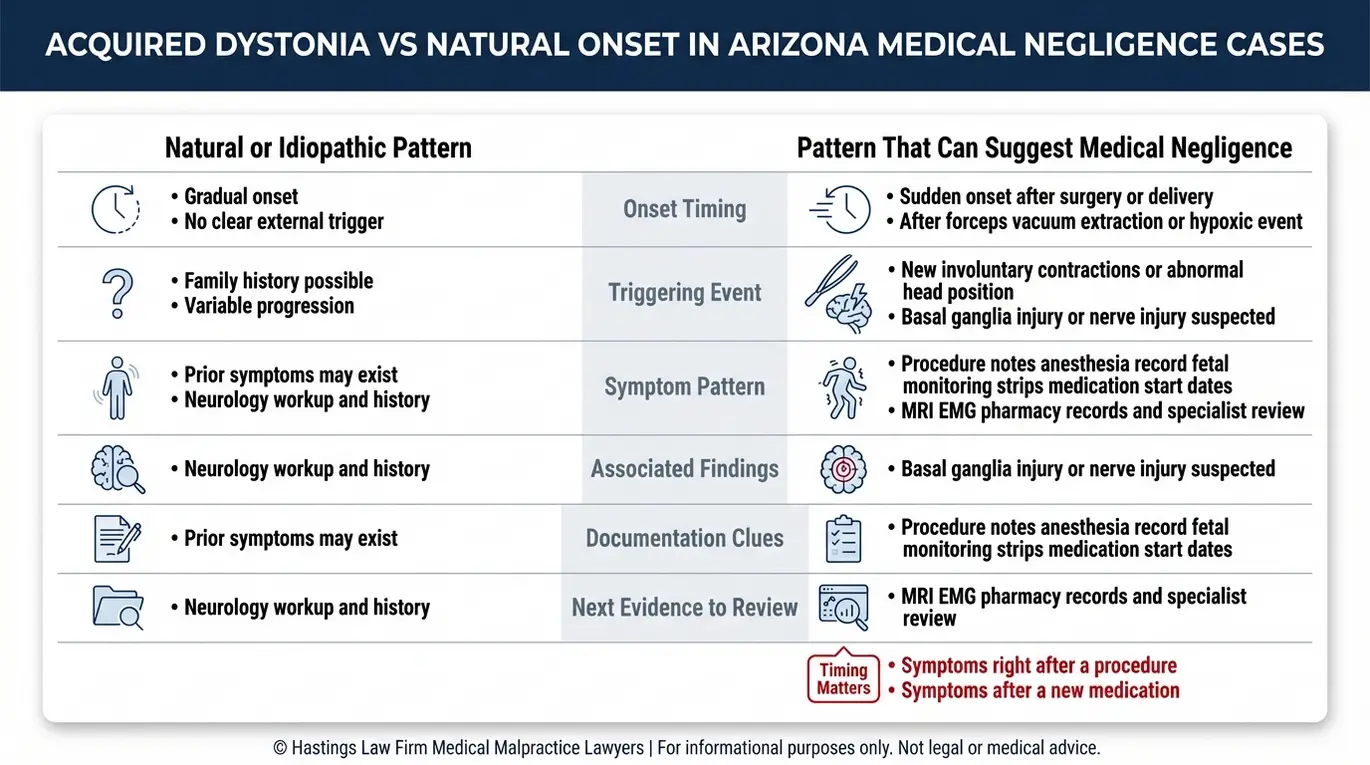
The following table outlines how naturally presenting dystonia typically differs from dystonia that may be linked to a negligent medical event:
| Feature | Natural/Genetic Presentation | Signs Potentially Linked to Negligence |
|---|---|---|
| Onset | Gradual, often in childhood or adolescence | Sudden or rapid onset following a medical event |
| Trigger | No identifiable external cause | Symptoms appear after surgery, birth trauma, or new medication |
| Type | May present as generalized dystonia | Often focal, such as cervical dystonia (spasmodic torticollis) causing abnormal head position |
| Family History | Frequently present | Typically absent |
| Associated Findings | Consistent with known genetic markers | Nerve injury, documented hypoxia, or basal ganglia damage visible on imaging |
This comparison is a starting point. Confirming whether dystonia was caused by negligence requires a detailed medical and legal investigation into your specific circumstances.
Common Medical Errors Leading to Dystonia Claims
The most common grounds for a dystonia lawsuit include birth injuries involving oxygen deprivation or forceps use, surgical damage to nerves, and the prescription of dopamine-blocking medications without proper monitoring. Medical malpractice occurs when a health care provider fails to follow the accepted standard of care. Each category involves a different mechanism of injury, but all share a common thread: a medical provider failed to meet the expected standard of care.
Birth Injuries
During labor and delivery, complications that restrict oxygen deprivation to a baby’s brain can cause hypoxic-ischemic encephalopathy (HIE), a type of brain damage resulting from oxygen loss. HIE can injure the basal ganglia and lead to movement disorders, including dystonia. Research published in *BMC Pediatrics* confirms that spasticity and dystonia are under-identified in young children at high risk for cerebral palsy. This means some families may not receive a dystonia diagnosis until months or years after a birth injury occurs.
Common birth-related risk factors for acquired dystonia include:
- Prolonged or obstructed labor without timely intervention
- Misuse of forceps, a metal instrument used to guide the baby during a forceps-assisted delivery, or vacuum extractors that apply excessive force to the infant’s head
- Failure to perform a timely emergency C-section when fetal distress is evident
- Delayed response to abnormal fetal heart rate patterns
Surgical Errors
Procedures involving the spine, neck, or brain carry risks to surrounding nerve structures. When a surgeon nicks or compresses a nerve during a spinal or cervical operation, the resulting nerve injury can trigger focal dystonia, particularly cervical dystonia. This type of injury is not an expected complication; it can indicate that the surgeon deviated from accepted technique.
Medication Errors
Certain medications can cause a condition known as tardive dystonia, a form of acquired dystonia triggered by drugs that block dopamine receptors in the brain. An Arizona dystonia malpractice lawyer will examine whether the prescribing physician followed appropriate protocols for monitoring and discontinuation.
Drug-Induced Dystonia and Dopamine-Blocking Medications
Tardive dystonia is a serious movement disorder caused by prolonged use of dopamine-blocking medications, or dopamine antagonists, which are drugs that interfere with dopamine signaling in the brain. Common examples include antipsychotic medications and anti-nausea drugs like Metoclopramide (brand name Reglan).
According to the NCBI Bookshelf overview of Tardive Dystonia, this condition can become permanent, especially when the medication is continued after early warning signs appear. A doctor has a duty to warn patients about these risks, monitor for the first signs of involuntary muscle contractions, and promptly adjust or discontinue the drug if symptoms develop.
When we investigate these cases, we review medical records for documentation of informed consent, follow-up appointments, and any notes indicating the provider recognized or ignored emerging symptoms. Expert testimony from neurologists and pharmacologists helps establish whether the prescribing decisions met the standard of care.

The Hastings Law Firm Difference
Results matter, but what truly sets us apart is how we achieve them. Every verdict, every settlement, and every Arizona courtroom victory comes from one guiding promise: To treat each client’s fight for justice as if it were our own.
This balance of skill, experience, and empathy reflects our core philosophy that justice should not only compensate the injured, but also make health care safer nationwide.

Proving Liability and the Standard of Care in Arizona
To prove liability in an Arizona dystonia case, your legal team must demonstrate that the medical provider breached the accepted standard of care—the level of treatment a reasonably competent provider would deliver under similar circumstances—and that this specific breach directly caused the neurological injury, a connection often substantiated by expert testimony.
Arizona medical malpractice claims are decided under a “preponderance of the evidence” standard. Unlike criminal cases requiring proof beyond a reasonable doubt, we must show it is more likely than not. This requires a greater than 50% probability that the provider’s actions directly led to the dystonia and requires a meticulous assembly of clinical evidence.
Our dystonia disorder law firm in Arizona follows a structured investigation process designed to build that proof:
- Collecting medical records: We gather all relevant documentation, including surgical reports, nursing notes, pharmacy logs, and imaging studies such as MRI and EMG (electromyography, a test that measures electrical activity in muscles and nerves).
- Reviewing fetal heart monitoring strips: In birth injury cases, cardiotocography (CTG) tracings, the paper or electronic records of fetal heart rate during labor, can reveal whether signs of distress were present and whether providers responded appropriately.
- Consulting qualified medical experts: Independent specialists review the records and provide opinions on whether a reasonably prudent doctor would have acted differently. Their expert testimony is essential to establishing the breach.
- Establishing causation: We work with neurologists and other specialists to connect the provider’s specific error to the onset of dystonia, ruling out alternative explanations.
Arizona courts have consistently reinforced the importance of expert analysis in malpractice cases. The Arizona Supreme Court’s decision in Henke v. Hospital Development of West Phoenix Inc. underscores the procedural requirements that apply to medical negligence claims in this state. It specifically addresses the standard of proof and the role of expert testimony in establishing causation. This legal precedent reinforces why thorough preparation from the start of a case matters; a procedural misstep in presenting expert evidence can jeopardize a valid claim.
Our team, which includes former defense attorneys and in-house nursing professionals, knows what opposing counsel will look for in these records. We prepare every case as if it will go to trial, which strengthens our position whether the case resolves through settlement negotiations or before a jury. We anticipate the defense’s strategy to attribute the condition to genetic causes and proactively build a counter-narrative based on the facts.

Recoverable Damages for Victims of Dystonia
Patients who developed dystonia due to medical negligence may recover compensation for past and future medical expenses, lost earning capacity, pain and suffering, and the cost of lifelong therapies such as Botulinum toxin (Botox), a neurotoxic protein used to temporarily paralyze muscles and reduce spasms, or deep brain stimulation (DBS) surgery, a procedure where electrodes are implanted in the brain to regulate abnormal movement signals. Recoverable damages represent the financial compensation available to those injured by medical errors. We seek past and future medical expenses to ensure you can afford the care you need.
Economic Damages
These cover the measurable financial costs of living with dystonia, including:
- Past and future medical bills (hospitalizations, neurologist visits, diagnostic testing)
- Ongoing treatments such as Botox injections, which may be needed every few months for years to manage localized pain and stiffness
- Physical therapy and occupational therapy to maintain function and independence
- DBS surgery and related device maintenance
- Lost wages and reduced earning capacity, particularly when dystonia limits the ability to work or changes the type of work a person can perform
Calculating these figures requires projecting costs 20 to 40 years into the future. We work with life care planners and financial experts who specialize in estimating the true lifetime cost of a neurological condition. These experts account for medical inflation, the need for replacement devices in DBS, and the potential need for home modifications or in-home care as the patient ages.
Non-Economic Damages
Dystonia affects more than finances. The chronic pain, social stigma associated with visible movement disorders, loss of enjoyment of life, and emotional distress all warrant compensation. Arizona law recognizes these intangible losses, and as an Arizona Dystonia Disorder Lawyer team, we present detailed evidence, such as day-in-the-life videos and witness testimony, of how the condition has changed our client’s daily life and relationships.
No Caps on Damages in Arizona
Unlike some states, Arizona does not cap medical malpractice damages. The Arizona Constitution protects a patient’s right to full compensation, which is especially meaningful in dystonia cases where lifetime care costs can be substantial. This constitutional protection ensures that a jury can award an amount that truly reflects the severity of the injury. There are no arbitrary legislative limits reducing the financial recovery available to the patient.
Why Choose Hastings Law Firm for Your Arizona Malpractice Claim
Hastings Law Firm offers a trial-ready approach with no upfront costs, combining the resources of a national powerhouse with a dedicated Phoenix office to fight for families affected by medical negligence. This trial-ready approach means that when we sit across from a hospital’s defense attorneys or insurance carriers during settlement negotiations, they know we are fully prepared to present the case to a jury.
Our Arizona dystonia disorder attorneys work from our Phoenix office, giving Arizona families direct access to a firm with national resources. Our team includes former defense counsel, in-house nurse consultants, and a dedicated patient advocate to guide you through the process.
You pay nothing upfront. We handle these cases on a contingency fee basis, or a “no win, no fee” structure, which means there are no attorney fees or costs unless we secure a recovery for you.
Contact the Arizona Birth Injury Attorneys at Hastings Law Firm Today for Help
If you or a loved one developed dystonia after a medical procedure, a difficult birth, or the use of a prescribed medication, you do not have to accept silence from the healthcare system. Something may have gone wrong, and you have the right to find out.
Contact an Arizona Dystonia Disorder Lawyer at Hastings Law Firm for a free, confidential case evaluation. Our patient advocates will listen to your story, review the circumstances, and help you understand whether you have a viable claim. There is no fee unless we recover compensation on your behalf.
Call our Phoenix office or submit your information online. We are ready to investigate what happened and help protect your family’s future.
Frequently Asked Questions About Dystonia Disorder in Arizona


This content was researched and written by the Hastings Law Firm editorial team, which includes attorneys, medical professionals, and experienced researchers. Our writing is informed by internal knowledge and practical experience, and we cross-check critical details against authoritative sources cited throughout. Every piece undergoes human-led fact-checking and legal review. Because legal and medical information can change, if you spot an error, please contact us. Learn more about our content standards and review process on our editorial policy page.

Tommy Hastings, founder of Hastings Law Firm, is a board-certified personal injury trial lawyer dedicated exclusively to healthcare injury cases. Since 2001, he has represented injured patients and families in litigation against major hospital systems, pharmaceutical companies, and negligent healthcare providers nationwide. He has handled numerous high-profile cases that have drawn national media attention and resulted in multi-million dollar recoveries. He draws on that experience in his writing, helping readers understand how these cases work and what options may be available to them.
