


Arizona Discordant Twin Growth Negligence Lawyer
Written by: Hastings Law Firm | Reviewed by: Tommy Hastings | Updated: July 27, 2026
Discordant twin growth can signal a serious problem in a high risk twin pregnancy, and missed warning signs or delayed intervention can lead to permanent injury and long term disability. This topic often involves whether providers followed appropriate surveillance based on chorionicity, recognized concerning ultrasound and Doppler findings, and responded promptly to reduced fetal movement or signs of fetal distress. Understanding how monitoring gaps happen can help families make sense of complex prenatal records and outcomes. If you or a loved one were harmed or worse due to discordant twin growth negligence in Arizona, contact Hastings Law Firm for a free, confidential case review.

Top Rated Legal Representation for Birth Injury Families in Arizona
What You Should Know About Unequal Fetal Growth Malpractice Claims in Arizona:
- Permanent neurological injury can result when discordant twin growth is not recognized or treated promptly, especially when oxygen deprivation or premature delivery complications occur.
- The risk of severe outcomes can increase when providers take a watch and wait approach despite worsening signs of growth restriction or fetal compromise.
- Options for meaningful compensation in Arizona can be broader because damages in malpractice cases cannot be arbitrarily capped by the legislature.
- Disputes about causation are common because hospitals may claim the outcome was genetic, inevitable, or due to unpreventable prematurity rather than negligent care.
- Missed or delayed escalation can be central when abnormal Doppler findings or other high risk indicators do not lead to specialist referral or timely delivery planning.
- The strength of a claim can turn on what the prenatal record shows about serial ultrasound measurements and whether growth divergence was acted on.
- Placental pathology findings can be pivotal because they may distinguish between an acute event during labor and a chronic condition developing over weeks.
- Documentation of fetal monitoring strips, nursing notes, and physician orders can shape what can be proven about warning signs and response times.

A Healthcare Focused Law Firm
When your twins face complications during pregnancy or delivery, the experience can leave you searching for answers about what went wrong and whether it could have been prevented. If you suspect that delayed monitoring or missed warning signs contributed to your baby’s injuries, you or a loved one may feel confused and overwhelmed by the medical information surrounding your case.
An Arizona discordant twin growth negligence lawyer can help you understand what happened and whether the care your family received met accepted medical standards. At Hastings Law Firm, we focus exclusively on medical malpractice litigation, and our team includes in-house nurses and former defense attorneys who know how to analyze complex prenatal records and identify where care may have fallen short.
If your twins suffered injuries that you believe were preventable, we invite you to contact us for a free, confidential case evaluation. We can review your medical records and explain your legal options.
Understanding High Risk Twin Pregnancies and Discordant Growth
Discordant twin growth occurs when one twin significantly outgrows the other, often signaling placental insufficiency or Twin-to-Twin Transfusion Syndrome (TTTS) that requires immediate medical intervention to prevent permanent injury. This condition, typically defined as a weight difference of 15-25% or more between twins, represents one of the most critical warning signs in obstetrics.
Understanding why discordant growth develops requires knowing how twins share resources in the womb. Twins fall into two main categories based on their placental arrangement. Dichorionic twins have separate placentas, which generally reduces the risk of one twin “stealing” nutrients from the other. Monochorionic twins, sharing a single placenta, face substantially higher risks because blood vessels may connect the two circulations unevenly.
In monochorionic pregnancies, these shared connections can cause one twin to receive more blood flow and nutrients while the other becomes progressively growth-restricted. According to the International Society of Ultrasound in Obstetrics and Gynecology (ISUOG) Practice Guidelines, these high-risk pregnancies demand specialized surveillance protocols that differ significantly from singleton pregnancies.
A discordant twin growth negligence attorney in Arizona examines whether your medical team followed these protocols. Amniotic fluid discordance, where one twin has too much fluid (polyhydramnios) while the other has too little (oligohydramnios), often accompanies growth differences and signals worsening conditions that require urgent evaluation.
Research published in PubMed Central on ultrasound surveillance in twin pregnancy confirms that early and consistent monitoring can identify problems before they cause permanent harm. A twin pregnancy birth injury lawyer reviews whether your care team recognized these warning signs in time.
Warning Signs Obstetricians Must Monitor
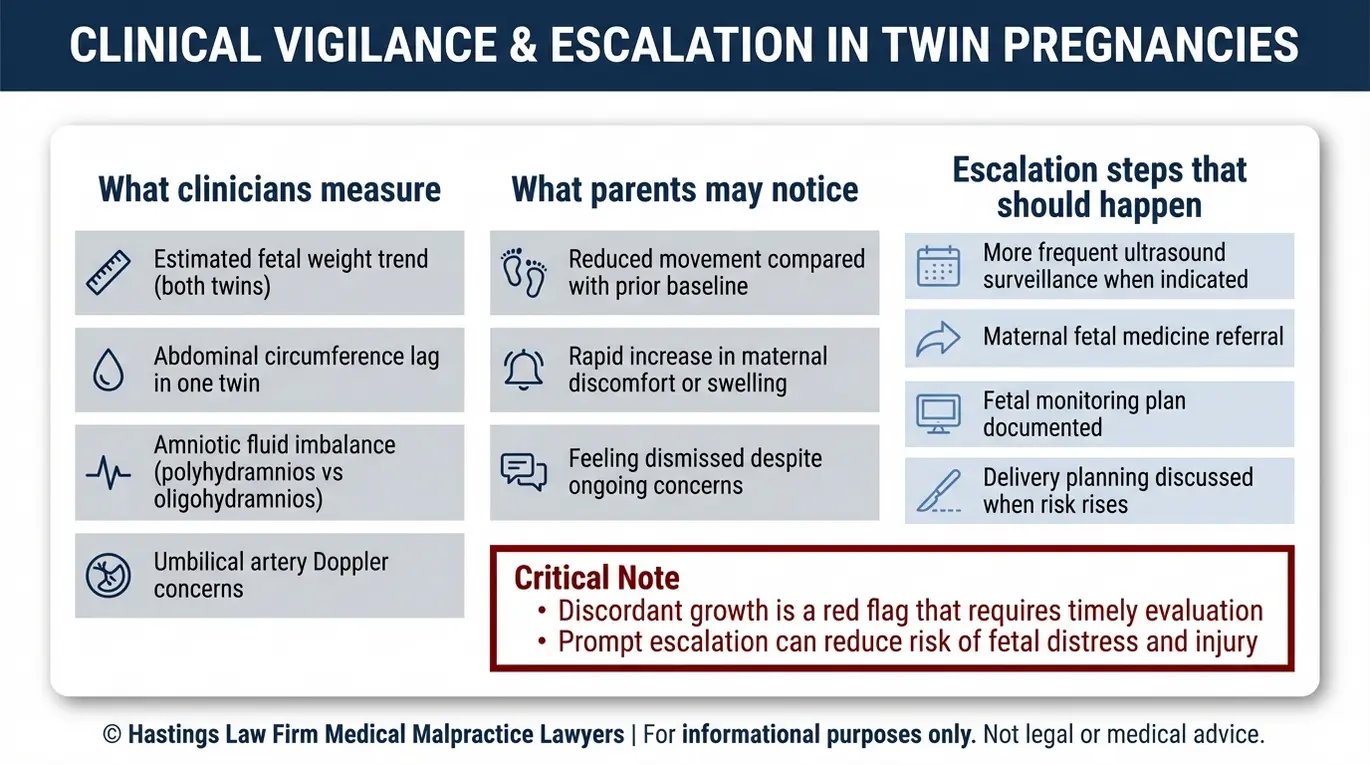
During high-risk twin pregnancies, medical professionals must watch for specific warning signs of discordant growth through consistent surveillance.
- Significant weight difference (15% or greater) between twins on serial ultrasounds
- Lagging abdominal circumference measurements in one twin
- Amniotic fluid discrepancies between the two sacs
- Abnormal umbilical artery Doppler findings
- Reduced fetal movement reported by the mother
- Signs of fetal distress on monitoring strips
When these indicators appear, the standard of care requires prompt action. An Arizona discordant twin growth lawyer can determine whether your providers responded appropriately to documented warning signs.
Obstetrical Negligence in Monitoring Twin Growth Discrepancies
Medical malpractice and obstetric malpractice occur when an obstetrician fails to adhere to the strict monitoring schedule required for multiples, resulting in missed diagnoses of growth restriction or fetal distress. Twin pregnancies demand a level of fetal monitoring and surveillance that far exceeds what single pregnancies require, and deviations from these protocols can have devastating consequences.
The standard of care for monitoring twin pregnancies typically requires ultrasound evaluations every two to four weeks, depending on chorionicity. According to the Global Library of Women’s Medicine, monochorionic twins often need scans every two weeks starting at 16 weeks because complications can develop rapidly. Chorionicity, which describes whether twins share a placenta (monochorionic) or have separate placentas (dichorionic), determines the intensity of required monitoring.
A negligence lawyer for twin injuries investigates whether your care team maintained the appropriate scan frequency. Doppler flow studies, which measure blood flow through the umbilical artery, provide critical information about whether a growth-restricted twin is receiving adequate oxygen and nutrients. When these studies show abnormal patterns, the standard of care typically requires referral to a Maternal-Fetal Medicine specialist or consideration of early delivery.
An Arizona birth injury attorney examines the gap between what should have happened and what actually occurred. Problems often arise when providers adopt a passive “watch and wait” approach despite mounting evidence of discordant growth, rather than taking decisive action. This form of medical negligence typically involves a failure to perform a timely C-section before the weaker twin suffers irreversible harm. Delayed intervention can allow a treatable condition to progress into permanent injury, leaving families with questions about why their medical team did not act sooner to protect their babies.
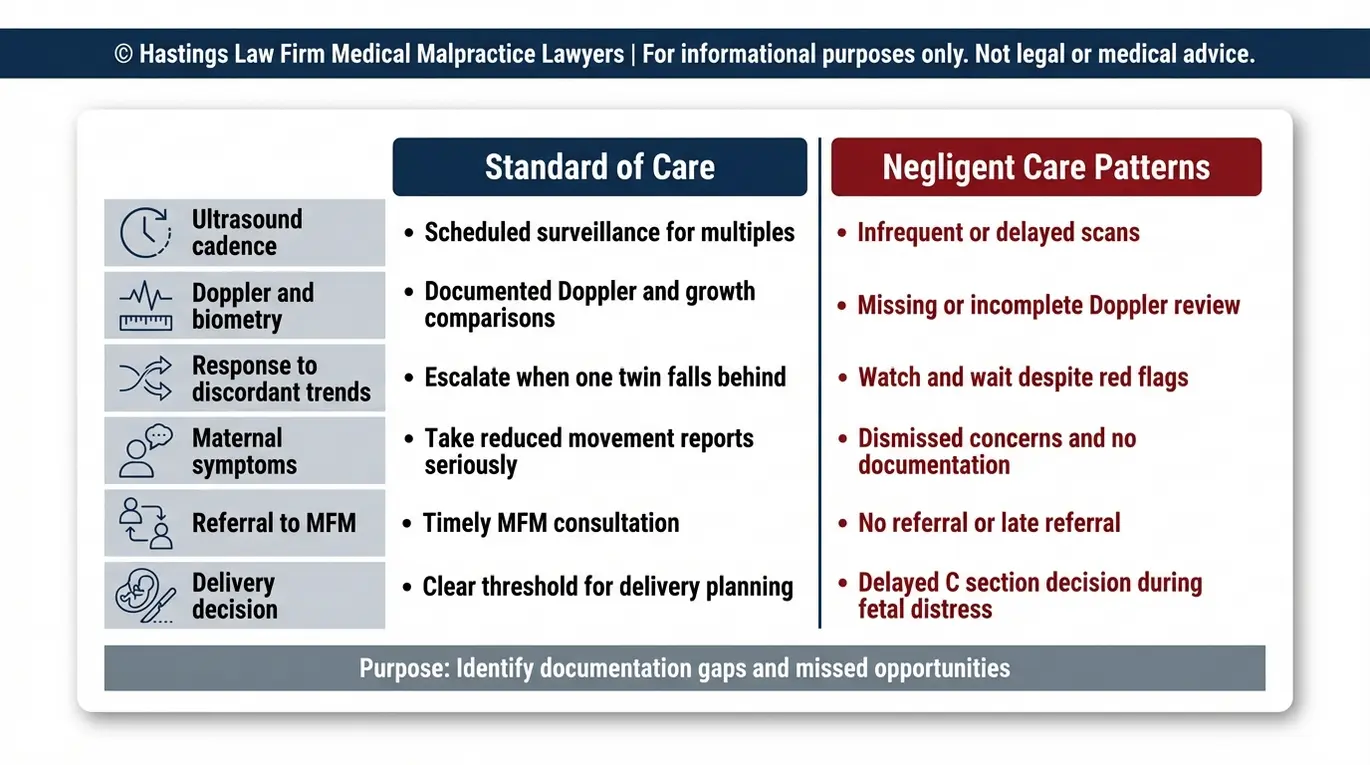
Standard of Care vs. Negligent Care
When evaluating how a medical team managed a twin pregnancy, our firm compares the documented care against established standards of care.
| Standard Care | Negligent Care |
|---|---|
| Regular biometry scans every 2-4 weeks based on chorionicity | Infrequent scanning with gaps of 6 weeks or more |
| Doppler flow studies when growth discrepancy is identified | Failure to order Doppler studies despite documented size difference |
| Prompt referral to Maternal-Fetal Medicine for high-risk findings | No specialist referral despite abnormal results |
| Responsive evaluation when mother reports reduced movement | Dismissing maternal concerns about decreased fetal activity |
| Documented discussion of delivery timing options | No delivery planning despite progressive growth restriction |
| Consideration of early delivery when fetal status deteriorates | Continued observation despite signs of fetal compromise |
When reviewing a case involving malpractice regarding twin growth, our team compares the care documented in your records against these established standards. This comparison forms the foundation of establishing whether negligence occurred.
The Hastings Law Firm Difference
Results matter, but what truly sets us apart is how we achieve them. Every verdict, every settlement, and every Arizona courtroom victory comes from one guiding promise: To treat each client’s fight for justice as if it were our own.
This balance of skill, experience, and empathy reflects our core philosophy that justice should not only compensate the injured, but also make healthcare safer nationwide.

Injuries Caused by Mismanagement of Discordant Growth
Failure to address discordant growth often leads to catastrophic outcomes including cerebral palsy, hypoxic-ischemic encephalopathy (HIE), and severe neurological impairments caused by oxygen deprivation or premature delivery complications. Understanding the connection between monitoring failures and these injuries helps families recognize when they may have a valid legal claim.
When one twin experiences intrauterine growth restriction (IUGR), that baby’s brain and organs may not receive adequate oxygen and nutrients over time. This chronic deprivation can cause progressive damage even before delivery. If the situation worsens without intervention, acute oxygen loss (hypoxia) can occur, leading to brain damage that manifests as cerebral palsy or HIE.
A lawyer for twin birth injuries examines how these conditions developed. Twin-to-twin transfusion syndrome (TTTS), a condition where blood flows unequally between twins sharing a placenta, represents one of the most dangerous complications. According to the National Center for Biotechnology Information, untreated TTTS can result in the death of one or both twins, or severe neurological damage to survivors. Selective fetal growth restriction (sFGR), where one twin fails to grow adequately while the other develops normally, carries similar risks.
Research published in PubMed on selective fetal growth restriction documents the serious perinatal outcomes associated with this condition, including higher rates of preterm labor, premature birth, and neurological injury. The study highlights that when growth discrepancies are identified early, strategic management can reduce the likelihood of these adverse events.
An Arizona discordant twin growth negligence lawyer investigates whether delays in recognizing these conditions or performing emergency delivery contributed to your child’s injuries. By analyzing the medical timeline, we can determine if earlier medical action would have altered the outcome and prevented the long-term disabilities your family now faces.
Potential Complications from Mismanaged Discordant Growth
When discordant twin growth is not properly monitored or addressed, several potential birth complications can result in lifelong challenges.
- Cerebral palsy resulting from chronic or acute oxygen deprivation
- Hypoxic-ischemic encephalopathy (HIE) causing permanent brain damage
- Neurological damage affecting motor function, cognition, or both
- Premature birth complications when emergency delivery becomes necessary
- Death of one or both twins in severe, untreated cases
- Developmental delays requiring lifelong therapy and support
A medical malpractice lawyer analyzes your records to determine whether earlier intervention could have prevented these outcomes.
Establishing Medical Negligence Through Specialized Investigation
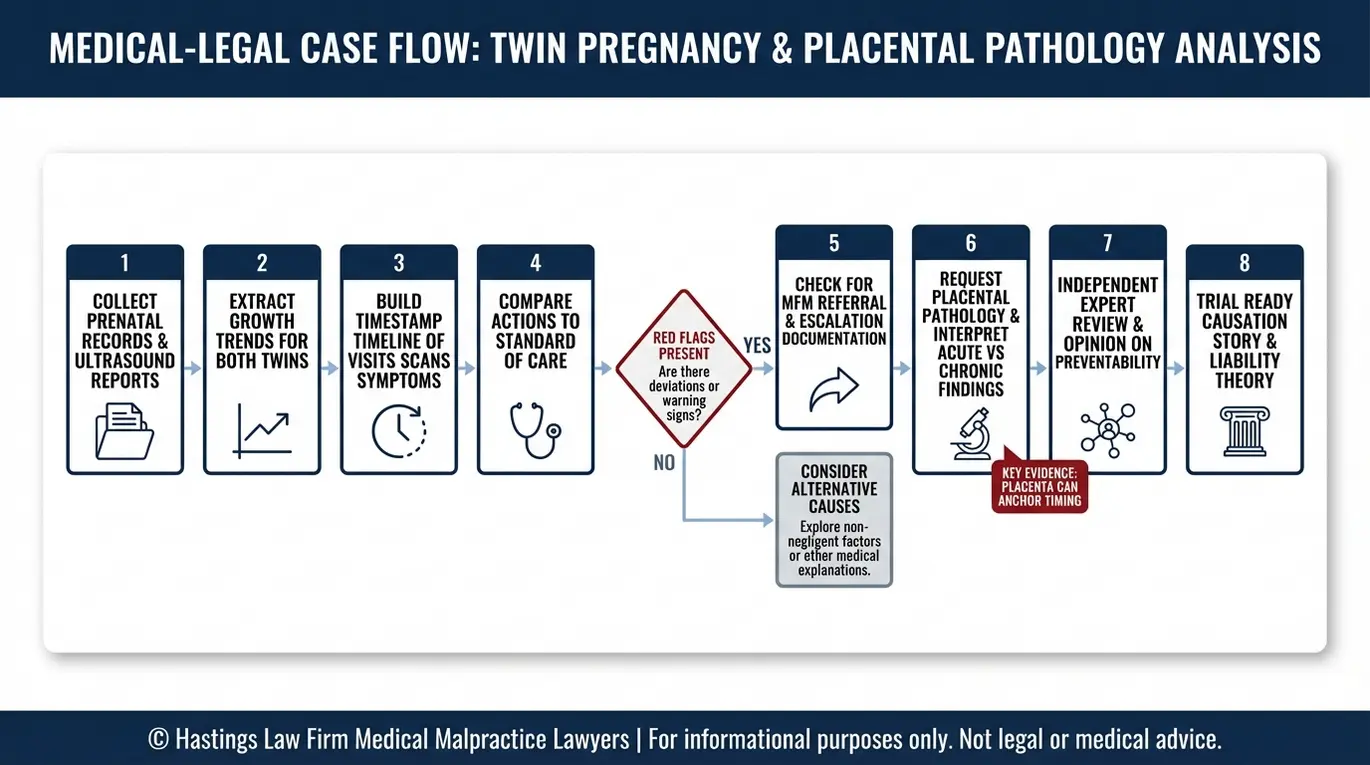
Proving negligence in discordant growth cases requires a forensic analysis of prenatal records and placental pathology to demonstrate that the injury was foreseeable and preventable had the doctor acted sooner. This investigation demands expertise that general law firms typically lack and is essential for substantiating a medical malpractice claim.
Our Arizona birth injury lawyer team begins by securing all relevant medical records, including ultrasound reports, fetal monitoring strips, nursing notes, and physician orders. We include in-house medical staff who can interpret these clinical documents and identify inconsistencies or gaps in care.
Placental pathology, the microscopic examination of the placenta after delivery, provides critical evidence about the timing and nature of injury. According to research published in PubMed Central on placental examination for forensic pathologists, placental analysis can distinguish between acute events (happening during labor) and chronic conditions (developing over weeks). This distinction often determines whether the injury was preventable with earlier intervention.
A birth injury attorney works with medical experts to establish what the standard of care required. Fetal biometry, which includes measurements of estimated fetal weight and abdominal circumference, creates a documented record of how each twin grew over time. These measurements reveal when growth divergence became apparent and whether providers responded appropriately.
Our firm prepares every case as if it will go to trial from day one. This “trial-ready” approach means retaining Maternal-Fetal Medicine specialists and other qualified experts early in the investigation. When suing for twin negligence, this preparation signals to defense attorneys and insurance carriers that we will not accept inadequate settlement offers.
Trial Strategy for Twin Injury Cases
An experienced attorney constructs a timeline of missed opportunities showing the jury exactly when intervention should have occurred. Medical experts review the records and identify specific decision points where the standard of care required action. This timeline approach makes complex medical evidence accessible to jurors who must determine whether negligence caused your child’s injuries.
Compensation for Lifetime Care Needs in Arizona
Families of twins injured by medical negligence may recover damages for past and future medical expenses, life care planning, pain and suffering, and the parents’ loss of income providing care. Understanding the full scope of available compensation helps ensure your family’s future financial security.
An Arizona discordant twin growth negligence lawyer works with qualified experts to calculate the true cost of caring for a child with cerebral palsy, HIE, or other permanent conditions. A Life Care Planner evaluates your child’s lifetime care needs across their entire lifespan and prepares a detailed report documenting projected expenses. This report is vital whether we are negotiating a settlement or presenting your case to a jury, as it provides a concrete basis for the financial support your child will require for decades.
The Arizona Constitution, Article II, Section 31 protects the right to recover full and adequate damages in malpractice cases. This constitutional protection means that compensation for birth injuries cannot be arbitrarily capped by the legislature, allowing families to seek resources commensurate with the severity of the injury.
Recoverable Damages in Arizona Birth Injury Cases
Families of children who suffered preventable injuries may be eligible for the recovery of damages to cover extensive lifetime costs.
- Past and future medical expenses, including surgeries, hospitalizations, and therapies
- Lifetime care costs for nursing support, attendant care, and residential assistance
- Adaptive equipment such as wheelchairs, communication devices, and modified vehicles
- Specialized education and developmental services
- Physical, occupational, and speech therapy
- Pain and suffering experienced by the child
- Loss of enjoyment of life and diminished quality of life
- Parents’ lost income from providing direct care
Standards published in the Journal of Life Care Planning guide how these projections should be developed. An Arizona discordant twin growth negligence lawyer ensures that all categories of damages are properly documented and presented.
Contact the Arizona Birth Injury Attorneys at Hastings Law Firm Today for Help
When your family is searching for answers about what happened during your twin pregnancy, you deserve a legal team that understands both the medicine and the law. Led by board-certified trial lawyer Tommy Hastings, our team focuses exclusively on medical malpractice cases and includes nurses and former defense attorneys who know how hospitals and their insurers approach these claims.
We believe that holding negligent providers accountable helps protect future families from similar harm. Every case we accept receives immediate preparation for trial, which positions us to negotiate from strength.
Arizona law limits the time you have to file a medical malpractice claim. While birth injury cases involving minors may have extended deadlines, early investigation helps preserve critical evidence like placental pathology samples and electronic fetal monitoring data.
If you believe your twins’ injuries resulted from inadequate monitoring or delayed intervention, contact us for a free, confidential evaluation. Our patient advocates can review your situation and explain whether you may have a case. You pay no attorney fees unless we recover compensation for your family.
Frequently Asked Questions About Discordant Twin Growth Negligence in Arizona


This content was researched and written by the Hastings Law Firm editorial team, which includes attorneys, medical professionals, and experienced researchers. Our writing is informed by internal knowledge and practical experience, and we cross-check critical details against authoritative sources cited throughout. Every piece undergoes human-led fact-checking and legal review. Because legal and medical information can change, if you spot an error, please contact us. Learn more about our content standards and review process on our editorial policy page.

Tommy Hastings, founder of Hastings Law Firm, is a board-certified personal injury trial lawyer dedicated exclusively to healthcare injury cases. Since 2001, he has represented injured patients and families in litigation against major hospital systems, pharmaceutical companies, and negligent healthcare providers nationwide. He has handled numerous high-profile cases that have drawn national media attention and resulted in multi-million dollar recoveries. He draws on that experience in his writing, helping readers understand how these cases work and what options may be available to them.
