


Arizona Dialysis Error Lawyer
Written by: Hastings Law Firm | Reviewed by: Tommy Hastings | Updated: July 27, 2026
Dialysis is a life sustaining treatment that requires careful setup, monitoring, and infection control. When clinics or staff deviate from safety protocols, patients can suffer severe infections, dangerous blood loss, cardiac events, permanent vascular damage, or worse. Not every complication is malpractice, but preventable harm tied to errors such as chemical mixing problems, equipment issues, or inadequate oversight can raise serious concerns about the standard of care. If you or a loved one were harmed or worse due to dialysis treatment negligence in Arizona, contact Hastings Law Firm for a free, confidential case review.

Trusted Arizona Medical Attorneys for Dialysis Treatment Negligence Claims
What You Should Know About Dialysis Treatment Negligence Claims in Arizona:
- Outcomes can be catastrophic when dialysis errors occur, including sepsis, severe blood loss, cardiac arrest, permanent vascular damage, and fatal outcomes.
- Liability can extend beyond an individual clinician when facility policies, staffing levels, training, or equipment maintenance contribute to patient harm.
- Recovery options can be lost if action is delayed, since Arizona medical malpractice claims are subject to a filing time limit.
- Disputes often turn on whether harm was a known complication or a preventable result of a breach in safety protocols.
- Harm can occur quickly during hemodialysis when machine setup, chemical mixing, or monitoring failures happen.
- Serious infections can follow when sterile technique breaks down during catheter or needle handling.
- Widespread harm can occur when water treatment failures allow contaminants into the dialysis circuit.
- Compensation can include medical bills, lost wages, pain and suffering, and wrongful death damages when a dialysis error is fatal.
- Publicly available facility quality metrics can help identify patterns of substandard care.
- Key evidence can depend on treatment charts, machine logs, and documentation of alarms and vital signs.

A Healthcare Focused Law Firm
Dialysis keeps people alive when their kidneys can no longer do the job. When errors during treatment cause harm instead of healing, the emotional weight can be overwhelming. You trusted a medical team to protect your loved one, and that trust was broken.
At Hastings Law Firm, we focus exclusively on medical malpractice. Our team of attorneys, in-house nurse consultants, and board-certified patient advocates understands both the medical and legal details of dialysis injury claims. As an experienced Arizona dialysis error lawyer team, we prepare every case as if it is going to trial, because that level of preparation is what it takes to hold negligent providers accountable.
If you or a family member was harmed during dialysis treatment, we can review what happened and explain your options during a free, confidential case evaluation. You pay nothing unless we recover compensation on your behalf.
Understanding Dialysis Malpractice and Patient Safety Standards
Dialysis malpractice occurs when a healthcare provider or facility deviates from the accepted standard of care during renal replacement therapy, resulting in preventable injury or death. For patients living with kidney failure or end-stage renal disease, dialysis is not optional. It is a life-sustaining treatment that demands precision, vigilance, and strict adherence to safety protocols at every step.
There are two primary forms of dialysis, and each carries distinct risks when performed negligently.
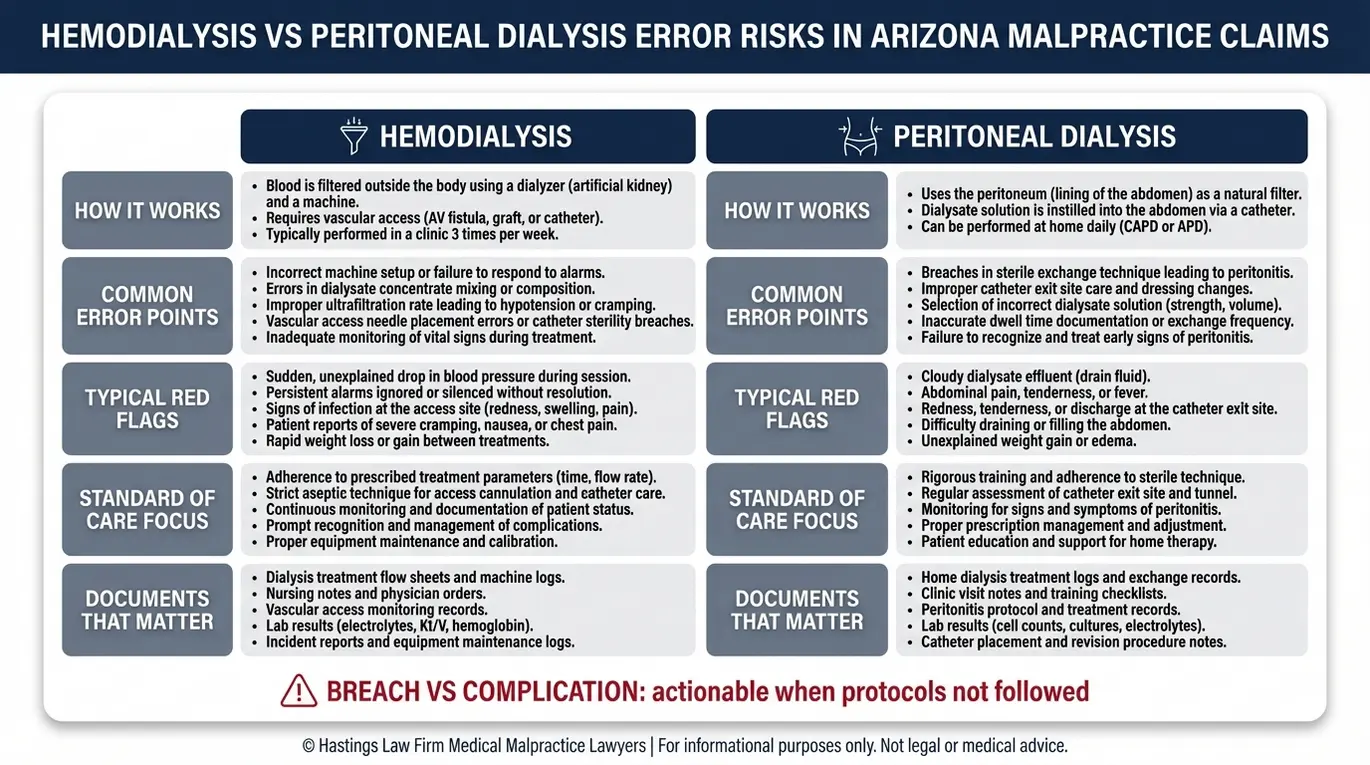
Hemodialysis, the process of filtering a patient’s blood through an external machine, draws blood from the body through a vascular access point to clean it of toxins. Because the machine acts as an artificial kidney, any mechanical failure or setup error directly endangers the patient’s life. Errors in machine setup, chemical mixing, or monitoring can lead to serious injury within minutes.
Peritoneal dialysis, which uses the lining of the patient’s abdomen called the peritoneum to filter waste, requires a special fluid called dialysate to be introduced into the abdominal cavity. This fluid absorbs toxins and is then drained. Infection from improper catheter technique is one of the most common risks with this method.
| Hemodialysis | Peritoneal Dialysis | |
|---|---|---|
| Method | Blood filtered through external machine | Fluid filters waste through abdominal lining |
| Common Error Points | Machine malfunction, air in lines, dialysate mixing errors, monitoring failures | Catheter contamination, improper fluid exchange, infection control failures |
| Typical Injury Risks | Air embolism, blood loss, cardiac events, hemolysis | Peritonitis, sepsis, catheter-related infections |
Not every complication during dialysis is malpractice. The legal threshold requires proving that the injury was not simply a known risk but the result of a breach in safety protocols. Proving a violation is complex and requires distinguishing between an unavoidable negative outcome and one caused by negligence.
Under Arizona Revised Statutes § 12-563, a patient must show that the provider failed to exercise the required degree of care, skill, and learning. This represents what a reasonable, prudent health care provider in the same profession or class would have demonstrated under the same or similar circumstances. Nephrologists are kidney specialists who oversee dialysis care. Our dialysis malpractice attorneys in Arizona work with independent medical experts to evaluate the standard of care for every case we review.
Common Errors Committed by Dialysis Clinics and Staff
Common errors include improper dialysate mixing, failure to monitor vital signs, contamination of water lines, and mismanagement of vascular access points. These failures are not rare anomalies. They often stem from systemic issues within clinics, including rushed treatment schedules and inadequate training.
Here are the categories of errors we most frequently investigate as an Arizona dialysis negligence lawyer team:
- Machine and technical errors: Improper setup of the dialysis machine, failure to perform pre-treatment safety checks, and air bubbles entering the bloodstream, also known as an air embolism. Equipment protocols, such as those outlined in the AK 98 Quick Reference Guide from Baxter Renal Care, exist for a reason. Skipping steps or ignoring alarm signals can have fatal consequences.
- Dialysate and chemical mixing errors: Dialysate, the specially formulated fluid used to draw toxins from the blood during hemodialysis, requires precise mixing. When the acid concentrate, one of the key chemical components in that fluid, is mixed at the wrong ratio, it can cause dangerous shifts in a patient’s electrolyte levels. A single dialysate error can trigger cardiac arrhythmias or destroy red blood cells.
- Vascular access mismanagement: Every hemodialysis session requires access to the patient’s bloodstream through a catheter, fistula, or graft. Improper needle placement, failure to maintain sterile technique, or reusing a compromised access site can result in severe bleeding, clotting, or bloodstream infections.
- Staffing negligence and oversight failures: Some for-profit dialysis centers assign technicians to monitor too many patients at once. When staff are stretched thin, alarms go unanswered, vitals go unchecked, and subtle changes in a patient’s condition get missed. These are not just inconveniences. They are the conditions under which preventable deaths occur.
Shortened Dialysis Sessions and Mortality Risk
Research has consistently linked shortened dialysis sessions to higher mortality rates among patients with end-stage renal disease. When treatment time is cut short, the machine cannot adequately perform ultrafiltration, the process of removing excess fluid from the blood, at a safe rate. Rapid fluid removal stresses the cardiovascular system and increases the risk of sudden cardiac death (SCD).
Dialysis adequacy is measured by a value called Kt/V, which reflects how effectively waste products are cleared during a session. When sessions are shortened, Kt/V targets are not met, and the patient’s quality of care suffers. If a clinic is consistently ending sessions early, whether due to scheduling pressure or patient volume, that pattern may indicate a systemic failure that warrants investigation.
Acting quickly preserves your ability to file a legal claim. Under Arizona Revised Statutes § 12-542, the statute of limitations for medical malpractice claims is generally two years, so preserving evidence early is critical to protecting your legal rights.

The Hastings Law Firm Difference
Results matter, but what truly sets us apart is how we achieve them. Every verdict, every settlement, and every Arizona courtroom victory comes from one guiding promise: To treat each client’s fight for justice as if it were our own.
This balance of skill, experience, and empathy reflects our core philosophy that justice should not only compensate the injured, but also make healthcare safer nationwide.

Severe Injuries Caused by Dialysis Mistakes
Negligence in dialysis can lead to catastrophic outcomes including sepsis, air embolisms (gas bubbles that enter the bloodstream and block vessels), severe blood loss, cardiac arrest, and permanent vascular damage. Because dialysis patients are already medically fragile, even a single error can trigger a chain of complications that permanently alters their health or proves fatal. We investigate these cases to determine if preventable injuries were caused by a breach in safety protocols.
| Injury Type | Primary Cause | Potential Consequence |
|---|---|---|
| :— | :— | :— |
| Infections | Unsterile needle or catheter insertion | Sepsis, organ failure |
| Vascular Injuries | Mishandling of AVF or AVG access | Infiltration, severe blood loss |
| Cardiac Events | Electrolyte imbalance, fluid overload | Arrhythmias, cardiac arrest |
Infections and sepsis. Bloodstream infections are among the most common injuries we see as a lawyer for dialysis injuries team. When a catheter or needle is inserted without proper sterile technique, bacteria can enter the bloodstream directly. The CDC’s National Healthcare Safety Network (NHSN) Dialysis Event Surveillance tracks these infections nationally because of how frequently they occur. Left untreated, a localized infection can progress to sepsis, a life-threatening immune response.
Vascular injuries. Hemodialysis requires repeated access to high-flow blood vessels, typically through an arteriovenous fistula (AVF), a surgically created connection between an artery and a vein, or an arteriovenous graft (AVG). When a technician mishandles the access point, it can cause infiltration, where the needle punctures through the vessel wall, or a blowout that leads to rapid blood loss. Damage to an AVF or AVG may require surgical repair.
Cardiovascular events. Sudden cardiac death remains one of the leading causes of mortality among dialysis patients. Errors in dialysate composition can cause dangerous shifts in potassium levels, triggering fatal cardiac arrhythmias. Fluid overload from inadequate monitoring during treatment can also place extreme stress on the heart.
Water Contamination and Hemolytic Anemia
Dialysis machines process large volumes of water during each treatment session. That water must pass through a multi-stage water treatment system, which typically includes reverse osmosis (RO) filtration and carbon filtration to remove contaminants before the water contacts the patient’s blood. When water treatment systems fail or are improperly maintained, harmful substances like chloramine, a chemical disinfectant commonly found in municipal water supplies, can enter the dialysis circuit. Carbon filtration is particularly critical because chloramine is not effectively removed by reverse osmosis alone.
Unlike a dialysate error involving chemical mixing, water contamination affects the base fluid itself. Chloramine exposure during hemodialysis destroys red blood cells, a condition known as hemolytic anemia. Patients may experience severe chest pain, shortness of breath, and dangerously low hemoglobin levels. In the worst cases, contaminated water incidents affect multiple patients in the same clinic during the same shift.
Liability: Can You Sue a Dialysis Center in Arizona?
Yes, patients and families can pursue legal claims against dialysis centers, nephrologists, and technicians if evidence demonstrates that negligence directly caused the injury or wrongful death. Suing a dialysis clinic in Arizona involves identifying every responsible party and understanding how liability flows through the organization.
Many dialysis patients in the United States receive care at facilities operated by large national chains like DaVita or Fresenius. These corporate entities have a legal duty to maintain safe staffing levels, functional equipment, and proper training programs. When a facility’s own policies or cost-cutting measures contribute to patient harm, the corporation itself may bear liability for corporate negligence.
Quality metrics and safety data for specific facilities are publicly available through the [End-Stage Renal Disease Dialysis Facility Care Compare tool on Medicare.gov from the Centers for Medicare and Medicaid Services]. This data can be a useful starting point for identifying patterns of substandard care.
Vicarious liability is another important legal concept in these cases. This doctrine holds a facility responsible for the negligent actions of its employees, including dialysis technicians and nurses, when those actions occur within the scope of their duties. Even if the individual technician who made the error has limited personal resources, the clinic that employed and supervised them can be held accountable.
In some cases, the injury is not caused by human error at all but by a defective dialysis machine or component. When equipment malfunctions contribute to patient harm, a product liability claim may be appropriate against the device manufacturer, separate from or in addition to a medical negligence claim against the treating facility.
The Dialysis Malpractice Litigation Process
The litigation process involves an initial case screening, gathering of medical records, filing the complaint, discovery and depositions, and proceeding to trial if a fair settlement is not offered. Our approach as a medical malpractice attorney for dialysis errors is built around thorough preparation from day one.
Here is how a dialysis malpractice case typically moves forward:
- Free case evaluation. A patient advocate on our team reviews the details of what happened during a confidential screening to determine whether the case meets the legal threshold for negligence.
- Medical records investigation. Our in-house nursing staff and board-certified patient advocates conduct a detailed review of treatment charts, machine logs, and clinic protocols. We look for inconsistencies, such as gaps in documented vitals or alarm records that do not match the reported timeline.
- Independent expert review. Arizona law under ARS § 12-2604 sets specific qualifications for expert witnesses. We work with board-certified nephrologists and dialysis professionals who can evaluate whether the standard of care was breached. Our team uses independent expert review to determine how a breach caused the patient’s injury.
- Filing and discovery. Once the case is filed, we enter the discovery phase, where both sides exchange evidence, take depositions, and build their arguments. Because we prepare every case as if it will go before a jury, our evidence and strategy are already well developed by this stage.
- Settlement negotiation or trial. Many cases resolve through negotiation when the evidence is strong. But if a fair offer is not made, we are fully prepared to present the case at trial. Our team includes former defense attorneys who understand how the other side thinks, giving us a meaningful strategic advantage.

Recoverable Damages for Dialysis Injury Victims
Compensation may include coverage for past and future medical bills, lost wages, pain and suffering, and in fatal cases, wrongful death damages for the surviving family. In a legal claim, damages represent the financial and personal losses caused by an injury. A dialysis error compensation lawyer can work with financial and medical experts to project these costs accurately.
Compensable damages often include:
- Economic damages: These cover financial losses that can be calculated with documentation, including the cost of corrective surgeries, extended hospitalizations, additional dialysis treatments needed to address the original error, prescription medications, and rehabilitation. If the injury prevented the patient from working, lost wages and diminished future earning capacity are also recoverable.
- Non-economic damages: These address the human toll of the injury. Physical pain, emotional distress, loss of independence, and reduced quality of life all fall into this category. These losses do not come with receipts, but they are real and recognized under Arizona law. For a patient who already relied on dialysis to survive, an error that worsens their condition dramatically changes their day-to-day existence.
- Wrongful death damages: These become available when a dialysis error proves fatal. Surviving family members may recover funeral and burial expenses, the loss of the deceased’s financial support, and loss of companionship and guidance. Arizona law allows certain family members to bring these claims on behalf of the person who was lost. No amount of money replaces a loved one, but a wrongful death claim can provide financial stability and a measure of accountability for what happened.
Contact the Arizona Healthcare Malpractice Attorneys at Hastings Law Firm Today for Help
Losing a loved one or watching them suffer because of a preventable dialysis error is something no family should have to endure. If you believe negligence contributed to what happened, you deserve answers, and you deserve a legal team that knows how to find them.
Hastings Law Firm focuses exclusively on medical malpractice. Founded by board-certified trial lawyer Tommy Hastings, who has over two decades of experience, we help patients who have been let down by the healthcare system. Our team includes in-house medical professionals and former defense attorneys who understand the clinical and legal details of dialysis injury cases. We prepare every case with the rigor needed to hold negligent providers and facilities accountable.
There is no cost to learn where you stand. We handle cases on a contingency fee basis, meaning you pay no attorney fees or costs unless we secure a recovery for you. Contact us today for a free, confidential case evaluation and let us help you understand your options.
Frequently Asked Questions About Dialysis Error in Arizona


This content was researched and written by the Hastings Law Firm editorial team, which includes attorneys, medical professionals, and experienced researchers. Our writing is informed by internal knowledge and practical experience, and we cross-check critical details against authoritative sources cited throughout. Every piece undergoes human-led fact-checking and legal review. Because legal and medical information can change, if you spot an error, please contact us. Learn more about our content standards and review process on our editorial policy page.

Tommy Hastings, founder of Hastings Law Firm, is a board-certified personal injury trial lawyer dedicated exclusively to healthcare injury cases. Since 2001, he has represented injured patients and families in litigation against major hospital systems, pharmaceutical companies, and negligent healthcare providers nationwide. He has handled numerous high-profile cases that have drawn national media attention and resulted in multi-million dollar recoveries. He draws on that experience in his writing, helping readers understand how these cases work and what options may be available to them.
