


Arizona Dialysis Center Malpractice Lawyer
Written by: Hastings Law Firm | Reviewed by: Tommy Hastings | Updated: July 27, 2026
Dialysis is a life sustaining treatment that depends on careful monitoring, sterile technique, and properly maintained equipment. When a dialysis center, nephrologist, or technician fails to follow accepted safety standards, patients can suffer infections, blood loss events, falls, severe medical complications, or worse. Harm may also stem from systemic problems such as understaffing, inadequate training, or cost cutting decisions by corporate owners. Understanding how preventable errors happen can help families recognize when an injury may be linked to negligent care. If you or a loved one were harmed or worse due to dialysis negligence in Arizona, contact Hastings Law Firm for a free, confidential case review.
Trusted Legal Representation for Dialysis Negligence in Arizona
What You Should Know About Dialysis Clinic Negligence Claims in Arizona:
- Life altering harm can follow when dialysis safety protocols are ignored, including severe complications and wrongful death.
- Accountability can extend beyond an individual technician when injuries stem from understaffing, inadequate training, or cost cutting by corporate owners.
- Options for financial recovery can include both measurable losses and personal losses, such as medical costs and pain and suffering.
- Disputes often turn on whether baseline safeguards were followed, such as vital sign monitoring and sterile handling of vascular access.
- Catastrophic events can occur when equipment safeguards fail, including air in the dialysis circuit or disconnected lines.
- Serious injury can result from facility water treatment failures when contaminants enter dialysate and damage red blood cells.
- A clearer picture of what happened can depend on facility records, including treatment logs, maintenance logs, incident reports, and staffing schedules.
- Patterns of safety problems can be suggested by publicly reported facility data on infections, hospitalizations, and inspection results.

A Healthcare Focused Law Firm
When someone you love depends on dialysis to survive, you trust that every treatment session will be handled with precision and care. If that trust has been broken by a preventable error, infection, or unexplained decline, you deserve answers. Patients living with end-stage renal disease (ESRD), the permanent loss of kidney function that requires ongoing dialysis, already carry an enormous medical burden. Complications like intradialytic hypotension (IDH), a dangerous drop in blood pressure during treatment, should be anticipated and managed, not ignored.
As an Arizona dialysis center malpractice lawyer, Hastings Law Firm represents patients and families harmed by negligent dialysis care. Our firm was founded by Tommy Hastings, a board-certified trial lawyer who has been recognized as a Super Lawyer since 2013. Our team includes in-house medical professionals and former defense attorneys who know how to investigate these facilities and uncover what went wrong. If you suspect a dialysis injury was preventable, we welcome the chance to review what happened and explain your options in a free, confidential consultation.
Understanding Negligence in Hemodialysis Treatment
Dialysis negligence occurs when a facility, nephrologist, or technician fails to follow the accepted standard of care, resulting in patient injury or death. Not every bad outcome qualifies as malpractice, but when protocols are ignored or shortcuts are taken, the line between a known complication and preventable harm becomes clear.
Hemodialysis, the process of filtering waste and excess fluid from the blood using an external machine, is a life-sustaining treatment for patients with kidney failure. The procedure involves drawing blood through a vascular access point, passing it through a dialyzer where it is cleaned using a specialized solution called dialysate, and returning it to the body. Patients with end-stage renal disease (ESRD) rely entirely on this technology to perform the function their organs cannot, meaning that any deviation from safety protocols can lead to rapid destabilization. Every step of this process demands strict adherence to clinical protocols because the margin for error is razor-thin.
The distinction between a recognized complication and actionable medical negligence comes down to whether the care team followed established safety standards. A patient experiencing a temporary drop in blood pressure during treatment may be a known risk. But if no one was monitoring vital signs when it happened, that is a different situation entirely.
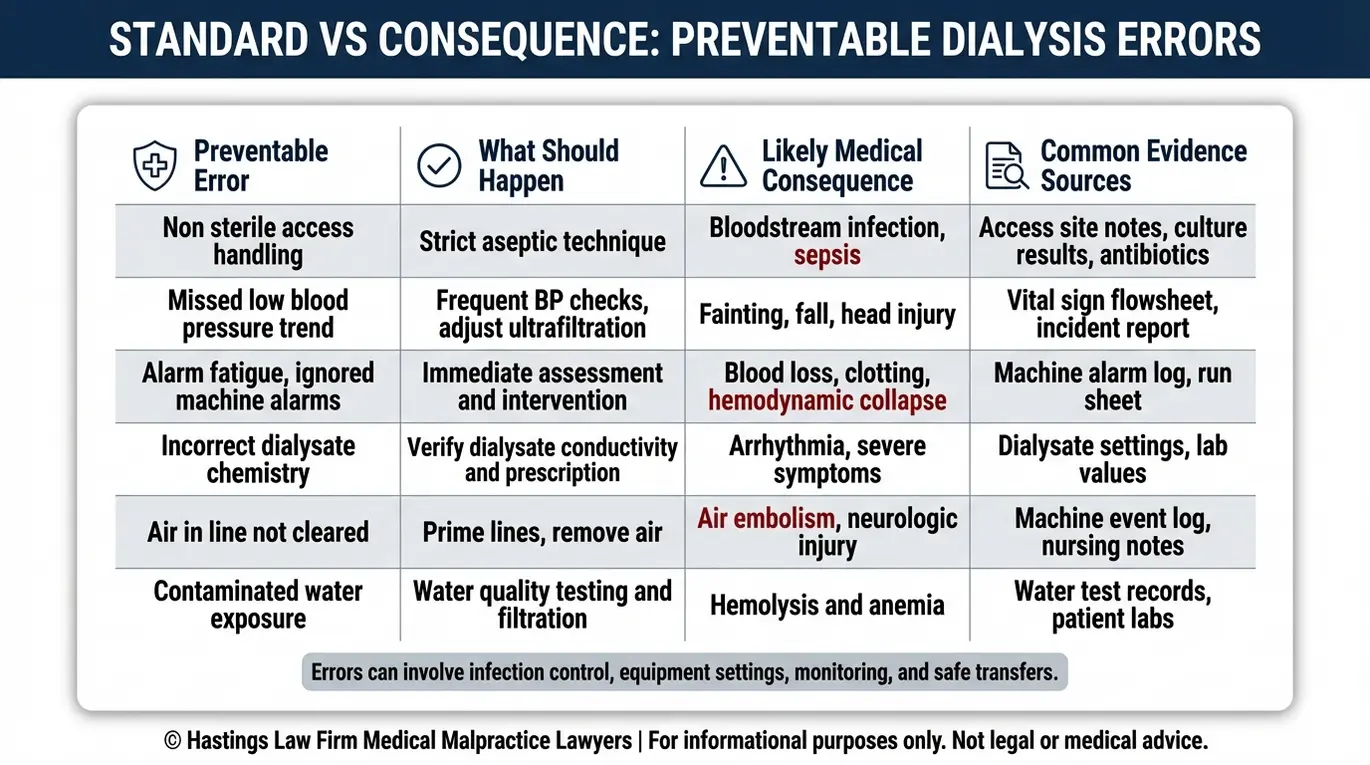
A dialysis malpractice attorney in Arizona will evaluate whether the facility met these baseline standard of care expectations:
- Continuous monitoring of vital signs before, during, and after each treatment session
- Maintaining sterile fields during catheter and vascular access handling
- Proper calibration and maintenance of dialysis machines
- Correct preparation and testing of dialysate solution
- Adequate staffing levels to respond to alarms and patient distress
- Supervision of technicians by qualified medical professionals
These are not aspirational goals. They are minimum requirements. The CDC’s guidance on dialysis event surveillance outlines the infection control and safety benchmarks that every facility is expected to meet.
Common Preventable Errors at Arizona Dialysis Centers
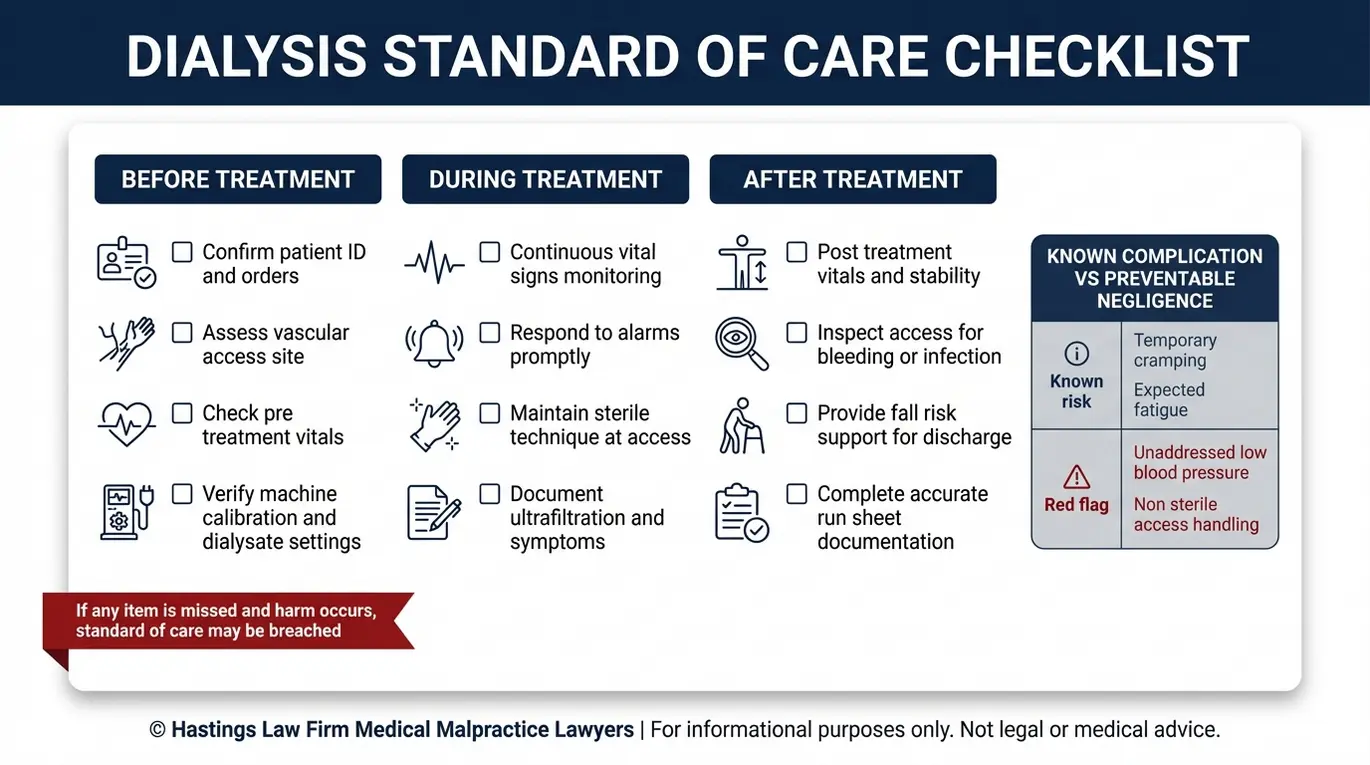
Common errors include unsterilized equipment leading to infection, failure to monitor blood pressure causing falls, and fatal mistakes involving dialysate chemical balance. Preventable errors are not rare edge cases. They are recurring patterns that an Arizona dialysis negligence lawyer sees across claims involving both independent clinics and large corporate chains.
Infections
A bloodstream infection (BSI), where bacteria or other pathogens enter the blood through a contaminated access site or improperly cleaned equipment, is one of the most frequent and dangerous complications in dialysis care. Patients with catheters, fistulas (AVF), or grafts (AVG) are especially vulnerable.
When sterile technique is not followed during needle insertion or line connection, bacteria can enter the bloodstream and trigger sepsis, a life-threatening immune response that can cause organ failure and death. The CDC’s best practices for bloodstream infection prevention in dialysis settings establish clear protocols for hand hygiene, vascular access care, and equipment sterilization that every facility is expected to follow.
Machine Errors
An air embolism, the entry of air bubbles into the bloodstream through the dialysis circuit, can cause chest pain, respiratory distress, stroke, or cardiac arrest. Modern dialysis machines have air detectors and automatic clamps designed to prevent this, but those safeguards only work if equipment is properly maintained and calibrated. Blood loss events from disconnected lines or improperly secured access points represent another preventable category of harm.
Staffing Errors
Patients who need assistance transferring to and from dialysis chairs can suffer serious falls when staff are unavailable or rushing between too many patients. Alarm fatigue, where technicians become desensitized to frequent machine alerts and stop responding promptly, can delay intervention during critical moments. Both scenarios point to staffing and training failures at the facility level.
| Preventable Error | How It Happens | Potential Consequence |
|---|---|---|
| Bloodstream infection | Unsterilized catheter or access site | Sepsis, hospitalization, death |
| Air embolism | Failure to detect air in the dialysis circuit | Stroke, cardiac arrest, death |
| Blood loss event | Disconnected line or unsecured access | Hemorrhage, shock |
| Patient fall | Inadequate transfer assistance | Fractures, head injury |
| Missed alarm response | Alarm fatigue from understaffing | Delayed treatment of crisis |
Dangers of Contaminated Water and Hemolytic Anemia
Dialysis patients are uniquely vulnerable to water contamination because the treatment exposes their blood directly to large volumes of water-based dialysate. Chloramines, chemical disinfectants commonly added to municipal water supplies, must be removed through the facility’s water treatment system before the water is used in dialysis.
If chloramines or other contaminants pass through a faulty filtration system, they can enter the bloodstream and destroy red blood cells. This condition, called hemolytic anemia, can cause severe chest pain, shortness of breath, and dangerously low blood counts. A facility’s failure to properly test and maintain its water purification equipment is a serious and preventable form of negligence.
The Hastings Law Firm Difference
Results matter, but what truly sets us apart is how we achieve them. Every verdict, every settlement, and every Arizona courtroom victory comes from one guiding promise: To treat each client’s fight for justice as if it were our own.
This balance of skill, experience, and empathy reflects our core philosophy that justice should not only compensate the injured, but also make healthcare safer nationwide.

Liability for Systemic Failures in For-Profit Dialysis Chains
Liability in dialysis malpractice cases often extends beyond the individual technician to the corporate entity that owns and operates the facility for putting profits over patient safety. When injuries stem from understaffing, inadequate training, or cost-cutting measures, the investigation needs to go deeper than a single employee’s mistake.
The majority of dialysis clinics in the United States are operated by large, for-profit chains, such as DaVita and Fresenius. These organizations face documented scrutiny regarding practices that may impact patient safety, including compressing treatment times and assigning technicians more patients than they can safely monitor.
When a facility lacks adequate staffing ratios or hires underqualified technicians as part of institutional management, the corporate structure that made those decisions can bear corporate liability. This accountability is important when systemic failures lead to catastrophic outcomes, including wrongful death.
A dialysis center malpractice lawyer examines more than just what happened during a single treatment session. The investigation may include reviewing internal policies on technician-to-patient ratios, training records, equipment maintenance logs, and whether a nephrologist was providing adequate on-site or remote supervision. Reports from the Centers for Medicare and Medicaid Services (CMS) provide insight into a facility’s compliance history and inspection outcomes, which can reveal whether systemic problems existed before the injury occurred.
Our legal team includes former defense attorneys and hospital nurses who previously worked for the systems they now challenge. This background allows us to anticipate defense tactics and identify inconsistencies in facility protocols.
Vascular access management is one area where systemic failures become particularly visible. This access point, where blood is drawn from and returned to the body during hemodialysis, typically uses an AV fistula (AVF), an AV graft (AVG), or a dialysis technician managed catheter. Each type requires specific care protocols. When facilities fail to train staff properly on access care, or when they push technicians to rush through cannulation procedures, infections and access failures become predictable outcomes rather than isolated incidents.
At Hastings Law Firm, our investigation targets the corporate policies and institutional decisions behind the individual error. Our team, which includes former defense attorneys who previously represented healthcare systems, understands how these organizations document, defend, and sometimes conceal operational shortcomings.
Recoverable Damages for Dialysis Injuries and Wrongful Death
Patients harmed by dialysis negligence may recover compensation for medical bills, future kidney care costs, lost income, and non-economic damages like pain and suffering or loss of consortium. An Arizona dialysis injury attorney can help identify the full scope of losses so that a claim reflects the true cost of the injury.
Economic Damages
These are the measurable financial losses tied directly to the negligent care. In many cases, a dialysis injury creates a cascade of new medical needs beyond the original kidney failure treatment:
- Emergency hospitalization and corrective surgeries, such as treatment for sepsis or repair of a damaged vascular access site
- Ongoing and future dialysis care costs, especially if the injury requires a change in treatment modality
- Lost wages and diminished earning capacity if the patient can no longer work due to the complications
- Funeral and burial costs in wrongful death cases
Non-Economic Damages
Not all harm shows up on a bill. Dialysis patients who suffer preventable injuries often endure prolonged physical pain, emotional distress, and a diminished quality of life. Family members may pursue loss of consortium claims for the companionship and support they have been denied.
In wrongful death cases, these non-economic losses can represent a significant portion of the total recovery. Settlement negotiations often hinge on properly articulating these intangible losses.
Hastings Law Firm prepares every case from day one as if it will go to a jury. This trial-ready approach gives our clients a stronger position during settlement negotiations because the other side knows we are prepared to present the full scope of damages in open court. We work to ensure that compensation covers the lifetime impact of the negligence.
How Hastings Law Firm Proves Dialysis Malpractice
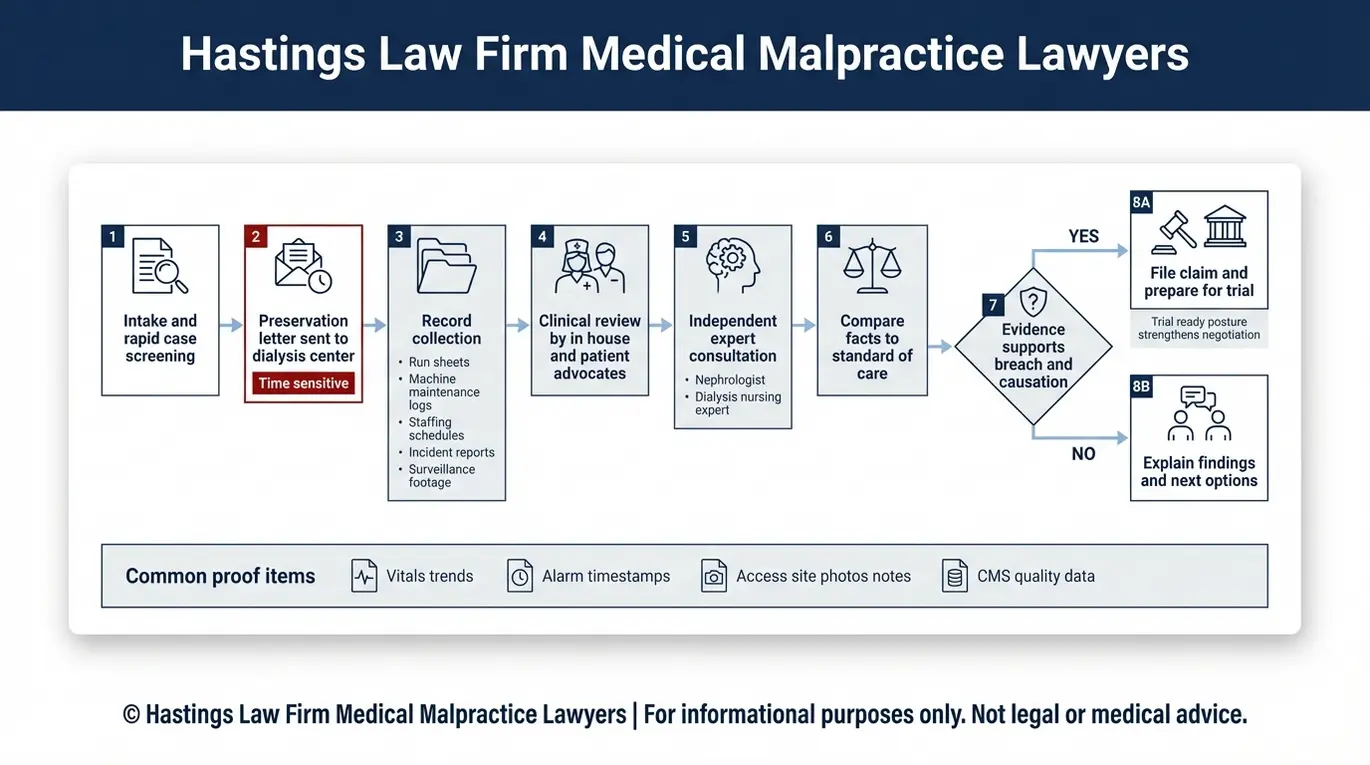
We work with a network of medical experts and former defense attorneys to secure critical evidence, including machine logs, staffing schedules, and surveillance footage, before it can be altered or destroyed. Speed matters in these cases because dialysis facilities are not always required to retain certain operational records indefinitely. We prioritize the gathering of critical evidence to build a strong foundation for the case.
Securing the Evidence
Our investigation begins with identifying and preserving the documents that tell the story of what happened during treatment. Immediate evidence preservation is important.
A dialysis run sheet, the treatment log that records a patient’s vital signs, machine settings, fluid removal rates, and any complications during the session, is one of the most important pieces of evidence. We also pursue machine maintenance records, incident reports, and staffing schedules for the day in question. In some cases, we seek surveillance footage from the treatment floor.
Expert Medical Review
Proving that the standard of care was violated requires qualified expert testimony. We retain medical experts, including nephrologists, dialysis nurses, and biomedical engineers, to review the clinical records and provide opinions on whether the care team’s actions fell below accepted practice. These experts help establish not only what went wrong, but how the error directly caused the patient’s injury.
Using Public Data to Show Patterns
Publicly available quality data can reveal whether a specific facility has a history of safety problems. Resources like CMS data and Medicare’s Care Compare data for Arizona dialysis facilities track infection rates, hospitalization rates, and inspection results. When a facility shows repeated deficiencies, it strengthens the argument that the injury was not an isolated event but part of a broader pattern of negligence.
As a dialysis malpractice lawyer in Arizona, Hastings Law Firm follows a structured process to build each case:
- Immediate preservation demands to prevent destruction of run sheets, machine data, and video
- Full medical record review by our in-house nursing staff and patient advocates
- Retention of independent medical experts to evaluate the standard of care
- Analysis of CMS inspection history and publicly reported quality metrics
- Deposition of facility staff, including technicians, charge nurses, and medical directors
- Development of a trial-ready case strategy that positions the claim for maximum recovery
Contact the Arizona Healthcare Malpractice Attorneys at Hastings Law Firm Today for Help
Dialysis patients deserve safe, competent care during every treatment session. When a facility’s negligence causes harm, whether through infection, equipment failure, or systemic understaffing, the people responsible should be held accountable.
Hastings Law Firm is built for exactly these cases. Our team of attorneys, nurse consultants, and medical experts focuses exclusively on medical malpractice, and we bring former defense experience to every investigation. We understand the medical details of dialysis injury claims, and we treat every client as a partner in the process.
Arizona law limits the time you have to file a malpractice claim, so early action protects both your rights and the evidence needed to prove your case. We handle these cases on a contingency fee basis, which means you pay no attorney fees or costs unless we secure a recovery for you.
Contact Hastings Law Firm today for a free, confidential case evaluation. Let us review what happened and help you understand your legal options.
Frequently Asked Questions About Dialysis Center Malpractice in Arizona


This content was researched and written by the Hastings Law Firm editorial team, which includes attorneys, medical professionals, and experienced researchers. Our writing is informed by internal knowledge and practical experience, and we cross-check critical details against authoritative sources cited throughout. Every piece undergoes human-led fact-checking and legal review. Because legal and medical information can change, if you spot an error, please contact us. Learn more about our content standards and review process on our editorial policy page.

Tommy Hastings, founder of Hastings Law Firm, is a board-certified personal injury trial lawyer dedicated exclusively to healthcare injury cases. Since 2001, he has represented injured patients and families in litigation against major hospital systems, pharmaceutical companies, and negligent healthcare providers nationwide. He has handled numerous high-profile cases that have drawn national media attention and resulted in multi-million dollar recoveries. He draws on that experience in his writing, helping readers understand how these cases work and what options may be available to them.
