


Arizona Developmental Delay Birth Injury Lawyer
Written by: Hastings Law Firm | Reviewed by: Tommy Hastings | Updated: July 27, 2026
Developmental delays after birth can leave families searching for clear answers about what happened during labor and delivery. Some delays are genetic or unrelated to birth, while others may follow oxygen deprivation, missed fetal distress, delayed emergency delivery, or traumatic use of delivery tools. Early signs can appear as missed milestones and changes in muscle tone, and medical records and independent evaluations can help clarify the cause. If you or a loved one were harmed or worse due to developmental delay birth injuries in Arizona, contact Hastings Law Firm for a free, confidential case review.

Top Rated Medical Malpractice Attorneys Serving Families in Arizona
What You Should Know About Infant Intellectual Disability Negligence Claims in Arizona:
- Long term developmental disabilities can follow preventable labor and delivery errors such as missed fetal distress or delayed emergency cesarean delivery.
- Lifelong financial strain can result when care needs include ongoing therapy, specialized education, assistive technology, and around the clock support.
- Disputes over the cause can shape outcomes because defense arguments often attribute delays to genetics or unavoidable complications rather than an acute birth event.
- Options can narrow if action is delayed because records and fetal monitoring data may be lost, altered, discarded, or overwritten over time.
- Clarity about the cause can improve when an independent pediatric neurologist or developmental specialist evaluates the child outside the original care team.
- Access to complete medical records can be pivotal because fetal monitoring strips may show whether fetal distress was recognized and addressed.
- Recovery for non economic harm is not limited by a damages cap in Arizona medical malpractice cases.
- Filing time limits can be complex in Arizona because tolling for minors and the discovery rule can affect when a claim is treated as timely.
- Claims against public or government run hospitals can be barred if special notice requirements are missed.
- Expert opinions can be central in Arizona because qualified specialists must support medical malpractice claims and address standard of care and causation.

A Healthcare Focused Law Firm
When a child’s development doesn’t follow the expected path, parents often carry a weight that’s hard to describe. You may sense something went wrong during birth, but proving it feels impossible when you’re facing a medical system that holds all the information.
An Arizona developmental delay birth injury lawyer at Hastings Law Firm understands this moment. Led by founder Tommy Hastings, a board-certified trial lawyer with over 20 years of experience, our team focuses exclusively on medical malpractice. Our legal team includes former defense attorneys who know how hospitals protect themselves, along with in-house nurses who understand clinical records from the inside.
If you believe your child’s delays stem from preventable medical errors, we’re here to listen and explain your options. Contact us for a free, confidential case evaluation.
Identifying Early Signs of Developmental Delays Caused by Birth Injuries
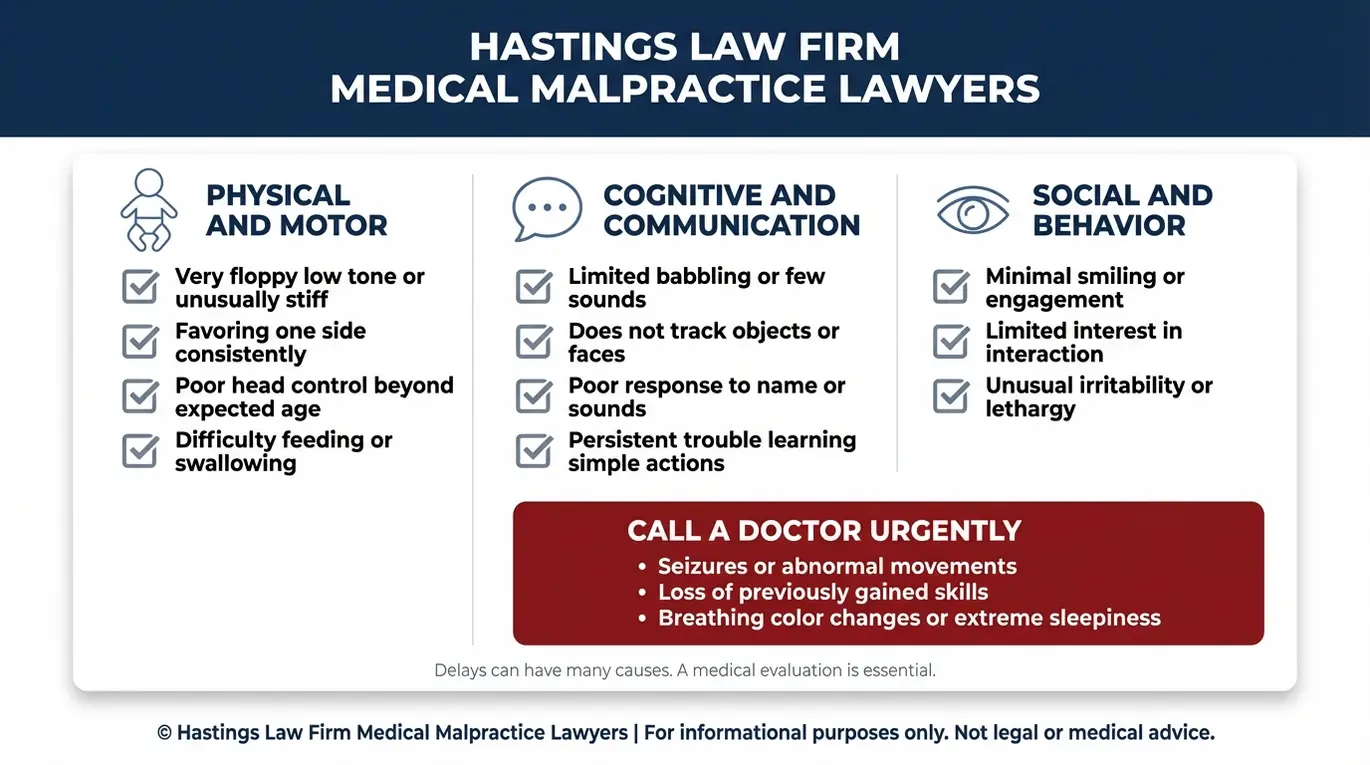
Developmental delays linked to birth injuries often appear as missed physical, cognitive, or social milestones in the first 12 to 24 months of life. A child may fail to roll over, struggle to track objects with their eyes, or show reduced muscle tone, a condition called hypotonia.
Understanding the Difference Between Genetic and Injury-Related Delays
Not all developmental delays have the same cause. Some conditions are inherited or develop for reasons unrelated to birth. However, when a delay results from oxygen deprivation during labor, the pattern is often different. Hypoxic ischemic encephalopathy (HIE), which is brain damage caused by reduced oxygen and blood flow around the time of birth, frequently leads to cerebral palsy and intellectual disability. This condition differs from genetic anomalies because it stems from an acute event of hypoxia, or insufficient oxygen, affecting the fetal brain.
The timing matters significantly. Genetic conditions typically show consistent patterns from the very beginning of early development. Injury-related delays often appear after a period of seemingly normal progress or alongside specific physical findings that point to birth trauma. Distinguishing between these causes is essential for families seeking answers.
Warning Signs That May Indicate a Birth-Related Injury
Parents should monitor their child’s progress against expected Milestone Checklists by Age from the CDC. Keeping a detailed log of when your child attempts or misses these milestones is valuable evidence. Watch for these potential indicators:
- Unusual muscle tone: either stiff limbs or “floppy” body
- Favoring one side of the body when reaching or crawling
- Difficulty feeding or persistent trouble swallowing
- Lack of response to sounds or visual tracking by 3 months
- No babbling or attempts at words by 12 months
- Persistent irritability or difficulty being consoled
- Seizures in the newborn period
If your child shows several of these signs, consulting with an independent pediatric neurologist can help determine whether the delay may be linked to birth events. A qualified developmental delay birth injury attorney can then help you understand whether a legal claim is worth pursuing based on those medical findings.
Immediate Steps for Parents Suspecting Negligence Caused a Delay
Parents should immediately request a full copy of their child’s medical records including fetal monitoring strips, consult with an independent pediatrician or neurologist for a second opinion, and contact a specialized attorney before discussing suspicions with hospital risk management. Acting quickly helps preserve evidence and ensures you do not miss the statute of limitations for filing a claim.
Step 1: Request Complete Medical Records
Under federal law, the U.S. Department of Health and Human Services HIPAA Privacy Rule gives you the right to access your child’s full medical file. Request records from every facility involved in prenatal care, labor, and delivery. Be specific: ask for fetal monitoring strips, which are the printed records from electronic fetal monitoring (EFM) that track your baby’s heart rate during labor. These strips often contain the clearest evidence of whether the medical team recognized fetal distress, a dangerous pattern indicating the baby isn’t getting enough oxygen.
Records can be altered or misplaced over time. Submitting your request in writing and keeping copies of all correspondence creates a paper trail that prevents important data from disappearing.
Step 2: Seek an Independent Medical Evaluation
Schedule an appointment with a pediatric neurologist or developmental specialist who was not involved in your child’s birth. An independent medical evaluation helps you understand your child’s condition without the potential bias of providers connected to the original care.
Step 3: Consult an Attorney Before Speaking with Hospital Representatives
Hospital risk management departments protect the hospital’s interests, not yours. Before signing anything or providing a recorded statement, speak with a lawyer for birth injury delays who can advise you on what to share and what to protect. Avoid discussing your suspicions on social media or in writing with anyone connected to the case. These steps help ensure that if negligence occurred, the evidence needed to prove it remains intact.
The Hastings Law Firm Difference
Results matter, but what truly sets us apart is how we achieve them. Every verdict, every settlement, and every Arizona courtroom victory comes from one guiding promise: To treat each client’s fight for justice as if it were our own.
This balance of skill, experience, and empathy reflects our core philosophy that justice should not only compensate the injured, but also make healthcare safer nationwide.

Labor Errors Leading to Cognitive and Developmental Disabilities
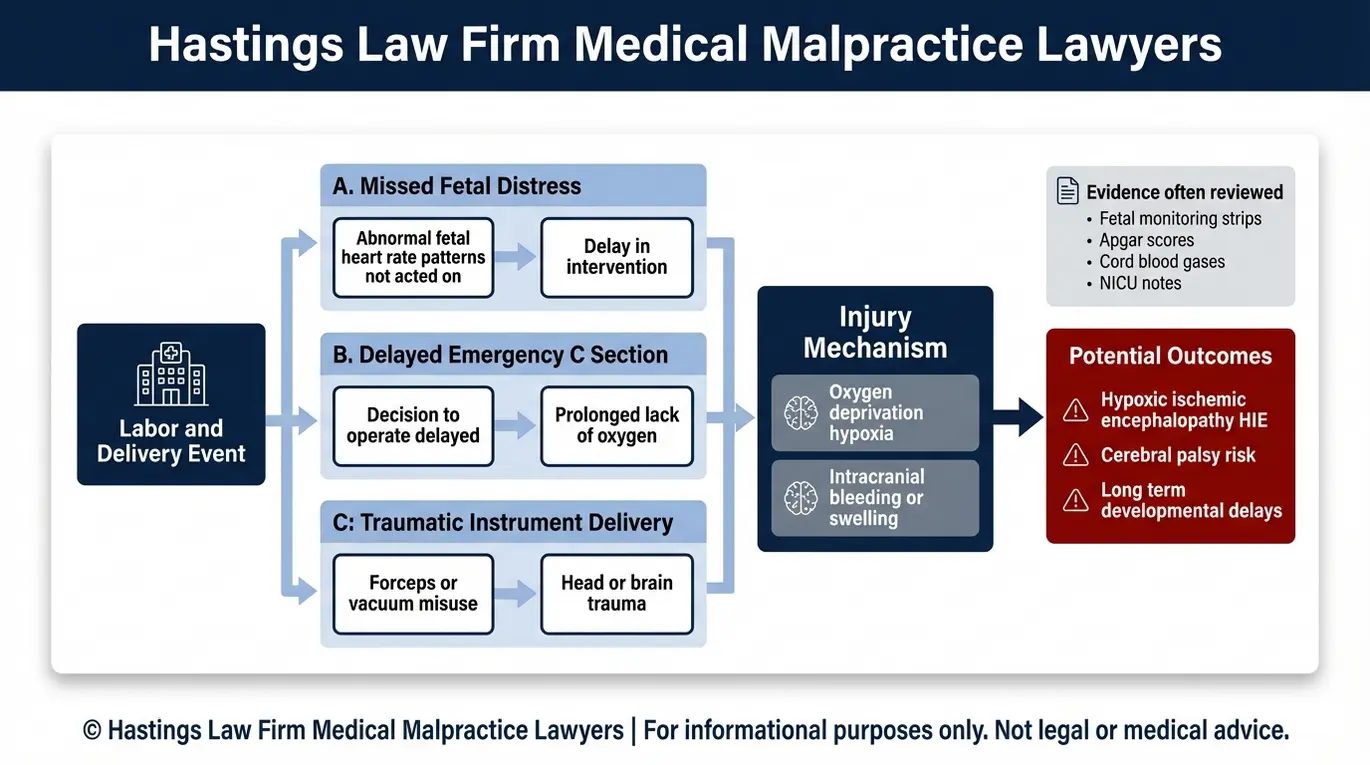
Preventable developmental disabilities are frequently caused by labor errors such as failure to detect fetal distress, delayed emergency cesarean sections resulting in oxygen deprivation, or improper use of delivery tools like forceps that cause physical brain trauma.
How Oxygen Deprivation Damages the Brain
The developing brain is extremely sensitive to oxygen levels. When blood flow or oxygen supply is interrupted during labor, brain cells begin to die within minutes. This process, called perinatal asphyxia or oxygen deprivation, can result in permanent damage affecting movement, cognition, and behavior. An experienced Arizona developmental delay birth injury lawyer knows that even brief interruptions in oxygen can have catastrophic consequences.
Hypoxia, which refers to low oxygen levels during labor and delivery, doesn’t always cause immediate visible harm. The injury may only become apparent months or years later when the child misses developmental milestones.
Common Labor and Delivery Errors
The table below shows how specific medical errors can lead to long-term developmental outcomes:
| Labor/Delivery Error | Potential Mechanism | Possible Outcome |
|---|---|---|
| Failure to respond to abnormal fetal heart rate | Prolonged oxygen deprivation | HIE, cerebral palsy |
| Delayed emergency C-section | Extended hypoxia during distress | Intellectual disability, motor deficits |
| Improper forceps or vacuum use | Direct brain trauma | Intracranial hemorrhage, developmental delays |
| Failure to treat maternal infection | Inflammation affecting fetal brain | Neurological injury |
| Excessive Pitocin causing hyperstimulation | Reduced oxygen between contractions | Brain damage |
Research published in Frontiers in Pediatrics confirms that outcomes following neonatal encephalopathy depend heavily on the severity and duration of the oxygen deprivation event. These medical errors often occur when hospital staff fail to monitor the baby’s health adequately during labor.
The Standard of Care in Obstetrics
Medical teams are expected to monitor fetal heart patterns continuously during labor and respond promptly when those patterns indicate distress. The standard of care, which is the accepted level of treatment a competent professional would provide, requires timely intervention when warning signs appear. A breach of that duty, meaning a failure to act as a reasonable provider would, can form the basis of a legal claim. An Arizona developmental delay birth injury lawyer works with medical experts to reconstruct the timeline of care and identify where the standard may have been violated.
Defense Strategy: Genetics vs. Preventable Injury
When families file birth injury claims, defense attorneys frequently argue that the child’s condition was caused by genetics or an unavoidable complication rather than medical error. This strategy attempts to break the causation link between the provider’s actions and the child’s injury.
We use expert witness testimony from specialists who can differentiate between conditions present from conception and injuries that occurred during labor. Our team works with geneticists and pediatric neurologists to analyze the timing of the injury using fetal monitoring records, MRI imaging, and clinical notes. When the evidence shows an acute event, such as a sudden drop in oxygen, it undermines the claim that the condition was predetermined.
Proving Medical Negligence in Arizona Developmental Delay Cases
Proving negligence requires establishing that the medical provider owed a duty of care, breached that duty by deviating from accepted medical standards, and directly caused the infant’s developmental delay through that specific error. Proving a medical malpractice claim involves four legal elements under state law.
The Four Elements of Medical Malpractice
Arizona law requires proof of four connected elements:
Duty of Care: When a doctor, nurse, or hospital accepts responsibility for a patient, they owe that patient a duty to provide competent care. In birth injury cases, this duty extends to both the mother and the baby.
Breach of Duty: A breach occurs when the provider fails to meet the standard of care. For example, if fetal monitoring shows signs of distress and the medical team delays ordering an emergency cesarean section, a surgical delivery performed urgently when the baby’s health is at immediate risk, that delay may constitute a breach.
Causation: The breach must have caused the harm. This is often the most contested element. Defense attorneys argue that the injury would have occurred regardless of the provider’s actions. Your Arizona birth injury attorney must demonstrate that the specific error, not some other factor, led to the developmental delay.
Damages: The child must have suffered actual harm, whether physical, cognitive, or both.
The Role of Expert Testimony
Arizona law requires that medical malpractice claims be supported by qualified expert opinions. Experts must practice in the same or similar specialty as the defendant provider.
The Arizona Law Review’s analysis of expert medical witness qualification explains how these standards affect case strategy. Experts must explain how the provider’s actions fell below accepted standards and how that failure caused conditions like intracranial hemorrhage, which is bleeding inside the skull that can occur from traumatic delivery.
An Arizona developmental delay birth injury lawyer coordinates this expert analysis to build a case that connects the medical evidence to the legal standard.
Calculating Lifetime Costs for a Child with Developmental Disabilities
Compensation packages for developmental delays must account for lifelong economic needs, including 24-hour nursing care, specialized education, physical therapy, assistive technology, and lost future earning capacity for the child. Identifying all economic needs early ensures that a settlement provides for the child’s entire life.
Economic Damages
Economic damages cover the measurable financial costs of caring for a child with disabilities. These expenses extend far beyond childhood and must be calculated through the child’s expected lifespan, often 70 or 80 years. This calculation is complex because it must account for inflation, the rising cost of medical services, and the need to replace durable equipment multiple times over decades.
A Life Care Planner, a medical expert who specializes in projecting long-term care needs, evaluates your child’s condition and documents anticipated expenses. Their assessment typically includes:
- 24-hour skilled nursing or personal care assistance
- Physical, occupational, and speech therapy
- Special education programs and tutoring
- Adaptive equipment such as wheelchairs, communication devices, and home modifications
- Medical appointments, medications, and hospitalizations
- Transportation for medical visits
- Future surgeries or medical interventions
- Residential care if independent living isn’t possible
Non-Economic Damages
Non-economic damages address losses that do not have a fixed financial cost, such as pain and suffering. These include your child’s loss of enjoyment of life and the inability to experience milestones like playing sports, attending school events, or living independently. Arizona does not cap non-economic damages in medical malpractice cases, meaning juries can award compensation based on the full impact of the injury.
Lost Earning Capacity
A child with severe developmental delays may never be able to work or may only qualify for limited employment. Economists calculate what the child would have earned over a typical career and include that figure in the damages claim.
Why Accurate Projections Matter
Insurance companies often propose settlements early in a case, before the full scope of the child’s needs is understood. Families who accept these offers may find themselves without resources years later when costs increase. Experienced lawyers for developmental delays work with life care planners and economists to ensure any settlement or verdict accounts for the complete picture, securing the financial stability your child will need for the rest of their life.
Arizona Statute of Limitations for Birth Injury Claims
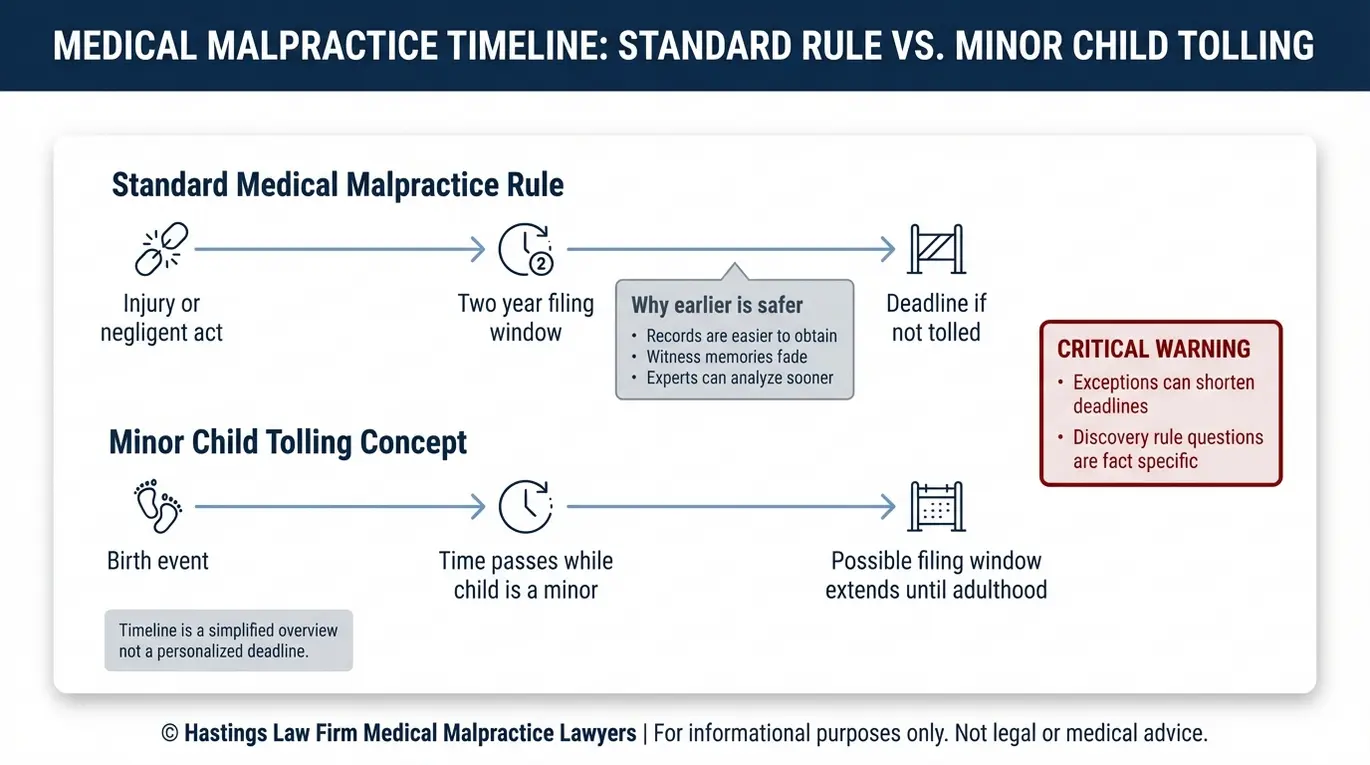
In Arizona, the standard statute of limitations for medical malpractice is two years, but for birth injuries involving minors, the statute is “tolled” (paused) until the child turns 18, at which point the child has two years—until age 20—to file a claim, though parents should file sooner to preserve evidence.
The Two-Year Rule and Tolling for Minors
For adults, Arizona requires medical malpractice claims to be filed within two years of the injury or within two years of when the injury was discovered. For children, tolling provisions extend this period, giving families more time to recognize that an injury occurred and take legal action. The tolling rules do not eliminate the need to act promptly to build a strong case.
The Discovery Rule
Arizona’s discovery rule allows the statute of limitations birth injury clock to begin only when the injury and its cause are discovered or reasonably should have been discovered. In developmental delay cases, this is significant because the full extent of brain damage may not be apparent until a child misses milestones years after birth. The discovery rule can extend filing deadlines, but it also introduces uncertainty about when the clock actually starts.
⚠️ Critical Warning
Even though you may have years to file, waiting degrades your case:
- Medical records may be lost, altered, or destroyed after retention periods expire
- Fetal monitoring strips are sometimes discarded or overwritten
- Witnesses forget details or become unavailable
- Experts have less reliable data to analyze
- The defense gains an advantage when evidence is incomplete
Keeping a paper trail is essential for proving negligence before evidence is lost.
Protect Your Claim Early
Speaking with an Arizona developmental delay birth injury lawyer sooner rather than later helps preserve evidence while it still exists. Effective litigation depends on clear, contemporaneous records. An early consultation costs nothing and creates no obligation, but it can make the difference between a strong case and one that cannot be proven.
The Litigation Process: From Investigation to Settlement
The process begins with a thorough investigation and affidavit of merit, followed by the discovery phase where experts review records, settlement negotiations, and potentially a jury trial if the insurance company refuses to offer fair compensation. Our team conducts a thorough investigation of the medical records and hospital policies to build the strongest possible case.
Step 1: Case Evaluation and Investigation
We start with a free, confidential evaluation of your case. Our in-house medical team, including nurses and patient advocates, reviews your child’s records to identify potential breaches in the standard of care. If we believe negligence occurred, we move forward with a full investigation.
Step 2: Filing the Lawsuit and Affidavit of Merit
Arizona law requires a preliminary expert opinion known as an Affidavit of Merit, certifying that a qualified medical expert has reviewed the case and believes the claim has merit. This requirement, outlined in Arizona Revised Statutes § 12-2603, prevents frivolous lawsuits and signals to the defense that your claim is supported by credible evidence.
Step 3: Discovery
During the discovery phase, both sides exchange evidence and conduct sworn interviews called depositions. We obtain testimony from the doctors, nurses, and staff involved in your child’s care to lock in their stories. Our medical experts analyze records, fetal monitoring data, and clinical notes to build a detailed timeline of what happened.
Step 4: Negotiation and Mediation
Many cases resolve through negotiation before trial. Because we prepare every case as if it will go to a jury, defense attorneys and insurance carriers understand we will not accept inadequate settlements. This trial-ready posture strengthens our position at the negotiation table, forcing insurers to take the claim seriously.
Step 5: Trial
If a fair settlement is not possible, we take the case to trial. Jury trials allow our legal team to present the medical evidence and advocate for full compensation. An experienced Arizona developmental delay birth injury lawyer guides you through every day of court.
No Fee Unless We Win
We work on a contingency fee basis. You pay no attorney fees unless we recover compensation for your family.
Contact the Arizona Birth Injury Attorneys at Hastings Law Firm Today for Help
Your family is not alone in this. When a child’s development is affected by preventable medical errors, the path forward can feel overwhelming. But you do not have to handle it by yourself.
At Hastings Law Firm, we’ve spent decades helping families uncover the truth about what happened during labor and delivery. Our focus is simple: to find answers, hold the responsible parties accountable, and secure the resources your child needs for a lifetime of care.
We take cases on a contingency fee basis, which means you pay nothing unless we win. There’s no financial risk in calling to learn more and requesting a free case evaluation.
If you’re looking for an Arizona developmental delay birth injury lawyer who will listen, investigate, and advocate for your family, contact us today. Let us help you take the first step toward understanding what happened and what comes next.
Frequently Asked Questions About Developmental Delay Birth Injury in Arizona


This content was researched and written by the Hastings Law Firm editorial team, which includes attorneys, medical professionals, and experienced researchers. Our writing is informed by internal knowledge and practical experience, and we cross-check critical details against authoritative sources cited throughout. Every piece undergoes human-led fact-checking and legal review. Because legal and medical information can change, if you spot an error, please contact us. Learn more about our content standards and review process on our editorial policy page.

Tommy Hastings, founder of Hastings Law Firm, is a board-certified personal injury trial lawyer dedicated exclusively to healthcare injury cases. Since 2001, he has represented injured patients and families in litigation against major hospital systems, pharmaceutical companies, and negligent healthcare providers nationwide. He has handled numerous high-profile cases that have drawn national media attention and resulted in multi-million dollar recoveries. He draws on that experience in his writing, helping readers understand how these cases work and what options may be available to them.
