


Arizona Dermatologist Malpractice Lawyer
Written by: Hastings Law Firm | Reviewed by: Tommy Hastings | Updated: July 27, 2026
Dermatologist errors can delay the diagnosis of skin cancer and allow a condition to progress beyond what it should have. Missed warning signs, incomplete exams, biopsy mistakes, and breakdowns in communicating pathology results can lead to more invasive treatment, disfigurement, lasting pain, and in some cases wrongful death. Arizona law also recognizes that responsibility may extend beyond the treating dermatologist to pathologists, laboratories, and medical practices when failures occur across the diagnostic chain. If you or a loved one were harmed or worse due to dermatologist malpractice in Arizona, contact Hastings Law Firm for a free, confidential case review.

Arizona Medical Negligence Attorneys for Victims of Skin Doctor Errors
What You Should Know About Skin Doctor Negligence Claims in Arizona:
- A delayed or missed skin cancer diagnosis can lead to more aggressive treatment and a worse prognosis, including sometimes fatal outcomes.
- Options for accountability can extend beyond the dermatologist when pathology errors or laboratory mishandling contribute to the harm.
- A poor outcome alone may not be actionable, since the key dispute is whether care fell below the accepted standard and caused the injury.
- Recovery can include financial losses and personal harms such as disfigurement and loss of life enjoyment.
- Compensation in Arizona is not limited by damage caps for personal injury and wrongful death claims.
- A missed opportunity for a better outcome can still matter in Arizona, since loss of chance principles may allow claims to reach a jury.
- A missed or delayed diagnosis can be driven by breakdowns such as rushed exams or failures to order a biopsy.
- A worsening outcome can be tied to communication failures when pathology results are lost, misfiled, or not conveyed.
- A medical record can become central when patient reported changes were dismissed without documentation or follow up.
- The ability to pursue a claim can be constrained by timing rules and expert support requirements in Arizona.

A Healthcare Focused Law Firm
When a dermatologist misses something that should have been caught, the consequences can change the course of your life. A delayed skin cancer diagnosis, a biopsy that was never ordered, or a pathology result that fell through the cracks can mean the difference between a simple procedure and aggressive treatment for advanced disease. If you or a loved one experienced harm because a skin doctor failed to meet the standard of care, you may have grounds for a medical malpractice claim.
At Hastings Law Firm, we focus exclusively on medical malpractice. Our legal and medical team includes former defense attorneys and experienced hospital nurses who previously worked for the healthcare systems they now challenge. As an experienced Arizona dermatologist malpractice lawyer team, we review your situation to explain what may have gone wrong and help you understand your options.
If something doesn’t feel right about the care you received, we welcome the chance to talk with you. Consultations are free and confidential, and you pay no fees unless we recover compensation on your behalf.
Understanding Dermatologist Malpractice and Failure to Diagnose Skin Cancer
Dermatologist malpractice occurs when a skin doctor deviates from the accepted medical standard of care, resulting in injury or a condition that progresses beyond what it should have. The standard of care represents the clinical guidelines and professional expectations that every physician must follow. This includes conducting thorough skin examinations, following established biopsy protocols for suspicious moles or lesions, and acting promptly when warning signs appear. When a dermatologist fails to meet that duty of care, the result can be medical negligence with serious, sometimes fatal, consequences.
Early detection is especially critical for skin cancers like melanoma, basal cell carcinoma, and squamous cell carcinoma. Melanoma in particular is highly treatable when caught at an early stage. According to data from the National Cancer Institute’s SEER Training Modules, five-year survival rates drop significantly as melanoma advances. Basal cell carcinoma and squamous cell carcinoma are generally less aggressive, but delayed diagnosis can still lead to tissue destruction, disfigurement, and in some cases, spread to other areas of the body.
Not every unfavorable outcome means malpractice occurred. A known complication of a properly performed procedure is different from an error caused by carelessness or a failure to follow accepted medical guidelines. The distinction matters when suing a skin doctor. A dermatology malpractice attorney in Arizona will examine whether the provider’s actions fell below what the profession demands, and whether that failure directly caused harm. That is what separates a bad outcome from actionable negligence.
Melanoma Staging and Clark Levels
When a physician diagnoses melanoma, they often measure its severity by how deeply it has invaded the skin. Two key tools doctors use for this are Clark’s Level, a classification system that describes how far melanoma cells have penetrated through the layers of the skin, and Breslow thickness, a precise millimeter measurement of the tumor’s depth from the skin’s surface.
These measurements directly affect your prognosis, which is the expected course and outcome of the disease. A patient with a thin, superficial melanoma caught early may only require minor excision, but when a provider delays diagnosis, the cancer can invade deeper layers and eventually reach the lymphatic system or bloodstream. This process, called metastasis (the spread of cancer from the original site to distant organs), transforms melanoma from a curable condition into a life-threatening one. Every week of delay can allow a lesion to progress from one stage to the next, and we evaluate whether timely action would have prevented that progression.

Common Errors Arizona Dermatologists Make When Diagnosing Skin Conditions
Common errors include dismissing a malignant mole as cosmetic, failing to order a biopsy for a changing lesion, misinterpreting pathologic analysis reports, or conducting an inadequate full-body exam. These errors can rob patients of critical treatment windows when early intervention could have made the greatest difference.
As an Arizona dermatologist malpractice lawyer team, we see recurring patterns in the cases we investigate. Research from the Agency for Healthcare Research and Quality (AHRQ) Patient Safety Network highlights that diagnostic errors remain one of the most common and harmful types of medical mistakes. In dermatology, those errors tend to fall into specific categories:
- The rushed or incomplete exam. A total body skin examination (TBSE), a systematic head-to-toe inspection of the entire skin surface, is the standard screening method for detecting suspicious growths. When providers rush through appointments or skip areas of the body entirely, such as the scalp, soles of the feet, or between the toes, dangerous lesions can go unnoticed.
- Biopsy sampling errors. Biopsy sampling errors occur when a doctor takes an inadequate tissue sample or collects it from the wrong area. This can lead to a false-negative result, meaning the lab report shows no cancer even though it is present.
- Communication failures. Test results that are lost, misfiled, or never communicated to the patient represent a systemic breakdown. A positive pathology finding that sits in a medical record without a follow-up call can delay treatment by months, allowing the disease to metastasize while the patient remains unaware of their diagnosis.
- Cosmetic dismissal. Some dermatologists treat a suspicious growth as a benign age spot, wart, or cosmetic concern without performing any diagnostic testing. This type of misdiagnosis can be especially harmful with melanoma, where weeks or months of delay may allow the cancer to advance.
A skin cancer negligence lawyer evaluates whether the dermatologist followed accepted protocols at each step of the diagnostic process. When the evidence shows that a provider deviated from those protocols, and that deviation led to a worse outcome, the foundation of a failure to diagnose or delayed diagnosis claim begins to take shape.
The Hastings Law Firm Difference
Results matter, but what truly sets us apart is how we achieve them. Every verdict, every settlement, and every Arizona courtroom victory comes from one guiding promise: To treat each client’s fight for justice as if it were our own.
This balance of skill, experience, and empathy reflects our core philosophy that justice should not only compensate the injured, but also make healthcare safer nationwide.

Symptoms and Warning Signs of Skin Cancer Neglected by Doctors
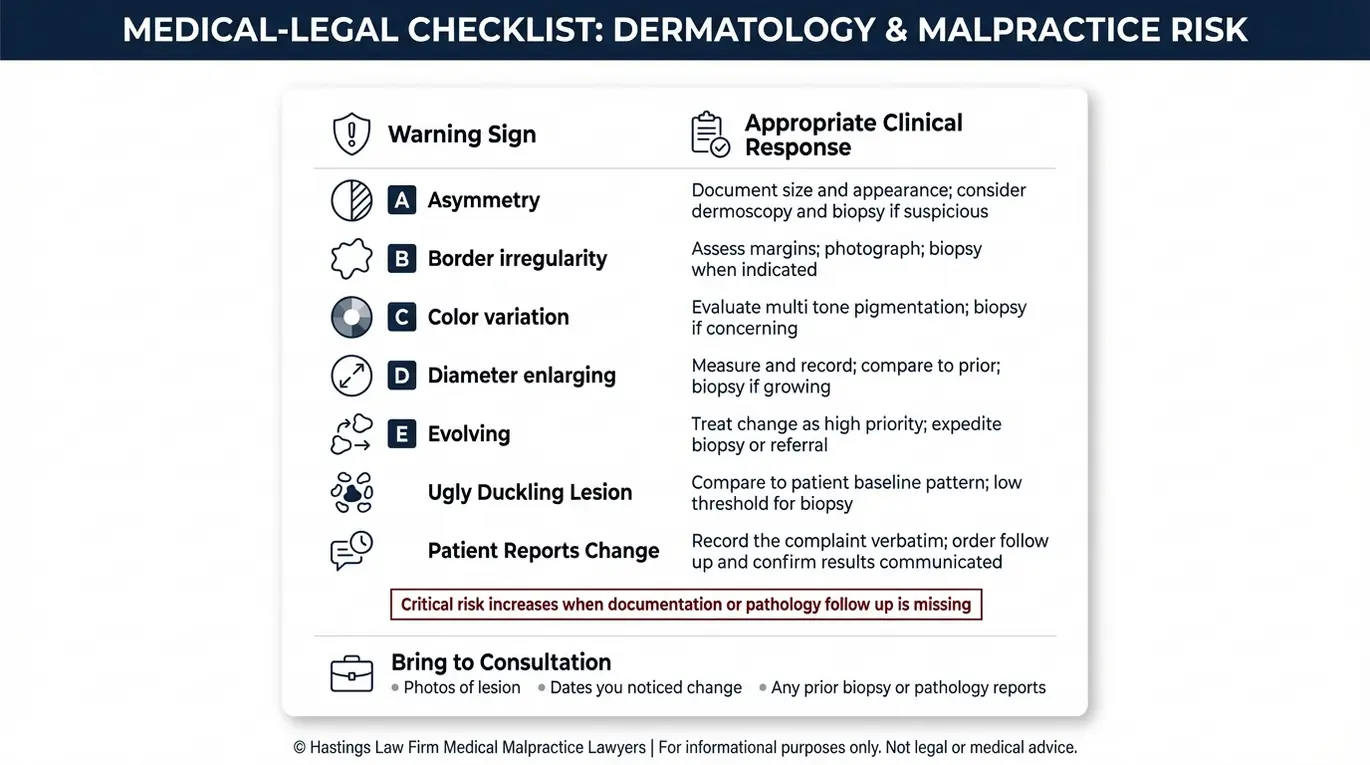
Physicians must be vigilant for the “ABCDE” signs of melanoma: Asymmetry, Border irregularity, Color variation, Diameter larger than a pencil eraser, and Evolving shape or size. Ignoring these signs constitutes a breach of duty.
The ABCDE rule, a widely taught set of melanoma warning signs used by dermatologists to evaluate suspicious moles and skin lesions, provides a framework for identifying growths that require further evaluation. According to Mayo Clinic’s overview of skin cancer symptoms and causes, these are the specific indicators every dermatologist should assess:
| Letter | Warning Sign | What the Doctor Should Do |
|---|---|---|
| A | Asymmetry: One half of the mole doesn’t match the other | Document the irregularity and consider biopsy |
| B | Border irregularity: Edges are ragged, notched, or blurred | Flag for monitoring or immediate tissue sampling |
| C | Color variation: Multiple shades of brown, black, red, white, or blue | Order a biopsy to rule out melanoma |
| D | Diameter: Larger than 6mm (about the size of a pencil eraser) | Evaluate size in context of other features and biopsy if indicated |
| E | Evolving: The mole is changing in size, shape, or color | Treat as high priority for biopsy and possible referral |
Beyond the ABCDE criteria, dermatologists should also watch for the “Ugly Duckling” sign, a mole or lesion that simply looks different from all the others on a patient’s body. An outlier mole that doesn’t match the patient’s overall pattern can be an early indicator of melanoma, even if it doesn’t clearly meet every ABCDE criterion. Dermatologists are trained to identify these outliers, and failing to investigate a lesion that stands out essentially ignores a major red flag.
In medical malpractice for missed skin cancer cases, a frequent issue is that the patient reported changes to their doctor, but the concern was dismissed without documentation or follow-up testing. When a patient flags a changing mole and the provider fails to act on that information, the medical record itself can become key evidence. We examine the clinical notes, visit history, and any documented patient complaints to determine whether the provider met or fell short of the expected standard.
Establishing Liability: Suing a Dermatologist or Pathologist in Arizona
Liability often extends beyond the dermatologist. Pathologists who misread biopsy slides and laboratories that mishandle tissue samples can also bear responsibility. Proving liability requires demonstrating a direct causal link between the provider’s error and the worsening of the patient’s condition.
As an Arizona dermatologist malpractice lawyer team, we investigate every party in the diagnostic chain to determine where the breakdown occurred. In many skin cancer cases, more than one provider or entity contributed to the harm:
- Dermatologist liability: The treating dermatologist may be liable for failing to biopsy a suspicious lesion, failing to refer the patient to a specialist, or failing to obtain informed consent. Informed consent means your doctor explained the risks and you agreed to the treatment.
- Pathologist liability: Dermatopathology, the subspecialty focused on microscopic examination of skin tissue, requires precise pathologic analysis. A pathologist who issues a false-negative pathology report, a lab result that incorrectly indicates no cancer is present when cancer cells actually exist in the sample, can cause months of delayed treatment.
- Vicarious liability: The medical practice, clinic, or hospital that employs the provider may also be liable for systemic failures. Inadequate staffing, poor follow-up systems, or lack of quality controls within a facility can contribute to diagnostic errors. If a clinic prioritizes volume over patient safety, resulting in rushed exams or lost records, the entity itself may be held accountable for the culture of negligence.
Arizona law requires that medical malpractice claims be supported by qualified expert testimony. Under A.R.S. § 12-2604, an expert witness in a medical malpractice action must be qualified by knowledge, skill, experience, or training in the specific area of medicine at issue. This means a dermatology malpractice case will typically require testimony from a board-certified dermatologist, and a pathology error case will require a qualified pathologist.
We use a national network of medical experts and in-house board-certified patient advocates to interpret clinical data and identify record inconsistencies. Our medical staff analyzes these records to build a clear picture of when a failure occurred and how it affected your outcome. Establishing causation, the direct link between the provider’s breach and the resulting harm, is the core of every case we pursue for liability for skin cancer misdiagnosis.
Recoverable Damages in Arizona Skin Cancer Malpractice Lawsuits
Patients harmed by dermatologist negligence can recover economic damages for medical bills and lost wages, as well as non-economic damages for pain, suffering, disfigurement, and loss of life enjoyment. Arizona stands apart from many states because its constitution prohibits caps on damages for personal injury and wrongful death claims.
An Arizona dermatologist malpractice lawyer will evaluate the full scope of harm when building a damages claim. The categories of compensation available in skin cancer malpractice cases typically include:
- Past and future medical costs. A delayed melanoma diagnosis can lead to aggressive oncology treatment, including chemotherapy, radiation, immunotherapy, and repeated surgeries. These expenses accumulate quickly and often continue for years. Treatment for advanced melanoma is significantly more expensive than early-stage intervention, potentially costing hundreds of thousands of dollars in immunotherapy and hospital stays.
- Disfigurement and scarring. When diagnosis is delayed, what could have been a simple excision may instead require wide local excision (WLE), a surgical procedure that removes the tumor along with a large margin of surrounding healthy tissue, or Mohs micrographic surgery (Mohs), a specialized layer-by-layer technique used for skin cancers in cosmetically sensitive areas. The psychological impact of facial scarring or disfigurement can be profound, justifying significant compensation for the permanent alteration of one’s appearance.
- Lost income and earning capacity. Extended treatment and recovery can prevent patients from working. In cases involving permanent disability, future earning capacity may also be recoverable.
- Pain and suffering. The physical pain and emotional toll of a cancer diagnosis that should have been caught earlier are recognized categories of non-economic damages.
- Wrongful death. When a delayed diagnosis leads to the death of a loved one, surviving family members may pursue a wrongful death claim for their loss. This can include compensation for the loss of companionship, income support, and the emotional anguish associated with the unnecessary death of a family member.
Arizona’s protection against damage caps is rooted in Article 2, Section 31 of the Arizona Constitution, which guarantees that the right to recover damages for injuries “shall never be abrogated.” This means juries are free to award full compensation based on the evidence, without arbitrary legislative limits. Unlike other jurisdictions where non-economic damages like pain and suffering are capped, Arizona allows the jury to assess the true extent of the harm. The Arizona Revised Statutes, Title 12, governs civil procedure for these claims, and our attorneys are experienced in presenting damages for delayed cancer diagnosis in a way that reflects the true impact on a patient’s life.
Contact the Arizona Doctor Malpractice Attorneys at Hastings Law Firm Today for Help
A cancer diagnosis is frightening. Learning that it could have been caught sooner, that a doctor’s error allowed it to progress, adds a layer of betrayal that is difficult to put into words. You deserve answers about what happened and whether the care you received fell short of what it should have been.
Hastings Law Firm is led by Tommy Hastings, a board-certified trial lawyer and member of the American Board of Trial Advocates (ABOTA) with over two decades of experience holding negligent medical providers accountable. Our team includes former defense attorneys who understand the strategies the other side will use, and in-house medical professionals who know how to identify where the standard of care was breached.
If you or a loved one suffered harm because a dermatologist or pathologist failed to diagnose or properly treat skin cancer, our Arizona dermatologist malpractice lawyer team is ready to listen. We offer free, confidential case evaluations and work on a contingency fee basis, meaning you pay nothing unless we secure compensation for you.
Contact Hastings Law Firm to discuss what happened and learn what options may be available to you.
Frequently Asked Questions About Dermatologist Malpractice in Arizona


This content was researched and written by the Hastings Law Firm editorial team, which includes attorneys, medical professionals, and experienced researchers. Our writing is informed by internal knowledge and practical experience, and we cross-check critical details against authoritative sources cited throughout. Every piece undergoes human-led fact-checking and legal review. Because legal and medical information can change, if you spot an error, please contact us. Learn more about our content standards and review process on our editorial policy page.

Tommy Hastings, founder of Hastings Law Firm, is a board-certified personal injury trial lawyer dedicated exclusively to healthcare injury cases. Since 2001, he has represented injured patients and families in litigation against major hospital systems, pharmaceutical companies, and negligent healthcare providers nationwide. He has handled numerous high-profile cases that have drawn national media attention and resulted in multi-million dollar recoveries. He draws on that experience in his writing, helping readers understand how these cases work and what options may be available to them.
