


Arizona Delayed Twin Delivery Injury Lawyer
Written by: Hastings Law Firm | Reviewed by: Tommy Hastings | Updated: July 27, 2026
Delayed medical intervention during a twin delivery can leave families facing overwhelming uncertainty and long term care needs. Twin and multiple pregnancies are treated as high risk, and safe outcomes depend on careful monitoring, clear communication, and timely decisions when warning signs appear. When a team misses fetal distress, fails to prepare for an emergency C section, or does not track both babies correctly, oxygen deprivation and permanent injury can follow. If you or a loved one were harmed or worse due to delayed twin delivery injury in Arizona, contact Hastings Law Firm for a free, confidential case review.

Compassionate Legal Representation for Multiple Birth Negligence in Arizona
What You Should Know About Twin Birth Delivery Negligence Claims in Arizona:
- Lifelong consequences can follow when a delayed emergency C section allows prolonged oxygen deprivation during a twin delivery.
- Severe outcomes can occur when fetal distress patterns are not recognized or acted on without unnecessary delay.
- Greater risk can arise in twin labor when both fetal heart rates are not monitored independently and one baby is effectively missed.
- Hospital responsibility can extend beyond the delivering physician when staffing and monitoring protocols are not adequately supported.
- Options for financial recovery can be shaped by the need to fund long term medical care and lost future earning capacity for injured children.
- Recovery can include both economic losses and non economic harm because Arizona does not allow caps on damages for personal injury and wrongful death.
- Legal rights can be lost if Arizona timing rules are missed, including special requirements for claims involving public hospitals.
- Case clarity can depend on detailed labor and delivery records that show monitoring tracings, response timing, and team communication.

A Healthcare Focused Law Firm
When your twins are injured during birth because of delayed medical intervention, the pain runs deep. You trusted your medical team to protect both of your babies, and that trust was broken. The questions you have right now deserve clear answers, and your family deserves a legal team that understands both the medicine and the law behind what went wrong.
At Hastings Law Firm, we focus exclusively on medical malpractice cases. Our founder, Tommy Hastings, is board-certified in personal injury trial law, a distinction held by a small percentage of practitioners. Our team includes in-house nurses and former defense attorneys who know how hospitals operate. As your Arizona delayed twin delivery injury lawyer, we bring that insider perspective to every investigation we conduct.
If you or a loved one believe your twins were harmed by a preventable delay, we can review your medical records and explain your legal options. The consultation is free and confidential.
Understanding High Risk Pregnancies Involving Twins and Multiples
High-risk twin pregnancies require elevated monitoring because they present increased dangers such as preeclampsia, gestational diabetes, and fetal growth restriction that demand proactive medical management. The medical community classifies all twin and multiple pregnancies as high-risk from the start, regardless of maternal age or health history.
One of the critical first steps in effectively monitoring twins is determining chorionicity, which refers to whether the babies share a single placenta (monochorionic) or have separate placentas (dichorionic). This distinction matters because monochorionic twins face additional complications related to shared blood flow. According to The Fetal Medicine Foundation’s protocol for ultrasound scans, determining chorionicity early allows providers to plan appropriate surveillance throughout the pregnancy.
Medical teams should schedule frequent sonogram exams, often called ultrasounds. They also use non-stress testing to measure fetal heart rate patterns in response to movement and identify problems before they become emergencies. A twin delivery injury lawyer in Arizona often reviews these records to determine whether the monitoring schedule was adequate and followed protocols.
When conditions like preeclampsia or gestational diabetes go undiagnosed or untreated, the consequences can be severe. A multiple birth injury attorney will examine whether providers failed to recognize warning signs that required immediate action. An Arizona delayed delivery lawyer investigates whether the standard testing protocols were followed.
Common risk factors that require close monitoring in twin pregnancies include:
- Preeclampsia, a dangerous blood pressure condition that can restrict blood flow to the babies
- Gestational diabetes, which can cause excessive fetal growth and delivery complications
- Fetal growth restriction, where one or both twins fail to develop properly
- Placental abnormalities that affect nutrient delivery to the babies
- Preterm labor, which occurs more frequently in multiple pregnancies
The Dangers of Delayed Delivery and C Section Failures
A delayed delivery occurs when a medical team fails to perform an emergency C-section despite clear signs of fetal distress, leading to oxygen deprivation and permanent brain injury. For twins, these risks multiply because providers must track the status of two babies simultaneously while making rapid decisions to prevent issues like a prolapsed umbilical cord.
Fetal distress refers to signs that a baby is not receiving adequate oxygen during labor. These warning signs appear on fetal heart rate monitors as specific patterns that trained providers should recognize immediately. When a delayed twin delivery attorney reviews a case, we examine whether the medical team identified these patterns and responded appropriately.
The decision-to-incision time, or the interval between deciding a C-section is needed and beginning surgery, can determine whether a baby suffers permanent harm. While some sources have suggested a 30-minute benchmark for emergencies, the appropriate response time depends on the specific clinical situation, and some circumstances demand even faster action.
| Warning Sign | Expected Medical Response |
|---|---|
| Prolonged fetal heart rate deceleration | Immediate preparation for emergency delivery |
| Absent heart rate variability | Continuous monitoring and evaluation for intervention |
| Cord prolapse identified | Emergency C-section within minutes |
| One twin in breech position during active labor | Assessment for cesarean delivery |
| Non-reassuring heart rate pattern in either twin | Repositioning, oxygen, and preparation for possible surgery |
According to the Washington University clinical practice guideline on intrapartum fetal heart rate monitoring, providers must interpret these patterns systematically and act without unnecessary delay. A lawyer for delayed C-section cases analyzes whether the medical team followed these interpretation standards.
Prolonged oxygen deprivation can cause hypoxic ischemic encephalopathy (HIE), a type of brain damage that may result in cerebral palsy, developmental delays, or death. An Arizona birth injury lawyer understands that even minutes of delay can change a child’s life permanently. Twin injury counsel must establish exactly when intervention became necessary and whether the response met the standard of care.
Delayed Interval Delivery Risks for Twins
Delayed interval delivery describes the rare situation where one twin is born and the second remains in the womb for an extended period. This scenario creates specific dangers for the remaining baby that require proactive medical management.
After the first twin delivers, the cervix may begin to close, or infection may develop in the uterine environment. The second twin may also shift into a breech presentation, meaning the baby is positioned feet-first or bottom-first rather than head-first. Breech position can complicate vaginal delivery and may require an emergency C-section.
Medical teams must monitor the second twin’s heart rate continuously after the first delivery and be prepared to intervene if distress develops.
Monochorionic Placenta Risks and Vascular Perfusion
Identical twins who share a single placenta (monochorionic twins) face unique risks during delivery. Because their blood supplies are connected through the shared placenta, problems affecting one twin can rapidly impact the other.
Twin-to-twin transfusion syndrome (TTTS) occurs when blood flow becomes unbalanced between the twins, causing one to receive too much blood while the other receives too little. If delivery is delayed when one twin is already compromised, the shared circulation can cause acute oxygen deprivation in the healthier twin as well.
Conditions like placenta previa, where the placenta covers the cervix, add another layer of risk that demands careful planning and rapid response capability. Establishing causation in these cases requires detailed analysis of how blood flow problems developed and whether earlier delivery would have prevented the injuries.

The Hastings Law Firm Difference
Results matter, but what truly sets us apart is how we achieve them. Every verdict, every settlement, and every Arizona courtroom victory comes from one guiding promise: To treat each client’s fight for justice as if it were our own.
This balance of skill, experience, and empathy reflects our core philosophy that justice should not only compensate the injured, but also make healthcare safer nationwide.

Common Forms of Negligence in Arizona Twin Deliveries
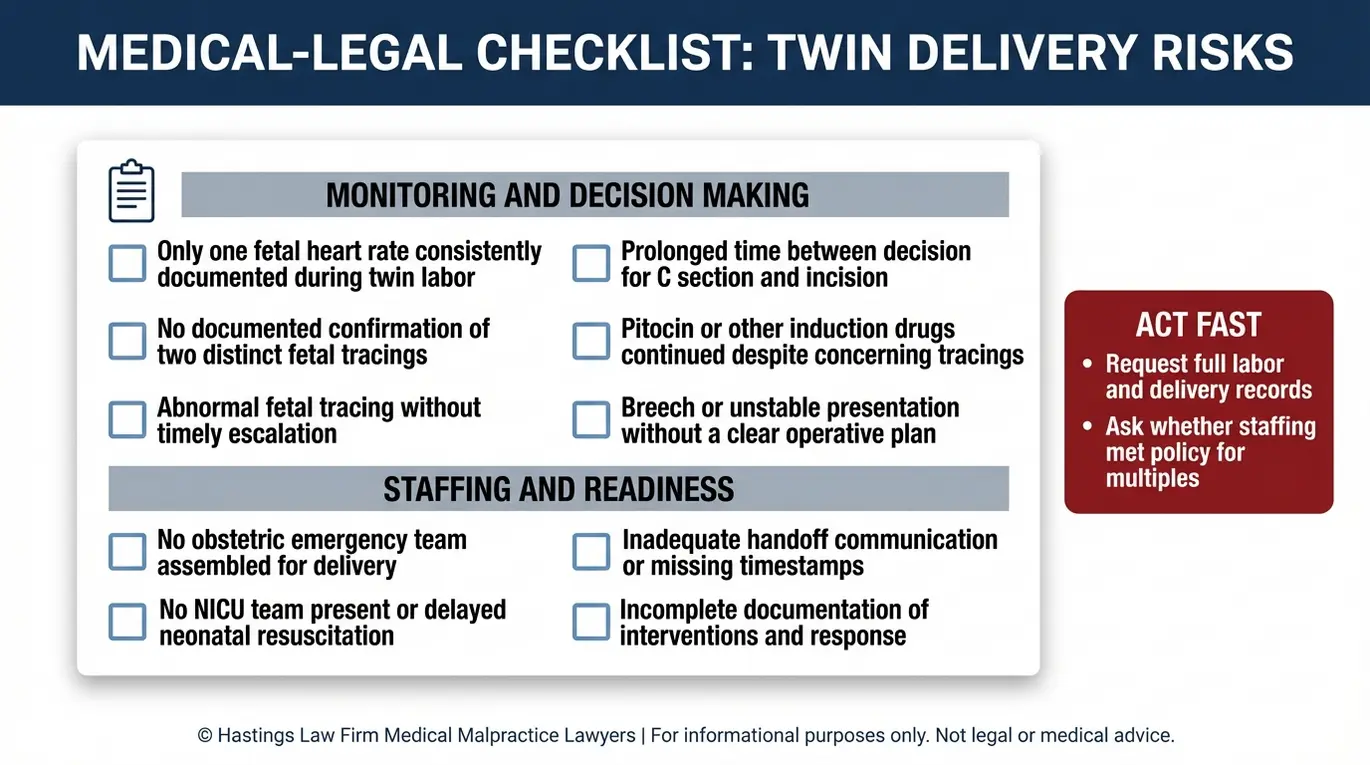
Negligence in twin deliveries often involves the failure to monitor both heart rates independently, improper use of delivery instruments like forceps, or the failure to assemble a full surgical team for high-risk births. A medical malpractice lawyer for twins investigates medical negligence to determine if providers met the standards required to prevent a birth injury.
Continuous electronic fetal monitoring for twins requires separate tracing for each baby, meaning the medical team must confirm they are tracking two distinct heart rate patterns. One of the most dangerous errors occurs when providers inadvertently monitor the same baby twice, missing signs of distress in the other twin entirely.
Labor-inducing medications like Pitocin (synthetic oxytocin) require careful dosing in any delivery, but twin pregnancies demand even greater caution. Excessive contractions can reduce blood flow to both babies and cause fetal distress.
A Phoenix delayed delivery attorney also examines staffing decisions. The Agency for Healthcare Research and Quality’s Patient Safety Indicator guidelines establish benchmarks for safe obstetric care, including appropriate preparation for high-risk deliveries. Arizona multiple birth negligence cases often involve hospitals that failed to have adequate personnel ready, increasing the risk of cerebral palsy.
Standard of care breaches we examine in twin delivery cases:
- Failure to differentiate between two fetal heart rates on the monitor
- Monitoring the same baby twice while missing distress in the other twin
- Improper Pitocin administration that caused excessive uterine contractions
- Failure to have a surgical team on standby for emergency C-section
- NICU team not present or prepared for a multiple birth
- Delayed response to non-reassuring fetal heart rate patterns
- Inadequate communication between nurses and physicians about concerning findings
Determining Liability and Responsibility in Arizona Hospitals
Liability in Arizona birth injury cases may extend beyond the obstetrician to include labor and delivery nurses, the hospital entity for negligent staffing, or independent specialists involved in the care. Determining liability for twin injuries requires examining each provider’s role in the delivery and their relationship to the hospital.
Every healthcare provider involved in the delivery owes a duty of care to both the mother and both infants. This means each provider must meet the standard of care for their specialty and respond appropriately to complications. When multiple providers fail, a malpractice lawyer in Phoenix may pursue claims against several defendants by establishing causation for each role.
Hospitals can be held directly liable for administrative decisions that compromise patient safety, such as inadequate staffing during high-risk deliveries or failure to enforce monitoring protocols. The discovery rule in Arizona allows claims to proceed when the full extent of negligence only becomes apparent after investigation of the medical records.
| Provider Type | Employment Status | Hospital Liability |
|---|---|---|
| Labor and delivery nurses | Usually hospital employees | Hospital typically liable for nurse actions |
| Staff obstetricians | Hospital employees | Hospital typically liable |
| Private attending OB-GYNs | Often independent contractors | Hospital may not be liable for physician |
| Anesthesiologists | May be either | Depends on employment relationship |
| NICU specialists | Often hospital employees | Hospital typically liable |
Independent Contractor vs Hospital Employed Obstetricians
Arizona law distinguishes between hospital employees and independent contractors when determining whether suing an Arizona hospital for a physician’s negligence is possible. Many obstetricians maintain privileges at hospitals but operate as independent contractors rather than employees.
When a doctor is an independent contractor, the hospital may argue it cannot be held vicariously liable for that physician’s malpractice or breach of the standard of care. However, if the hospital held the doctor out as its agent, or if patients reasonably believed the doctor was hospital staff, liability may still attach.
We examine credentialing records, hospital marketing materials, and the specific agreements between physicians and facilities to determine who can be held responsible.

Recovering Damages for Lifetime Care of Injured Twins
Compensation in twin injury cases must cover the lifetime cost of medical care, including 24/7 nursing, physical therapy, specialized equipment, and lost future earning capacity for the injured children. When both twins are injured, the financial burden can be staggering, making accurate damage calculations essential.
Economic damages include all quantifiable costs: medical bills, rehabilitation, adaptive equipment, home modifications, and the wages parents lose while caring for disabled children. According to the CDC’s analysis of economic costs associated with cerebral palsy, lifetime care expenses can exceed one million dollars per affected individual.
Non-economic damages address the pain, suffering, and loss of normal life experiences that injured children endure. Compensation for birth injury must also account for the emotional toll on parents and siblings.
We work with Life Care Plan experts who project costs over 40 to 50 years, ensuring that any Arizona injury settlement provides future financial security for your children’s needs throughout their lives. Under Arizona Revised Statutes 12-542, families have specific timeframes to pursue these claims.
Contact the Arizona Birth Injury Attorneys at Hastings Law Firm Today for Help
If your twins suffered injuries due to a delayed delivery, you need a legal team that views your case as a cause for justice, not just a file. At Hastings Law Firm, we dedicate our entire practice to medical malpractice cases because families deserve attorneys who understand the medicine as deeply as the law.
Our team includes nurses and former defense attorneys who know how hospitals document care and how they defend against claims. We prepare every case as if it will go to trial, which strengthens our position whether we negotiate a settlement or present your case to a jury.
We operate on a contingency fee basis, meaning you pay no attorney fees unless we recover compensation for your family. The path forward starts with a conversation.
Contact us today to schedule a free, confidential evaluation of your case.
Frequently Asked Questions About Delayed Twin Delivery Injury in Arizona


This content was researched and written by the Hastings Law Firm editorial team, which includes attorneys, medical professionals, and experienced researchers. Our writing is informed by internal knowledge and practical experience, and we cross-check critical details against authoritative sources cited throughout. Every piece undergoes human-led fact-checking and legal review. Because legal and medical information can change, if you spot an error, please contact us. Learn more about our content standards and review process on our editorial policy page.

Tommy Hastings, founder of Hastings Law Firm, is a board-certified personal injury trial lawyer dedicated exclusively to healthcare injury cases. Since 2001, he has represented injured patients and families in litigation against major hospital systems, pharmaceutical companies, and negligent healthcare providers nationwide. He has handled numerous high-profile cases that have drawn national media attention and resulted in multi-million dollar recoveries. He draws on that experience in his writing, helping readers understand how these cases work and what options may be available to them.
