


Arizona Defective Joint Replacement Lawyer
A defective joint implant can turn a surgery meant to restore mobility into ongoing pain, instability, and the stress of additional treatment. Symptoms can be obvious, like swelling and grinding, or subtle, like systemic effects linked to metal particles. These problems can stem from a product defect, a failure to warn, or errors during implantation, and the responsible party is not always clear at first. Understanding the medical and liability issues can help clarify what happened and what comes next. If you or a loved one were harmed or worse due to a defective joint replacement implant in Arizona, contact Hastings Law Firm for a free, confidential case review.
Last Updated: July 27, 2026
Trusted Legal Representation for Orthopedic Device Failure Claims
Joint replacement surgery is supposed to relieve pain and restore mobility. When a defective implant causes new suffering instead of healing, the sense of frustration and betrayal can be overwhelming. You may be dealing with unexplained pain, another surgery, or the fear that something toxic is happening inside your body.
At Hastings Law Firm, we focus exclusively on medical malpractice and defective medical device cases. Our team includes in-house medical professionals who understand the clinical side of implant failure, and former defense attorneys who know exactly how manufacturers and hospitals build their defenses. If you or a loved one is experiencing complications from a hip, knee, or shoulder replacement, an Arizona defective joint replacement lawyer at our firm can review your situation and help you understand your legal options in a free, confidential consultation.

Recognizing the Signs of a Defective Joint Implant
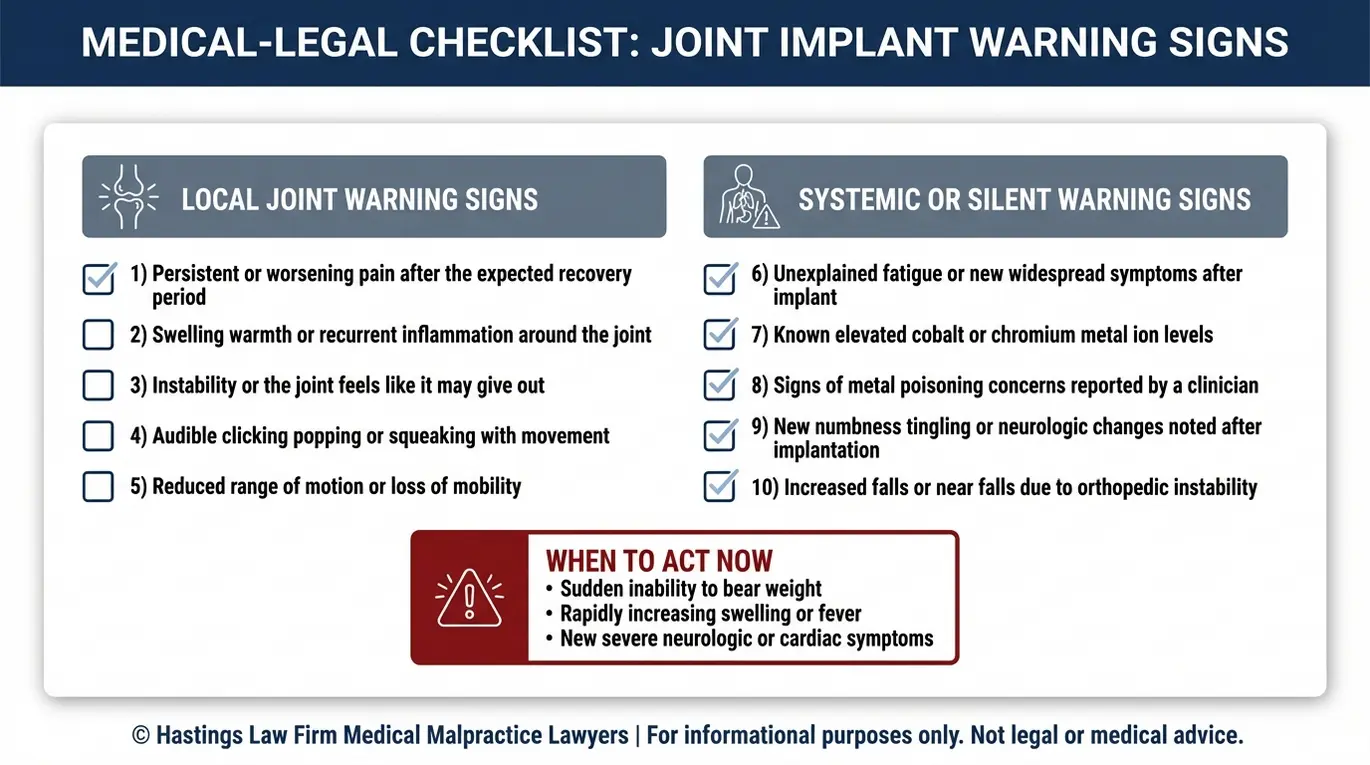
A defective joint implant often presents symptoms such as chronic pain, swelling, instability, audible clicking or squeaking noises, and loss of mobility that persists long after the initial recovery period. Orthopedic devices are complex medical implants used to replace damaged bone and cartilage. These symptoms are not normal parts of healing. If months or years have passed since your joint replacement and you are still struggling, the orthopedic device itself may be the problem.
Some warning signs are easy to feel. The joint may shift or give way during normal activities, creating orthopedic instability that significantly increases your risk of falls and secondary injuries like fractures. You might hear grinding, popping, or squeaking with routine movement. Persistent swelling and inflammation around the joint, even without a clear infection, can also point to device failure. According to University of Utah Health, infection symptoms can overlap with signs of implant failure, making accurate diagnosis essential.
Other symptoms are far less obvious. Metal-on-metal implants can release microscopic metal particles into the surrounding tissue and bloodstream. This process, called metallosis (a condition where metallic debris accumulates in the soft tissues around the implant), can cause tissue death and chronic inflammation without any external warning signs. Over time, elevated cobalt and chromium levels may lead to systemic metal poisoning, affecting the heart, thyroid, and nervous system.
Bone deterioration is another concern. Osteolysis, the gradual destruction of bone tissue around the implant caused by the body’s reaction to wear particles, can silently weaken the bone that holds the device in place. By the time it becomes painful, the damage may already require a complex revision surgery to correct.
Signs that may indicate implant failure:
- Persistent or worsening pain in the joint beyond the expected recovery window
- Swelling, warmth, or redness around the implant site
- Joint instability, catching, or giving way during movement
- Audible clicking, squeaking, or grinding sounds
- Reduced range of motion or difficulty bearing weight
- Unexplained fatigue, brain fog, tremors, or heart palpitations (possible signs of elevated metal ion levels)
- Frequent falls or near-falls due to joint instability
If you recognize any of these symptoms, speaking with an Arizona defective joint replacement lawyer who understands both the medical and legal dimensions of these cases can help you determine whether your implant may be at fault.
Liability for Defective Medical Devices and Surgical Errors
Liability in joint replacement cases typically falls on the device manufacturer for product defects or on the surgeon for medical malpractice if the implantation was performed incorrectly. Liability refers to the legal responsibility of a party for the harm caused to another person. In many cases, both theories apply at the same time, which is why a thorough investigation matters.
Product liability claims against a manufacturer generally fall into three categories:
- Design defect: The device was inherently unsafe due to its design. Metal-on-metal (MoM) hip implants, which are devices where both the ball and socket components are made of metal alloys, are a well-known example. Their design caused accelerated wear, releasing toxic metal particles into patients’ bodies.
- Manufacturing defect: A specific unit or batch left the factory with flaws, such as contamination, dimensional errors, or material impurities, even though the approved design may have been adequate.
- Failure to warn: The manufacturer knew or should have known about specific risks but failed to adequately disclose them to surgeons and patients. If internal data showed high failure rates and that information was withheld, the manufacturer can be held liable.
Arizona applies both consumer expectation and risk-utility analyses in design defect cases. As explored by the Arizona Law Review, courts may evaluate whether a product’s risks outweigh its benefits when the defect is not obvious to an ordinary consumer. The U.S. Food and Drug Administration has also issued safety communications about specific devices, such as Exactech implants with defective packaging, reinforcing these concerns at a federal level.
Medical Malpractice
Medical malpractice claims are separate from product defects. Medical malpractice occurs when a healthcare provider fails to meet the accepted medical standard of care, which is the level of care a competent professional would provide in a similar situation. These claims arise when the surgeon makes an error during implantation, such as improper positioning, selecting a wrong-sized component, or failing to address aseptic loosening, which is the gradual failure of the bond between the implant and bone that occurs without infection. An Arizona defective joint replacement lawyer evaluates both pathways to determine who is responsible and build the strongest possible case.
| Product Liability | Medical Malpractice | |
|---|---|---|
| Defendant | Device manufacturer or distributor | Surgeon, hospital, or surgical team |
| Legal Theory | Strict liability or negligence | Breach of the standard of care |
| Key Evidence | Device design files, manufacturing records, FDA filings, recall data | Operative reports, imaging, surgical technique, expert review |
| Common Examples | Metal-on-metal wear, packaging failures, contamination | Incorrect sizing, malpositioning, failure to revise |

The Hastings Law Firm Difference
Results matter, but what truly sets us apart is how we achieve them. Every verdict, every settlement, and every Arizona courtroom victory comes from one guiding promise: To treat each client’s fight for justice as if it were our own.
This balance of skill, experience, and empathy reflects our core philosophy that justice should not only compensate the injured, but also make health care safer nationwide.

Common Manufacturers and Recalled Orthopedic Implants
Major manufacturers like DePuy, Stryker, and Zimmer Biomet have faced thousands of lawsuits regarding recalled hip, knee, and shoulder implants due to high failure rates and metallosis. Orthopedic device manufacturers are responsible for ensuring their products are safe before they reach patients. If your device was made by one of these companies, you are not alone, and there may already be established litigation related to your specific implant.
Several widely used devices have been the subject of recalls and mass litigation:
| Manufacturer | Device | Primary Issue |
|---|---|---|
| DePuy (Johnson & Johnson) | ASR XL / Pinnacle | Metal-on-metal wear, elevated metal ion levels |
| Stryker | Rejuvenate / ABG II | Corrosion at modular neck junction, metallosis |
| Zimmer Biomet | Durom Cup / Persona Knee | Early loosening, high revision rates |
| Exactech | GXL Knee / Connexion GXL | Defective packaging causing polyethylene oxidation |
| Wright Medical | Conserve / Profemur | Metal-on-metal wear, fractures |
The Exactech recall deserves particular attention. The issue was not a flaw in the implant’s design or material, but in the packaging. Many Exactech polyethylene components were packaged in vacuum bags that were missing the ethylene vinyl alcohol (EVOH) oxygen barrier layer required by packaging specifications. Without this barrier, oxygen permeated the packaging and degraded the plastic components through a process called polyethylene oxidation, causing the insert to become brittle and wear down prematurely after implantation.
Many of these devices reached the market through the FDA’s 510(k) clearance process. Under 510(k), a manufacturer only needs to show that a new device is “substantially equivalent” to one already on the market, bypassing the more rigorous clinical testing required for full premarket approval. You can search for specific recalls and safety alerts through the FDA’s Medical Device Recalls database. A defective joint replacement attorney can cross-reference your implant’s model and lot number against known recall lists and litigation databases.
Compensation Available to Victims of Implant Failure
Victims of defective implants may recover damages for medical expenses related to revision surgery, lost wages, pain and suffering, and in rare cases, punitive damages to punish the manufacturer. Compensation is the financial recovery provided to help a patient return to the state they were in before the injury occurred.
Compensatory damages generally fall into two categories. Economic damages cover the direct medical bills and financial costs of the injury.
Revision surgery alone can cost tens of thousands of dollars, and many patients require extended physical therapy and rehabilitation afterward. If the injury forced you to miss work or reduced your ability to earn a living, those losses are recoverable too. Future medical costs are also part of this category, including ongoing imaging, follow-up procedures, and assistive devices.
Non-economic damages address the harm that does not come with a receipt. Chronic pain, loss of mobility, emotional distress, and the loss of activities you once enjoyed all carry real weight in these claims.
One category of damages that is often overlooked involves long-term monitoring costs for metallosis and metal ion poisoning. Patients with metal-on-metal implants may need periodic blood testing to measure cobalt and chromium blood metal ion levels, which are the concentrations of these metals circulating in the bloodstream. If levels are elevated, the patient may be diagnosed with systemic cobalt toxicity (sometimes called cobaltism), a condition that can affect the heart, thyroid, vision, and neurological function.
The cost of monitoring and treating these effects can extend for years or even a lifetime. An Arizona defective joint replacement lawyer at our firm works to ensure these ongoing needs are fully accounted for in any recovery, and our defective joint replacement law firm does not charge fees unless we secure compensation for you.
How We Prove Your Case Through Rigorous Investigation
We build a winning case by securing the explanted device for analysis, reviewing the Device History Record for manufacturing errors, and utilizing international registry data to prove higher-than-average failure rates. Proving a case involves gathering evidence to show how a device failed and who is responsible. Each piece of evidence strengthens the connection between the defective device and the harm it caused.
The first priority after revision surgery is preserving the explanted device. A forensic examination of the removed implant by a materials engineering expert can reveal wear patterns, corrosion, fractures, or manufacturing inconsistencies that would otherwise go undetected. We advise clients and their surgeons to retain the device and any associated components before they are discarded.
From there, we pursue the paper trail. The Device History Record (DHR), a manufacturer’s internal documentation of every step in a device’s production, assembly, and quality control testing, is one of the most valuable pieces of evidence in these cases. During discovery, we also seek internal emails between sales representatives and surgeons, complaint logs, and adverse event reports filed with the FDA. These records can reveal whether the manufacturer was aware of problems before your surgery.
When domestic data is limited, we turn to international joint registries, which are large national databases maintained by countries like Australia and the United Kingdom that track implant performance across hundreds of thousands of patients. If a device shows a significantly higher failure rate in registry data compared to alternatives, that evidence can be powerful in proving a design or manufacturing defect.
Key evidence we pursue in defective implant cases:
- The explanted device and all surgical hardware
- Operative reports, imaging, and post-surgical medical records
- The manufacturer’s Device History Record (DHR)
- Internal company communications, including sales rep correspondence
- FDA adverse event reports and 510(k) or PMA submission files
- International joint registry data (Australian, UK, and Nordic registries)
- Expert testimony from orthopedic surgeons, metallurgists, and biomedical engineers
As an experienced defective joint replacement lawyer team, we coordinate this investigation from day one, working alongside our in-house medical staff and a national network of qualified experts to build your case from the ground up.

Time Limits for Filing a Defective Joint Replacement Claim
In Arizona, the statute of limitations for a product liability or injury claim is generally two years from the date of the injury or the date you discovered the defect. A statute of limitations is a legal deadline that limits how much time you have to file a lawsuit. Missing this deadline can permanently bar your right to seek compensation, regardless of how strong your case may be.
Under A.R.S. § 12-542, the standard filing window is two years. For defective joint replacement cases, identifying the exact start date of that clock is not always simple. Many implant failures develop gradually, and patients may not connect their symptoms to a device problem until years after surgery. Arizona’s discovery rule can extend the deadline by starting the clock when you knew, or reasonably should have known, that your injury was linked to the implant. Certain legal exceptions, known as tolling, may pause this timeframe, but these are rare.
Filing deadlines can differ if your case is consolidated into a federal Multidistrict Litigation (MDL). MDL proceedings have their own procedural timelines that may affect when and how claims are filed. Acting quickly protects your ability to preserve evidence, including the explanted device, surgical records, and manufacturer documents. Arizona defective joint replacement lawyers at Hastings Law Firm can evaluate your timeline and ensure no critical deadline is missed.
Contact the Arizona Medical Device Attorneys at Hastings Law Firm Today for Help
If you or a loved one is living with pain, complications, or the burden of additional surgery because of a failed hip, knee, or shoulder implant, you do not have to face the manufacturer’s legal team on your own.
Hastings Law Firm brings a team of board-certified trial attorneys, in-house medical professionals, and former defense counsel who understand how these cases are built and how they are defended. Founded by Tommy Hastings, a board-certified trial lawyer and 2025 inductee into the American Board of Trial Advocates, our firm has recovered millions for patients harmed by medical negligence and defective medical products.
We offer a free, confidential case evaluation, and we work on a contingency fee basis, meaning you pay no attorney fees or costs unless we secure a recovery for you. Contact our Arizona defective joint replacement lawyer team today to discuss what happened and learn what options may be available to you.
Frequently Asked Questions About Defective Joint Replacement in Arizona


This content was researched and written by the Hastings Law Firm editorial team, which includes attorneys, medical professionals, and experienced researchers. Our writing is informed by internal knowledge and practical experience, and we cross-check critical details against authoritative sources cited throughout. Every piece undergoes human-led fact-checking and legal review. Because legal and medical information can change, if you spot an error, please contact us. Learn more about our content standards and review process on our editorial policy page.

Tommy Hastings, founder of Hastings Law Firm, is a board-certified personal injury trial lawyer dedicated exclusively to healthcare injury cases. Since 2001, he has represented injured patients and families in litigation against major hospital systems, pharmaceutical companies, and negligent healthcare providers nationwide. He has handled numerous high-profile cases that have drawn national media attention and resulted in multi-million dollar recoveries. He draws on that experience in his writing, helping readers understand how these cases work and what options may be available to them.
