


Arizona CT Scan Radiation Overdose Lawyer
Written by: Hastings Law Firm | Reviewed by: Tommy Hastings | Updated: July 27, 2026
CT scan radiation overdose can happen when imaging equipment malfunctions or incorrect settings deliver far more radiation than intended. The effects can be delayed and may involve painful burns, lasting tissue damage, and serious long term health risks. Identifying the cause often depends on technical dose data and whether calibration, maintenance, or operator choices led to unsafe exposure. Responsibility may involve a hospital or imaging center, a technologist, or a device manufacturer. If you or a loved one were harmed or worse due to CT scan radiation overdose in Arizona, contact Hastings Law Firm for a free, confidential case review.

Trusted Arizona Medical Attorneys for CT Scan Radiation Injuries and Negligence Claims
What You Should Know About Radiation Overdose From Imaging Claims in Arizona:
- Long term health risks can follow a CT scan radiation overdose when a scan delivers far more radiation than intended.
- Recovery can turn on whether the injury pattern matches radiation exposure, such as a band like area of hair loss or visible tissue damage.
- Options can be limited if time limits under Arizona law are missed.
- Responsibility can involve more than one party, including a hospital or imaging center, a technologist, or a CT scanner manufacturer.
- Compensation can include both financial losses and personal harms such as pain, disfigurement, and mental anguish.
- Proof can depend on obtaining scanner dose data that may not be included in standard medical records and can be lost if equipment is serviced or replaced.
- Causation disputes can be central when later conditions are alleged, since expert analysis may be needed to connect radiation dose to cellular damage.
- Outcomes can hinge on whether dose indices show exposure exceeded accepted diagnostic ranges.
- Product related claims can matter when overexposure is tied to software defects or calibration problems rather than operator error.

A Healthcare Focused Law Firm
A CT scan is supposed to help doctors diagnose and treat you, not cause new injuries. But when equipment malfunctions or a technologist applies the wrong settings, a routine imaging procedure can deliver dangerously high levels of radiation. This type of radiation overdose, where the body absorbs far more energy than the scan requires, can lead to painful burns, lasting tissue damage, and serious long-term health risks.
Proving what went wrong often requires retrieving technical machine data and identifying whether improper calibration caused the excess dose. This involves checking if the machine’s radiation output met safety standards while working with specialized experts to interpret the findings. Hastings Law Firm focuses exclusively on medical malpractice, and our team includes in-house medical professionals who understand how to build these cases from the evidence up.
If you or a loved one experienced unusual symptoms after a CT scan in Arizona, an experienced Arizona CT scan radiation overdose lawyer can review what happened and help you understand your options. Contact us for a free, confidential case evaluation.
Recognizing Signs of CT Scan Radiation Overdose
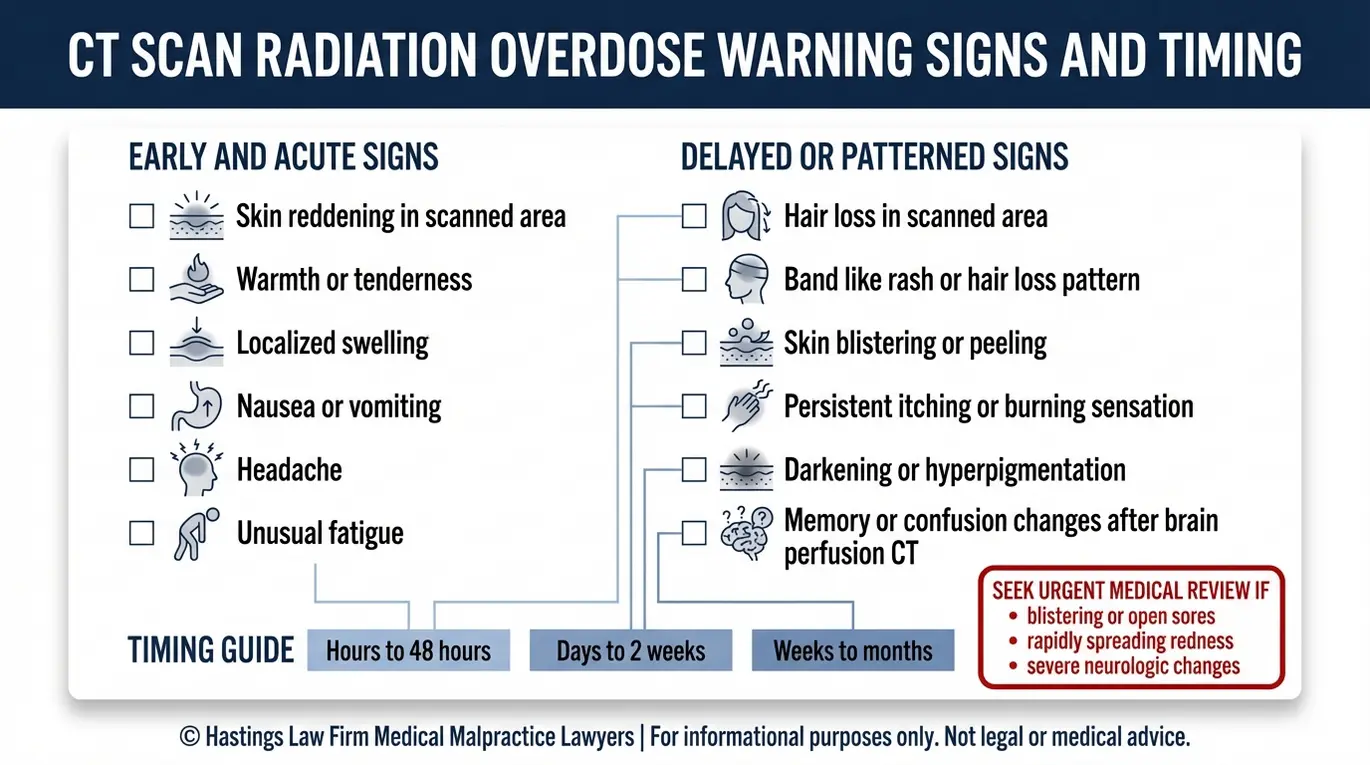
A radiation overdose from a CT scan typically shows up as visible tissue damage, such as skin reddening (erythema) or hair loss in the area that was scanned. These symptoms often appear days to weeks after the procedure, making them easy to overlook or attribute to something else entirely. These symptoms may indicate that the radiation dose exceeded safe medical limits.
Immediate symptoms can include nausea, vomiting, and headaches shortly after the scan. But other effects may take much longer to surface. In cases involving the brain, symptoms like confusion, memory problems, or cognitive changes can be mistaken for the underlying condition the scan was meant to evaluate, such as a stroke.
Brain perfusion CT scans, a specialized type of imaging used to measure blood flow in the brain during a suspected stroke, are among the most common sources of significant radiation overdose. Because the scanner repeatedly targets the same small area of the head, even a minor error in settings can multiply the dose rapidly. Research published in Events That Have Shaped the Quality Movement in Radiology (PubMed Central) documents how these perfusion scan incidents prompted national safety reforms.
A telltale band-like pattern of hair loss, or epilation (radiation-induced hair loss), often follows the scanner beam’s path. This distinct sign helps distinguish a radiation burn, also known as a cutaneous radiation injury, from other skin conditions.
If you or a family member noticed any of the following after a CT scan, it may warrant a closer look:
- Reddening, blistering, or peeling skin in the scanned area
- A strip or band of hair loss on the scalp
- Nausea or vomiting within hours of the procedure
- Persistent headaches that developed after imaging
- Confusion, memory difficulties, or cognitive changes following a brain scan
- Skin thickening or discoloration weeks after the procedure
Accurate dose measurement, tracked through values like CTDIvol and DLP, is how medical physicists confirm whether exposure exceeded safe thresholds. A study on CTDIvol, DLP and Effective Dose as Measures for CT Quality Improvement (PubMed Central) explains how these indices are used to identify overexposure. Because Arizona law under A.R.S. § 12-542 imposes time limits on injury claims, anyone experiencing acute radiation symptoms should speak with an Arizona radiation overdose attorney or CT scan injury lawyer promptly.
Liability for CT Scan Errors in Arizona Hospitals and Imaging Centers
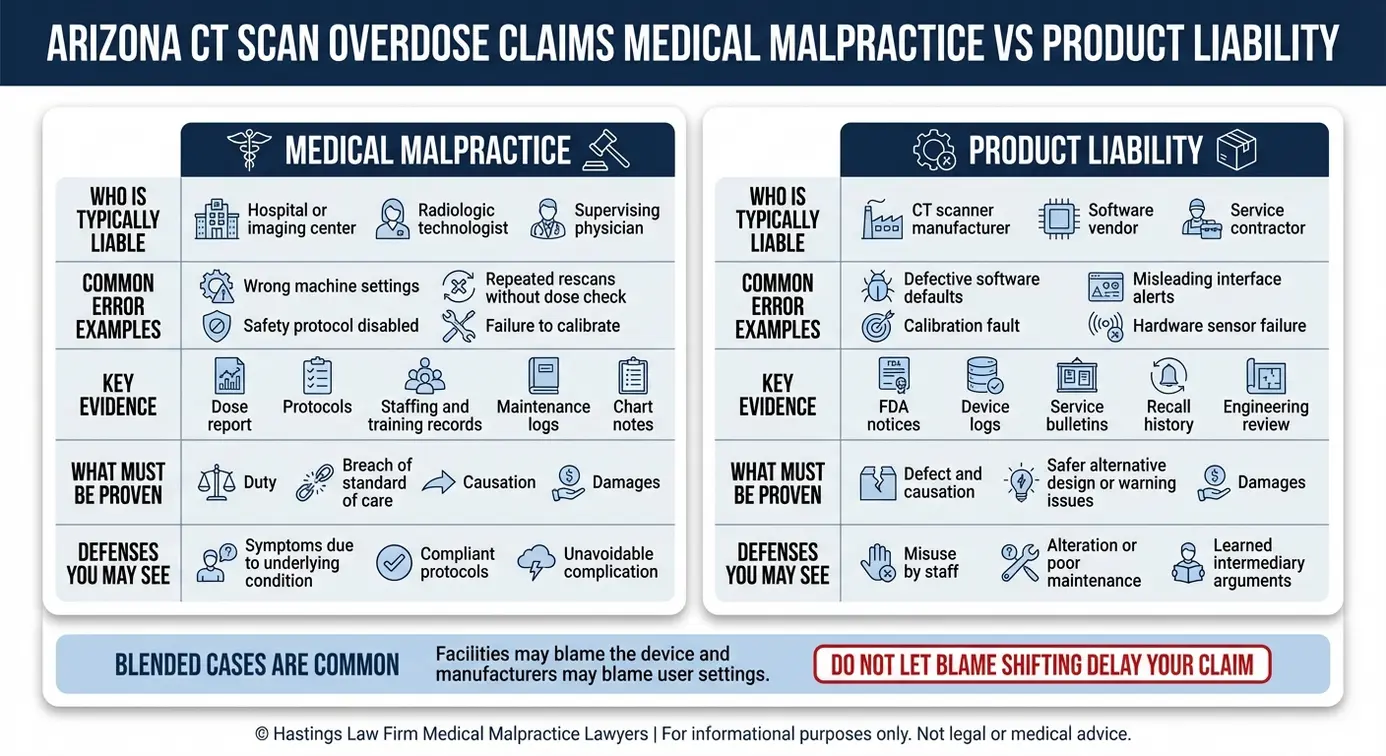
Liability for a radiation injury may fall on the hospital for negligent oversight, the technologist for improper machine settings, or the manufacturer if the device contained a software defect or calibration error. In many cases, more than one party shares responsibility. Determining liability involves examining the standard of care, which is the level of care a competent medical professional should provide.
Technician error is one of the most common causes of CT radiation overdose. This can include disabling built-in safety protocols, manually overriding dose limits, or repeatedly scanning the same area to improve image clarity without accounting for dose accumulation. This is common in a brain perfusion CT (CT perfusion/CTP), a scan measuring blood flow, where repeated passes are necessary.
When a technologist fails to follow established imaging protocols, the facility that trained and supervised them may also bear responsibility. Arizona law requires a preliminary expert opinion in medical malpractice cases under A.R.S. § 12-2603. Working with a radiation negligence lawyer in Arizona who has access to qualified experts is important from the start of your claim.
The FDA’s White Paper on Reducing Unnecessary Radiation Exposure from Medical Imaging highlights how defective CT scanners can cause harm. Machines from manufacturers like GE Healthcare and Toshiba were involved in FDA investigations into overexposures at multiple hospitals, though the investigations focused on whether equipment design or operator error was responsible. Product liability applies when the equipment itself, not the operator, caused the overdose.
Institutional negligence covers situations where a hospital or imaging center failed to maintain, calibrate, or update its equipment on schedule. It also includes failures in staff training and quality assurance programs. Our legal team includes former defense attorneys who understand how hospitals and manufacturers build their arguments.
| Factor | Medical Malpractice | Product Liability |
|---|---|---|
| Defendant | Hospital, imaging center, or technologist | CT scanner manufacturer (e.g., GE Healthcare, Toshiba) |
| Basis of Claim | Failure to follow standard imaging protocols | Defective design, software error, or calibration defect |
| Key Evidence | Dose reports, operator logs, training records | FDA recalls, engineering analysis, software logs |
| Legal Standard | Breach of standard of care | Strict liability or negligence in design/manufacture |
The Hastings Law Firm Difference
Results matter, but what truly sets us apart is how we achieve them. Every verdict, every settlement, and every Arizona courtroom victory comes from one guiding promise: To treat each client’s fight for justice as if it were our own.
This balance of skill, experience, and empathy reflects our core philosophy that justice should not only compensate the injured, but also make healthcare safer nationwide.

Investigating Radiation Levels and Securing Evidence
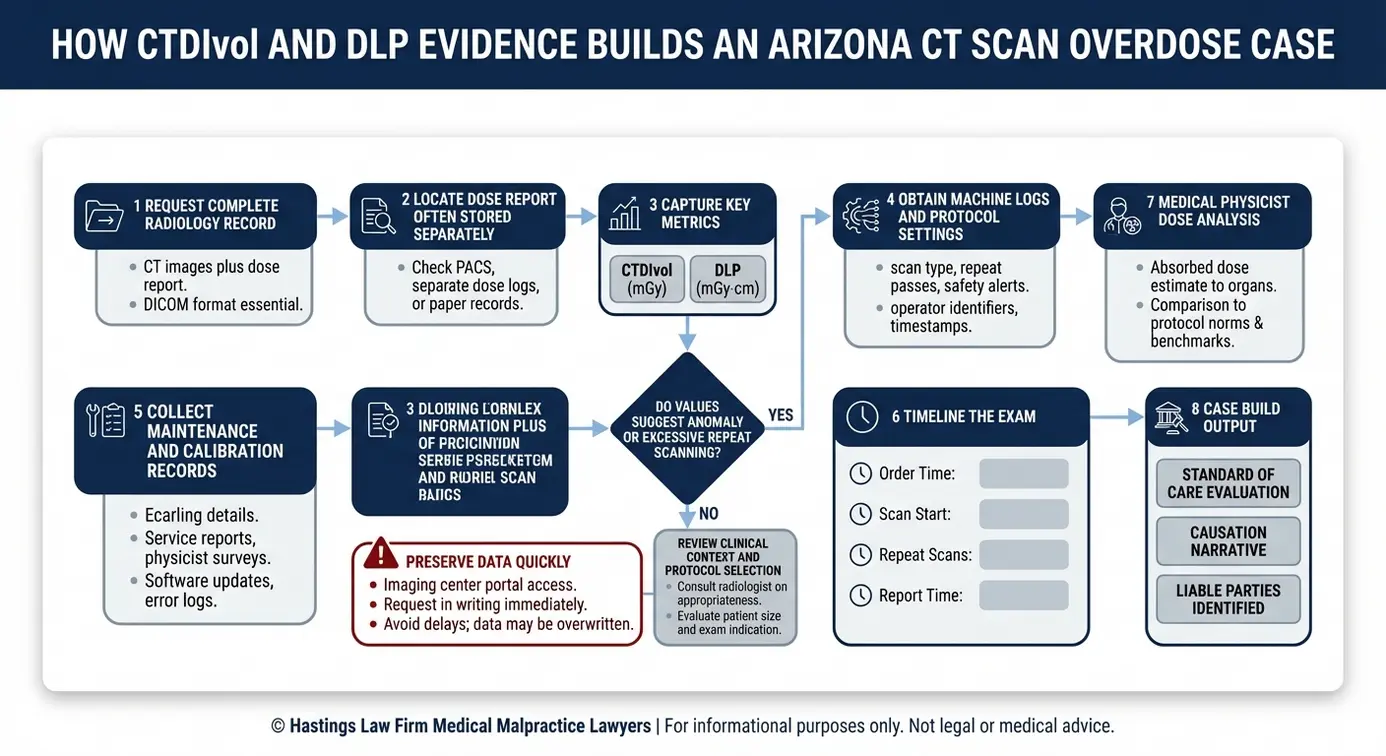
Proving a radiation overdose requires securing the specific dose report generated by the scanner, then comparing the recorded CTDIvol (Computed Tomography Dose Index volume, a measure of radiation output per scan rotation) and DLP (Dose Length Product, which accounts for the total radiation delivered across the scanned area) values against established safety standards. Dose reports provide a technical summary of the radiation levels used during your scan.
The dose report, sometimes referred to as a dose sheet, is often the most important piece of evidence, and one of the hardest to obtain. Unlike the diagnostic images your doctor reviews, the dose report is a separate technical document stored in the scanner’s system which contains dose indices vital for review.
It is not always included in your medical records automatically. It must be specifically requested, and if the machine is serviced, updated, or replaced, that data can be lost. Early preservation is critical. An FDA investigation into similar device failures underscores the need for this data.
Once the report is secured, we work with medical physicists who calculate the actual absorbed dose based on the machine’s logs and settings. As explained in Optimization of CT Radiation Dose: Insight into DLP and CTDI (Future Health Journal), these measurements allow experts to determine exactly how much radiation your body received and whether it fell within acceptable diagnostic ranges. An Arizona CT scan lawsuit attorney can initiate evidence preservation requests before this data disappears.
Understanding Diagnostic Radiation Dose Measurements
Medical physicists use units like the millirem to calculate how much radiation a person’s body receives during a procedure. A standard head CT might deliver an effective dose of roughly 100 to 200 millirem (mrem), a unit measuring effective radiation dose. But in documented overdose cases, patients have received doses many times higher than intended, sometimes up to eight times the normal amount in a single session. Measuring radiation in units like millirem helps experts determine the extent of tissue exposure.
At those levels, the risk shifts from routine diagnostic exposure to direct tissue injury. Prolonged or repeated overdose can contribute to genetic damage at the cellular level, increasing the likelihood of cancer and tumors over time. The CTDIvol (radiation output) and DLP (total dose) values on the dose report are what allow our experts to distinguish a properly administered scan from a negligent one.
Contact the Arizona Healthcare Malpractice Attorneys at Hastings Law Firm Today for Help
If you or a family member experienced radiation burns, hair loss, or other unexplained symptoms after a CT scan, those signs deserve a thorough investigation. Holding the responsible parties accountable, whether a hospital, a technologist, or an equipment manufacturer, requires a legal team that understands both the medicine and the technology involved.
Founded by Tommy Hastings, a board-certified trial attorney, Hastings Law Firm brings in-house medical staff, board-certified patient advocates, and a national network of experts in radiology and medical physics. As a dedicated Arizona CT scan radiation overdose lawyer, we prepare every case as if it will go to trial, which positions our clients for the strongest possible outcome at every stage.
We handle these cases on a contingency fee basis, so you pay no attorney fees or costs unless we secure a recovery. Contact us today for a free, confidential case evaluation. Let us help you find answers and understand your legal options.
Frequently Asked Questions About CT Scan Radiation Overdose in Arizona


This content was researched and written by the Hastings Law Firm editorial team, which includes attorneys, medical professionals, and experienced researchers. Our writing is informed by internal knowledge and practical experience, and we cross-check critical details against authoritative sources cited throughout. Every piece undergoes human-led fact-checking and legal review. Because legal and medical information can change, if you spot an error, please contact us. Learn more about our content standards and review process on our editorial policy page.

Tommy Hastings, founder of Hastings Law Firm, is a board-certified personal injury trial lawyer dedicated exclusively to healthcare injury cases. Since 2001, he has represented injured patients and families in litigation against major hospital systems, pharmaceutical companies, and negligent healthcare providers nationwide. He has handled numerous high-profile cases that have drawn national media attention and resulted in multi-million dollar recoveries. He draws on that experience in his writing, helping readers understand how these cases work and what options may be available to them.
