


Arizona Cryotherapy Center Malpractice Lawyer
Written by: Hastings Law Firm | Reviewed by: Tommy Hastings | Updated: July 27, 2026
Cryotherapy injuries can be sudden and severe, especially when equipment fails, staff are not properly trained, or safety protocols are ignored. Whole body cryotherapy uses extremely low temperatures and nitrogen, so mistakes can lead to serious burns, frostbite, nerve damage, and oxygen deprivation. Liability often depends on whether the harm came from operator error, poor supervision, inadequate screening, or a defective machine, and waivers may not block claims tied to gross negligence or undisclosed risks. If you or a loved one were harmed or worse due to cryotherapy center malpractice in Arizona, contact Hastings Law Firm for a free, confidential case review.

Top Rated Legal Representation for Cryotherapy Injuries in Arizona
What You Should Know About Medical Cryotherapy Injury Claims in Arizona:
- Life altering harm can occur when cryotherapy sessions are not properly supervised because nitrogen exposure and extreme cold can cause catastrophic injury.
- Recovery options can expand beyond the operator when a business failed to train or supervise staff because the facility may share responsibility for unsafe practices.
- A signed waiver may not prevent accountability when injuries stem from gross negligence, reckless misconduct, or defective equipment.
- Serious injury can be harder to prove when symptoms are not visible because nerve damage may require specialized testing to document.
- Disputes over fault can intensify when both operator error and machine malfunction are possible because each side may blame the other.
- Severe burns can result within seconds when moisture is present because wet clothing can freeze and accelerate tissue damage.
- Oxygen deprivation risk can rise quickly in poorly ventilated settings because nitrogen gas can displace oxygen without warning.
- Claim value can change significantly based on the extent of tissue damage because deeper frostbite is linked to more permanent impairment.
- Options can be limited if time is lost because Arizona law places a time limit on filing personal injury claims.
- Critical evidence can disappear quickly because video footage and device logs may be overwritten, deleted, or altered.

A Healthcare Focused Law Firm
Cryotherapy injuries can be sudden and severe, leaving you with painful burns, nerve damage, or worse, and very few answers about what went wrong. If you or a loved one was harmed during a cryotherapy session at an Arizona medspa or wellness center, you deserve to know whether negligence played a role. You also deserve a legal team that understands both the medicine and the law behind these cases.
At Hastings Law Firm, we focus exclusively on medical malpractice. Founded by board-certified trial lawyer Tommy Hastings, our firm handles these complex cases with a trial-ready perspective. Tommy is a 2025 inductee into the American Board of Trial Advocates (ABOTA), an elite invitation-only organization for trial lawyers.
Our team includes in-house nurses, former defense attorneys, and board-certified trial lawyers who know how to investigate cryotherapy injuries and hold the responsible parties accountable. If you are looking for an Arizona cryotherapy center malpractice lawyer, we are here to help. Contact us for a free, confidential case evaluation to learn what your options are.
Severe Injuries Caused by Negligent Cryotherapy Administration
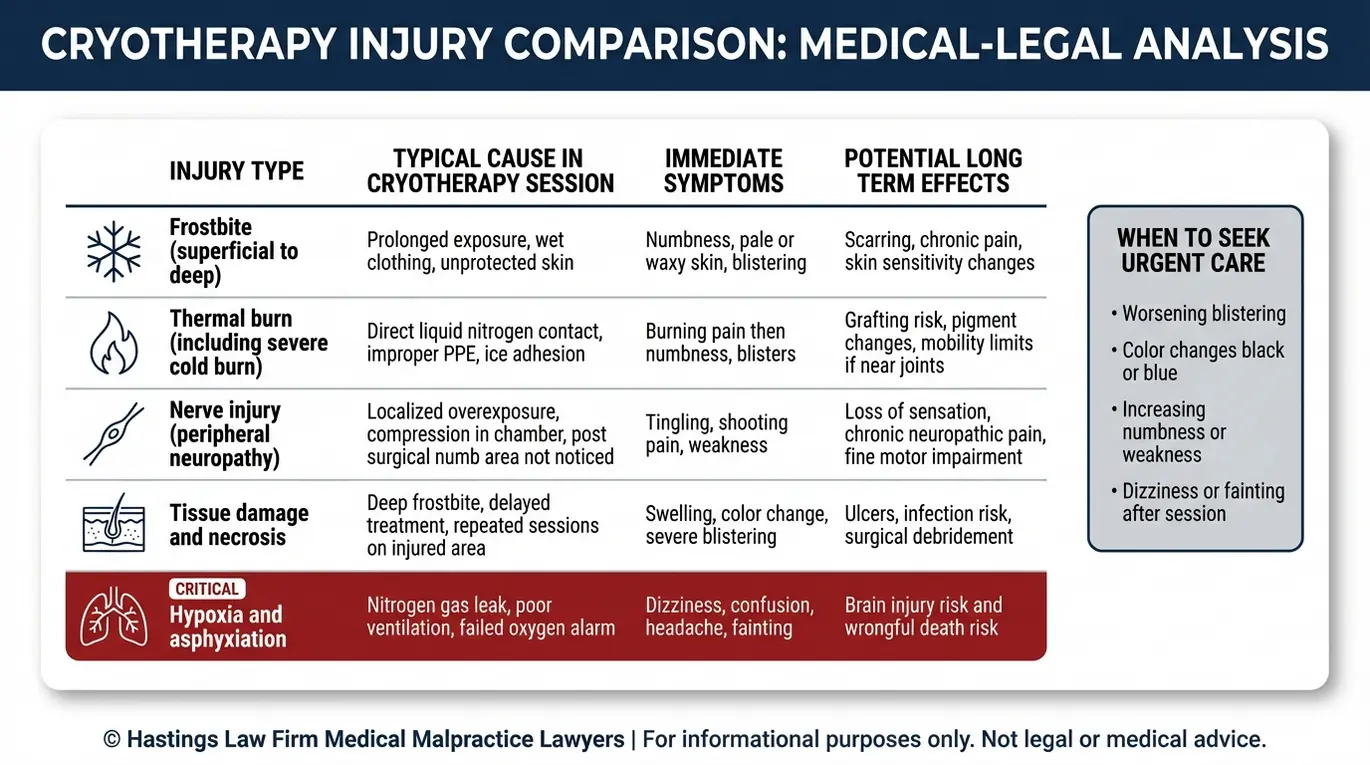
Cryotherapy negligence typically results in severe thermal burns, frostbite, permanent nerve damage, and in extreme cases, asphyxiation caused by nitrogen gas leaks. These are not minor side effects of feeling cold. They are preventable injuries that occur when equipment fails, operators make mistakes, or safety protocols are ignored.
Whole body cryotherapy (WBC), a treatment that exposes the body to extremely low temperatures using liquid nitrogen or nitrogen gas, has grown popular in medspas and recovery centers across Arizona. During a session, the patient enters a chamber cooled to temperatures between negative 200 and negative 300 degrees Fahrenheit for up to three minutes. When performed correctly and supervised properly, the session ends without incident. But when something goes wrong at these extremes, the damage can be catastrophic.
A cryotherapy injury attorney can help you understand whether the harm you suffered was caused by someone else’s failure to follow basic safety standards.
How Frostbite Escalates During Cryotherapy
Frostbite, the freezing of skin and underlying tissue caused by extreme cold exposure, does not always announce itself with sharp pain. In a cryotherapy chamber, frostbite can develop in seconds rather than minutes, and it progresses through distinct stages of severity.
First-degree frostbite affects the outer layer of skin, causing redness, numbness, and a stinging sensation after rewarming. Second-degree frostbite reaches deeper, producing blisters filled with clear or milky fluid within 12 to 36 hours. Third-degree frostbite destroys the full thickness of the skin, leading to blood-filled blisters, blackened tissue, and long-term scarring. Fourth-degree frostbite extends into muscle, tendon, and bone, and may require amputation.
In cold therapy lawsuits, the degree of frostbite directly affects the value of the claim because it determines the extent of permanent damage, the cost of treatment, and whether the patient will face lifelong limitations.
| Injury Type | Mechanism | Long-Term Symptoms |
|---|---|---|
| First-degree frostbite | Surface skin freezing | Temporary numbness, skin sensitivity to cold |
| Second-degree frostbite | Deeper tissue freezing with blistering | Chronic pain, discoloration, cold intolerance |
| Third-degree frostbite | Full-thickness skin destruction | Permanent scarring, tissue loss, recurring infections |
| Fourth-degree frostbite | Freezing of muscle, tendon, or bone | Possible amputation, permanent disability |
| Third-degree burns | Prolonged contact with cryogenic surfaces or wet clothing | Nerve destruction, contracture scarring, skin grafts |
| Peripheral nerve damage | Sustained cold exposure to nerve pathways | Loss of sensation, chronic neuropathic pain, motor weakness |
| Hypoxia / Asphyxiation | Oxygen displacement by nitrogen gas | Brain injury, organ damage, death |
Neurological Impact and Nerve Damage Claims
Not every cryotherapy injury leaves a visible scar. Nerve damage from prolonged cold exposure can cause peripheral neuropathy, a condition where damaged nerves in the hands, feet, or limbs send faulty pain signals, cause numbness, or lose function entirely. Patients may experience burning sensations, tingling, or muscle weakness weeks after the session. Because these symptoms are invisible on the surface, they can be difficult to document without specialized testing.
These nerve damage claims require an experienced cryotherapy injury attorney who understands how to connect the clinical evidence to the legal standard of proof. Under A.R.S. § 12-563, a patient in an Arizona negligence case must prove that the defendant’s conduct fell below the accepted standard of care and that this failure directly caused the injury.
Systemic Risks: Hypoxia and Asphyxiation
The most dangerous cryotherapy injuries are not burns or frostbite. They involve breathing. Whole body cryotherapy chambers use liquid nitrogen to achieve extreme temperatures, and as the nitrogen evaporates, it displaces oxygen in the surrounding air. If ventilation is inadequate or the chamber malfunctions, oxygen levels can drop to dangerous concentrations in seconds.
Hypoxia, a condition where the body does not receive enough oxygen, can cause confusion, loss of consciousness, and brain damage. In enclosed or poorly ventilated spaces, nitrogen gas accumulation can lead to asphyxiation without any warning. The Department of Energy’s report on Oxygen Deficient Atmosphere Hazards documents how rapidly oxygen-depleted environments can become fatal, particularly when nitrogen gas is involved. These same principles apply to cryotherapy chambers where liquid nitrogen is the cooling agent.
Post-Surgical Desensitization Risks
Some patients seek cryotherapy to reduce inflammation after surgery. This creates a specific and often overlooked danger. Post-surgical desensitization, the reduced ability to feel pain in areas affected by recent surgery, anesthesia, or nerve disruption, can mask the early warning signs of frostbite. The patient may not feel the burning or stinging that would normally prompt them to alert an operator or end the session.
By the time the tissue damage becomes apparent, it may have already progressed to second- or third-degree frostbite. Operators have a responsibility to screen for recent surgical history and adjust protocols accordingly. When they fail to do so, the resulting injuries may support a cold therapy lawsuit.
Using EMG Testing to Prove Nerve Damage
When a cryotherapy injury causes nerve damage that cannot be seen on the skin’s surface, objective medical testing becomes essential to your case. Electromyography (EMG), a diagnostic procedure that measures the electrical activity of muscles and the nerves controlling them, can detect peripheral neuropathy even when there are no visible wounds.
EMG testing provides the kind of hard, measurable evidence that expert witnesses can use in court to demonstrate the nature and severity of the nerve injury. Without it, defense attorneys may argue that the patient’s symptoms are exaggerated or unrelated to the cryotherapy session. Our in-house medical staff works closely with treating physicians to ensure the right diagnostic tests are ordered early, preserving the evidence needed to build a strong claim.
Establishing Liability and Standard of Care for Arizona Cryotherapy Centers
Arizona cryotherapy centers owe a duty of care to ensure equipment is maintained, staff is trained, and sessions are monitored; failure to meet these standards constitutes malpractice. Liability refers to the legal responsibility for an injury. When a center fails to meet these standards and a patient is injured, it may constitute negligence under Arizona law. The standard of care acts as the benchmark for how a reasonably competent professional should have performed the procedure.
What “Duty of Care” Means for Medspas and Wellness Centers
Every healthcare or wellness provider in Arizona has a legal obligation to act with reasonable care toward their patients. For a cryotherapy center, this duty of care, the legal standard requiring providers to deliver treatment consistent with what a reasonably competent professional would provide in similar circumstances, covers everything from pre-session screening to the moment the client exits the chamber.
The challenge with cryotherapy is that medspas and wellness centers often operate in a gray area of regulation. They are not traditional hospitals, and their staff may not hold medical licenses. However, the services they provide carry real medical risks, including severe cold burns and asphyxiation. The duty of care requires that these facilities implement specific safety protocols, such as verifying the patient’s medical history for contraindications like Raynaud’s disease.
Operators must also continuously monitor the patient’s physical state during the session. If an operator is looking at their phone or leaves the room, they breach this duty. An Arizona cryotherapy center malpractice lawyer examines whether the facility met its duty of care based on what a reasonable operator, with proper training and functioning equipment, would have done.
The Operator vs. the Business Entity
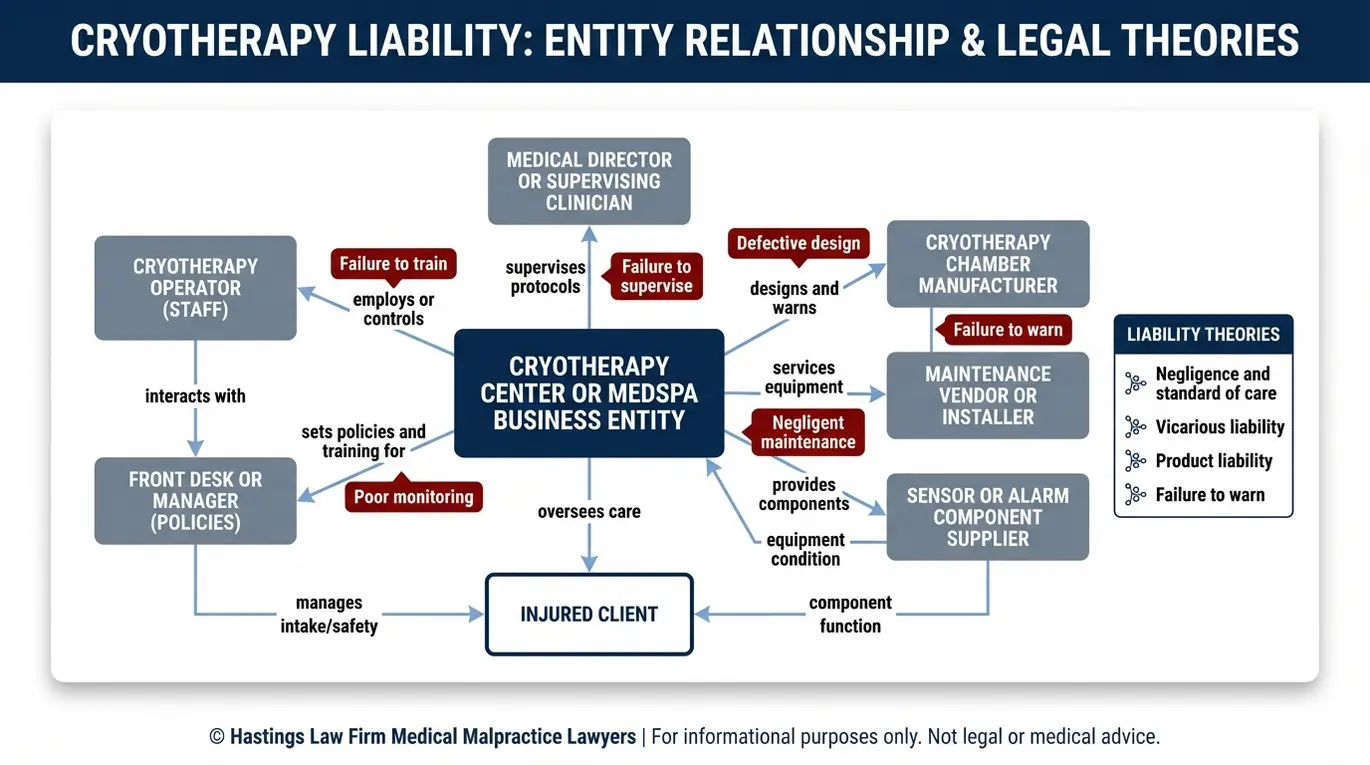
Cryotherapy injuries often involve multiple layers of responsibility. The individual operator who ran the session may have made a major mistake, but the business that hired, trained, and supervised that person may bear equal or greater responsibility. Negligent hiring or supervision occurs when a facility fails to provide adequate training on nitrogen safety or emergency procedures.
Negligent hiring and supervision are distinct legal claims. If a spa hires an employee with no background in cryotherapy and allows them to operate dangerous machinery without certification or oversight, the business is directly liable for that administrative failure. We investigate the training logs and employment records to determine if the staff members were qualified to perform the treatments they administered.
Arizona law allows injured patients to pursue claims against the business entity itself, not just the individual employee. If a cryotherapy technician left the room during a session or failed to ensure the client’s clothing was completely dry, the center itself can be held liable for that failure. We also look at whether the facility had a qualified medical director overseeing operations and whether written safety protocols existed.
A Bad Outcome Is Not Always Malpractice
Not every cryotherapy injury is the result of negligence. Cold therapy carries inherent risks, and some discomfort or mild skin irritation may fall within the range of expected outcomes. The legal question is whether the injury resulted from a breach of the standard of care or from a known risk that the patient accepted.
To establish a valid claim, we must show four things: that the center owed you a duty of care, that they breached that duty through action or inaction, that the breach directly caused your injury, and that you suffered actual damages as a result. Establishing causation, the direct link between the provider’s breach and the specific injury suffered, is often the most complex part of litigation. We must prove that your burns or nerve damage would not have occurred if the standard of care had been followed.
This framework applies whether the claim is styled as a medspa malpractice case, a personal injury lawsuit, or a product liability action. Our team investigates each case by reconstructing the timeline of events, reviewing session logs and intake forms, and analyzing equipment maintenance history. We also consult with medical experts who can testify about what the standard of care required. This process allows us to identify clear standard of care violations, distinguishing between an unfortunate outcome and a preventable one.
Vicarious Liability and Multi-Party Claims
In many cryotherapy injury cases, liability does not rest with a single person. The operator, the business owner, the medical director (if one exists), and even the equipment manufacturer may each bear some responsibility. Our liability investigation maps every relationship to determine who owed a duty to the patient and who failed.
Under the doctrine of respondeat superior, an employer is vicariously liable for the negligent acts of its employees committed within the scope of their employment. This means that if a technician makes an error, the medspa answers for it. However, if the medical director is an independent contractor, establishing their liability may require a different legal approach.
If an operator was never trained on nitrogen safety, the center that hired them may be negligent in its supervision. If the medical director approved protocols that skipped pre-session screening, that physician may also carry liability. And if the machine itself malfunctioned, a product liability claim against the manufacturer may run alongside the standard of care violations against the facility. An experienced Arizona cryotherapy center malpractice lawyer will identify every responsible party early in the case. This approach maximizes the potential for full compensation while ensuring accountability across the board.
The Hastings Law Firm Difference
Results matter, but what truly sets us apart is how we achieve them. Every verdict, every settlement, and every Arizona courtroom victory comes from one guiding promise: To treat each client’s fight for justice as if it were our own.
This balance of skill, experience, and empathy reflects our core philosophy that justice should not only compensate the injured, but also make healthcare safer nationwide.

Proving Operator Error and Failure to Supervise
Operator error occurs when cryotherapy staff fail to time sessions accurately, do not provide dry protective clothing, or leave the patient unattended during nitrogen exposure. Operator error is often preventable and forms the basis of many cryotherapy negligence claims in Arizona.
Wet Clothing: The Leading Cause of Cryogenic Burns
The single most common cause of severe cryotherapy burns is moisture. When a patient enters a cryotherapy chamber wearing damp socks, sweaty clothing, or skin that has not been thoroughly dried, the moisture freezes almost instantly on contact with the nitrogen-cooled air. This creates a direct thermal bridge between the cryogenic environment and the skin, dramatically accelerating tissue damage.
A wet clothing-related cryogenic burn, an injury occurring when residual moisture on skin or fabric freezes during exposure to cryogenic temperatures, causes the material to bond to the skin and produce deep burns in seconds rather than minutes. Because liquid nitrogen lowers air temperature so rapidly, even a small amount of sweat can turn into ice crystals that destroy the epidermis and dermis. Responsible operators are trained to check that the patient is completely dry, wearing approved protective gear, and free of any moisture before the session begins. When they skip this step, the result can be third-degree burns that require skin grafts and months of recovery.
Timing Errors and the Three-Minute Safety Limit
Whole body cryotherapy sessions are designed to last no more than three minutes. Three-minute safety limit violations, even by 30 to 60 seconds, can cause the difference between mild cold exposure and serious frostbite or tissue damage.
Timing errors happen for several reasons: the operator may become distracted, the timer may malfunction, or the session may be intentionally extended based on a misguided belief that longer exposure produces better results. Regardless of the cause, exceeding the maximum safe duration of a cryotherapy session represents a clear breach of the standard of care. Our team reviews session logs, timestamps, and any available video footage to determine exactly how long the patient was exposed.
Failure to Supervise the Session
A cryotherapy operator should never leave a patient unattended in a chamber filled with nitrogen gas. The patient cannot open the chamber from the inside in most designs, and if they experience a medical emergency, panic, or frostbite, there may be no way to self-rescue.
A failure to supervise the session, even briefly, represents a serious failure by the facility. We investigate whether the facility had a policy requiring continuous supervision and whether the operator followed that policy during your session. Continuous visual contact allows the operator to spot signs of distress, such as slumping (indicating hypoxia) or expressions of severe pain, and engage the emergency stop immediately.
Head-Above-Fog Height Adjustment
In a standard whole body cryotherapy chamber, the patient’s head is meant to remain above the top of the unit, above the fog line where nitrogen gas pools. Nitrogen gas pooling, the accumulation of heavier-than-air nitrogen vapors at lower elevations within the chamber, creates an oxygen-depleted zone. If the platform inside the chamber is not properly adjusted for the patient’s height, their head can drop below this fog line, exposing them to dangerously low oxygen levels.
This is not a minor oversight. Failure to adjust the platform is a direct operator error that can lead to hypoxia, a condition where insufficient oxygen reaches the brain and other organs, causing confusion, loss of consciousness, and potentially fatal oxygen deprivation.
Red Flags That May Indicate Cryotherapy Operator Negligence
If any of the following occurred during your session, it may indicate that the operator or facility failed to meet the standard of care:
- You entered the chamber with damp skin, wet socks, or sweaty clothing and no one checked
- The session lasted longer than three minutes
- The operator left the room or was not visibly present during the session
- Your head dropped below the top of the chamber during the session
- No pre-session screening was conducted regarding recent surgeries, skin conditions, or circulatory disorders
- The facility had no visible emergency shut-off procedure posted
- You were not provided with protective gloves, socks, or ear coverings
- No alarm mechanism or automatic shut-off activated when the session exceeded normal parameters
OSHA Nitrogen Handling Standards
While specific medspa regulations for cryotherapy may be limited in Arizona, federal workplace safety standards still provide a strong framework for evaluating negligence. OSHA establishes clear guidelines for the storage and handling of nitrogen gas, including requirements for ventilation, oxygen level monitoring, and emergency response procedures in areas where oxygen displacement can occur.
These standards are directly relevant to cryotherapy centers because they define safe handling practices for the dangerous substances used in treatment. If a facility stores and dispenses liquid nitrogen without proper ventilation, oxygen sensors, or emergency protocols, those omissions can be used as evidence that the center failed to meet a reasonable standard of care. Our cryotherapy injury attorneys use OSHA nitrogen handling standards as a benchmark when evaluating whether a facility’s safety mechanisms and practices were adequate to prevent hypoxia and other injuries.
Product Liability Claims for Defective Cryotherapy Machines
If a cryotherapy chamber malfunctions due to a frozen valve, defective sensor, or failed automatic shut-off, the manufacturer may be strictly liable for the resulting injuries. Product liability claims in cryotherapy cases focus not on what the operator did wrong, but on whether the machine itself was unreasonably dangerous.
User Error vs. Machine Failure
One of the first questions in any cryotherapy injury case is whether the harm was caused by the person operating the machine or by the machine itself. If the operator set the temperature too low, failed to monitor the timer, or ignored safety protocols, the medspa bears responsibility. But if a machine failure occurred, such as a valve freezing or a temperature sensor giving a false reading, the defect may trace back to the manufacturer.
In many cases, both factors contribute. A defective machine and an untrained operator can create a combined failure that dramatically increases the risk of serious injury. Manufacturers often try to blame the operator for misuse, while the medspa blames the machine for malfunctioning. That is why our team investigates both angles in every cryotherapy case, pursuing the center for standard of care violations and the manufacturer for product defect claims when the evidence supports it.
Under A.R.S. § 12-681, Arizona defines the legal framework for product liability actions, including claims based on manufacturing defects, design defects, and failure to warn. A defective cryotherapy machine lawyer will evaluate your case under these statutes to determine the strongest path forward.
Common Cryotherapy Machine Defects
Product liability claims in cryotherapy cases typically involve one or more of the following equipment failures:
- Frozen valves that cause continuous, uncontrolled release of liquid nitrogen into the chamber
- Defective temperature sensors that display inaccurate readings, allowing the chamber to reach unsafe temperatures without triggering alarms
- Failed automatic shut-off systems that do not engage when the session exceeds the programmed time or temperature limit
- Malfunctioning oxygen sensors that fail to detect dangerous drops in oxygen levels inside or near the chamber
- Absent or defective alarm mechanisms that should alert the operator to abnormal conditions
- Marketing defects involving a failure to warn about specific contraindications, such as use after surgery or by patients with circulatory conditions, in the product labeling or operator manual
An oxygen sensor, a safety device designed to monitor air quality and detect falling oxygen levels, is critical for preventing asphyxiation. Similarly, an automatic shut-off, a fail-safe mechanism intended to stop nitrogen flow when safe limits are exceeded, must function perfectly every time. When these components fail, the machine becomes a trap.
Strict Liability and the Manufacturer’s Responsibility
Arizona product liability law allows injured patients to pursue claims against manufacturers under a strict liability theory. This means you do not have to prove that the manufacturer was careless. You need to show that the product was defective, that it was unreasonably dangerous when it left the manufacturer’s control, and that the defect caused your injury.
There are generally three types of product defects we look for: design defects, manufacturing defects, and marketing defects (failure to warn). A design defect means the machine was inherently unsafe even when manufactured correctly. A manufacturing defect occurs when a specific unit was built incorrectly. A marketing defect involves inadequate instructions or warnings about the risks.
This distinction matters because manufacturers often argue that the operator misused the machine. While misuse can be a defense, it does not eliminate liability if the product lacked adequate safety mechanisms or if the defect would have caused harm regardless of how the machine was operated. Our team works with biomedical engineers and product safety experts to inspect the specific unit involved, review its maintenance and calibration history, and determine whether the defect originated in the design, manufacturing, or labeling process. A product liability lawsuit can run alongside a negligence claim against the cryotherapy center. This approach gives injured patients the best opportunity to recover compensation from every party that contributed to the harm.
Overcoming Liability Waivers and Assumption of Risk Defenses
A liability waiver does not protect a cryotherapy center from lawsuits involving gross negligence, reckless misconduct, or defective equipment. If you signed a waiver before your session, you may still have a valid claim.
What a Waiver Actually Covers
Most cryotherapy centers require clients to sign a liability waiver before their first session. These documents typically include language about “inherent risks” and “assumption of risk,” and they are designed to discourage injured patients from seeking legal recourse. But the legal reality is more limited than the waiver suggests. A cryotherapy liability waiver generally only covers inherent risks that are natural to the procedure itself.
Under Arizona law, a waiver can protect a business from liability for risks that are inherent to the activity. For cryotherapy, inherent risks might include temporary skin redness, mild discomfort from the cold, or brief numbness. These are expected side effects that a properly informed patient accepts when they step into the chamber.
A waiver that says “you accept all risks” does not legally encompass equipment malfunction, operator abandonment, or nitrogen asphyxiation.
Gross Negligence and Reckless Misconduct
Even in situations where a waiver might otherwise apply, Arizona courts have consistently held that waivers cannot excuse gross negligence. Gross negligence goes beyond a simple mistake. It involves conduct that demonstrates a conscious disregard for the safety of others.
If a cryotherapy center allowed an untrained employee to operate a nitrogen chamber, or if the facility knew its oxygen sensor was broken and continued running sessions anyway, those facts may support a claim for gross negligence that no waiver can bar. Proving gross negligence in Arizona often voids the waiver entirely, allowing the client to seek full damages.
Why “Failure to Warn” Can Void a Waiver
A waiver is only as strong as the information it discloses. A liability waiver is a legal document signed before treatment where a patient acknowledges certain risks. If the center failed to warn you about specific risks, such as the danger of entering the chamber with damp skin or the risk of oxygen depletion, the waiver may be unenforceable because you could not have meaningfully consented to risks you were never told about.
Distinguishing Inherent vs. Unforeseeable Risks
The legal distinction between inherent and unforeseeable risks is important in cryotherapy waiver disputes. A patient who signs up for a cryotherapy session reasonably expects to be cold. They do not reasonably expect the chamber’s valve to freeze open, flooding the unit with liquid nitrogen. They do not expect the operator to leave the room and miss the three-minute timer. And they do not expect oxygen levels to drop to the point of asphyxiation.
Inherent risks are the known, expected consequences of an activity performed correctly. Unforeseeable risks arise from negligence, equipment failure, or conditions the patient was never told about. A signed waiver generally covers the first category. It does not cover the second.
Arizona’s statute of limitations for personal injury claims is governed by A.R.S. § 12-542, which generally provides two years from the date of injury to file a lawsuit. If you believe your waiver may prevent you from filing a claim, consulting an Arizona cryotherapy center malpractice lawyer promptly is important to protecting your rights before time runs out.
How Our Medical Malpractice Team Investigates Your Case
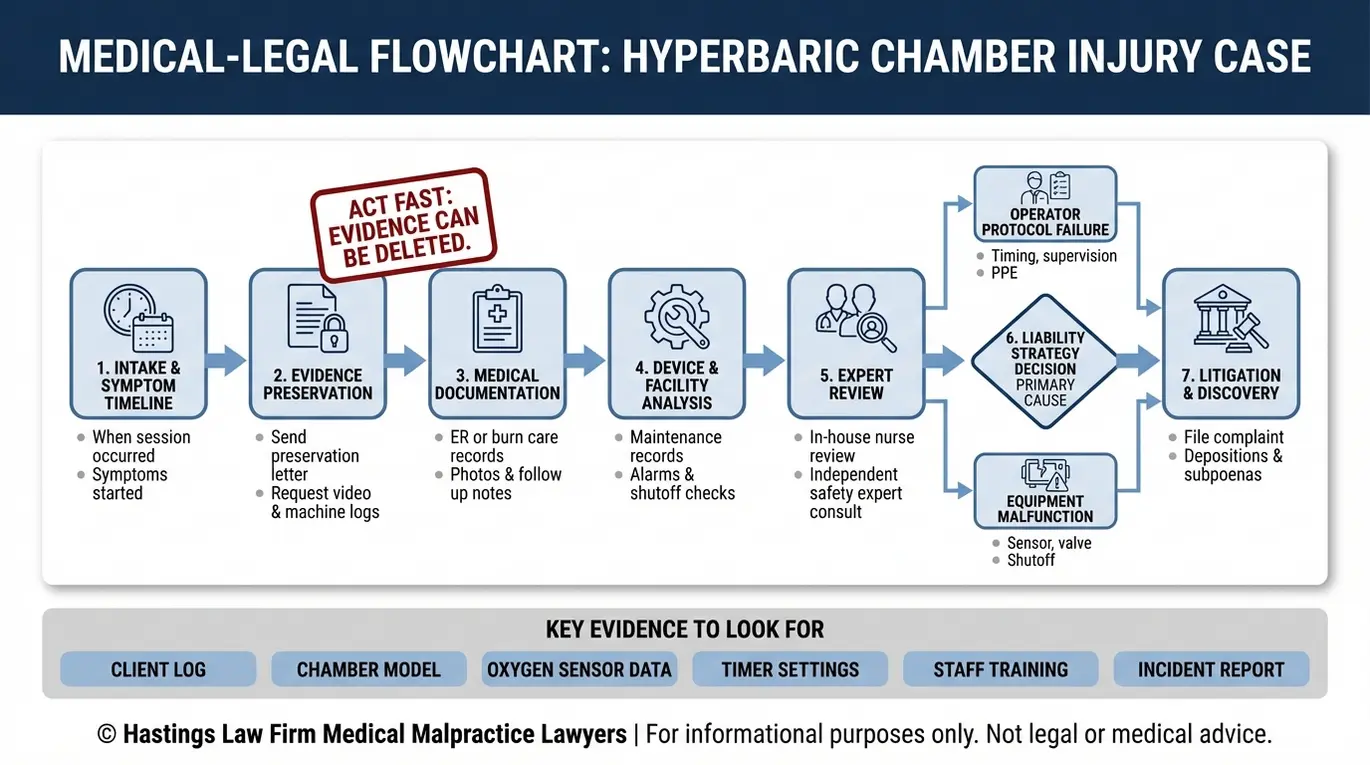
We utilize a comprehensive investigation process involving record acquisition, device log analysis, and expert medical review to build a compelling case for compensation. Every cryotherapy case we accept is prepared from day one as though it will go to trial.
Here is how we approach a cryotherapy injury investigation process:
Step 1: Immediate Evidence Preservation
The first priority is securing evidence before it disappears. We send a formal preservation letter to the cryotherapy center demanding that all security camera footage, machine data logs, session records, intake forms, and maintenance history be retained. Video footage is often overwritten within days, and machine logs can be deleted or altered. Acting quickly is essential to ensure that the digital footprint of the session is not erased by the facility.
Step 2: Medical Record Acquisition and Reconstruction
Our in-house nursing staff obtains and reviews all relevant medical records, including emergency room visits, specialist consultations, imaging studies, and EMG test results. They reconstruct the timeline of the injury, mapping what happened before, during, and after the cryotherapy session. This medical reconstruction identifies exactly where the standard of care was breached and how the breach caused the patient’s specific injuries. We look for inconsistencies between the facility’s incident report and the objective medical findings.
Step 3: Equipment and Device Log Analysis
For cases involving a potential machine malfunction, we work with biomedical engineers to inspect the cryotherapy unit, review its calibration records, and analyze its electronic logs. These logs can reveal whether the machine exceeded programmed temperature limits, whether the automatic shut-off engaged, and whether oxygen sensors were functioning during the session. This technical analysis is key for determining if the hardware itself played a role in the injury.
Step 4: Expert Medical Review and Causation Analysis
We consult with qualified medical experts, including burn specialists, neurologists, and pulmonologists, who can provide objective opinions on whether the injuries are consistent with negligent cryotherapy administration. Their testimony connects the breach of care to the specific harm you suffered, providing the necessary medical-legal foundation for the claim.
Step 5: Filing the Lawsuit and Managing Discovery
Once the investigation is complete and the evidence supports a claim, we handle all aspects of the litigation, from filing the complaint to managing depositions, written discovery, and pre-trial motions. Because our team includes former defense attorneys, we anticipate the strategies the other side will use and prepare accordingly.
Our approach to hiring a cryotherapy lawyer is simple: you focus on your recovery, and we handle the legal work.
Contact the Arizona Healthcare Malpractice Attorneys at Hastings Law Firm Today for Help
You should not have to bear the financial and physical burden of an injury caused by someone else’s carelessness. If you or a loved one suffered burns, frostbite, nerve damage, or worse during a cryotherapy session in Arizona, our team is ready to review what happened and explain your legal options.
Hastings Law Firm operates on a contingency fee basis, which means you pay no attorney fees or costs unless we recover compensation for you. Evidence in cryotherapy cases can disappear quickly, so reaching out early gives us the best chance to preserve the records and footage that matter most.
Contact us today for a free, confidential case evaluation. Let us help you find the answers you deserve.
Frequently Asked Questions About Cryotherapy Center Malpractice in Arizona


This content was researched and written by the Hastings Law Firm editorial team, which includes attorneys, medical professionals, and experienced researchers. Our writing is informed by internal knowledge and practical experience, and we cross-check critical details against authoritative sources cited throughout. Every piece undergoes human-led fact-checking and legal review. Because legal and medical information can change, if you spot an error, please contact us. Learn more about our content standards and review process on our editorial policy page.

Tommy Hastings, founder of Hastings Law Firm, is a board-certified personal injury trial lawyer dedicated exclusively to healthcare injury cases. Since 2001, he has represented injured patients and families in litigation against major hospital systems, pharmaceutical companies, and negligent healthcare providers nationwide. He has handled numerous high-profile cases that have drawn national media attention and resulted in multi-million dollar recoveries. He draws on that experience in his writing, helping readers understand how these cases work and what options may be available to them.
