


Arizona Infant Cortical Blindness Lawyer
Cortical visual impairment in infants is a neurological form of vision loss that can follow brain injury during pregnancy, labor, or delivery. Families may face lasting challenges when an infant has healthy eyes but cannot process visual information, especially when oxygen deprivation, trauma, or infection is involved. Early signs can be subtle, and diagnosis often relies on imaging and specialized testing. Understanding how CVI happens and how negligence is evaluated can help families make informed decisions. If you or a loved one were harmed or worse due to infant cortical blindness in Arizona, contact Hastings Law Firm for a free, confidential case review.

Last Updated: September 24, 2026
Committed Legal Advocacy for Families of Infants with CVI in Arizona
Learning that your infant has been diagnosed with cortical visual impairment can feel overwhelming, especially when you suspect the condition could have been prevented. You may have questions about what went wrong during labor or delivery, and you may not know where to turn for answers. That uncertainty is completely understandable.
At Hastings Law Firm, we focus exclusively on medical malpractice cases, including birth injuries that result in serious neurological harm. Our team of attorneys, in-house nurse consultants, and medical experts works together to investigate what happened and determine whether your child’s injury was caused by a preventable medical error.
If you are looking for an Arizona infant cortical blindness lawyer, we are here to help you understand your legal options. Contact us for a free, confidential case evaluation. You pay nothing unless we recover compensation for your family.

Understanding Cortical Visual Impairment and Medical Negligence
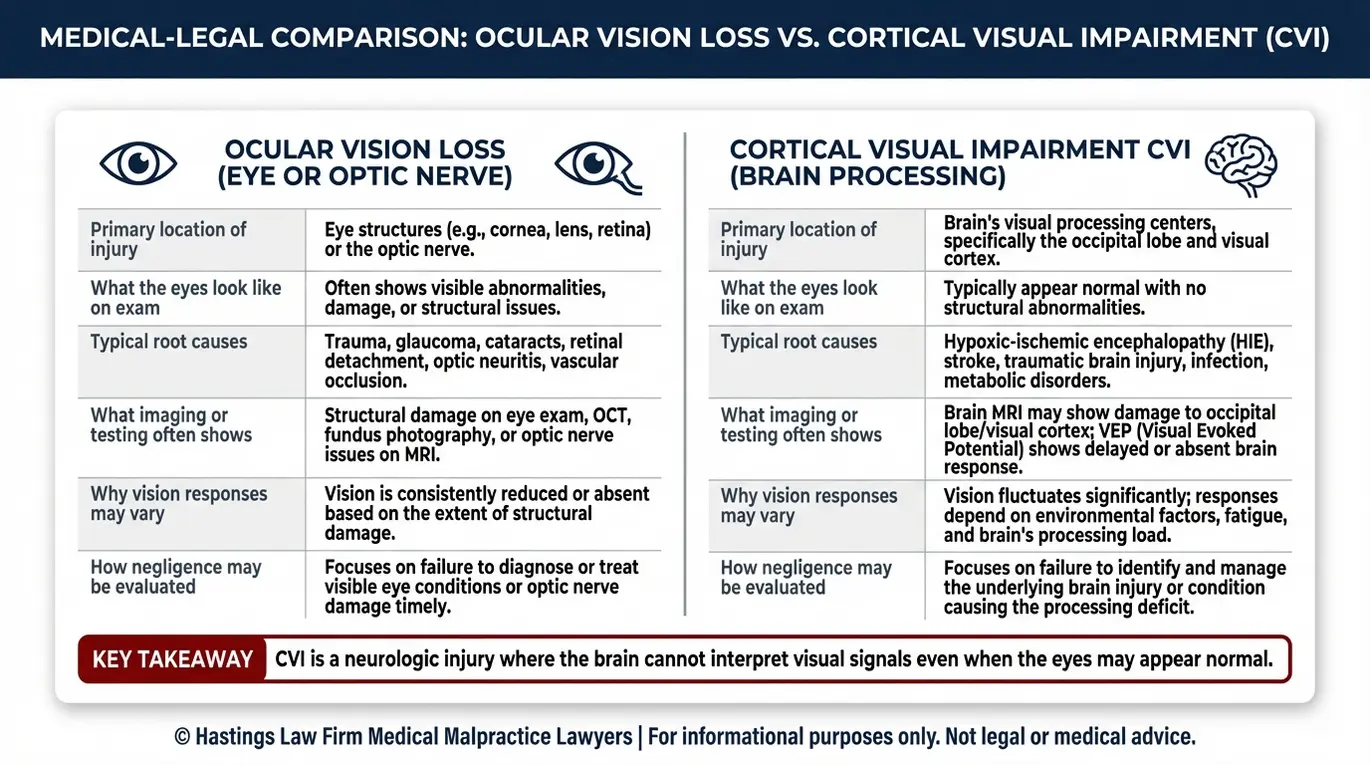
Cortical Visual Impairment (CVI), also known as cortical blindness, is a neurological form of vision loss caused by damage to the brain’s visual pathways rather than the eyes themselves. Unlike ocular blindness, where a structural defect in the eye prevents sight, CVI occurs when the brain cannot properly process the visual information the eyes are sending.
Because the damage involves the brain’s processing ability, children with CVI often have healthy eyes but cannot interpret what they see. The visual cortex, the region of the brain responsible for interpreting what we see, is located in the occipital lobe at the back of the skull. When this area sustains damage from oxygen deprivation, trauma, or infection, the result can be a neurological visual impairment.
The eyes may be structurally healthy and fully functional, but the brain cannot make sense of the signals they transmit. According to the National Eye Institute’s overview of Cerebral Visual Impairment, CVI is now the most common cause of visual impairment in children in developed countries.
CVI is often a secondary result of a broader brain injury. This means in many cases, the visual impairment did not happen in isolation. It followed a preventable event during pregnancy, labor, or delivery. As an Arizona infant cortical blindness lawyer, our role is to investigate whether medical negligence caused or contributed to the brain damage behind your child’s diagnosis.
How Birth Injuries and Lack of Oxygen Cause Cortical Blindness
Birth injuries leading to CVI typically involve oxygen deprivation or trauma that damages the visual centers of the infant’s brain during labor or delivery. When something disrupts the supply of oxygen or blood flow to the brain, even briefly, the consequences can be severe and permanent.
One of the most well-documented causes is hypoxic-ischemic encephalopathy (HIE), a condition where both oxygen deprivation (hypoxia) and restricted blood flow (ischemia) combine to destroy developing brain tissue. Brain damage leading to CVI is often permanent because neural pathways in the occipital lobe do not regenerate once destroyed by lack of oxygen. HIE can result from prolonged labor, umbilical cord complications, placental abruption, or delays in performing an emergency C-section.
Research published in Frontiers in Human Neuroscience on pre- and postnatal damage to retro-geniculate visual pathways confirms that injuries along these pathways can cause measurable retinal degeneration. This reinforces the connection between birth-related brain injury and lasting visual impairment.
Other causes of cortical blindness in infants include:
- Head trauma during delivery, particularly from the improper use of forceps or vacuum extraction devices
- Untreated infections such as meningitis or encephalitis, which are central nervous system infections that can damage brain tissue if not caught and treated quickly
- Hydrocephalus, a buildup of cerebrospinal fluid that places pressure on the brain, including the visual processing centers
Why the Visual Cortex Is Especially Vulnerable to Blood Supply Loss
The visual cortex is particularly vulnerable during oxygen deprivation because it depends on adequate blood flow and oxygen to function. When blood pressure drops or oxygen levels fall during labor or delivery, the brain’s visual processing areas can be severely affected.
Hypoxia, a shortage of oxygen, and ischemia, a decrease in blood supply, can cause lasting damage to the visual processing centers. This is why even a short period of oxygen loss during birth can cause permanent damage to these areas while other parts of the brain may appear less affected. For families working with an infant cortical blindness attorney in Arizona, understanding this vulnerability is an important part of building a strong case.
The Hastings Law Firm Difference
Results matter, but what truly sets us apart is how we achieve them. Every verdict, every settlement, and every Arizona courtroom victory comes from one guiding promise: To treat each client’s fight for justice as if it were our own.
This balance of skill, experience, and empathy reflects our core philosophy that justice should not only compensate the injured, but also make health care safer nationwide.

Recognizing the Signs and Diagnosing Infant CVI
Early signs of CVI include a lack of visual response to faces, a preference for peripheral vision, and gazing at lights, which are often confirmed through MRI scans and visual evoked potential tests.
CVI can be difficult to identify in very young infants because the eyes themselves may look completely normal. Parents and pediatricians should watch for behavioral markers that suggest the brain is not processing visual input correctly. Research published in Frontiers in Human Neuroscience on the implications of CVI on life and learning highlights how early identification shapes long-term outcomes.
Common signs and diagnostic steps to discuss with your child’s doctor include:
- Staring at lights or bright objects for extended periods (light gazing)
- Little or no eye contact with caregivers
- Better visual response to objects in peripheral vision rather than directly ahead
- Visual fatigue, where the child “shuts down” visually in busy environments
- Variable visual responses from one day to the next
- MRI imaging to identify structural damage to the occipital lobe, the brain region that processes vision
- Visual evoked potential (VEP) testing, which measures the brain’s electrical response to light stimulation, providing objective data about how well the visual cortex is functioning
Validated tools such as the CVI Range assessment, studied for reliability in clinical research published by PubMed Central, can help clinicians track a child’s functional vision over time. CVI remains the leading cause of permanent visual impairment in children, making early and accurate diagnosis essential for accessing treatments like visual stimulation therapy or seizure medications and for supporting any future legal claim.

Proving Malpractice in Arizona Cortical Blindness Cases
Proving malpractice requires demonstrating that a healthcare provider breached the accepted standard of care during pregnancy or delivery, directly causing the brain injury that resulted in CVI. In Arizona, medical negligence occurs when a provider deviates from the accepted standard of care, resulting in patient harm. This means your legal team must establish four connected elements.
The first element is duty: the doctor or medical team owed your child a professional obligation to provide competent care. The second is breach: they failed to meet the standard of care, which is the level of treatment a reasonably competent provider would have delivered under similar circumstances. The third is causation: that specific failure directly caused or contributed to the brain damage. And the fourth is damages: your child suffered measurable harm as a result.
Each of these elements requires support from qualified medical experts. Under Arizona Revised Statutes § 12-2604, expert witnesses in medical malpractice actions must meet specific qualifications, including active practice or teaching in the relevant specialty. An OB/GYN or maternal-fetal medicine specialist may testify about errors like failure to monitor fetal heart rate patterns, mismanagement of Pitocin, or delays in performing a C-section. A pediatric neurologist can then connect those errors to the brain damage that caused CVI.
As an Arizona cortical blindness lawyer, we work with our in-house nursing staff and a national network of medical experts to reconstruct the timeline of care, identify where the standard was violated, and build the evidence needed to prove causation.

Calculating Damages for a Lifetime of Vision Loss
Compensation in CVI cases covers lifelong medical expenses, specialized therapies, adaptive technology, and noneconomic damages for the child’s loss of quality of life. Because CVI is a permanent condition, the financial impact extends across your child’s entire lifetime.
Economic damages account for the measurable costs your family will face. These may include:
| Category | Examples |
|---|---|
| Ongoing therapies | Occupational therapy, physical therapy, speech therapy, visual stimulation therapy |
| Medical care | Neurological follow-ups, seizure medications, specialist visits |
| Education | Specialized schooling, assistive technology, one-on-one instruction |
| Home and daily living | Home modifications, adaptive devices, potential full-time caregiving |
Noneconomic damages address the harm that cannot be assigned a receipt. This includes your child’s pain and suffering, loss of enjoyment of life, and the emotional toll on your family.
To accurately project these costs, we work with life care planners who build detailed, evidence-based plans estimating expenses 50 or more years into the future. The standards and methodology for these projections are outlined by the Journal of Life Care Planning’s Practitioner’s Toolkit. As an Arizona birth injury attorney for cortical blindness cases, we make sure every category of loss is documented and supported so that your child’s future needs are fully accounted for.
Contact the Arizona Birth Injury Attorneys at Hastings Law Firm Today for Help
If your child has been diagnosed with cortical visual impairment and you believe medical negligence may have caused the injury, you have a limited window to take legal action. Waiting too long can affect your ability to preserve evidence and protect your family’s rights.
Hastings Law Firm is built to handle exactly these cases. Our legal team includes former defense attorneys and hospital nurses who understand how hospitals and insurers evaluate malpractice claims. Founded by Tommy Hastings, a board-certified trial lawyer and member of the invitation-only American Board of Trial Advocates (ABOTA), our firm has recovered millions for families affected by preventable birth injuries.
We operate on a contingency fee basis, which means you pay no attorney fees or costs unless we win. If you need an Arizona infant cortical blindness lawyer, reach out for a free, confidential case evaluation. Let us help you find the answers you deserve and take the first step toward securing your child’s future.
Frequently Asked Questions About Infant Cortical Blindness in Arizona


This content was researched and written by the Hastings Law Firm editorial team, which includes attorneys, medical professionals, and experienced researchers. Our writing is informed by internal knowledge and practical experience, and we cross-check critical details against authoritative sources cited throughout. Every piece undergoes human-led fact-checking and legal review. Because legal and medical information can change, if you spot an error, please contact us. Learn more about our content standards and review process on our editorial policy page.

Tommy Hastings, founder of Hastings Law Firm, is a board-certified personal injury trial lawyer (by the Texas Board of Legal Specialization) dedicated exclusively to healthcare injury cases. Since 2001, he has represented injured patients and families in litigation against major hospital systems, pharmaceutical companies, and negligent healthcare providers nationwide. He has handled numerous high-profile cases that have drawn national media attention and resulted in multi-million dollar recoveries.
