


Arizona Contrast Dye Injury Lawyer
Written by: Hastings Law Firm | Reviewed by: Tommy Hastings | Updated: July 27, 2026
Contrast dye used in CT scans and MRI studies can cause serious kidney injury when proper screening and precautions are missed. Some harm is a known risk, but negligence may be involved when providers skip kidney function checks, ignore abnormal lab results, choose a higher risk agent, or fail to monitor for decline after the procedure. The consequences can be lasting and may include kidney failure, dialysis, or fatal outcomes. If you or a loved one were harmed or worse due to contrast dye injuries in Arizona, contact Hastings Law Firm for a free, confidential case review.

Trusted Arizona Medical Attorneys for Contrast Dye Injury Claims
What You Should Know About Contrast Induced Nephropathy Malpractice Claims in Arizona:
- Long term kidney damage can follow contrast dye exposure when screening and safety protocols are skipped.
- Liability can extend beyond one clinician because ordering physicians and radiologists may share responsibility for safe contrast use.
- Severe outcomes can include kidney failure, end stage renal disease, and wrongful death when declining kidney function is not recognized or managed.
- Recovery options can be limited if procedural requirements are not met, including the need for a qualified expert to support the claim.
- Compensation can include medical bills, lost wages, reduced earning capacity, and pain and suffering when contrast related injury causes lasting impairment.
- Disputes often focus on causation because providers may attribute kidney failure to pre existing disease rather than contrast exposure.
- Risk can increase when higher risk linear gadolinium agents are used despite safer alternatives being available.
- Medical records can be central because imaging orders, lab results, nursing notes, and radiology reports may show whether kidney risks were evaluated.

A Healthcare Focused Law Firm
When a routine imaging scan leads to serious kidney damage, the shock can be overwhelming. You trusted your medical team to take the right precautions, and now you may be dealing with unexpected complications that have upended your health and your daily life. You are not alone, and what you are feeling is valid.
An experienced Arizona contrast dye injury lawyer can help you understand whether the care you received fell short of accepted medical standards. At Hastings Law Firm, our team includes in-house medical professionals and former defense attorneys who know how to investigate these cases from the inside out. We focus exclusively on medical malpractice, and every case we accept is prepared as though it will go to trial.
If you or a loved one suffered kidney injury or other harm after receiving contrast dye, we welcome the chance to review your records and explain your options at no cost and with no obligation.
Understanding Medical Negligence Involving Contrast Dye Administration
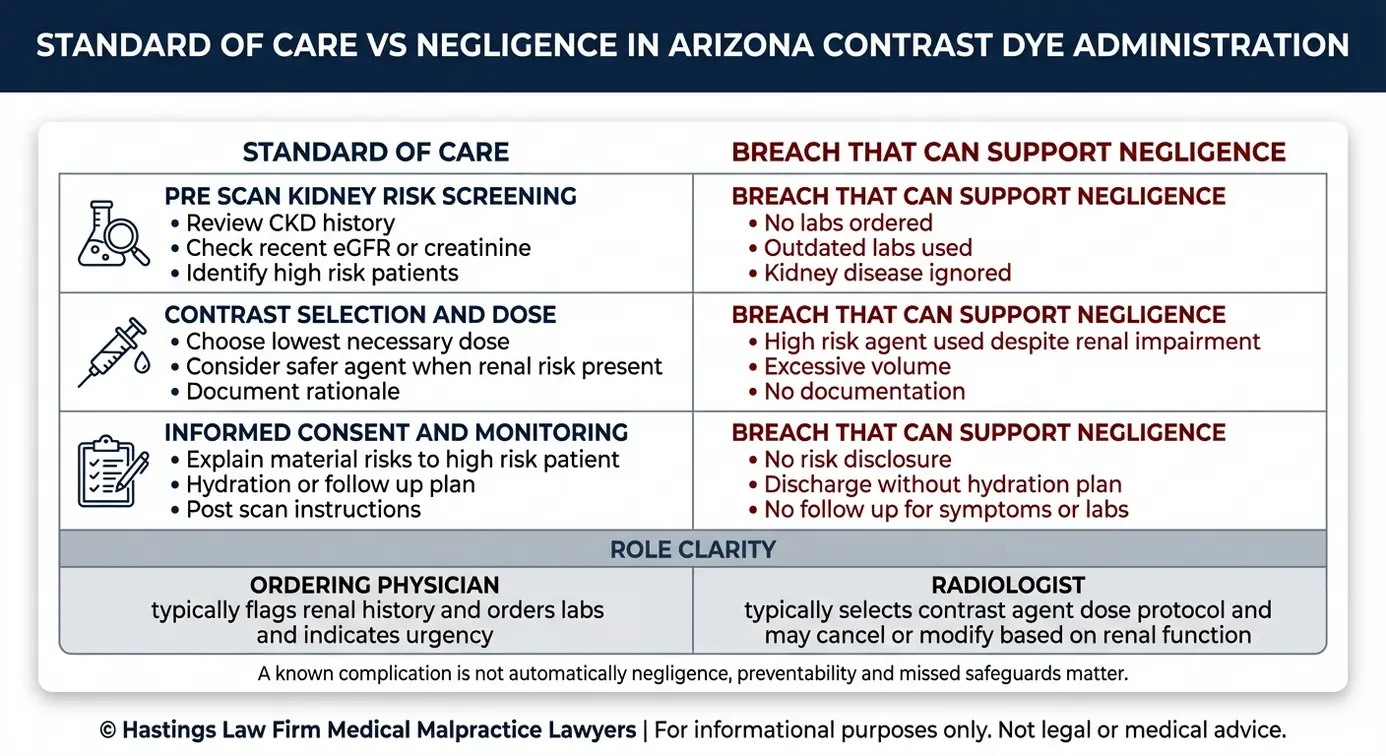
Medical negligence in contrast dye cases occurs when a healthcare provider fails to adhere to the standard of care, such as failing to screen for kidney risks before administering gadolinium or iodinated contrast, resulting in preventable injury. This type of failure can turn a routine diagnostic scan into a life-altering medical event.
The standard of care refers to the level of care and caution that a reasonably competent healthcare professional should provide under similar circumstances. Our in-house medical staff, including nurse practitioners, helps us identify where this standard was breached. Before any imaging procedure that requires IV contrast, the standard typically calls for evaluating the patient’s kidney function. This involves checking the patient’s estimated glomerular filtration rate (eGFR), a blood test that measures how well the kidneys filter waste.
When eGFR levels indicate impaired function, guidelines published by organizations like the American College of Radiology in its Contrast Media Manual call for modified protocols. Our Arizona medical malpractice lawyer often finds that providers ignored these protocols. The UCSF Department of Radiology’s CT and X-ray Contrast Guidelines detail screening expectations. Failure to follow these can lead to conditions like contrast-induced nephropathy (CIN), a sudden deterioration in renal function.
There is a distinction between a known side effect and medical negligence. As our contrast dye malpractice attorney will explain, negligence arises when the injury was preventable. This means a provider either skipped required screening, ignored abnormal lab results, or failed to adjust the imaging plan. A contrast induced nephropathy lawyer reviews these specific actions.
Liability may involve the ordering physician or the radiologist. The radiologist must verify that the patient can safely receive the contrast agent. When providers fail to identify risk factors, a kidney injury lawyer Arizona residents trust can determine liability. As a medical negligence attorney Phoenix patients rely on, we examine each provider’s role to determine where the standard of care was breached.
Signs of Kidney Failure and Reactions After Contrast Dye Exposure
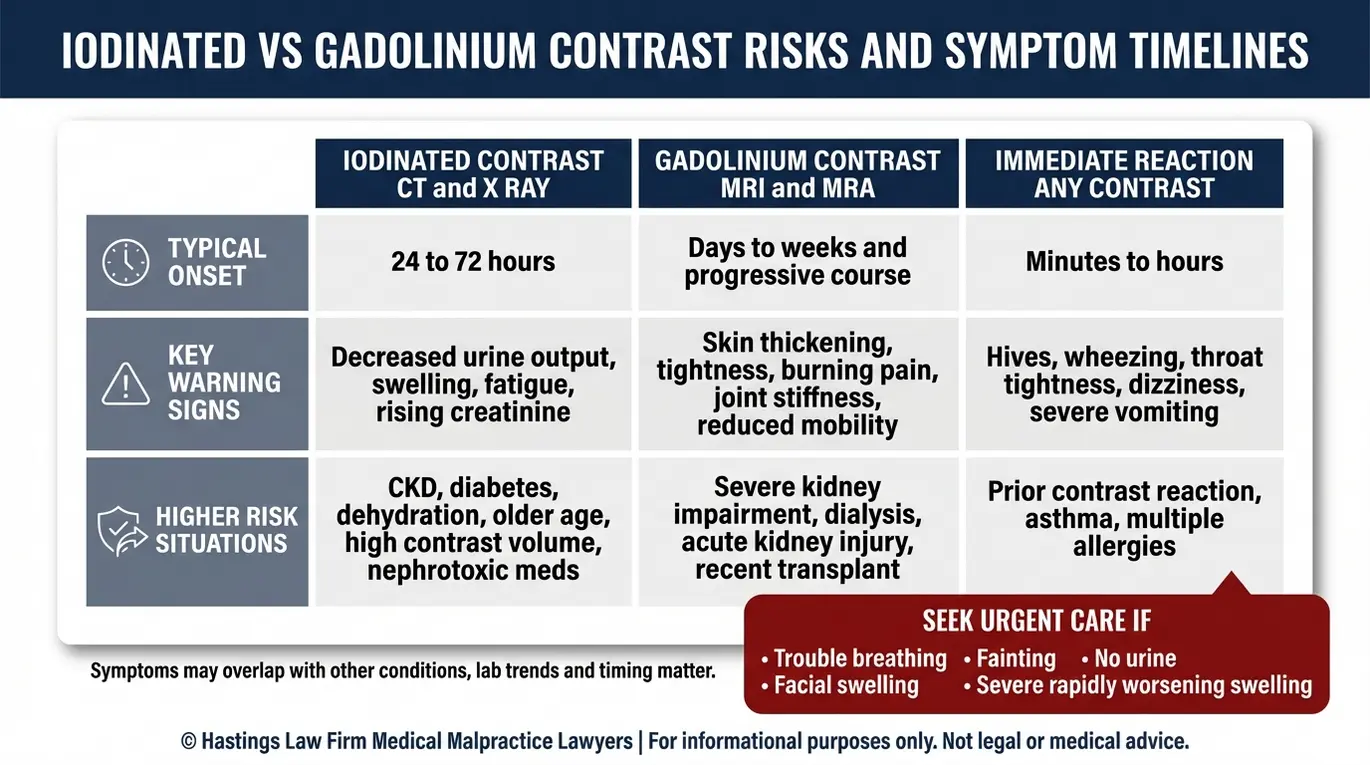
Symptoms of contrast-induced injury can range from immediate allergic reactions to delayed onset of kidney failure (decreased urine output, fatigue, swelling) or skin thickening associated with Nephrogenic Systemic Fibrosis (NSF). Recognizing these warning signs early is important for both your medical treatment and any potential legal claim.
Contrast-induced nephropathy (CIN) is an acute kidney injury marked by a rapid rise in serum creatinine. This waste product is measured through blood tests to gauge kidney function. According to the National Center for Biotechnology Information’s overview of Contrast-Induced Nephropathy, this decline typically appears within 24 to 72 hours after exposure to iodinated contrast media used in CT scans. A kidney failure malpractice lawyer can evaluate if your symptoms match this timeline. Symptoms can include decreased urine output, swelling, fatigue, nausea, and confusion.
Nephrogenic systemic fibrosis (NSF), sometimes referred to as nephrogenic fibrosing dermopathy (NFD), is a distinct and serious condition linked specifically to gadolinium-based contrast agents used in MRI and MRA scans. NSF causes progressive thickening and hardening of the skin and restricted joint mobility. As documented in the NCBI Bookshelf’s clinical reference on NSF, patients with significantly impaired kidney function are at the highest risk because their bodies cannot clear gadolinium efficiently. We are familiar with these severe outcomes.
Gadolinium deposition disease (GDD) is a more recently recognized concern. Unlike NSF, GDD can affect patients who had normal kidney function at the time of their MRI. Symptoms may include persistent headaches, bone and joint pain, and cognitive changes that develop after gadolinium exposure and do not resolve.
| Condition | Contrast Type | Primary Risk Group | Typical Onset | Key Symptoms |
|---|---|---|---|---|
| Contrast-Induced Nephropathy (CIN) | Iodinated contrast (CT/X-ray) | Patients with reduced kidney function, diabetes, dehydration | 24 to 72 hours post-scan | Decreased urine, swelling, fatigue, rising creatinine |
| Nephrogenic Systemic Fibrosis (NSF) | Gadolinium (MRI/MRA) | Patients with severe kidney impairment (low eGFR) | Days to weeks post-scan | Skin thickening, joint stiffness, organ fibrosis |
| Gadolinium Deposition Disease (GDD) | Gadolinium (MRI/MRA) | Can affect patients with normal kidney function | Days to months post-scan | Headaches, bone pain, cognitive changes |
If you experienced any of these symptoms after an imaging procedure, an Arizona contrast dye injury lawyer can help. Whether you need an iodinated contrast lawyer, an MRI dye injury attorney, or a CT scan dye lawyer, proper screening analysis is important.
Specific Contrast Agents and Brand Name Risks
Not all gadolinium-based contrast agents (GBCAs), the class of dyes used during MRI and MRA imaging, carry the same level of risk. GBCAs are categorized as either linear or macrocyclic agents based on their molecular structure. Linear agents have been associated with a higher likelihood of gadolinium retention in the body.
Agents frequently cited in litigation include Omniscan, OptiMARK, and Magnevist. These are linear GBCAs that have been linked to elevated rates of NSF in patients with kidney impairment. Macrocyclic agents such as ProHance and Gadavist are generally considered more stable and less likely to cause gadolinium retention, though they are not entirely without risk.
Gadolinium deposition disease (GDD) involves the retention of gadolinium in tissues even when kidney function is normal. This has broadened the scope of concern beyond traditional at-risk populations. When a provider selects a higher-risk linear agent over a safer available alternative, that decision becomes a central question in our investigation.
The Hastings Law Firm Difference
Results matter, but what truly sets us apart is how we achieve them. Every verdict, every settlement, and every Arizona courtroom victory comes from one guiding promise: To treat each client’s fight for justice as if it were our own.
This balance of skill, experience, and empathy reflects our core philosophy that justice should not only compensate the injured, but also make healthcare safer nationwide.

Common Causes of Contrast Induced Injuries and Hospital Errors
Most contrast injuries stem from procedural errors, such as failing to hydrate a patient, ignoring a history of kidney disease, administering dye to a high-risk patient, or using an excessive volume of contrast agent. When hospitals and imaging centers follow established screening protocols, the risk of serious harm drops significantly. The injuries we investigate as an Arizona contrast dye injury lawyer often trace back to steps that were skipped or ignored.
These are some of the most common failures a hospital negligence lawyer Arizona evaluates:
- Failure to screen kidney function: Not ordering or reviewing BUN and creatinine lab work before the scan, leaving chronic kidney disease or baseline renal impairment undetected.
- Ignoring patient history: Overlooking documented risk factors such as diabetes, prior kidney problems, advanced age, or current use of nephrotoxic medications. Nephrotoxic drugs are substances that are poisonous to the kidneys.
- Failure to hydrate: Discharging a patient without administering hydration prophylaxis, which uses pre- and post-contrast IV hydration to help the kidneys flush the dye.
- Wrong agent selection: Using high-risk iodinated contrast media or a linear gadolinium agent on a patient with impaired renal function when a safer macrocyclic alternative was available.
- Excessive contrast volume: Administering more dye than necessary for the diagnostic study, increasing the toxic load on already compromised kidneys.
- Inadequate post-procedure monitoring: Failing to recheck kidney labs or observe the patient for signs of declining renal function, leading to unmanaged end-stage renal disease. End-stage renal disease is the final stage of kidney failure.
Each of these failures represents a potential breach of the standard of care. A medical injury lawyer Phoenix patients trust can identify these gaps. When a hospital’s own protocols call for pre-scan screening and that step is incomplete, it can become evidence in a contrast dye lawsuit Arizona allows patients to file. Our team reviews every record entry. In some cases, we also act as a wrongful death contrast dye attorney to help families recover for the loss of a loved one.
Grounds for Filing a Contrast Dye Malpractice Lawsuit in Arizona
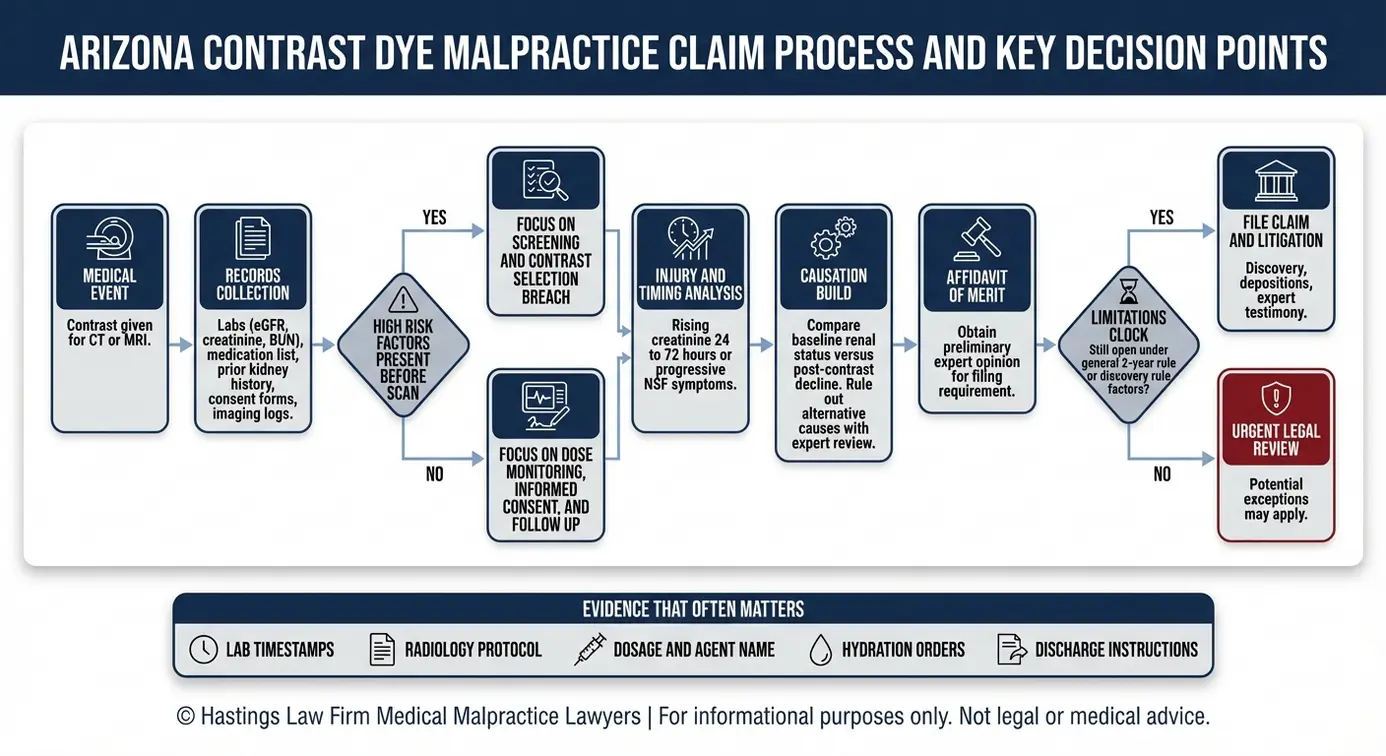
To file a lawsuit in Arizona, a victim must prove a doctor-patient relationship existed, the provider breached the standard of care by administering dye unsafely, and this breach directly caused significant permanent injury or financial loss.
Arizona imposes specific procedural requirements that make early legal guidance essential. An Arizona contrast dye injury lawyer at our firm handles the complex steps required to build your case. Our founder, Tommy Hastings, is board-certified in personal injury trial law and ensures every case is trial-ready.
- Obtain and review medical records: Your imaging orders, lab results, nursing notes, and radiology reports form the foundation of the case.
- Secure a preliminary expert opinion: Under Arizona Revised Statutes § 12-2603, a plaintiff must file an affidavit of merit. This is a sworn statement from a qualified medical expert. Filing a medical lawsuit Arizona requires this step.
- File within the statute of limitations: The medical malpractice statute of limitations Arizona generally allows two years from the date the injury occurred or was discovered. The Arizona Judicial Branch’s guidance on the Statute of Limitations outlines the framework.
- Establish causation through expert testimony: Defense teams frequently argue that the patient’s kidney failure was the result of a pre-existing condition. Overcoming this requires proving causation, which means showing the medical error directly caused the injury.
- Prove Damages: You must show actual damages, such as medical costs or wrongful death losses.
Our firm maintains a national network of specialists who provide the expert testimony, as these cases demand. This helps maximize contrast dye injury settlements.
Recoverable Damages for Victims of Contrast Dye Negligence
Victims may recover compensation for past and future medical bills (including dialysis or transplant costs), lost wages, loss of earning capacity, and non-economic damages for pain, suffering, and reduced quality of life.
Economic damages cover the tangible costs tied to the injury. These can include emergency treatment, ongoing nephrology care, long-term dialysis, and future medical care. Lost wages and diminished earning capacity are also recoverable when kidney failure prevents a return to work. A medical malpractice damages Arizona attorney ensures these are calculated correctly.
Non-economic damages address the personal impact. Compensation for pain and suffering, loss of enjoyment of life, and the physical burden of conditions like NSF all fall within this category. In cases where contrast dye negligence resulted in a patient’s death, surviving family members may pursue a wrongful death claim.
An Arizona contrast dye injury lawyer can work with experts to build a life care plan that accounts for your needs. If you need a kidney failure compensation attorney, we work to secure the full scope of your recovery.
Contact the Arizona Healthcare Malpractice Attorneys at Hastings Law Firm Today for Help
Kidney failure after a diagnostic scan is not something you should have to accept without answers. If you suspect that proper precautions were not taken before your imaging procedure, you have every right to find out what happened.
At Hastings Law Firm, our in-house medical team can review your records and evaluate the care timeline. We handle medical malpractice cases exclusively. Our firm, led by American Board of Trial Advocates inductee Tommy Hastings, handles medical malpractice cases exclusively. Our attorneys include former defense counsel who understand how hospitals and their insurers respond to these claims.
There is no cost for a consultation, and you pay no attorney fees unless we recover compensation on your behalf. If you or a loved one suffered a contrast dye injury in Arizona, contact our Phoenix medical malpractice lawyers today. We can help you take the first step toward answers.
Frequently Asked Questions About Contrast Dye Injury in Arizona


This content was researched and written by the Hastings Law Firm editorial team, which includes attorneys, medical professionals, and experienced researchers. Our writing is informed by internal knowledge and practical experience, and we cross-check critical details against authoritative sources cited throughout. Every piece undergoes human-led fact-checking and legal review. Because legal and medical information can change, if you spot an error, please contact us. Learn more about our content standards and review process on our editorial policy page.

Tommy Hastings, founder of Hastings Law Firm, is a board-certified personal injury trial lawyer dedicated exclusively to healthcare injury cases. Since 2001, he has represented injured patients and families in litigation against major hospital systems, pharmaceutical companies, and negligent healthcare providers nationwide. He has handled numerous high-profile cases that have drawn national media attention and resulted in multi-million dollar recoveries. He draws on that experience in his writing, helping readers understand how these cases work and what options may be available to them.
