


Arizona Compartment Syndrome Malpractice Lawyer
Written by: Hastings Law Firm | Reviewed by: Tommy Hastings | Updated: July 27, 2026
A missed or delayed diagnosis of acute compartment syndrome can turn a treatable emergency into permanent tissue damage, nerve injury, or limb loss. This condition involves rapidly rising pressure inside a muscle compartment that cuts off blood flow, and it requires prompt recognition and intervention rather than a wait and see approach. Problems often arise when severe pain is dismissed, warning signs are not escalated during handoffs, or objective pressure measurements are skipped. If you or a loved one were harmed or worse due to compartment syndrome malpractice in Arizona, contact Hastings Law Firm for a free, confidential case review.

Trusted Arizona Medical Attorneys for Failure to Diagnose Compartment Syndrome Claims
What You Should Know About Failure to Diagnose Compartment Syndrome Claims in Arizona:
- Permanent harm can result when acute compartment syndrome is not recognized and treated as an emergency.
- Limb loss can follow when severe pain out of proportion is dismissed as routine discomfort or drug seeking behavior.
- Irreversible tissue damage can occur when pressure is not relieved promptly with emergency surgery.
- Recovery options can be limited when a delayed diagnosis breaks the link between earlier treatment and a better outcome.
- Hospital accountability can turn on communication breakdowns when worsening symptoms are documented but not escalated during shift changes.
- Liability disputes can focus on whether objective pressure measurements were performed when warning signs were present.
- Long term financial losses can be substantial due to prosthetics, rehabilitation, home modifications, and ongoing medical care.
- Severe systemic complications can occur when dead muscle tissue breaks down and triggers kidney failure that may require long term dialysis.
- Responsibility can involve multiple parties when failures occur in monitoring, diagnosis, casting decisions, or timely transfer to a higher level of care.

A Healthcare Focused Law Firm
If you or someone you love suffered permanent harm because a doctor failed to recognize and treat compartment syndrome in time, you already know something went wrong. The pain was there. The warning signs were there. And the response that should have followed never came.
At Hastings Law Firm, we focus exclusively on medical malpractice, and we understand the physical, emotional, and financial toll these injuries carry. Founded by board-certified trial attorney Tommy Hastings, we have focused exclusively on complex medical negligence cases since 2005. Our team includes former hospital nurses and defense attorneys who understand how facilities manage these cases. We work with in-house nurse consultants and medical experts to investigate what happened, identify where the standard of care broke down, and ensure accountability for the responsible parties. As your Arizona compartment syndrome malpractice lawyer, we maintain a trial-ready approach from day one to drive fair results.
If you have questions about what happened to you or a family member, we are here to listen. Contact us for a free, confidential case evaluation to understand your options.
Understanding Acute Compartment Syndrome and Medical Negligence
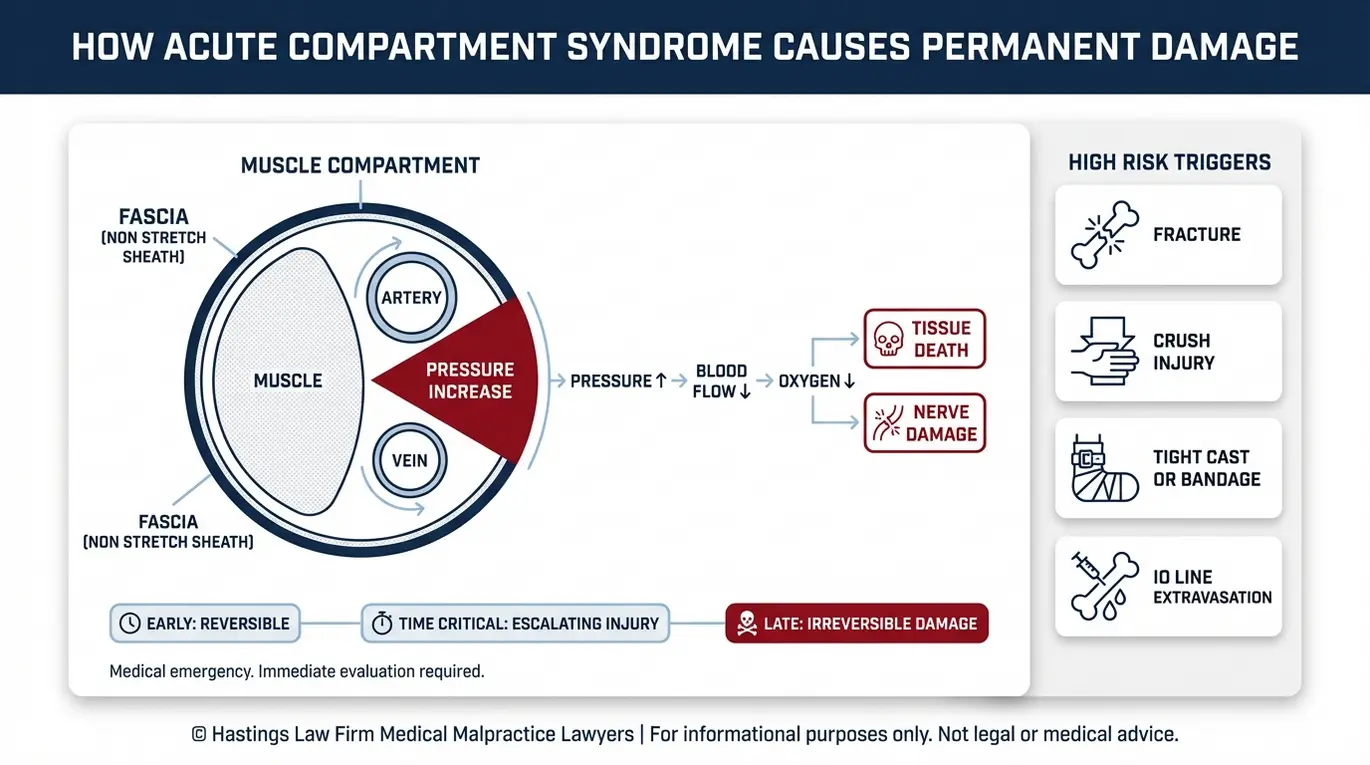
Acute compartment syndrome is a medical emergency where pressure builds rapidly within a group of muscles, cutting off blood flow and threatening permanent tissue damage. This pressure builds within muscle groups, which are compartments surrounded by tough, non-stretchy tissue. When medical providers fail to recognize and treat this condition immediately, the consequences can be devastating, and that failure often constitutes medical negligence.
To understand why this condition is so dangerous, it helps to know a little anatomy. Muscles in the arms and legs are enclosed in tight layers of connective tissue called fascia, which does not stretch. Under normal circumstances, this tissue keeps muscles in place, but it becomes a liability after trauma.
When swelling or bleeding causes pressure to build inside these compartments, the unyielding fascia has nowhere to give, creating a tourniquet effect from the inside out. Blood flow slows, then stops. Without intervention, muscle, nerves, and surrounding tissue begin to die from oxygen deprivation.
This medical crisis, known as acute compartment syndrome, requires rapid intervention to save the limb. This is not a condition that allows a “wait and see” approach. According to the National Center for Biotechnology Information (NCBI Bookshelf), acute compartment syndrome requires urgent diagnosis and treatment to prevent irreversible injury. The pressure must be relieved before the tissue suffers ischemic necrosis, or tissue death from lack of blood flow, because every minute of delay increases the likelihood of a poor outcome.
Certain situations carry a higher risk of triggering this condition. Common high-risk scenarios include:
- Tibial and forearm fractures, which are the most frequent causes of acute compartment syndrome
- Crush injuries from accidents or trauma that cause significant internal swelling
- Tight casts or bandages that restrict swelling from expanding outward, trapping pressure inside the compartment
- Intraosseous (IO) line extravasation, a less commonly discussed but serious cause where fluid intended for the bone marrow leaks into surrounding tissue, rapidly increasing compartment pressure
When providers fail to connect these risk factors with the clinical signs of rising pressure, the delay can cross the line from an unfortunate outcome into actionable medical malpractice. Arizona compartment syndrome malpractice lawyers evaluate these timelines closely to determine whether the standard of care was met.
Recognizing the Signs: Did Your Doctor Miss the Warning Signals?
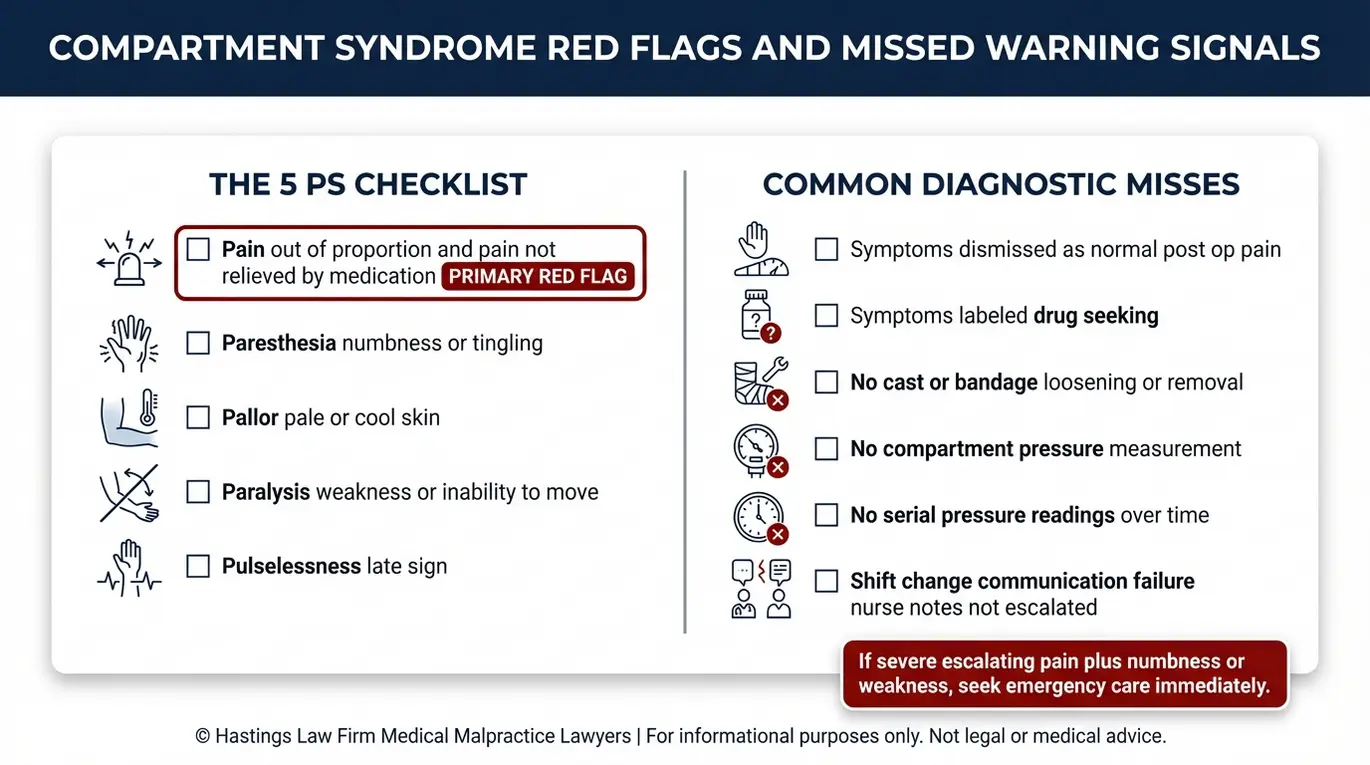
The hallmark symptom of compartment syndrome is pain out of proportion to the injury, meaning pain that is far more severe than what the underlying condition would normally cause, and that does not respond to standard medication. Compartment syndrome is a surgical emergency where internal pressure blocks blood flow to muscle and nerve tissue. In too many cases, this critical warning sign is dismissed by medical staff as drug-seeking behavior or routine post-surgical discomfort.
That dismissal can result in the loss of a limb or other permanent complications.
Medical professionals are trained to recognize a specific set of clinical indicators known as the 5 Ps of compartment syndrome. These are the warning signals that should trigger immediate investigation:
- Pain that is severe, worsening, and unresponsive to analgesics
- Paresthesia, or abnormal sensations like tingling, burning, or numbness in the affected limb
- Paralysis, a late and ominous sign indicating nerve and muscle compromise
- Pallor, or pale, cool skin suggesting reduced blood flow
- Pulselessness, the absence of a distal pulse, which is a very late finding that often signals irreversible damage is underway
When these signs are present, the standard of care calls for objective measurement. Providers should perform compartment pressure measurement using a manometer or similar device. Serial pressure readings, meaning repeated measurements over time, help track whether pressure is rising and whether surgical intervention is needed. The Emergency Medicine Residents’ Association (EMRA) states that relying solely on clinical exam without objective data is a well-documented diagnostic pitfall.
Yet these measurements are frequently skipped or delayed.
One pattern we examine closely involves communication failures within the care team. A nurse may document increasing pain or neurovascular deficits, or signs of nerve and blood vessel damage, in the chart, but that information is never escalated to the attending physician. During shift changes, critical details about a patient’s worsening condition can be lost entirely. These breakdowns in communication are not minor administrative issues. They represent failures in the system that can directly lead to tissue death, nerve damage, or amputation.
If you believe warning signs were present but ignored, an Arizona compartment syndrome malpractice lawyer can review the medical records to identify exactly where the breakdown occurred.
The Hastings Law Firm Difference
Results matter, but what truly sets us apart is how we achieve them. Every verdict, every settlement, and every Arizona courtroom victory comes from one guiding promise: To treat each client’s fight for justice as if it were our own.
This balance of skill, experience, and empathy reflects our core philosophy that justice should not only compensate the injured, but also make healthcare safer nationwide.

Establishing Liability: When Does a Delayed Diagnosis Become Malpractice?
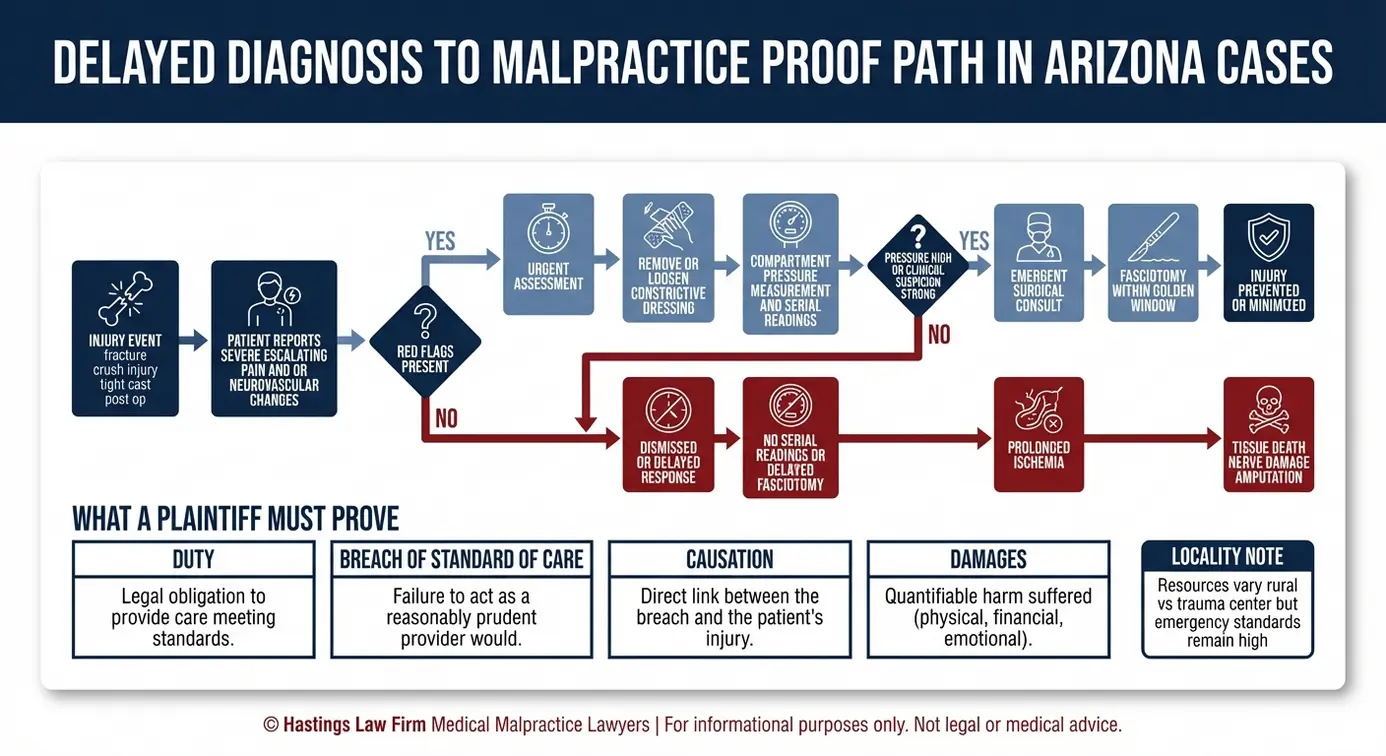
Liability in a compartment syndrome case is established by proving that the treating physician deviated from the standard of care, the accepted level of treatment a reasonably competent doctor would provide under similar circumstances, by failing to order a fasciotomy within the critical treatment window before permanent tissue death occurred. A fasciotomy is an emergency surgery to open the muscle compartment and relieve pressure.
A fasciotomy is the definitive treatment for acute compartment syndrome. In this surgical procedure, the fascia is cut open to immediately relieve pressure inside the compartment. The medical community widely recognizes a “golden window” of roughly four to six hours from the onset of dangerous pressure. After that window closes, the risk of irreversible muscle death, nerve injury, and limb loss increases sharply.
To build a malpractice claim in Arizona, we must demonstrate specific legal elements. Under Arizona Revised Statutes § 12-563, a medical malpractice case requires proof that the provider’s conduct fell below the recognized standard of care, and that this breach directly caused the patient’s injury.
We examine common breaches that may lead to a delayed diagnosis, such as dismissing reports of severe pain; failing to loosen a tight cast when swelling is evident; neglecting to order intracompartmental pressure measurement; or delaying a fasciotomy once the clinical picture warrants surgical intervention. The element of causation connects the breach directly to the harm. If a misdiagnosis meant a fasciotomy performed at hour two would have preserved the limb, but the six-hour delay resulted in amputation, that delay is the direct cause of the injury.
One consideration specific to Arizona involves differences in facility resources. A rural hospital may not have the same surgical capacity as a Level I trauma center in Phoenix. However, even in a rural setting, the standard of care requires that providers recognize the emergency, stabilize the patient, and arrange a timely transfer when they cannot perform the needed procedure. Basic emergency standards do not lower simply because of geography.
If you are looking for a compartment syndrome lawyer in Arizona, our team works with qualified medical experts to reconstruct the clinical timeline and establish exactly where the standard of care was violated. As an Arizona compartment syndrome malpractice lawyer, Hastings Law Firm has the resources to build a case that ensures accountability for every responsible party.
The Consequences of Negligence: Seeking Compensation for Life-Altering Injuries
Patients who suffer harm from compartment syndrome malpractice can recover damages for medical bills, lost wages, amputation-related costs, and non-economic losses like pain and suffering. Failure to treat compartment syndrome can lead to permanent muscle and nerve death.
The physical consequences of a missed diagnosis are often permanent. Amputation of the affected limb, foot drop, and lasting nerve damage are among the most common outcomes. Foot drop is a condition where nerve damage makes it difficult to lift the front of the foot. This injury can result in permanent tissue harm and severely impairs mobility.
In severe cases, the breakdown of dead muscle tissue releases proteins into the bloodstream, causing rhabdomyolysis. This is a dangerous condition that can lead to acute kidney failure and require long-term dialysis.
The financial impact is also significant. Prosthetic devices, physical rehabilitation, home modifications, and ongoing medical care create costs that extend over a lifetime. Many patients are unable to return to their previous occupation, resulting in lost future earning capacity that must be accounted for in any claim.
| Type of Damage | What It Covers |
|---|---|
| Medical expenses | Past and future surgeries, hospital stays, rehabilitation, prosthetics |
| Lost wages and earning capacity | Income lost during recovery and reduced ability to earn in the future |
| Pain and suffering | Physical pain, emotional distress, and diminished quality of life |
| Life care costs | Long-term needs such as in-home assistance, adaptive equipment, and ongoing therapy |
An experienced Arizona medical malpractice attorney for compartment syndrome works with economists to create a thorough life care plan and calculate the full scope of these losses. This ensures any recovery reflects what you and your family will need going forward.
Contact the Arizona Healthcare Malpractice Attorneys at Hastings Law Firm Today for Help
The window for treating compartment syndrome is measured in hours. The legal deadline for taking action in Arizona is also limited. If you believe a delayed or missed diagnosis caused you or a loved one to suffer permanent harm, you do not have to carry that burden alone.
At Hastings Law Firm, our legal and medical team investigates every detail of what happened, from the initial presentation through every charting entry, communication gap, and treatment decision. Our in-house nurse consultants and national network of medical experts allow us to evaluate your case with the clinical depth it demands.
You pay nothing unless we recover compensation for you. That is our commitment.
If you are searching for an Arizona compartment syndrome malpractice lawyer who will prepare your case with the thoroughness and seriousness it deserves, contact Hastings Law Firm today for a free, confidential consultation. Let us help you find the answers you deserve.
Frequently Asked Questions About Compartment Syndrome Malpractice in Arizona


This content was researched and written by the Hastings Law Firm editorial team, which includes attorneys, medical professionals, and experienced researchers. Our writing is informed by internal knowledge and practical experience, and we cross-check critical details against authoritative sources cited throughout. Every piece undergoes human-led fact-checking and legal review. Because legal and medical information can change, if you spot an error, please contact us. Learn more about our content standards and review process on our editorial policy page.

Tommy Hastings, founder of Hastings Law Firm, is a board-certified personal injury trial lawyer dedicated exclusively to healthcare injury cases. Since 2001, he has represented injured patients and families in litigation against major hospital systems, pharmaceutical companies, and negligent healthcare providers nationwide. He has handled numerous high-profile cases that have drawn national media attention and resulted in multi-million dollar recoveries. He draws on that experience in his writing, helping readers understand how these cases work and what options may be available to them.
