


Arizona Colonoscopy Perforation Lawyer
Written by: Hastings Law Firm | Reviewed by: Tommy Hastings | Updated: July 27, 2026
A bowel perforation during a colonoscopy can be a known complication, but it can also reflect preventable errors or a delayed response after warning signs appear. The difference often turns on whether the care met the standard expected of a reasonably competent gastroenterologist and whether the injury was recognized and treated promptly. When a perforation is missed, the harm can escalate quickly into life threatening infection, emergency surgery, and lasting changes to daily life. If you or a loved one were harmed or worse due to colonoscopy perforation malpractice in Arizona, contact Hastings Law Firm for a free, confidential case review.

Trusted Arizona Medical Attorneys for Colonoscopy Negligence Claims
What You Should Know About Endoscopy Perforation Malpractice Claims in Arizona:
- Long term harm can be far worse when a perforation is not recognized and treated promptly after a colonoscopy.
- Liability can depend on whether the injury resulted from a deviation from the standard of care rather than an accepted procedural risk.
- Recovery can turn on whether post procedure complaints were dismissed and warning signs were not investigated.
- Severe outcomes can include sepsis, organ failure, emergency open surgery, and a temporary or permanent ostomy.
- Responsibility may extend beyond the gastroenterologist when facility staff or emergency care delays contribute to a failure to rescue.
- Options are not eliminated by signing an informed consent form when the perforation was caused by negligent technique.
- Compensation can reflect both financial losses and quality of life impacts when injuries cause lasting limitations.
- Recovery in Arizona is not limited by damage caps for personal injury and wrongful death claims.
- Case strength can depend on what imaging and procedure documentation show about free air, technique, and the timeline of recognition.
- The ability to pursue a claim can be lost if the applicable filing deadline is missed under Arizona law.

A Healthcare Focused Law Firm
A colonoscopy is one of the most common medical procedures in the country. When it goes as planned, it saves lives. But when a doctor’s error causes a bowel perforation, the consequences can be severe, sometimes life-threatening, and the recovery can change the course of your daily life.
If you or a loved one suffered a perforated bowel during a colonoscopy, you likely have questions about what went wrong and whether anyone is being held accountable. Those questions deserve clear answers, not more confusion.
At Hastings Law Firm, we focus exclusively on medical malpractice. Our team includes in-house nurses, former defense attorneys, and board-certified trial lawyers who understand both the medicine and the law behind these cases. As an experienced Arizona colonoscopy perforation lawyer, we are here to help you understand what happened and what your options may be.
Contact us for a free, confidential case evaluation. You pay nothing unless we recover for you.
Is a Perforated Bowel During Colonoscopy Considered Malpractice?
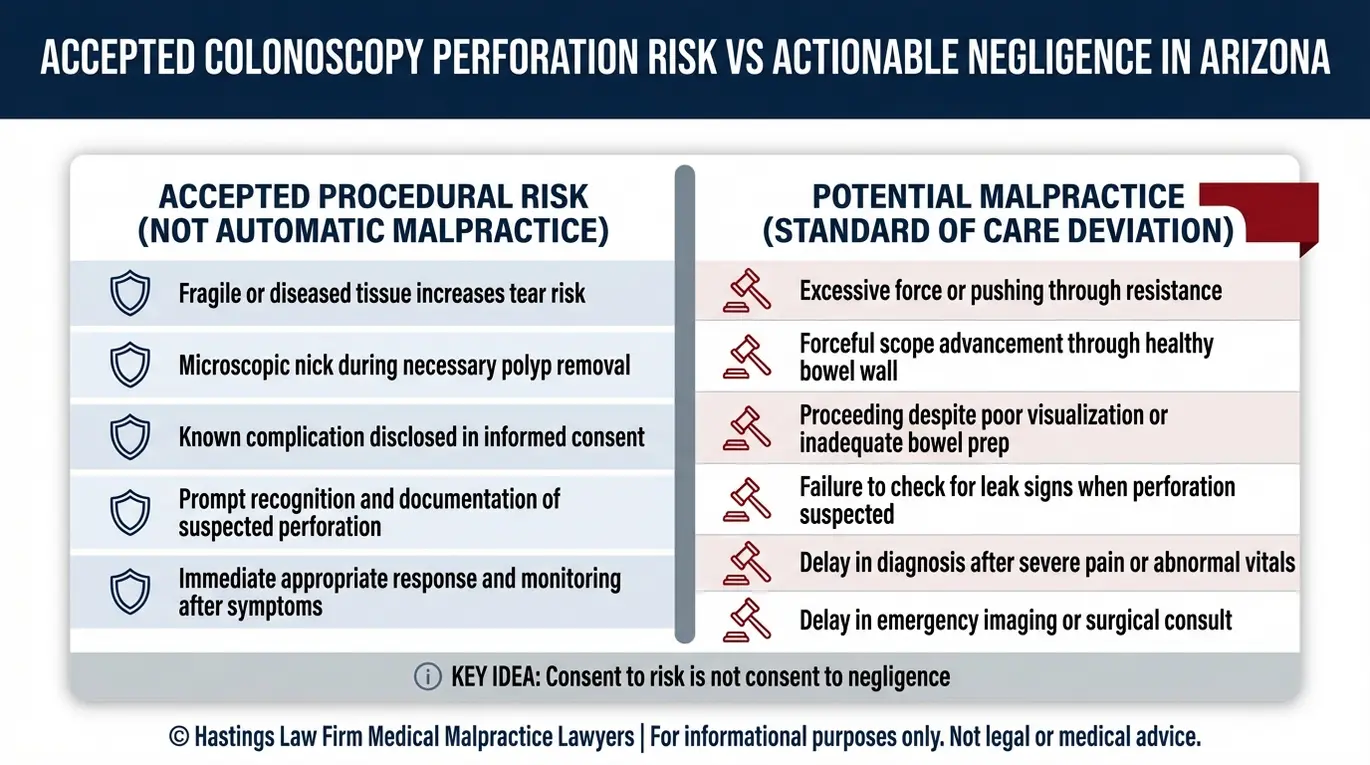
A perforated bowel is not automatically malpractice, because it is a known risk of the procedure. Malpractice occurs when the perforation resulted from a deviation from the standard of care, or when the physician failed to recognize and treat the injury promptly. Medical malpractice litigation in Arizona requires proof of a breach in the standard of care.
A bowel perforation, which is a hole or tear in the wall of the colon, can happen even during a properly performed colonoscopy. Colonoscopies involve advancing a flexible scope through the large intestine, and the colon wall is naturally thin and susceptible to injury. That reality, on its own, does not make the doctor liable.
The standard of care refers to the level of treatment a reasonably competent gastroenterologist would provide under similar circumstances. As an Arizona colonoscopy malpractice lawyer, we explain that under Arizona’s medical malpractice statutes (A.R.S. § 12-561 et seq.), a medical malpractice claim requires proof that the provider failed to meet this standard and that the failure caused harm.
One common source of confusion involves informed consent. Before a colonoscopy, patients typically sign a consent form that lists perforation as a possible risk. But acknowledging a risk is not the same as waiving your right to competent care. If the doctor caused the tear through negligence, the consent form does not shield them from liability.
Equally important is the distinction between what caused the tear and how the medical team responded to it. A perforation that is identified and repaired immediately may not result in lasting harm. But when a perforation goes undiagnosed and the patient is sent home with worsening symptoms, the failure to act can be more legally significant than the tear itself.
| Accepted Procedural Risk | Potentially Actionable Malpractice |
|---|---|
| Small tear during removal of a large polyp in diseased tissue | Forceful advancement of the scope through a healthy bowel wall |
| Minor bleeding controlled during the procedure | Failure to inspect for signs of perforation before ending the exam |
| Brief post-procedure discomfort | Dismissing severe abdominal pain as “normal gas” after the procedure |
| Documented risk with proper informed consent | Performing the procedure without appropriate patient screening |
Key Distinction: The “Nick” vs. Gross Negligence
Not every tear is the same. During a polypectomy, the removal of a polyp from the colon wall, a microscopic nick in already-diseased tissue may be an inherent risk of the technique. This is especially true when the polyp is large or positioned in a difficult area.
A traumatic perforation happens when the scope is forced through a loop or healthy tissue. This injury can also happen if a thermal injury, which is a burn from cauterization tools, goes too deep and damages the bowel wall. The injury is then no longer an accepted complication. It is the result of operator error. Our team reviews the operative report, pathology findings, and endoscopy images to determine which category applies.
Common Causes of Colonoscopy Perforation Malpractice
Malpractice leading to a perforation often stems from technical errors during the procedure itself, including excessive force with the scope, poor visualization due to inadequate preparation, or performing a high-risk technique on a patient who was not a suitable candidate. The colon is the long, tube-like organ that helps process waste and is the site where these procedures take place.
Understanding the specific cause is central to your case, which is why a colonoscopy perforation attorney in Arizona reviews every detail. We often consult with experts to analyze CT scan and X-rays imaging, which can reveal free air in the abdomen indicative of a leak. We also assess whether an unnecessary procedure was attempted on a candidate with contraindications.
When our medical and legal teams investigate, we look for specific patterns of error that fall below the accepted standard.
Common causes include:
- Mechanical force: Pushing the scope too aggressively through a looped or narrowed section of the colon can tear the bowel wall. This is especially dangerous in patients with adhesions from prior surgeries or those with anatomical variations.
- Barotrauma from excessive air insufflation: The scope inflates the colon with air or carbon dioxide to improve visibility. Over-insufflation can stretch the bowel wall beyond its limit, causing it to burst.
- Thermal injury from cauterization tools: Devices used during polyp removal generate heat. If the application is prolonged or too close to healthy tissue, the resulting burn can weaken the bowel wall and lead to a delayed perforation days later.
- Negligent visualization due to poor bowel preparation: Bowel preparation, the process of clearing the colon before the procedure, is essential for a safe exam. When a gastroenterologist proceeds despite inadequate bowel prep, meaning stool is still obstructing the view, they are operating without clear sight of the tissue. This significantly increases the risk of accidental injury.
Research published through a PubMed Central study on iatrogenic colonic perforation confirms that procedural technique and clinical decision-making are primary factors in patient safety. Iatrogenic refers to an injury caused by medical care. Our in-house nurses and medical consultants review the endoscopy report, nursing notes, and pre-procedure documentation to identify exactly where the standard of care may have been breached.
The Hastings Law Firm Difference
Results matter, but what truly sets us apart is how we achieve them. Every verdict, every settlement, and every Arizona courtroom victory comes from one guiding promise: To treat each client’s fight for justice as if it were our own.
This balance of skill, experience, and empathy reflects our core philosophy that justice should not only compensate the injured, but also make healthcare safer nationwide.

Recognizing the Warning Signs: Symptoms of a Perforated Bowel
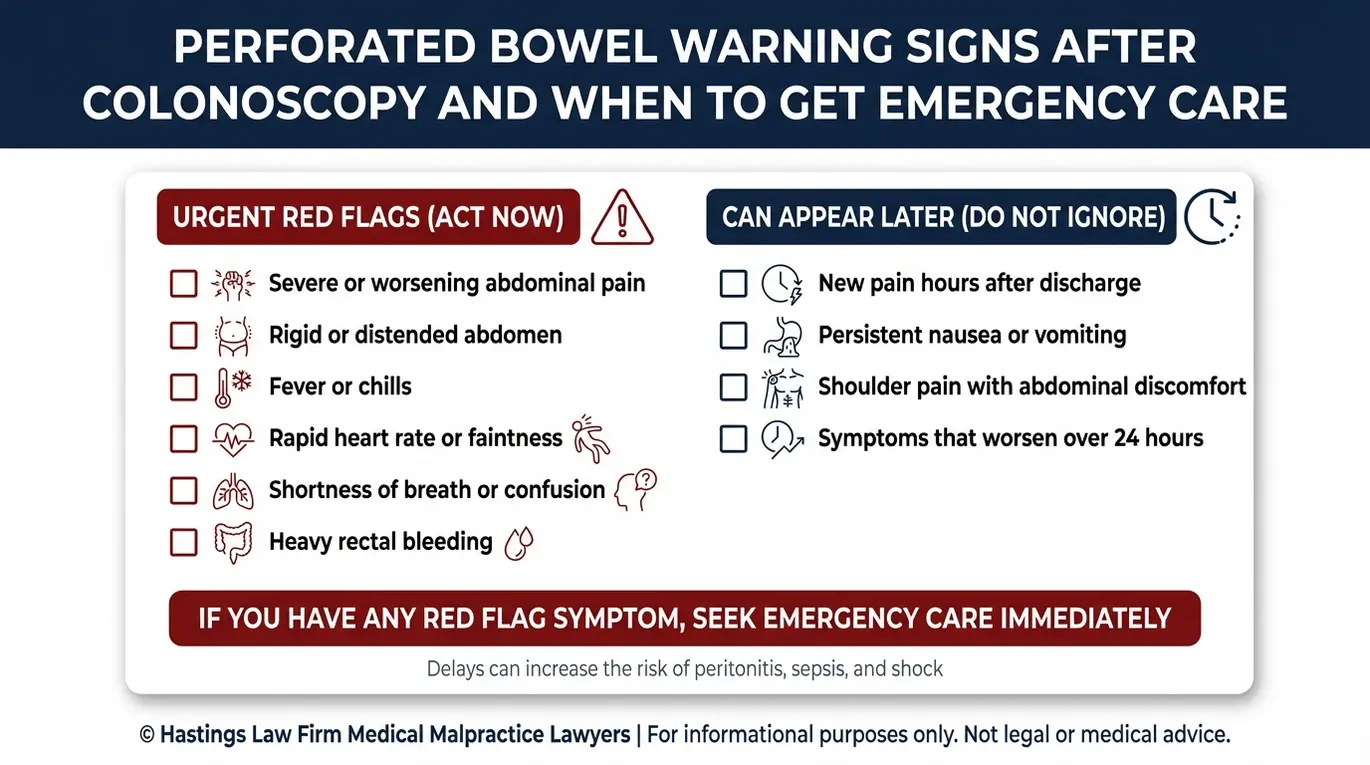
Symptoms of a bowel perforation often appear immediately or within the first 24 hours after the procedure. They include severe abdominal pain, a rigid or swollen abdomen, fever, rectal bleeding, and signs of shock. When these symptoms are ignored or dismissed, the resulting delay in treatment can cause far greater harm than the perforation itself.
Some perforations are obvious during the procedure. Others, particularly those caused by thermal injury, may not develop until two to five days later as the burned tissue breaks down. This delayed presentation makes post-procedure monitoring and patient education critical.
If a patient calls the office with escalating pain and is told it is “just gas,” that failure to investigate may suggest a failure to diagnose. Recognizing these symptoms early is the difference between a simple repair and a life-altering catastrophe. When medical providers dismiss these red flags, they fail their patients.
Here is what to watch for after a colonoscopy:
- Severe or worsening abdominal pain that does not improve with rest
- Abdominal rigidity, bloating, or visible distension
- Fever or chills
- Rectal bleeding, especially if heavy or persistent
- Nausea and vomiting
- Rapid heart rate, dizziness, or fainting, which are often early indicators of septic shock
Left untreated, a perforation allows intestinal contents, including bacteria, to spill into the abdominal cavity. This triggers peritonitis, an inflammation and infection of the peritoneal lining that surrounds the abdominal organs. Peritonitis can rapidly progress to sepsis, a dangerous systemic infection where the body’s response to bacteria begins damaging its own organs.
According to a PubMed Central review on colonoscopic perforation management, delays in recognition and treatment are directly linked to higher rates of surgical intervention and mortality. This is why, in many of the cases we evaluate as an Arizona colonoscopy perforation lawyer, the delay in diagnosis and treatment is often more legally significant than the perforation itself. We call this “failure to rescue,” and it is one of the strongest foundations for a malpractice claim.
The Medical Aftermath: Sepsis, Surgery, and Colostomy Bags
When a perforation goes untreated, bacteria leak freely into the abdominal cavity, causing life-threatening sepsis and organ failure. Emergency open surgery is often the only option, and many patients wake up with a colostomy bag they never anticipated. A colonoscopy uses a flexible scope to view the large intestine, where these injuries occur.
The surgical response to a delayed perforation is typically an exploratory laparotomy, a major open abdominal surgery where the surgeon opens the abdomen to locate the tear, clean out infected material, and assess the damage. Depending on how much bowel tissue has been compromised, the surgeon may need to perform a bowel resection, removing the damaged section entirely.
In many cases, the remaining bowel cannot be safely reconnected right away. The surgeon creates a stoma, a surgically made opening in the abdomen, and diverts the intestine through it. This is known as a colostomy or ileostomy, depending on which part of the intestine is involved.
Waste is then collected in an external bag attached to the body. Some stomas are temporary and can be reversed with a second surgery months later. Others are permanent.
If sepsis leads to septic shock, blood pressure drops and organs may fail. The patient then requires intensive care with antibiotics and vasopressors to maintain blood flow to critical organs. ICU stays can last weeks, and recovery often involves lasting damage to the kidneys, liver, or heart.
Beyond the physical toll, the long-term consequences reshape daily life. Patients face chronic pain from adhesions, or bands of scar tissue that form after abdominal surgery. Incisional hernias are common. Reversal surgeries carry their own risks. And the psychological impact of living with a stoma, including changes to body image, intimacy, and independence, is profound and often underestimated.
These are the damages that matter in a colonoscopy perforation case. They are not abstract. As an Arizona colonoscopy perforation lawyer, we see the medical bills, the lost income, and the permanent changes to how someone lives.
Establishing Liability for Endoscopy Errors in Arizona
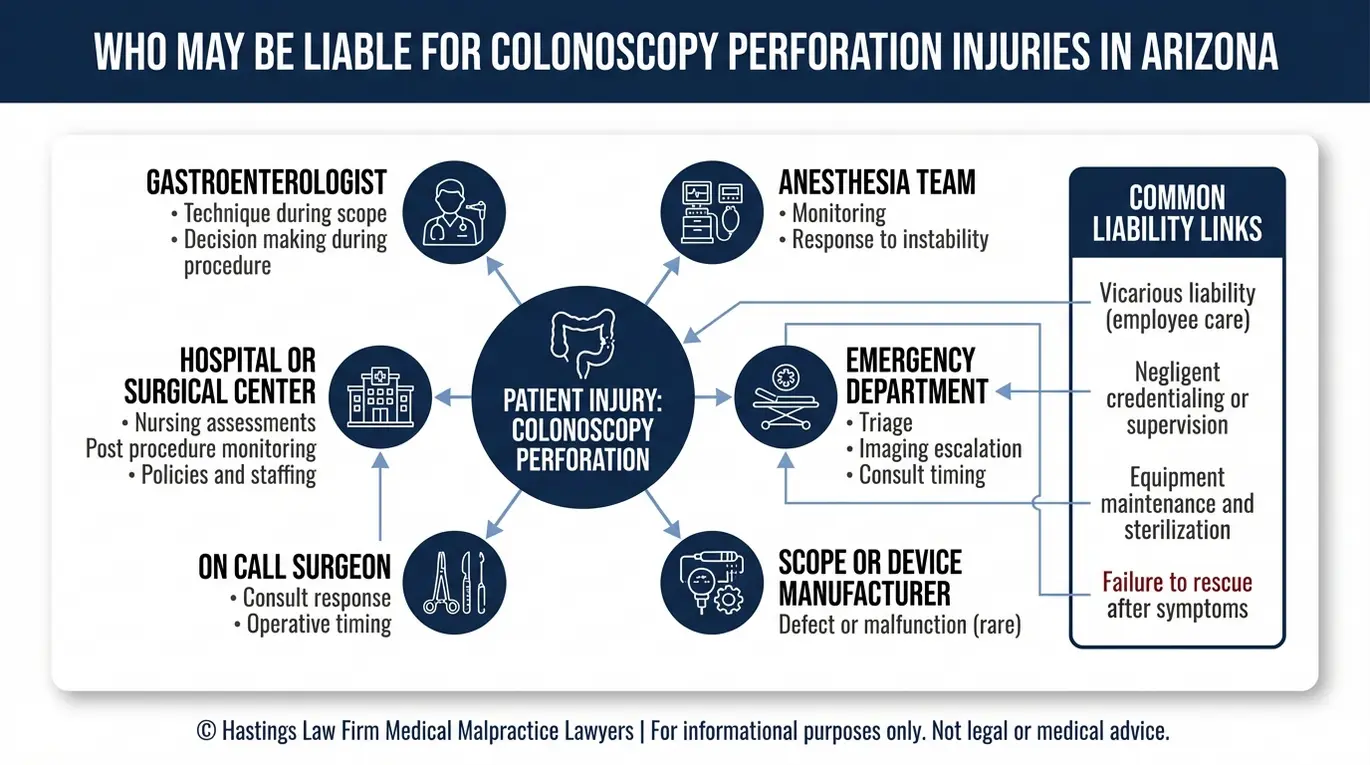
Liability for a colonoscopy perforation may extend beyond the performing gastroenterologist to the hospital or ambulatory surgical center if institutional failures contributed to the injury. Gastroenterologists are doctors who specialize in the digestive system.
Here is how liability typically breaks down in these cases:
The gastroenterologist carries primary liability for technical errors during the procedure. If the doctor used excessive force, proceeded despite poor bowel prep, or failed to recognize a perforation before ending the exam, that is a direct breach of the standard of care.
The hospital or surgical center may share liability if system-level failures contributed to the injury. For example, if nursing staff ignored a patient’s repeated complaints of severe pain after the procedure, or if equipment sterilization protocols were not followed and led to infection, the facility itself can be held accountable. The emergency room and on-call surgeon may also share liability if a patient returns with signs of perforation but is not taken to surgery in a timely manner. Delays in the ER are a common source of “failure to rescue” claims. Under vicarious liability principles, a hospital may also be responsible for the actions of its employed physicians.
Medical device manufacturers may bear liability in rare situations where the endoscope or associated instruments malfunctioned during the procedure, though these claims require specific evidence of a product defect.
Patient safety data tracked by the Agency for Healthcare Research and Quality (AHRQ) Quality Indicators helps identify patterns in iatrogenic complications, including perforation rates during lower GI endoscopy. These benchmarks give our team context for evaluating whether a facility’s complication rate or response protocols fall outside acceptable norms.
As an Arizona colonoscopy injury lawyer, we investigate every entity involved, from the doctor to the facility to the equipment used, to identify all potentially liable parties and build the strongest possible case.
Arizona Colonoscopy Malpractice Verdicts and Settlements
Settlement and verdict values for colonoscopy perforation cases in Arizona vary widely based on the severity of the injury, the degree of permanent disability, and the strength of the evidence of negligence. Our firm was founded by Tommy Hastings, a board-certified trial lawyer with over two decades of experience in medical negligence. Cases involving wrongful death or catastrophic sepsis injuries have produced multi-million dollar results.
The damages in these cases fall into two broad categories.
Economic damages cover the financial losses you can document: past and future medical bills, including surgeries, hospital stays, and ongoing care; lost wages from time away from work; and loss of earning capacity if the injury prevents you from returning to your previous occupation. A patient who requires a permanent colostomy and multiple corrective surgeries may accumulate hundreds of thousands of dollars in medical costs alone.
Non-economic damages address the losses that do not come with a receipt: physical pain and suffering, loss of quality of life, emotional distress, disfigurement from surgical scarring, and the daily burden of living with a stoma, a surgically created opening in the abdomen used to divert the intestine. A bowel resection, which is the surgical removal of damaged intestinal tissue, can leave patients with permanent digestive limitations that affect every meal and every outing. Because there is no cap on damages, the jury can look at the full picture of your suffering. This includes the loss of enjoyment of life and the mental anguish caused by the injury.
One critical advantage for patients in Arizona: the Arizona Constitution, as outlined by the Center for American Civics at ASU, prohibits caps on damages for personal injury and wrongful death claims. Unlike many other states that limit non-economic recovery, Arizona law ensures that juries can award full compensation based on the actual harm suffered.
At Hastings Law Firm, as your Arizona colonoscopy perforation lawyer, we work with medical economists, life care planners, and surgical experts to document the true scope of your losses, both current and future.
Contact the Arizona Healthcare Malpractice Attorneys at Hastings Law Firm Today for Help
If you or a loved one suffered a bowel perforation during a colonoscopy, you deserve to know whether the injury was preventable. That answer starts with a thorough review of the medical records, the operative report, and the timeline of care.
Hastings Law Firm focuses exclusively on medical malpractice. Our team includes nurse practitioners and Board Certified Patient Advocates who help interpret complex clinical data alongside our former defense attorneys and national experts. We prepare every case as if it is going to trial, because that preparation is what drives fair results.
We understand the weight of what you are carrying, physically, emotionally, and financially. Our goal is to give you clarity about what happened and honest guidance about your legal options.
Contact us today for a risk-free case evaluation. There is no fee unless we recover for you.
Frequently Asked Questions About Colonoscopy Perforation in Arizona


This content was researched and written by the Hastings Law Firm editorial team, which includes attorneys, medical professionals, and experienced researchers. Our writing is informed by internal knowledge and practical experience, and we cross-check critical details against authoritative sources cited throughout. Every piece undergoes human-led fact-checking and legal review. Because legal and medical information can change, if you spot an error, please contact us. Learn more about our content standards and review process on our editorial policy page.

Tommy Hastings, founder of Hastings Law Firm, is a board-certified personal injury trial lawyer dedicated exclusively to healthcare injury cases. Since 2001, he has represented injured patients and families in litigation against major hospital systems, pharmaceutical companies, and negligent healthcare providers nationwide. He has handled numerous high-profile cases that have drawn national media attention and resulted in multi-million dollar recoveries. He draws on that experience in his writing, helping readers understand how these cases work and what options may be available to them.
