


Arizona Chiropractor Malpractice Lawyer
Written by: Hastings Law Firm | Reviewed by: Tommy Hastings | Updated: July 27, 2026
A serious injury after a chiropractic adjustment can leave a family facing sudden medical needs, missed work, and lasting uncertainty. Arizona chiropractic malpractice claims often focus on whether the chiropractor followed the standard of care, obtained informed consent for neck manipulation, and recognized warning signs that required urgent medical referral. The article also discusses how cervical manipulation can be linked to arterial dissection and stroke, and how documentation and timelines can shape what happened next. If you or a loved one were harmed or worse due to chiropractic negligence in Arizona, contact Hastings Law Firm for a free, confidential case review.

Top Rated Arizona Legal Representation for Chiropractic Injury Victims
What You Should Know About Chiropractor Injury Claims in Arizona:
- Life changing harm can follow a chiropractic adjustment, including stroke, spinal cord damage, and permanent brain injury.
- Options for accountability can depend on whether the chiropractor breached the Arizona standard of care rather than whether the outcome was simply bad.
- A disputed cause of injury can become central when symptoms appear hours or days after an adjustment and the event is labeled spontaneous.
- The ability to decline a neck manipulation can be affected when informed consent does not clearly communicate material risks such as stroke.
- The risk of severe injury can increase when high velocity adjustments are performed on patients with known risk factors.
- Irreversible harm can result when a chiropractor fails to recognize a medical emergency and does not refer a patient for immediate hospital care.
- Financial recovery can be shaped by the full scope of losses, including medical bills, lost wages, and reduced quality of life.
- Recovery limits are less restrictive in Arizona because the article states there is no statutory cap on malpractice damages.
- Evidence disputes can turn on the completeness and accuracy of chiropractic records, including imaging and documentation of screening.
- Record integrity can matter when audit trails suggest that chart entries were altered after an injury.

A Healthcare Focused Law Firm
When you trusted a chiropractor with your health and walked away with a serious injury, the confusion and frustration that follow can feel overwhelming. You may be dealing with unexpected medical bills, lost time at work, or a diagnosis you never saw coming. These injuries are not minor inconveniences. Strokes, spinal cord damage, and nerve injuries caused by chiropractic negligence can permanently change the course of your life.
Hastings Law Firm focuses exclusively on medical malpractice, and that includes holding negligent chiropractors accountable. Our team of attorneys, in-house nurses, and medical consultants understands both the medicine and the law behind these cases. If you or a loved one suffered a serious injury after a chiropractic adjustment, an experienced Arizona chiropractor malpractice lawyer at our firm can review what happened and explain your legal options in a free, confidential consultation.
Defining Chiropractic Negligence and the Standard of Care in Arizona
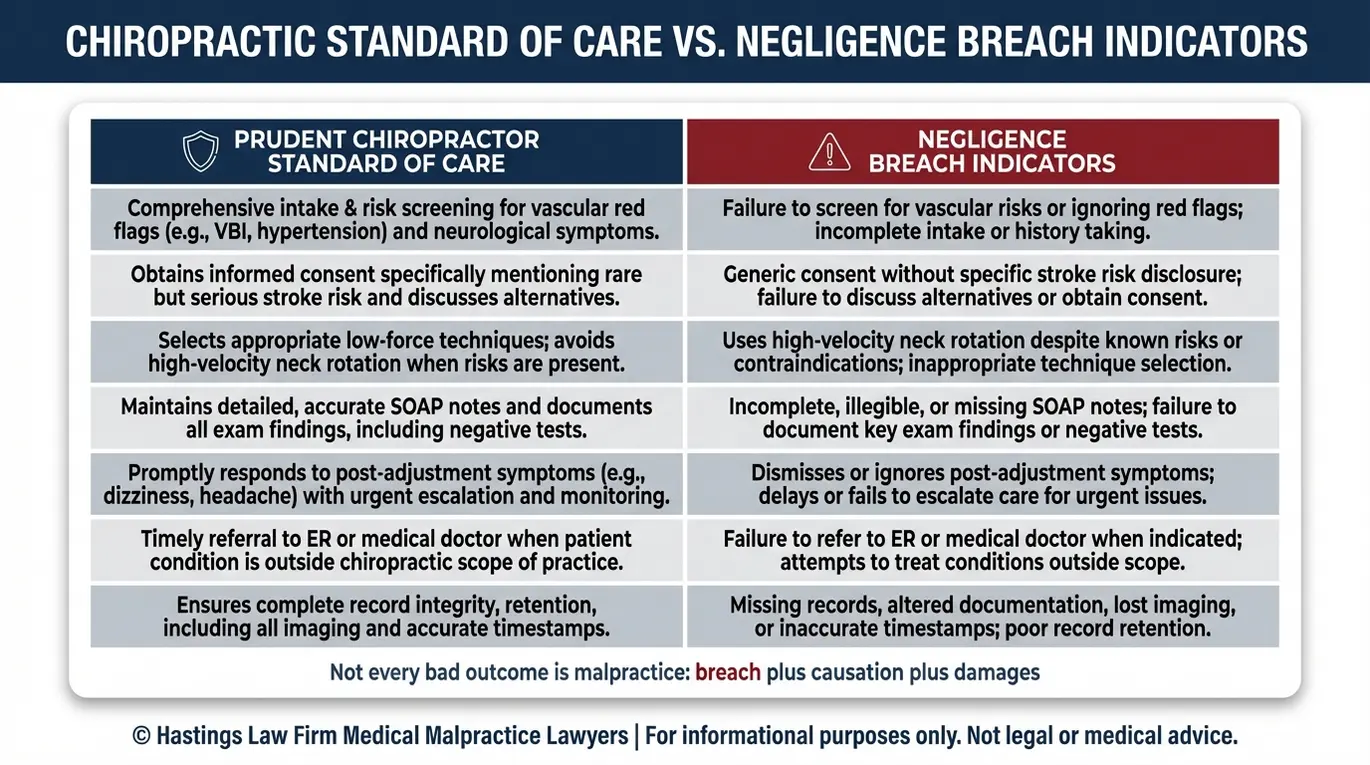
Chiropractic malpractice occurs when a chiropractor deviates from the accepted standard of care, such as performing high-velocity adjustments on high-risk patients or failing to refer them to a medical doctor, and that deviation results in injury. A bad outcome alone is not enough to support a legal claim. There must be a clear breach of the duty that a reasonably competent chiropractor would have met under the same circumstances.
In Arizona, the standard of care requires chiropractors to evaluate patients thoroughly before performing any spinal adjustment, which is the manual application of force to the spine intended to correct alignment or improve function. This includes reviewing the patient’s medical records and full medical history, ordering imaging when risk factors are present, and recognizing conditions that fall outside a chiropractor’s scope of practice. Thorough documentation is essential for tracking patient progress and identifying potential contraindications. When a chiropractor fails to take these precautions, they may miss critical warning signs that make treatment unsafe.
A chiropractic malpractice attorney in Arizona will also examine whether the chiropractor obtained proper informed consent before performing cervical manipulation. Informed consent for neck adjustments means the chiropractor must clearly explain the potential risks, including the risk of stroke, and give the patient the opportunity to decline the procedure.
A prudent chiropractor should:
- Review the patient’s full medical history before treatment
- Order imaging studies (X-rays or MRI) when risk factors are present
- Screen for contraindications such as osteoporosis, vascular disease, or prior neck injury
- Explain the risk of stroke before performing cervical manipulation
- Refer the patient to a physician when symptoms suggest a condition outside their scope
When any of these steps are skipped and an injury follows, the legal threshold for negligence may be met.
Vertebral Artery Dissection: The Link Between Neck Adjustments and Stroke
Cervical Manipulative Therapy (CMT) can tear the inner lining of the vertebral artery, causing a dissection that leads to blood clots and subsequent strokes, often in young, healthy patients. This high-velocity rotation and extension of the neck, performed during many chiropractic adjustments, can damage the delicate arterial walls. A tear, known as a vertebral artery dissection (VAD), causes blood clots to form at the injury site. Those clots can travel to the brain and cause a stroke or permanent brain injury, often in patients who had no prior warning signs.
The mechanism of injury is well documented. Rapid rotational force applied to the neck during adjustment can damage the arteries, particularly in patients with subtle vascular vulnerabilities. A scientific statement published in the journal *Stroke* by the American Heart Association/American Stroke Association on cervical arterial dissections and association with cervical manipulative therapy found a significant association between CMT and cervical arterial dissection, reinforcing the medical basis for these claims.
The Danger of the V3 Segment Anatomy
The V3 segment of the vertebral artery is especially vulnerable during neck adjustments. This segment loops around the top two vertebrae (C1 and C2) before entering the skull, making it the most exposed portion of the artery. Unlike segments protected within the bony canal of the spine, the V3 segment is tethered in a way that makes it susceptible to stretching and tearing during end-range cervical rotation, meaning when the neck is turned to its maximum range of motion. The internal carotid artery can also be affected, though vertebral artery injuries are more common.
One of the most challenging aspects of these cases is the timeline. Symptoms of a dissection, including severe headache, dizziness, or vision changes, may not appear for hours or even days after the adjustment. Defense attorneys often argue that the stroke was “spontaneous” and unrelated to the adjustment.
Arizona chiropractor malpractice lawyers counter this defense by reconstructing the clinical timeline and working with vascular neurology experts to establish causation. Our team examines the patient’s pre-adjustment health and the onset of symptoms to build a clear picture of what happened. If you are searching for a lawyer for chiropractic stroke, understanding this delayed timeline is one of the most important parts of your case.
Warning signs of vertebral artery dissection after a chiropractic adjustment include:
- Sudden, severe headache unlike any previous headache
- Dizziness or vertigo immediately after or within days of treatment
- Difficulty speaking or slurred speech
- Neck pain that worsens after the adjustment
- Vision changes or double vision
- Weakness or numbness on one side of the body
- Loss of coordination or difficulty walking
Any of these symptoms after a cervical adjustment should be treated as a medical emergency.
The Hastings Law Firm Difference
Results matter, but what truly sets us apart is how we achieve them. Every verdict, every settlement, and every Arizona courtroom victory comes from one guiding promise: To treat each client’s fight for justice as if it were our own.
This balance of skill, experience, and empathy reflects our core philosophy that justice should not only compensate the injured, but also make healthcare safer nationwide.

Common Errors and Injuries Committed by Arizona Chiropractors
Beyond strokes, chiropractic negligence can involve causing herniated discs, worsening existing fractures, and failing to diagnose medical emergencies that require immediate hospital care. These errors often represent a serious deviation from the safety standards expected of healthcare providers. These injuries often result from a combination of improper technique, inadequate patient screening, and a failure to recognize the limits of chiropractic treatment.
One common form of negligence involves performing a high-velocity, low-amplitude (HVLA) thrust, a quick and forceful manual adjustment, on patients whose conditions make them especially vulnerable. Patients with osteoporosis, spinal stenosis, or pre-existing disc injuries can suffer catastrophic damage when excessive force is applied without proper evaluation.
Another serious issue involves treating what chiropractors refer to as a chiropractic subluxation, a supposed misalignment of the spine, when the patient’s symptoms are actually caused by something far more dangerous. Cancer, spinal fractures, and vascular emergencies can all present with back or neck pain. A chiropractor who continues adjustments instead of referring the patient to a physician may cause irreversible harm.
| Category | Examples of Negligent Conduct | Potential Injuries |
|---|---|---|
| Worsening Existing Conditions | Adjusting patients with osteoporosis or herniated discs | Spinal cord injury, paralysis, ruptured disc |
| Failure to Refer | Treating symptoms of cancer, fracture, or stroke as routine pain | Permanent brain injury, delayed cancer treatment |
| Improper Technique | Using excessive force on elderly or fragile patients | Nerve damage, herniated disc, vertebral fracture |
| Ignoring Contraindications | Performing cervical manipulation despite vascular risk factors | Vertebral artery dissection, stroke |
A chiropractor negligence lawyer evaluates each of these failures by reviewing the treatment records, the patient’s medical history, and whether the chiropractor followed established clinical guidelines.
Failure to Diagnose and Refer Medical Emergencies
Chiropractors have a legal duty to recognize when a patient’s condition is beyond their scope of practice and must refer them to a medical doctor immediately rather than continuing adjustments. This obligation is not optional. It is a core component of the chiropractic standard of care.
One of the most dangerous failures involves a failure to diagnose underlying risks by neglecting to order imaging studies before treatment. When a patient presents with neck or back pain, an X-ray or MRI can reveal fractures, tumors, or vascular abnormalities that make spinal manipulation unsafe. Skipping this step and proceeding directly to adjustments puts the patient at serious risk.
The consequences are especially severe when a patient develops symptoms of cervical arterial dissection (CeAD), a tear in the arteries of the neck, during or after an adjustment. If a patient reports dizziness, sudden headache, nausea, or difficulty speaking after cervical manipulation, those symptoms may indicate a stroke in progress. A chiropractor who sends that patient home instead of directing them to an emergency room for a CT angiography (CTA) commits a failure to refer. This specialized imaging scan visualizes blood flow in the arteries and can detect vascular injuries such as dissections.
Delayed treatment in stroke cases directly affects outcomes. Every minute without proper medical intervention increases the risk of permanent neurological injury. A malpractice attorney for chiropractor errors will examine whether the chiropractor recognized the warning signs, how long the delay lasted, and whether medical misdiagnosis or negligence contributed to the severity of the harm.
Calculating Damages and Future Care Costs in Chiropractic Cases
Patients harmed by chiropractic negligence can recover compensation for economic damages like medical bills and lost wages, as well as non-economic damages for pain, suffering, and loss of quality of life. In the most tragic cases, families who lost a loved one may also pursue a wrongful death claim.
Economic damages cover the measurable financial losses caused by the injury:
- Past and future medical bills, including emergency care, surgery, rehabilitation, and ongoing therapy
- Lost wages and diminished earning capacity if the injury prevents you from returning to work
- Costs of assistive devices, home modifications, and adaptive equipment
- Long-term care expenses for patients who require around-the-clock assistance
For patients left with paralysis or severe brain injury, the lifetime cost of care can be staggering. According to the Genworth and CareScout 2024 Cost of Care Survey, the national median cost for a home health aide already exceeds $75,000 per year, and facility-based care is significantly higher. A lifecare planner can project these costs across a patient’s remaining life expectancy to ensure the full financial impact is accounted for.
Non-economic damages address the personal toll of the injury: chronic pain, emotional distress, loss of independence, and the inability to enjoy activities that once defined your daily life. When suing a chiropractor in Arizona, there is no statutory cap on these damages. The Arizona Constitution protects the right to full recovery, which means juries can award whatever amount they determine is fair.
An Arizona chiropractor malpractice lawyer will work with medical experts, economists, and lifecare planners to present the complete picture of your losses.
How Our Arizona Based Medical Malpractice Firm Investigates Claims
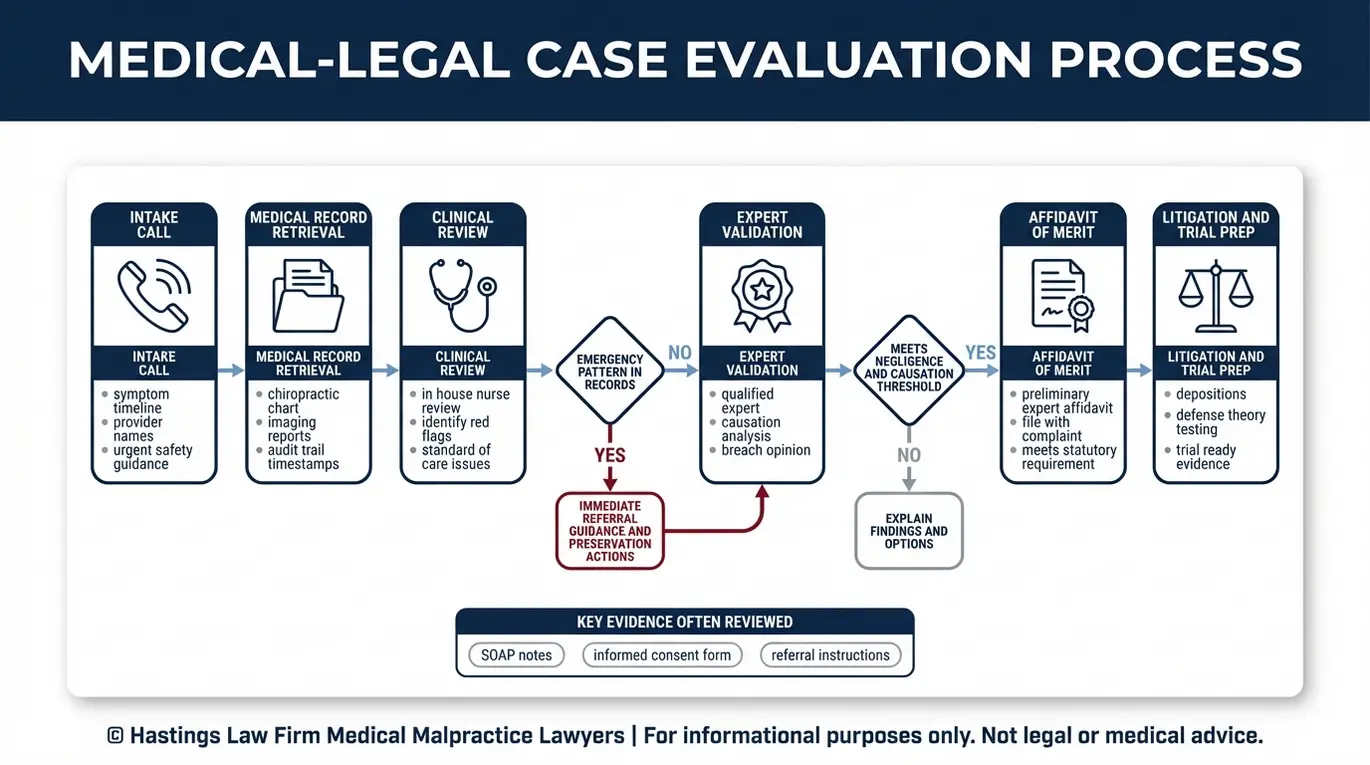
We start with a thorough record review by our in-house medical team to identify the breach of duty, followed by expert witness validation to build a trial-ready case against the chiropractor and their insurance carrier. Our chiropractor malpractice law firm handles every step of this process so you can focus on recovery.
Here is how our case process works:
- Step 1: Free evaluation with a patient advocate. You speak with a member of our team who listens to what happened, reviews the basic facts, and determines whether the case warrants a full investigation. There is no cost and no obligation.
- Step 2: Obtaining records and imaging. We formally request your complete chiropractic file and medical records, including SOAP notes, imaging studies, intake forms, and chart audit trails. Audit trails can reveal whether records were altered after the injury.
- Step 3: Filing the Preliminary Expert Opinion Affidavit. Arizona law requires a qualified medical expert to certify that the claim has merit before the case can proceed. Under Arizona Revised Statutes § 12-2603, this affidavit must be served with the plaintiff’s initial disclosure statements and confirm that the standard of care was breached. Our national expert network includes specialists who can provide this opinion.
- Step 4: Litigation and trial preparation. Founded by board-certified trial attorney Tommy Hastings, our firm prepares every case as if it will go to a jury trial. This includes detailed medical reconstruction, expert depositions, and a litigation strategy designed to hold the chiropractor and their insurer fully accountable through comprehensive insurance research.
Contact the Arizona Doctor Malpractice Attorneys at Hastings Law Firm Today for Help
You do not have to face the aftermath of a chiropractic injury alone. If you or a loved one suffered a stroke, spinal cord damage, or another serious injury after a chiropractic adjustment, our team is ready to listen and help you understand what went wrong.
Hastings Law Firm focuses exclusively on medical malpractice. Our attorneys, in-house nurses, and medical consultants have the training and resources to take on the insurance companies that protect negligent providers. We believe in finding the truth, holding the right people accountable, and making sure this does not happen to someone else.
The consultation is free and confidential. You pay no fees unless we recover compensation for you. Contact our Phoenix office today to speak with a patient advocate and take the first step toward getting the answers your family deserves. Taking legal action can help protect your future and provide the resources needed for your recovery.
Frequently Asked Questions About Chiropractor Malpractice in Arizona


This content was researched and written by the Hastings Law Firm editorial team, which includes attorneys, medical professionals, and experienced researchers. Our writing is informed by internal knowledge and practical experience, and we cross-check critical details against authoritative sources cited throughout. Every piece undergoes human-led fact-checking and legal review. Because legal and medical information can change, if you spot an error, please contact us. Learn more about our content standards and review process on our editorial policy page.

Tommy Hastings, founder of Hastings Law Firm, is a board-certified personal injury trial lawyer dedicated exclusively to healthcare injury cases. Since 2001, he has represented injured patients and families in litigation against major hospital systems, pharmaceutical companies, and negligent healthcare providers nationwide. He has handled numerous high-profile cases that have drawn national media attention and resulted in multi-million dollar recoveries. He draws on that experience in his writing, helping readers understand how these cases work and what options may be available to them.
