


Arizona Chiropractic Stroke Lawyer
Written by: Hastings Law Firm | Reviewed by: Tommy Hastings | Updated: July 27, 2026
A stroke after a chiropractic neck adjustment can leave families facing sudden disability, fear, and lasting uncertainty. These injuries are often linked to vertebral artery dissection, where forceful cervical manipulation tears the arterial wall and can lead to clot formation and brain injury. Symptoms may appear quickly or develop over hours, and reassurance from a trusted provider can delay emergency care when time sensitive treatment matters. Understanding how these events happen and what warning signs look like can shape medical outcomes and accountability. If you or a loved one were harmed or worse due to chiropractic stroke in Arizona, contact Hastings Law Firm for a free, confidential case review.

Trusted Arizona Medical Attorneys for Vertebral Artery Dissection Claims
What You Should Know About Vertebral Artery Dissection Malpractice Claims in Arizona:
- Life changing brain injury can follow cervical neck manipulation when a vertebral artery tear leads to clotting and stroke.
- Recovery can worsen when early warning signs are dismissed as normal after an adjustment and emergency care is delayed.
- Liability can turn on whether the chiropractor screened for contraindications and obtained informed consent about stroke risk.
- Options can narrow if the time limit for filing a claim is missed under Arizona law.
- Permanent disability or fatal outcomes can drive substantial long term losses such as medical care needs and lost earning capacity.
- Responsibility can extend beyond the chiropractor when an emergency department fails to diagnose a dissection and treatment is delayed.
- A missed diagnosis can occur when standard CT imaging is used instead of vascular imaging that can detect an arterial tear.
- Case proof can depend on whether chiropractic records and consent documents accurately reflect screening, warnings, and post adjustment symptoms.

A Healthcare Focused Law Firm
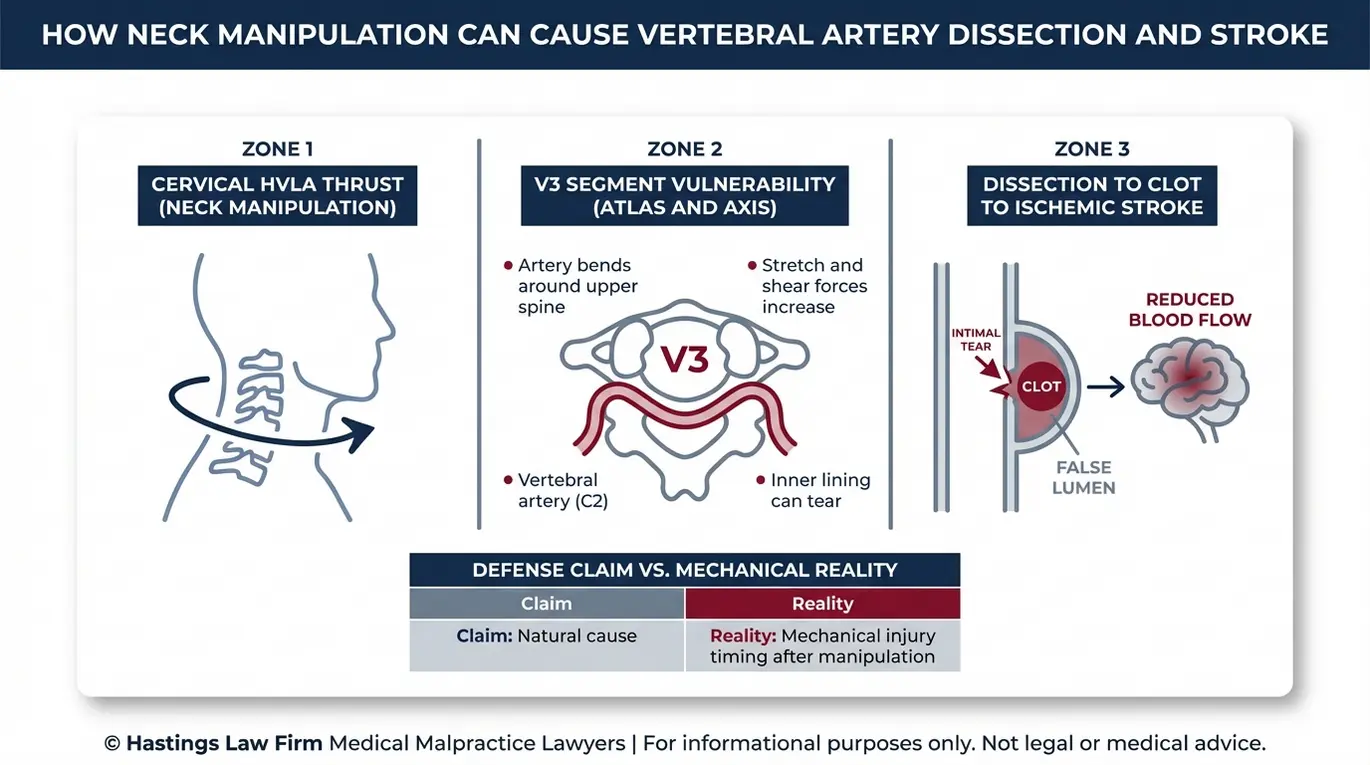
A chiropractor is supposed to relieve pain, not cause a life-altering injury. If you or a loved one suffered a stroke after a cervical neck manipulation, the confusion, fear, and sense of betrayal you may be feeling right now are understandable. These injuries often involve damage to the V3 segment of the vertebral artery, the portion that loops through the upper cervical spine, where forceful rotation can tear the arterial wall. That tear may lead to an arterial thrombus, a blood clot that can travel to the brain and cause a stroke.
An Arizona chiropractic stroke lawyer at Hastings Law Firm can help you understand what happened, why it happened, and what legal options may be available. Our team of attorneys, nurse consultants, and medical experts focuses exclusively on medical malpractice. If you have questions, we offer a free, confidential case evaluation with no obligation.
What Is Vertebral Artery Dissection Caused by Neck Adjustments
Vertebral artery dissection (VAD) is a tear in the inner lining of the vertebral artery, often caused by high-velocity neck manipulation, which allows blood to enter the arterial wall, form a clot, and potentially trigger a stroke.
In cases of chiropractic negligence, this type of injury is closely associated with high-velocity low-amplitude (HVLA) thrusts applied to the cervical spine during chiropractic neck manipulation. These quick, forceful rotations are designed to adjust joint alignment, but they place significant mechanical stress on the vertebral arteries.
The area of greatest concern is the V3 segment of the vertebral artery dissection (VAD), which winds around the atlas and axis vertebrae (C1 and C2), the top two bones of the spine. Because the artery is tethered to bone at this location, it has very little room to absorb the force of a sudden rotational thrust. That anatomical vulnerability makes the V3 segment especially susceptible to tearing during cervical adjustments.
Why the V3 segment is at risk during neck manipulation:
- The artery is physically anchored to the C1 and C2 vertebrae, limiting its ability to stretch or move.
- High-velocity rotation creates shearing force directly on the arterial wall at this fixed point.
- Even patients with no prior symptoms or vascular conditions can sustain a tear.
- The resulting clot formation may not cause immediate symptoms, meaning the full injury can unfold over minutes or hours.
A common defense argument in these cases is that the dissection was spontaneous or the result of natural causes, not the manipulation itself. However, as discussed in a study published by PubMed Central on cervical spine manipulation and cervical artery dissection, the mechanical forces applied during HVLA thrusts are a well-documented causal mechanism. Arizona chiropractic stroke attorneys at Hastings Law Firm work with qualified medical experts to establish this link between the adjustment and the arterial tear.
Recognizing Stroke Symptoms After a Chiropractic Adjustment
Symptoms of a stroke following neck manipulation typically appear immediately or within hours and include sudden vertigo, severe headache, slurred speech, facial drooping, and difficulty walking or balancing. In many cases, these signs begin while the patient is still in the chiropractor’s office or shortly after returning home.
A posterior circulation ischemic stroke, which affects the back of the brain supplied by the vertebral arteries, can present differently than the strokes most people picture. Patients may experience ataxia, which is a sudden loss of coordination or balance, blurred vision, nausea, or the worst headache of their life. These symptoms can be subtle at first, which is part of what makes them so dangerous.
One factor that delays medical attention is what many describe as the “white coat effect.” Patients naturally trust healthcare providers. If a chiropractor reassures them that dizziness or a headache is just a normal reaction to the adjustment, many patients accept that explanation and wait. That delay can allow the brain injury to progress significantly before emergency treatment begins. Identifying stroke warning signs as soon as they appear is important for patient recovery.
Use the BE-FAST checklist to identify stroke warning signs:
- B — Balance: Sudden loss of balance or coordination
- E — Eyes: Blurred or double vision, sudden vision loss
- F — Face: Drooping on one side of the face
- A — Arms: Weakness or numbness in one arm
- S — Speech: Slurred or difficult speech
- T — Time: Call 911 immediately if any of these signs appear
The Cleveland Clinic’s BE-FAST stroke recognition guide is a helpful resource for understanding these warning signs in detail.
If you or a family member experienced these symptoms after a chiropractic visit, time matters, both medically and legally. Under Arizona Revised Statutes § 12-542, the statute of limitations for personal injury claims is generally two years. Speaking with a lawyer for chiropractic stroke in Arizona early helps protect both your health records and your legal rights.
The Hastings Law Firm Difference
Results matter, but what truly sets us apart is how we achieve them. Every verdict, every settlement, and every Arizona courtroom victory comes from one guiding promise: To treat each client’s fight for justice as if it were our own.
This balance of skill, experience, and empathy reflects our core philosophy that justice should not only compensate the injured, but also make healthcare safer nationwide.

Proving Liability and the Standard of Care in Arizona
Proving liability requires demonstrating that the chiropractor deviated from the acceptable standard of care by performing high-risk maneuvers without proper screening or by failing to obtain informed consent about the risk of stroke. As an Arizona chiropractic stroke lawyer, our role is to build that case piece by piece.
Every healthcare provider, including chiropractors, owes a duty of care to their patients. In the context of cervical spine manipulation (CSM), which involves applying high-velocity low-amplitude (HVLA) thrusts or quick forceful rotations to the neck, that duty includes evaluating the patient for risk factors before performing the adjustment. It also includes clearly explaining the potential for serious complications. This process, known as informed consent, ensures you understand the risks before agreeing to treatment.
Our legal team includes former defense attorneys and hospital nurses who previously worked for the medical systems we now challenge. This insight helps us anticipate defense tactics and identify inconsistencies in medical records. The types of breaches we examine in chiropractic malpractice cases include:
- Failure to screen for contraindications: The chiropractor did not assess for medical reasons why a treatment should be avoided, such as connective tissue disorders or a history of vascular problems.
- Lack of informed consent: The patient was not warned that cervical manipulation carries a risk of vertebral artery dissection or stroke before agreeing to the procedure.
- Use of HVLA on high-risk patients: The chiropractor performed aggressive rotational thrusts despite the presence of known risk factors.
- Failure to respond to warning signs: The chiropractor dismissed post-adjustment symptoms like dizziness or headache instead of referring the patient for emergency evaluation.
Our legal team uses expert testimony from qualified chiropractic and medical professionals to establish what a competent provider should have done. We also review the chiropractor’s own training materials, board-required continuing education, and internal protocols. Under the guidelines published by the Arizona Board of Chiropractic Examiners, practitioners are expected to meet professional conduct standards that include appropriate patient screening and risk disclosure.
Arizona courts have reinforced the importance of expert affidavits in medical liability cases. A recent opinion from the Supreme Court of the State of Arizona addresses procedural requirements in malpractice litigation, including the role of preliminary expert opinions in establishing that a claim has merit.
The Dual Defendant Scenario and Delayed Diagnosis
In many cases, a patient seeks emergency care after the adjustment, but the ER doctor fails to diagnose the dissection, leading to a dual-defendant claim against both the chiropractor for causing the injury and the physician for the delay in treatment.
Often, this is a pattern our team sees repeatedly. A patient arrives at the emergency room with vertigo, a severe headache, or coordination problems. Because these symptoms overlap with more common conditions like migraines or benign positional vertigo, ER physicians may order a standard CT scan, which often appears normal, leading to a delayed diagnosis. Hours or days later, the stroke fully develops or worsens, causing permanent brain injury or death.
The problem is that a standard CT scan is not designed to detect an arterial tear. Detecting a vertebral artery dissection typically requires CT angiography (CTA), which uses contrast dye to visualize blood flow through the arteries, or MR angiography (MRA), which uses magnetic resonance imaging to evaluate the arterial walls without radiation. A study published by PubMed Central comparing multidetector CT angiography and MR imaging of cervical artery dissection confirms that these advanced imaging studies are far more effective at identifying dissections than standard imaging.
As an attorney for chiropractic negligence, our firm investigates both the initial injury and the downstream medical response. If the ER team had the clinical information to suspect a dissection, such as a recent history of cervical manipulation, and still failed to order the appropriate imaging, that failure may constitute a separate act of medical negligence. We work with emergency medicine experts, neuroradiologists, and neurologists to establish causation, which is the direct link between the medical error and the resulting harm, at each stage.

Compensation for Victims of Chiropractic Stroke in Arizona
Compensation for a chiropractic stroke can include coverage for past and future medical bills, lost earning capacity, lifelong rehabilitation costs, and non-economic damages for pain, suffering, and loss of enjoyment of life. As an Arizona chiropractic stroke lawyer, our goal is to build a case that fully accounts for the scope of harm a patient has suffered.
Strokes caused by vertebral artery dissection often result in long-term or permanent disability. The financial impact extends far beyond the initial hospital stay. An Arizona stroke malpractice lawyer must account for the full picture, which is why our team works with lifecare planners, vocational economists, and medical specialists to project future needs and ensure future financial security.
| Damage Category | Examples |
|---|---|
| Past Medical Expenses | Emergency room care, hospitalization, surgical intervention, imaging studies |
| Future Medical Costs | Ongoing neurology visits, rehabilitation therapy, prescription medications, assistive devices |
| Lost Wages and Earning Capacity | Income lost during recovery and reduced ability to earn in the future |
| Home and Personal Care | In-home nursing, 24/7 attendant care for severe brain injury |
| Non-Economic Damages | Physical pain, emotional suffering, loss of enjoyment of life, loss of independence |
| Loss of Consortium | Impact on the injured person’s spouse and family relationships |
| Wrongful Death Damages | Funeral expenses, loss of financial support, and loss of companionship when the stroke is fatal |
At Hastings Law Firm, we understand that this process is about more than a financial recovery. Many of our clients want answers about what happened and assurance that the same mistake will not happen to another patient. That motivation, the pursuit of truth and prevention, is something we share. Every case we take is an opportunity to hold negligent providers accountable and push for safer standards of care.
Steps to Take After a Stroke Caused by Neck Adjustment
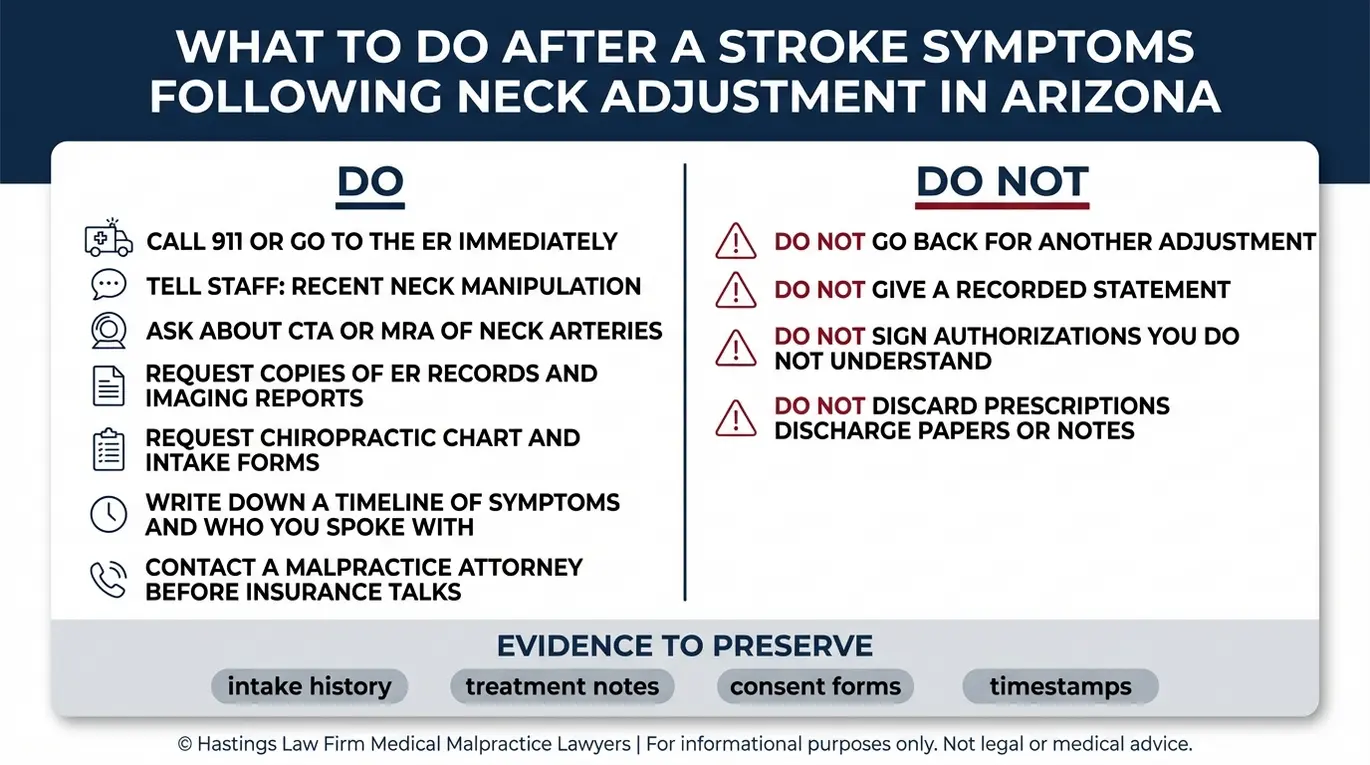
Victims of a stroke after neck adjustment should immediately seek emergency care, demand advanced imaging like a CTA, and secure legal counsel before speaking to insurance adjusters.
Immediate action checklist:
- Get to an emergency room immediately. Do not return to the chiropractor’s office. Tell the ER team about the recent cervical manipulation and request a CTA or MRA scan of the neck arteries.
- Request your chiropractic records right away. Ask for a complete copy of your treatment file, including intake forms, consent documents, and visit notes. Our team at Hastings Law Firm, which includes former defense attorneys and in-house medical staff familiar with charting practices, understands how important it is to ensure evidence preservation early before any alterations can occur.
- Do not give a recorded statement to the chiropractor’s malpractice insurance company. Insurance adjusters may contact you quickly, but anything you say can be used to minimize your claim.
- Contact an Arizona chiropractic negligence lawyer before discussing the case with any insurance representative. A lawyer for neck adjustment stroke cases can advise you on insurance carrier tactics and how to protect evidence and preserve your claim within Arizona’s filing deadlines.
Taking these steps early can help patients protect their health and their legal rights after a serious injury.
Contact the Arizona Healthcare Malpractice Attorneys at Hastings Law Firm Today for Help
You did not expect a routine chiropractic visit to change your life. If a stroke or vertebral artery dissection followed a neck adjustment, you deserve clear answers and honest guidance about what comes next.
Hastings Law Firm focuses exclusively on medical malpractice. Our team includes attorneys, nurse consultants, and former defense lawyers who understand how these cases are built and how they are defended. Founded by board-certified trial attorney Tommy Hastings, our firm is dedicated to the restoration of trust for patients who have been betrayed by the healthcare system.
We work on a contingency fee basis, which means you pay no attorney fees or costs unless we recover compensation for you. As an Arizona chiropractic stroke lawyer, our commitment is to stand beside you through every step of this process.
If you are ready to take the first step, contact us for a free case evaluation. We can review the details of your situation and explain your options.
Frequently Asked Questions About Chiropractic Stroke in Arizona


This content was researched and written by the Hastings Law Firm editorial team, which includes attorneys, medical professionals, and experienced researchers. Our writing is informed by internal knowledge and practical experience, and we cross-check critical details against authoritative sources cited throughout. Every piece undergoes human-led fact-checking and legal review. Because legal and medical information can change, if you spot an error, please contact us. Learn more about our content standards and review process on our editorial policy page.

Tommy Hastings, founder of Hastings Law Firm, is a board-certified personal injury trial lawyer dedicated exclusively to healthcare injury cases. Since 2001, he has represented injured patients and families in litigation against major hospital systems, pharmaceutical companies, and negligent healthcare providers nationwide. He has handled numerous high-profile cases that have drawn national media attention and resulted in multi-million dollar recoveries. He draws on that experience in his writing, helping readers understand how these cases work and what options may be available to them.
