


Arizona Cephalopelvic Disproportion Injury Lawyer
Cephalopelvic disproportion and obstructed labor can lead to severe birth injuries when warning signs are missed and a needed cesarean delivery is delayed. The article describes how a baby can become stuck during labor, how oxygen deprivation and trauma can follow, and why timely recognition and intervention matter for both mother and child. It also addresses how risk factors, monitoring, and decision making during labor can shape outcomes and long term care needs. If you or a loved one were harmed or worse due to cephalopelvic disproportion injuries in Arizona, contact Hastings Law Firm for a free, confidential case review.

Last Updated: September 24, 2026
Compassionate Legal Representation for Obstructed Labor Injuries in Arizona
When a delivery goes wrong because your baby was too large to safely pass through the birth canal, the consequences can be devastating. When medical teams fail to recognize warning signs or delay a necessary cesarean delivery, the results can be catastrophic. Complications may include oxygen deprivation, neurological damage, or uterine rupture, which is a tear in the uterine wall that can threaten the life of both mother and baby.
If your family is facing this situation, you are not alone. At Hastings Law Firm, we focus exclusively on medical malpractice, and our team includes nurse practitioners and former defense attorneys who understand how these cases unfold from the inside. As an Arizona cephalopelvic disproportion injury lawyer, we can review your records, explain what happened, and help you understand your options. Reach out to our Phoenix office for a free, confidential evaluation.

Understanding Cephalopelvic Disproportion and Preventable Birth Injuries
Cephalopelvic disproportion (CPD) occurs when a baby’s head or body is too large to fit through the mother’s pelvis, often requiring a cesarean section to prevent injury. This condition, also called obstructed labor, creates a physical mismatch that prevents the baby from descending through the birth canal even with strong contractions.
When CPD goes unrecognized, the baby can become stuck. The pressure on the baby’s head and the compression of the umbilical cord can lead to fetal distress, a condition where the baby’s oxygen supply is compromised. According to the MSD Manual’s overview of perinatal mortality, obstructed labor remains a significant contributor to adverse birth outcomes worldwide.
The critical window for intervention is narrow. Once the medical team recognizes that vaginal delivery is not safely possible, they must act quickly to perform a cesarean delivery. Delays during this window can result in brain injury, cerebral palsy, or other permanent harm. A CPD injury attorney examines the timeline of events to determine whether the decision to intervene came too late.
| Condition | Cause | Key Risk |
|---|---|---|
| Cephalopelvic Disproportion | Baby too large for maternal pelvis | Physical obstruction during delivery |
| Obstructed Labor | Prolonged labor without progress | Oxygen deprivation, fetal distress |
| Failure to Progress | Labor stalls without clear mechanical cause | May or may not involve CPD |
Distinguishing CPD from Failure to Progress
True CPD involves a mechanical obstruction where the baby physically cannot pass through the pelvis. Labor dystocia, commonly called failure to progress, describes a broader category where labor stalls for various reasons. The distinction matters because management differs.
When CPD is present, continued labor puts the baby at increasing risk. While CPD involves a physical mismatch, failure to progress is a general term for labor that has slowed or stopped. The standard of care is the level of care a reasonably competent medical professional would provide under similar circumstances. For legal and medical purposes, accurately identifying the condition affects how the standard of care is evaluated.

Risk Factors Doctors Must Monitor to Predict CPD
Obstetricians must monitor risk factors such as gestational diabetes, fetal macrosomia, and abnormal pelvic shape to predict and manage potential cephalopelvic disproportion. When these warning signs are present, the care team has a duty to prepare for possible complications.
Key risk factors include:
- Fetal macrosomia: A baby weighing more than 8 pounds, 13 ounces, which significantly increases the likelihood of CPD. According to the National Center for Biotechnology Information, macrosomia occurs in approximately 10% of pregnancies.
- Maternal diabetes: Both gestational and pre-existing diabetes are associated with larger babies.
- Small or abnormally shaped pelvis: Maternal anatomy plays a direct role in delivery feasibility, and a physical pelvic exam can help identify structural concerns.
- Post-term pregnancy: Babies who remain in the womb beyond 42 weeks continue growing, increasing size-related risks.
Before labor begins, physicians should use ultrasound imaging to obtain a fetal weight estimation, or estimated fetal weight (EFW), which helps predict whether vaginal delivery is safe. An Arizona birth injury lawyer reviews prenatal records to determine whether these assessments were performed and whether the results were appropriately considered.
The Hastings Law Firm Difference
Results matter, but what truly sets us apart is how we achieve them. Every verdict, every settlement, and every Arizona courtroom victory comes from one guiding promise: To treat each client’s fight for justice as if it were our own.
This balance of skill, experience, and empathy reflects our core philosophy that justice should not only compensate the injured, but also make health care safer nationwide.

Diagnosing CPD and The Decision to Perform a C-Section
A diagnosis of CPD is typically confirmed during labor when labor fails to progress despite strong contractions, necessitating an immediate decision to perform a C-section. By the time this diagnosis is made, the care team should already be prepared to act.
Clinical signs that suggest obstructed labor include molding of the fetal head and the development of caput succedaneum, swelling on the baby’s scalp caused by pressure against the cervix. When these signs appear alongside non-reassuring fetal heart rate patterns, the need for intervention becomes urgent.
An emergency cesarean delivery, or emergency C-section, is surgery performed when vaginal delivery poses an imminent danger. Continuing to use Pitocin, a synthetic form of oxytocin used to strengthen contractions, when CPD is present can force the baby against the obstruction and worsen oxygen deprivation. Similarly, attempting delivery with forceps or vacuum extractors in this situation can cause direct trauma. Attempting labor induction in the face of confirmed CPD is generally considered a breach of the standard of care.
The Role of Pelvimetry in Diagnosis
Radiologic pelvimetry is a diagnostic imaging technique that measures the dimensions of the mother’s pelvis. While it is not performed in every pregnancy, it can provide radiologic pelvimetry data when CPD is suspected. We examine whether these tools were available, ordered, or ignored when evaluating how the delivery was managed.

Proving Malpractice in Obstructed Labor Cases
Proving malpractice involves demonstrating that the medical provider deviated from the standard of care by failing to recognize CPD and delaying a necessary C-section, directly causing injury to the child. A medical malpractice claim requires proof of four elements of liability: duty, breach, causation, and damages.
Proving medical negligence involves showing that a competent obstetrician would have acted differently. Founded by board-certified trial attorney Tommy Hastings, we prepare every case from day one as if it will go to jury trial. Common breaches in CPD cases include failing to estimate fetal weight, continuing Pitocin augmentation after labor stalls, using forceps or vacuum extractors inappropriately, and delaying the decision to perform a cesarean.
Many parents hesitate to question their doctors. Years of trusting medical professionals can make it difficult to believe that something went wrong. Our role as a medical malpractice lawyer for CPD is to consult with an expert witness to validate your concerns and provide clarity through a thorough investigation and careful evidence preservation.
Evidence we gather includes:
- Labor and delivery nursing notes
- Fetal monitoring strips, also called cardiotocography (CTG) records, which track the baby’s heart rate throughout labor
- Physician orders and documentation
- Communication logs between nurses and physicians
- Ultrasound reports and prenatal records
Preserving Critical Labor and Delivery Evidence
Medical records and nursing notes are essential to reconstructing what happened during delivery. Fetal monitoring strips can be altered or lost if not secured early, and electronic audit trails can reveal if files were modified. If you believe your child was injured during birth, contacting an attorney promptly helps ensure that critical evidence is preserved before it becomes unavailable.
Identifying Liable Parties in Arizona Hospitals
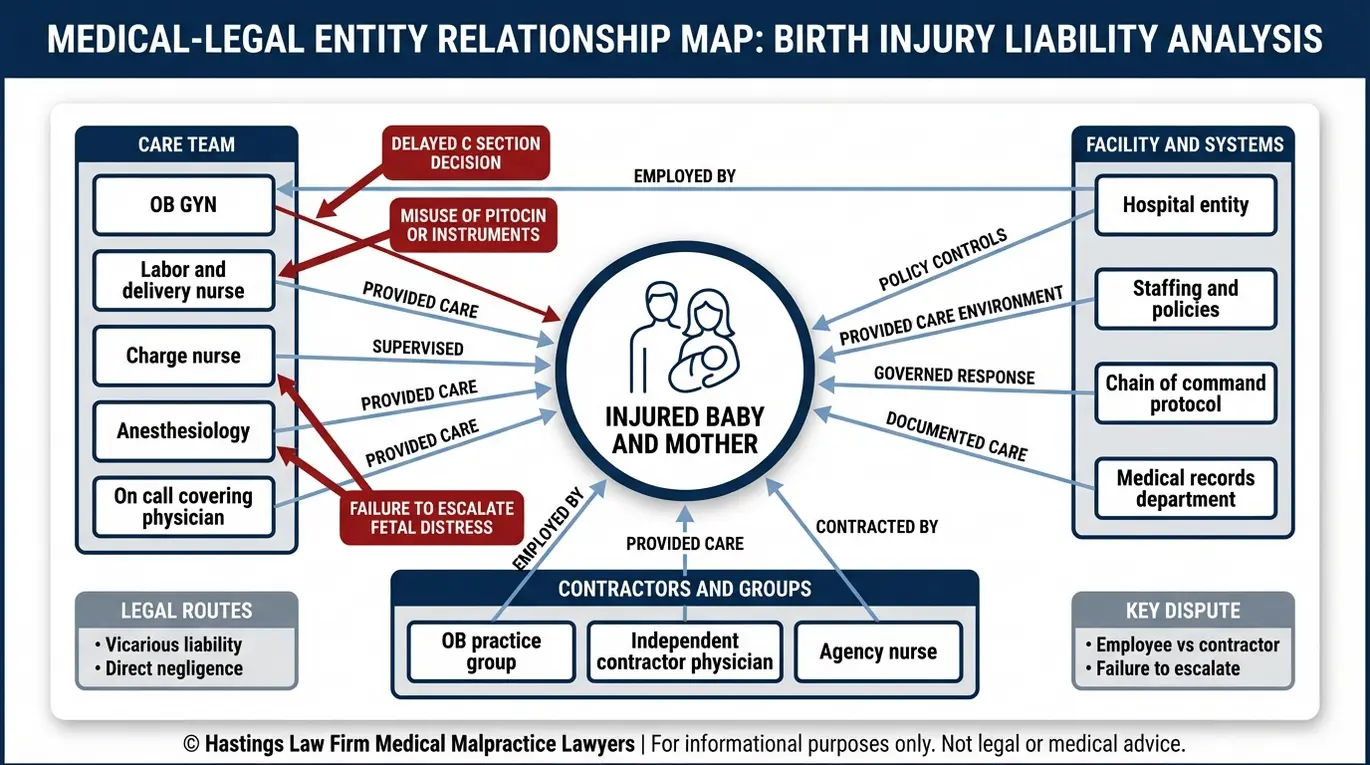
Liability in CPD cases may extend beyond the obstetrician to include nurses, the hospital entity for staffing failures, and independent contractors involved in the delivery. Determining who is responsible requires a careful examination of relationships and responsibilities.
Many obstetricians are independent contractors rather than hospital employees. Determining contractor liability versus hospital responsibility affects whether the hospital can be held vicariously liable for the physician’s actions. Vicarious liability means an employer is responsible for the actions of its employees while they are working. Under Arizona law, allegations of hospital negligence often focus on direct liability for failures, such as inadequate staffing or poorly maintained equipment.
The nursing staff has an independent duty to recognize signs of trouble and escalate concerns through the chain of command. If a nurse observes non-reassuring fetal heart tones and fails to alert the attending physician, that nurse and the hospital may share responsibility for the outcome.
Recovering Compensation for Lifetime Care Costs
Compensation in CPD birth injury claims covers past and future medical expenses, long-term rehabilitation, pain and suffering, and loss of future earning capacity. Children who suffer brain injuries from obstructed labor often require costly medical support and supervision for the rest of their lives.
Economic damages may include:
- Emergency and ongoing medical care
- Surgeries and hospitalizations
- Physical, occupational, and speech therapy
- Home modifications for accessibility
- Round-the-clock nursing care
Economic damages refers to measurable financial losses resulting from the injury. Non-economic damages address:
- Physical pain and suffering
- Emotional distress
- Loss of enjoyment of life
According to Scripps Health’s overview of life care planning, a full life care plan projects all future needs. This document is essential for calculating CPD injury compensation that truly accounts for lifetime costs, particularly for children diagnosed with cerebral palsy or hypoxic brain injury.
Contact the Arizona Birth Injury Attorneys at Hastings Law Firm Today for Help
At Hastings Law Firm, we understand that your family has been through something deeply painful. The medical system you trusted failed to protect your child, and now you are looking for answers. We are here to help you find them.
Our team prepares every case from day one as if it will go to trial. We do not handle other types of cases; medical malpractice is all we do. Our in-house medical staff, including Board Certified Patient Advocates, reviews records and helps us understand exactly what happened during your delivery.
We handle these cases on a contingency basis, which means you pay no attorney fees unless we recover compensation for your family. Reaching out costs nothing and carries no obligation.
If your child was injured during birth and you believe CPD was mismanaged, contact our Phoenix office today. Let us review your situation and explain your options.
Frequently Asked Questions About Cephalopelvic Disproportion Injury in Arizona


This content was researched and written by the Hastings Law Firm editorial team, which includes attorneys, medical professionals, and experienced researchers. Our writing is informed by internal knowledge and practical experience, and we cross-check critical details against authoritative sources cited throughout. Every piece undergoes human-led fact-checking and legal review. Because legal and medical information can change, if you spot an error, please contact us. Learn more about our content standards and review process on our editorial policy page.

Tommy Hastings, founder of Hastings Law Firm, is a board-certified personal injury trial lawyer (by the Texas Board of Legal Specialization) dedicated exclusively to healthcare injury cases. Since 2001, he has represented injured patients and families in litigation against major hospital systems, pharmaceutical companies, and negligent healthcare providers nationwide. He has handled numerous high-profile cases that have drawn national media attention and resulted in multi-million dollar recoveries.
