


Arizona Cauda Equina Syndrome Malpractice Lawyer
Written by: Hastings Law Firm | Reviewed by: Tommy Hastings | Updated: July 27, 2026
Cauda equina syndrome is a rare surgical emergency where delays in imaging and decompression can lead to permanent nerve damage and paralysis. Missed warning signs in emergency care can leave a person with lasting loss of bladder, bowel, sexual, and leg function, along with major financial and emotional strain. Understanding how symptoms were assessed, how quickly imaging was ordered, and whether treatment was escalated can clarify whether preventable harm occurred. If you or a loved one were harmed or worse due to a missed or delayed cauda equina syndrome diagnosis in Arizona, contact Hastings Law Firm for a free, confidential case review.

Experienced Arizona Medical Attorneys for Failure to Diagnose Cauda Equina Syndrome Claims
What You Should Know About Failure to Diagnose Cauda Equina Syndrome Claims in Arizona:
- Permanent paralysis and lifelong disability can result when cauda equina syndrome is not treated quickly with appropriate imaging and surgical decompression.
- Recovery prospects can drop sharply when care delays allow progression from incomplete symptoms to urinary retention.
- Liability can turn on whether red flag symptoms were recognized and treated as an emergency rather than dismissed as routine back pain or a urinary issue.
- Responsibility can be disputed among multiple providers when delays involve discharge decisions, imaging delays, or transfer delays.
- Compensation can account for long term medical costs, lost earning capacity, disability accommodations, and non economic harms such as pain and loss of enjoyment of life.
- Recovery options can be limited if the filing deadline under Arizona law is missed.
- Damage awards are not capped under Arizona law for personal injury or wrongful death.
- Case outcomes can depend on whether qualified experts link the delay in diagnosis or treatment to the permanent nerve damage.
- Future care needs can drive the value of a claim when life care planning projects ongoing supplies, therapy, and home modifications.

A Healthcare Focused Law Firm
Cauda Equina Syndrome is a surgical emergency where every hour without treatment can mean the difference between recovery and permanent paralysis. When doctors fail to recognize the warning signs, or delay the imaging and surgery that could prevent irreversible nerve damage, the consequences are devastating.
If you or a loved one suffered permanent injury because a medical provider missed or delayed a diagnosis of Cauda Equina Syndrome, you deserve answers. Founded by board-certified trial attorney Tommy Hastings, Hastings Law Firm focuses exclusively on medical malpractice litigation. Our team of attorneys, in-house nurse consultants, and medical experts understands both the medicine and the law behind these cases.
We are here to help you understand what happened and determine whether negligence played a role. Contact us for a free, confidential case evaluation to discuss your options.
Understanding Cauda Equina Syndrome and Emergency Medical Liability
Cauda Equina Syndrome (CES) is a rare but severe surgical emergency caused by the compression of the nerve roots at the lower end of the spinal cord, requiring immediate decompression to prevent permanent paralysis. The name comes from the Latin for “horse’s tail.” It describes the bundle of nerve roots and individual nerve fibers that branch off from the base of the spinal cord through the lumbar spine. Because these nerves provide connection to the lower body, damage here disrupts the signals necessary for basic bodily functions.
Unlike the spinal cord itself, these roots have some potential to heal, but only if pressure is removed before the nerve fibers die. These nerves control bladder function, bowel function, sexual function, and sensation and movement in the legs.
When something compresses these nerve roots, such as a herniated disc, a tumor, an abscess from infection, or spinal stenosis, patients can lose function rapidly. CES operates on a ticking clock. Research published in *Cauda Equina Syndrome: A Practical Guide to Definition and Classification* confirms that delays measured in hours can determine whether a patient walks again or faces lifelong disability. Timely emergency surgery is often the only way to relieve this pressure and preserve function.
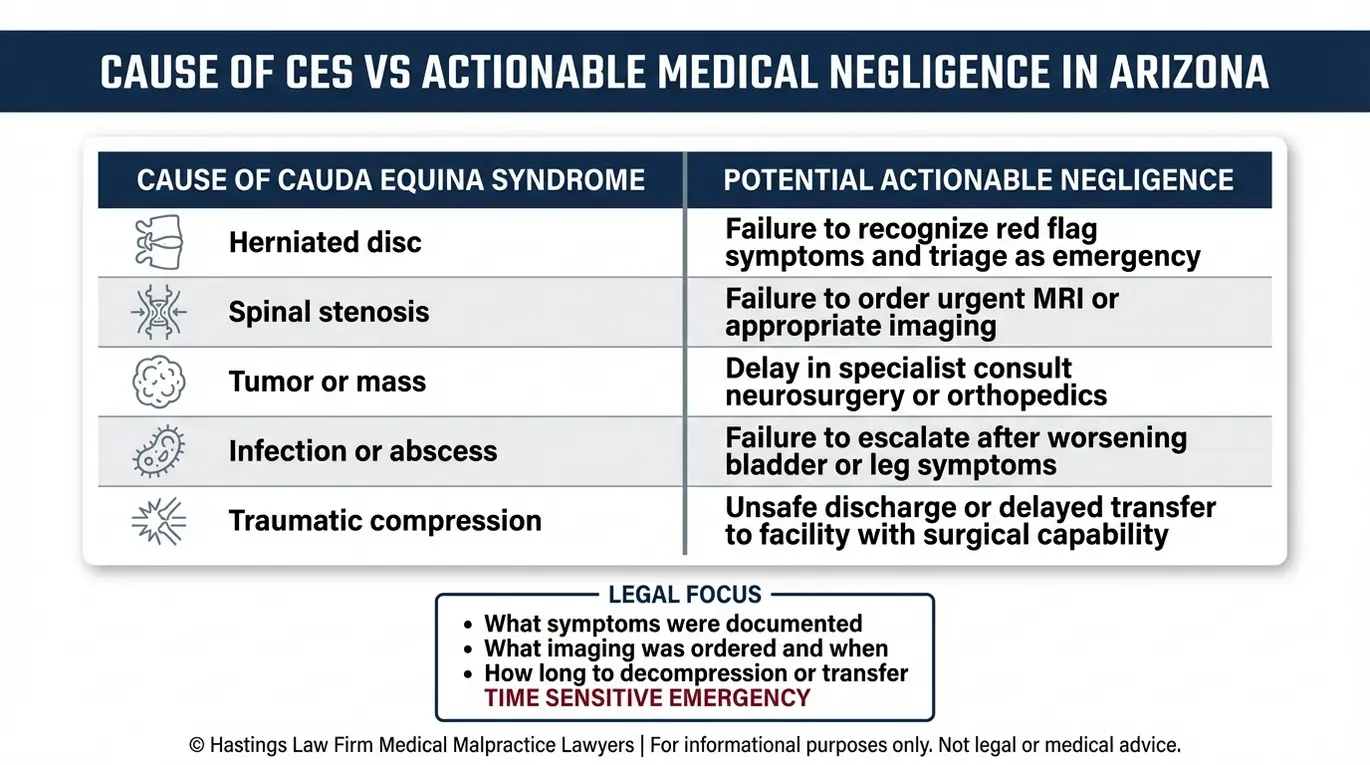
The medical cause of CES is not, by itself, grounds for a malpractice claim. The question is how the medical team responded once warning signs appeared.
| Medical Cause of CES | Potentially Liable Medical Act |
|---|---|
| Herniated disc compressing nerve roots | Dismissing symptoms as routine back pain without ordering imaging |
| Spinal tumor or abscess | Failing to investigate progressive neurological symptoms |
| Spinal stenosis causing nerve compression | Discharging the patient without an MRI or specialist consultation |
| Post-surgical swelling or hematoma | Ignoring new neurological deficits after a spinal procedure |
A Cauda Equina malpractice attorney examines whether the provider recognized the emergency and acted on it, or whether critical time was lost due to failures in diagnosis or treatment. A spinal cord injury lawyer builds the case around that gap between what should have been done and what actually happened.
Recognizing the Red Flags of Cauda Equina Syndrome
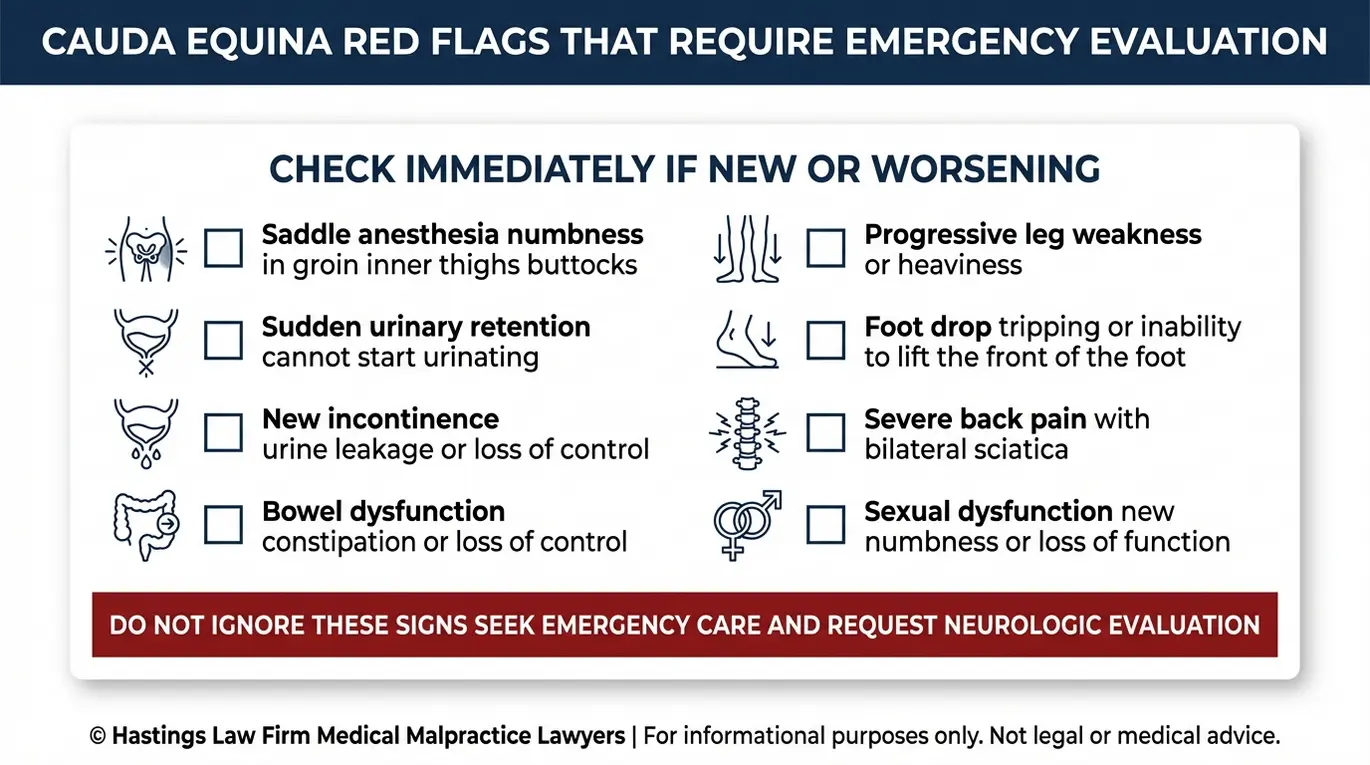
The hallmark “red flag” symptoms of Cauda Equina Syndrome include saddle anesthesia (numbness in the groin/buttocks), sudden urinary retention or incontinence, and severe lower back pain accompanied by leg weakness or foot drop. These symptoms are well-documented in emergency medicine literature, and any trained physician should recognize them as signals demanding immediate action.
Saddle anesthesia, which is numbness or loss of sensation in the groin, inner thighs, and buttocks, is one of the most critical warning signs. This symptom indicates direct compression of the sacral nerve roots. When it appears alongside back pain, it should immediately raise suspicion for CES.
In emergency departments, it can be overlooked if providers do not perform a thorough neurological examination. This examination is essential to identify the precise level of nerve involvement.
Bladder and bowel dysfunction are equally alarming. Urinary retention, the inability to empty the bladder despite feeling full, is a particularly ominous sign. It differs from incontinence, which involves involuntary leakage or loss of control. Both can signal CES, but retention is often the earlier indicator.
ER physicians sometimes attribute urinary symptoms to a urinary tract infection or medication side effects, especially in patients who also report back pain. This type of misdiagnosis can cost a patient the narrow window for effective treatment.
Motor deficits round out the clinical picture. Foot drop, where a patient cannot lift the front of the foot, or significant leg weakness can indicate progressive nerve damage. These symptoms may develop quickly or worsen over a matter of hours.
Red Flag Symptom Checklist for Cauda Equina Syndrome:
- Saddle anesthesia (numbness in the groin, buttocks, or inner thighs)
- Urinary retention or new-onset incontinence
- Bowel dysfunction or loss of bowel control
- Severe or rapidly worsening lower back pain
- Bilateral leg weakness or heaviness
- Foot drop (inability to lift the front of the foot)
- Sexual dysfunction or loss of genital sensation
- Sciatica-type pain radiating into both legs
When a patient presents with even one or two of these symptoms in combination with back pain, the standard of care generally calls for urgent diagnostic workup. When those red flags are ignored or mischaracterized, that delay can constitute medical negligence.
The Hastings Law Firm Difference
Results matter, but what truly sets us apart is how we achieve them. Every verdict, every settlement, and every Arizona courtroom victory comes from one guiding promise: To treat each client’s fight for justice as if it were our own.
This balance of skill, experience, and empathy reflects our core philosophy that justice should not only compensate the injured, but also make healthcare safer nationwide.

Establishing Negligence in Arizona Cauda Equina Malpractice Cases
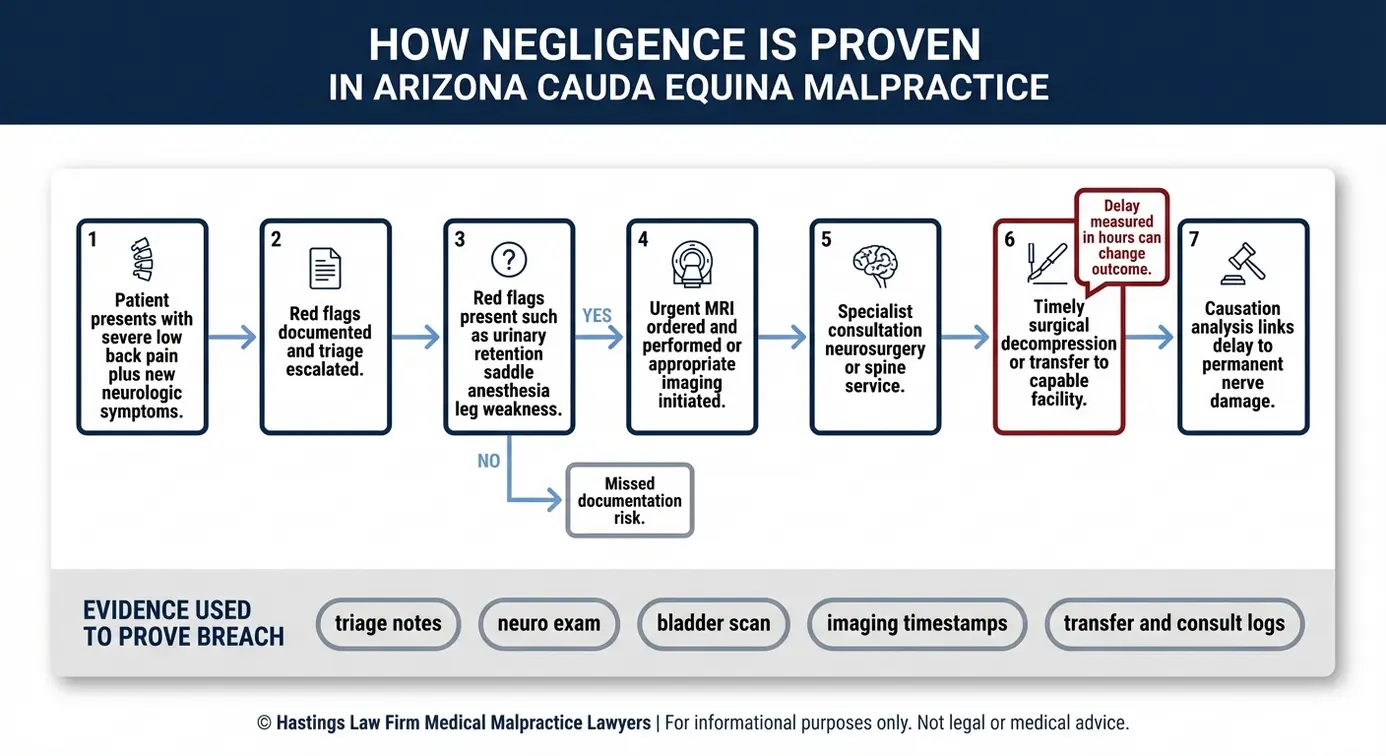
To establish negligence, a plaintiff must prove that the medical provider violated the standard of care by failing to order immediate diagnostic imaging (MRI) or failing to perform timely surgical decompression despite the presence of red flag symptoms. In Arizona, this requires building a clear chain of proof from the patient’s presentation to the provider’s actions to the resulting harm.
Our attorneys include former defense counsel who previously represented hospitals. This provides insight into the protocols and tactics the other side may use when defending a case involving permanent nerve damage from Cauda Equina Syndrome.
Defining the Standard of Care
The standard of care is the level of skill and treatment that a reasonably competent medical professional in the same specialty would provide under similar circumstances. For a patient who arrives at an Arizona emergency room with back pain and neurological symptoms like urinary retention, the standard of care typically calls for an urgent magnetic resonance imaging scan (MRI). This diagnostic tool uses magnetic fields to produce detailed images of the spinal cord and surrounding tissues.
While an MRI is the gold standard, a CT scan (computed tomography) may be used if an MRI is contraindicated, though it provides less detail of the soft tissues. If imaging confirms nerve compression, the next step is typically an emergency consultation with a neurosurgeon.
Where the Breach Occurs
An Arizona medical malpractice lawyer often identifies failures such as:
- Discharging a patient with pain medication and a follow-up appointment instead of ordering imaging
- Attributing classic CES symptoms to a simple back strain or urinary tract infection
- Ordering imaging but failing to act on the results with appropriate urgency
- Delaying transfer to a facility with neurosurgery capabilities when the current hospital cannot perform surgical decompression
A failure to diagnose Cauda Equina allows the compression to continue unchecked. Research published in *Definition and Surgical Timing in Cauda Equina Syndrome* (PLOS ONE) underscores that earlier decompression surgery is associated with better neurological outcomes.
Proving Causation
Causation is often the most contested element. The legal argument is that the breach of standard of care caused the permanent injury, not the underlying condition itself. Our team works with qualified neurosurgical experts to reconstruct the timeline.
We analyze when symptoms appeared, when imaging should have been ordered, and when surgery could have been performed. If the evidence shows that earlier intervention would have prevented the progression to permanent nerve damage, causation can be established. This analysis requires a minute-by-minute review of the medical records and provider logs.
Under Arizona Revised Statutes § 12-2506, Arizona has abolished joint and several liability in most cases, meaning each defendant is responsible only for the percentage of fault assigned to them. This makes precise identification of each provider’s role in the delay especially important.
Common Defense Strategies in CES Cases
Defense attorneys in CES cases often rely on two primary arguments. The first is “inevitability,” the claim that the nerve damage was already irreversible by the time the patient sought care, regardless of what the provider did. The second is “rarity,” where they argue that CES is so uncommon that a physician could not reasonably be expected to identify it.
These defenses attempt to shift responsibility away from the provider and onto the rarity of the condition. Both defenses can be challenged with expert testimony and a thorough review of the medical records. Documenting the exact timeline of symptom onset, provider contact, and treatment decisions allows our medical and legal teams to evaluate whether a window for intervention existed and was missed.
The Critical Distinction Between Incomplete and Complete Cauda Equina Syndrome
CES-Incomplete (CES-I) involves urinary difficulties such as altered sensation and reduced control, with some bladder function remaining, while CES-Retention (CES-R) involves painless urinary retention and overflow incontinence; the distinction is vital because surgery during the CES-I stage often reverses damage, whereas outcomes for CES-R are significantly worse. This differentiation between CES-I and CES-R is central to both the medical prognosis and the legal case.
When a patient is still in the CES-I stage, the nerve roots are compressed but not yet permanently damaged. Emergency surgery during this window often leads to significant recovery, and in some cases, full restoration of function. According to research cited in *Cauda Equina Syndrome: Poor Recovery Prognosis Despite Early Treatment* (PubMed), outcomes decline substantially once a patient progresses to CES-R. The surgical urgency cannot be overstated when a patient presents with incomplete symptoms.
This medical distinction carries enormous legal weight. A delayed diagnosis of Cauda Equina that allows a patient to deteriorate from incomplete to complete status demonstrates a clear failure. If medical records show that a patient arrived at the emergency department with CES-I symptoms, and hours passed without imaging or surgical intervention, that timeline can demonstrate a clear breach of the standard of care.
| Factor | CES-Incomplete (CES-I) | CES-Retention (CES-R) |
|---|---|---|
| Bladder function | Difficulty urinating; some control remains | Complete urinary retention or overflow incontinence |
| Sensation | Partial saddle anesthesia | Significant or total loss of perineal sensation |
| Recovery with prompt surgery | Often significant to full recovery | Frequently limited; permanent deficits common |
| Legal significance | Represents the treatable window; delay here is highly actionable | Progression to this stage after a missed diagnosis strengthens causation |
This distinction also directly counters the “inevitability” defense. If we can demonstrate through records and expert analysis that the patient was still in the incomplete stage when they first sought care, the argument that “nothing could have been done” falls apart.
In legal terms, the shift from incomplete vs complete CES represents a pivotal moment. If a medical provider had the opportunity to intervene during the incomplete stage but failed to do so, they may be liable for the worsening of the condition. This progression transforms a treatable injury into a life sentence of paralysis and permanent nerve damage.
Life Altering Consequences and Compensation for CES Victims
Victims of untreated Cauda Equina Syndrome can recover damages for past and future medical costs, lost earning capacity, permanent disability accommodations, and non-economic damages for pain, suffering, and loss of enjoyment of life. A Cauda Equina lawsuit seeks to account for the full scope of harm, both the costs you can measure and the losses that are harder to quantify. Seeking compensation for nerve damage helps families access essential resources without financial ruin.
Economic Damages
The financial burden of permanent nerve damage from CES is ongoing and substantial. Patients may require lifetime catheterization supplies and bowel management programs. This includes the catheters, sterile supplies, lubricants, and anti-infection medications required daily.
Physical therapy, occupational therapy, and pain management are necessary to maintain mobility and reduce suffering. Home modifications such as wheelchair ramps and accessible bathrooms accommodate limited mobility. Patients may also require mobility equipment including wheelchairs or braces for foot drop.
Non-Economic Damages
Beyond the bills, CES can fundamentally alter a person’s daily life, sometimes causing paralysis. Compensation for permanent disability settlements may include damages for chronic pain, loss of sexual function, mental anguish, and depression. These are deeply personal losses, and Arizona law recognizes their significance.
Life Care Planning
Calculating the true cost of a permanent CES injury requires more than adding up current medical bills. We work with certified life care planners to develop cost projections for the full range of medical, rehabilitative, and supportive care a patient will need.
The International Academy of Life Care Planners’ Standards of Practice provides the framework these experts use to develop evidence-based estimates. This analysis ensures that any settlement or verdict accounts for decades of care, not just immediate expenses. A comprehensive plan accounts for potential complications such as skin breakdown, recurring infections, and the need for increasingly supportive mobility devices.
Contact the Arizona Healthcare Malpractice Attorneys at Hastings Law Firm Today for Help
If you or a loved one suffered permanent injury because of a delayed or missed Cauda Equina Syndrome diagnosis, the team at Hastings Law Firm is ready to listen. As an Arizona Cauda Equina malpractice law firm, we focus exclusively on medical malpractice. Our attorneys, in-house nurses, and medical experts work together to determine what happened and whether negligence caused the harm.
We understand how isolating it can feel when the medical system has failed you. You may have questions about what went wrong or whether you even have a case. That is exactly what our free, confidential case evaluation is designed to answer.
Arizona’s statute of limitations means there is a deadline to file your claim, so we encourage you to contact our attorneys sooner rather than later. You pay no fees unless we recover compensation on your behalf. Let us help you find the answers you deserve.
Frequently Asked Questions About Cauda Equina Syndrome Malpractice in Arizona


This content was researched and written by the Hastings Law Firm editorial team, which includes attorneys, medical professionals, and experienced researchers. Our writing is informed by internal knowledge and practical experience, and we cross-check critical details against authoritative sources cited throughout. Every piece undergoes human-led fact-checking and legal review. Because legal and medical information can change, if you spot an error, please contact us. Learn more about our content standards and review process on our editorial policy page.

Tommy Hastings, founder of Hastings Law Firm, is a board-certified personal injury trial lawyer dedicated exclusively to healthcare injury cases. Since 2001, he has represented injured patients and families in litigation against major hospital systems, pharmaceutical companies, and negligent healthcare providers nationwide. He has handled numerous high-profile cases that have drawn national media attention and resulted in multi-million dollar recoveries. He draws on that experience in his writing, helping readers understand how these cases work and what options may be available to them.
