


Arizona Cardiologist Malpractice Lawyer
Written by: Hastings Law Firm | Reviewed by: Tommy Hastings | Updated: July 27, 2026
Cardiologist negligence can leave patients and families facing permanent heart damage, stroke, or other life changing losses after a missed warning sign, a testing error, a procedure mistake, or a medication problem. Arizona claims often turn on whether the care fell below the accepted standard and whether that lapse directly caused the harm. Medical records, timelines, and informed consent details can be central when care was delayed or critical information was missed during hand offs. If you or a loved one were harmed or worse due to cardiologist malpractice in Phoenix, Arizona, contact Hastings Law Firm for a free, confidential case review.

Top-Rated Arizona Legal Representation for Cardiac Negligence Patients
What You Should Know About Heart Doctor Negligence Claims in Arizona:
- Lasting heart damage, stroke, or fatal outcomes can follow when cardiac symptoms are minimized or treatment is delayed during a time sensitive emergency.
- Recovery can be blocked even after a clear mistake when a direct link between the cardiologist error and the injury cannot be shown.
- Hospital responsibility can become an issue when breakdowns occur during transitions of care between emergency staff and on call cardiologists.
- Compensation can cover financial losses and personal harms, including medical bills, lost wages, pain and suffering, and loss of enjoyment of life.
- Wrongful death claims can allow families to seek damages tied to the loss, including funeral expenses and loss of companionship.
- Options can be lost if Arizona time limits for filing a medical malpractice claim are missed.
- Total recovery is not capped in Arizona for personal injury or death, which can affect the potential value of severe cardiac injury claims.
- A reduced recovery can result when patient fault is alleged under comparative negligence, even when malpractice is also claimed.
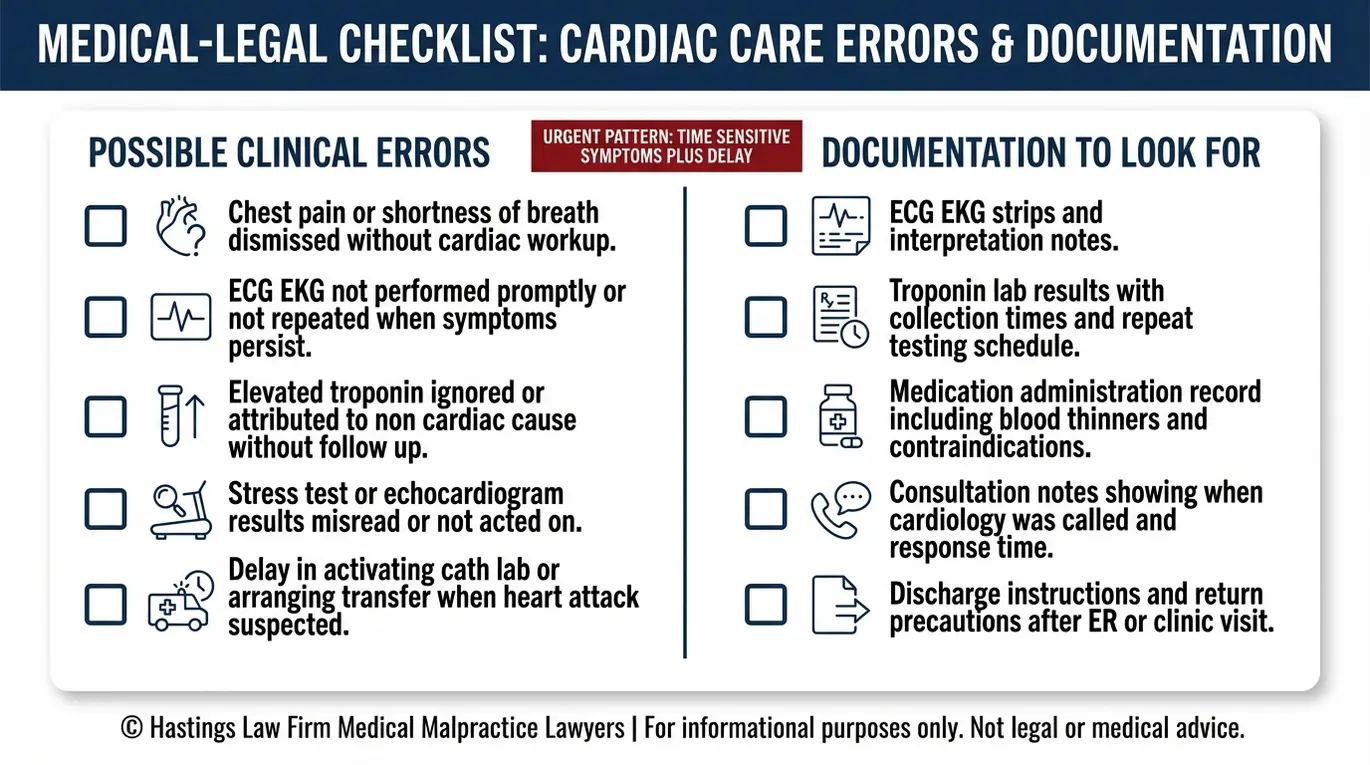
- Proof often depends on what the medical chart shows about tests ordered, abnormal results, and the timing of clinical decisions.
- Expert review can be central in cardiac cases because Arizona requires qualified specialists to support medical malpractice claims.

A Healthcare Focused Law Firm
When a cardiologist’s error causes serious heart damage or the loss of someone you love, the experience can feel impossible to carry alone. You trusted a specialist with your life, and something went wrong. You have every right to seek answers and understand what happened.
At Hastings Law Firm, we focus exclusively on medical malpractice. Our team of attorneys, nurse consultants, and board-certified patient advocates understands both the medicine and the law behind cardiac negligence claims. As a dedicated Arizona cardiologist malpractice lawyer team, we are here to help you understand your situation and your legal options.
If you believe a heart doctor’s mistake caused harm to you or a loved one, we welcome the chance to review your situation. Contact our Phoenix office for a free, confidential case evaluation.
When Does a Heart Doctor’s Error Constitute Medical Malpractice
Medical malpractice occurs when a cardiologist deviates from the accepted standard of care, resulting in injury or death. It is not simply a bad outcome. It is a preventable failure to act the way a competent specialist would under similar circumstances.
The standard of care in cardiology refers to the level of treatment and decision-making that a reasonably skilled cardiologist would provide given the same patient presentation, test results, and clinical setting. This legal duty of care is the benchmark for measuring negligence. This standard takes into account factors like the patient’s symptoms, medical history, and the diagnostic tools available at the time. It is not a standard of perfection, but rather one of competence. If a reasonably prudent doctor would have acted differently, the standard has been breached.
Not every complication after a cardiac procedure is malpractice. Heart treatments carry known risks, and patients may experience adverse outcomes even when a doctor does everything right. The legal question is whether the cardiologist’s actions fell below what the medical community would consider acceptable, and whether that failure directly caused the patient’s injury.
That second element is called causation. In cardiac cases, your Arizona cardiologist malpractice lawyer must establish a direct link between the doctor’s error and the resulting harm, whether that harm is permanent heart muscle damage, stroke, or death. This creates a complex burden of proof.
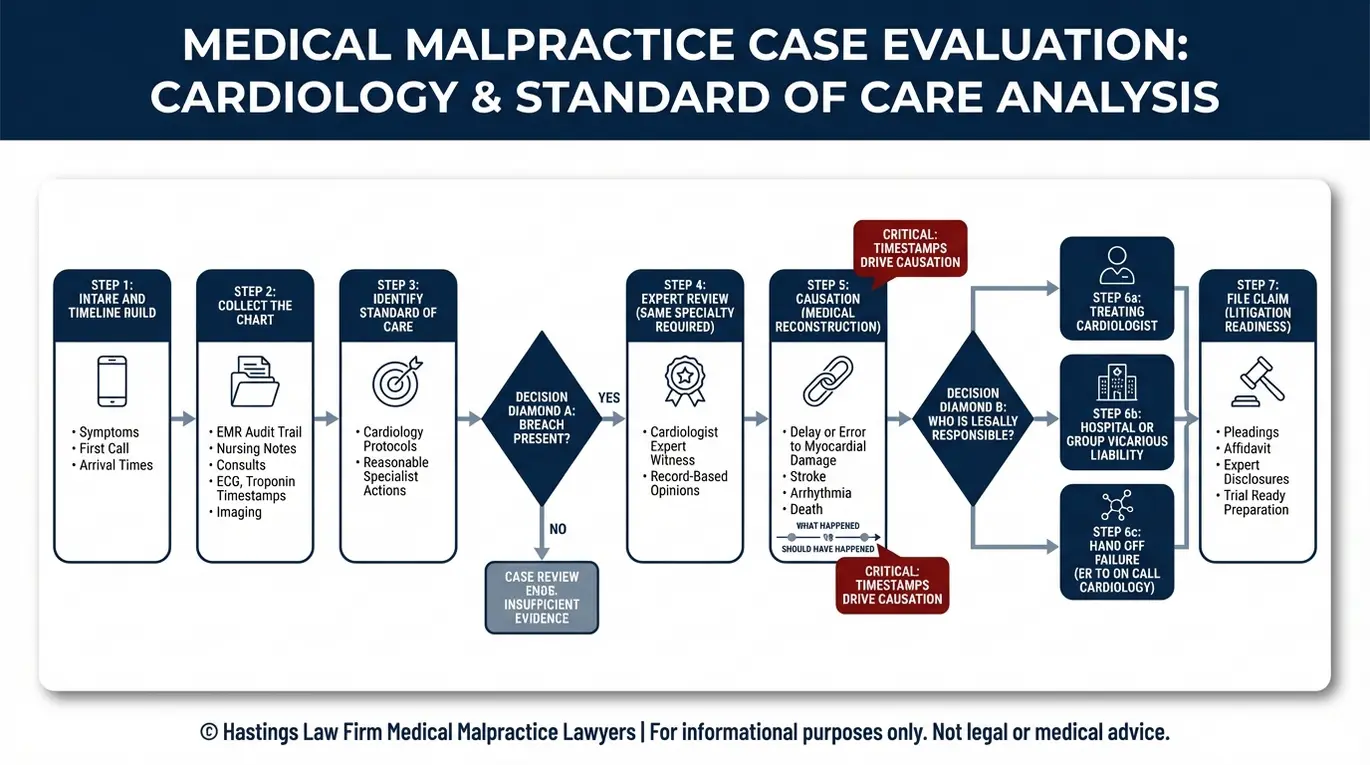
It is not enough to show that a mistake happened; we must prove that the specific injury would not have occurred but for that mistake. A cardiologist negligence attorney works with medical experts to reconstruct the timeline and determine whether proper care would have changed the outcome. Without this link, even a clear error cannot result in a successful malpractice claim.
To evaluate whether heart doctor negligence may have occurred, we typically examine:
- Whether the cardiologist ordered and correctly interpreted appropriate diagnostic tests, such as a cardiac stress test (a monitored exercise or medication-induced test that reveals how the heart responds under exertion) or an echocardiogram (an ultrasound of the heart that shows its structure and function)
- Whether the cardiologist acted on abnormal findings in a timely manner
- Whether the patient was properly informed of the risks and alternatives before a procedure
- Whether a breach of duty, meaning a failure to meet the expected standard, led to measurable harm
- Whether liability can be established through medical records, expert analysis, and clinical timelines
Understanding the difference between a known risk and a preventable error is the foundation of every cardiology malpractice case.
Common Forms of Cardiologist Negligence in Arizona
Common forms of cardiologist malpractice in Arizona include failure to diagnose heart attacks, medication errors, surgical mistakes during angioplasty or stenting, and failure to accurately interpret diagnostic tests like EKGs, echocardiograms, or stress tests.
Misdiagnosis and Failure to Diagnose
One of the most dangerous errors is dismissing cardiac symptoms as something less serious. Chest pain may be attributed to heartburn, anxiety, or musculoskeletal issues, especially in women and younger patients.
A myocardial infarction, or heart attack, occurs when blood flow to the heart is blocked. Research published by the National Institutes of Health on gender bias in cardiovascular diagnosis confirms that women are more likely to have their cardiac symptoms minimized or misinterpreted.
When a cardiologist fails to recognize the warning signs of a heart attack, the delay in treatment can be fatal. According to the CDC’s guidance on heart attack symptoms, risk, and recovery, recognizing and responding to symptoms quickly is essential to survival.
Testing Errors
Misreading an electrocardiogram (ECG/EKG), a test that records the electrical activity of the heart, is a well-documented source of cardiac negligence. Ignoring elevated cardiac troponin levels, a protein released into the blood when heart muscle cells are damaged, can also constitute a serious breach. These diagnostic tests exist precisely to catch life-threatening conditions early. When a cardiologist misinterprets or overlooks them, the consequences can be irreversible.
Surgical Errors
A cardiac catheterization involves using a thin tube to help doctors see how well the heart is functioning. Mistakes during catheterization, coronary stent placement, or pacemaker installation can lead to vessel perforation, blood clots, or device malfunction. These procedures require precision and careful patient monitoring before, during, and after intervention.
Medication Errors
Anticoagulants are specialized medications used to prevent blood clots from forming in the heart or vessels. Improper prescribing of blood thinners or anticoagulants may lead to uncontrolled bleeding, hemorrhagic stroke, or clotting events. Dosage miscalculations or failure to account for drug interactions can turn a treatable condition into a medical emergency.
| Error Type | Clinical Consequence |
|---|---|
| Failure to diagnose heart attack | Permanent heart muscle death, cardiac arrest, or fatality |
| Misreading EKG/ECG or troponin results | Delayed treatment, progressive heart damage |
| Surgical mistakes (stent, catheter, pacemaker) | Vessel perforation, blood clots, device failure |
| Medication errors (blood thinners, dosing) | Hemorrhage, stroke, or dangerous clotting |
A cardiac negligence lawyer evaluates each of these scenarios by reviewing the clinical timeline, the tests ordered, and the decisions made at every stage of care.
The Golden Hour and the Impact of Delayed Treatment
In cardiology, the phrase “time is muscle” reflects a critical medical reality. Every minute that passes during a heart attack without intervention means more heart muscle dies. The golden hour refers to the window of time immediately following a cardiac event when treatment, such as angioplasty or the administration of thrombolytics (clot-busting drugs that restore blood flow), is most effective.
When emergency room staff or on-call cardiologists delay intervention during this period, the consequences grow more severe with each passing minute. A patient who might have recovered fully with timely treatment may instead suffer permanent heart failure or death.
This is directly tied to the legal concept of proximate cause. If a patient presented with chest pain and shortness of breath, and the medical team failed to act within the appropriate window, we examine whether that delay is what caused the resulting injury. The medical records, lab timestamps, and treatment logs often tell that story clearly.
The Hastings Law Firm Difference
Results matter, but what truly sets us apart is how we achieve them. Every verdict, every settlement, and every Arizona courtroom victory comes from one guiding promise: To treat each client’s fight for justice as if it were our own.
This balance of skill, experience, and empathy reflects our core philosophy that justice should not only compensate the injured, but also make healthcare safer nationwide.

Proving Liability in Complex Cardiac Litigation
Proving liability requires gathering detailed medical records to demonstrate a breach of duty and securing expert testimony to establish that the cardiologist’s delay or error directly caused the patient’s injury or death.
Our team approaches every case with the same investigative discipline, regardless of whether the claim involves a missed diagnosis or a surgical complication. Here is how an Arizona cardiologist malpractice lawyer builds a case from the ground up:
- Collecting the full medical chart: This includes electronic medical record (EMR) audit trails, nursing notes, physician orders, lab timing stamps, and imaging results. These records reveal exactly what was known, when it was known, and what action was or was not taken.
- Retaining same-specialty medical experts: Under Arizona Revised Statutes § 12-2604, expert witnesses in medical malpractice cases must meet specific qualification standards. We work with board-certified cardiologists and cardiac surgeons who can speak credibly about what the standard of care required in a given situation.
- Evaluating informed consent: Before procedures like angioplasty or stent placement, patients must be told about the risks, alternatives, and expected outcomes. If a cardiologist failed to provide this information, or if the consent process was rushed or incomplete, that may form an independent basis for a claim. The Arizona Department of Health Services’ policy on informed consent outlines the standards that apply in emergency and clinical settings.
- Analyzing hand-off communication: Some of the most dangerous hand-off errors in heart specialist malpractice happen during transitions of care between emergency room physicians and on-call cardiologists. We review communication logs, call records, and transfer documentation to identify whether critical information was lost or delayed during these hand-offs. In some cases, vicarious liability, which means the hospital is legally responsible for the actions of its staff, may extend to the institution itself if its systems contributed to the breakdown.
Proving medical negligence in cardiac cases demands both legal precision and deep medical knowledge. Our in-house nurse consultants and board-certified patient advocates assist in analyzing clinical data so that every piece of evidence supports a clear narrative for a judge or jury.
Recoverable Damages for Cardiac Injuries in Arizona
Patients harmed by cardiologist negligence can recover economic damages for medical bills and lost wages, as well as non-economic damages for pain, suffering, and loss of enjoyment of life. In wrongful death cases, families may also recover funeral expenses and loss of companionship.
Economic Damages
These cover the measurable financial losses that result from a cardiac injury. Calculations for these losses often require economic experts to project the long-term financial impact of the injury on your household. They include:
- Past and future medical expenses, such as cardiac rehabilitation, ongoing medication, follow-up procedures, and in-home care
- Lost wages and diminished earning capacity if the injury prevents the patient from returning to work at their previous level
- Out-of-pocket costs related to travel for treatment, medical equipment, or necessary home modifications
Non-Economic Damages
Cardiac injuries affect more than a patient’s finances. No amount of money can undo the damage, but these funds provide resources to manage the life-altering consequences of the error. Non-economic damages account for:
- Physical pain and suffering caused by the injury and subsequent treatment
- Emotional distress, including anxiety, depression, and fear of future cardiac events
- Loss of consortium, which compensates a spouse or partner for the loss of companionship and support
Wrongful Death
When a cardiologist’s negligence results in death, surviving family members may pursue a wrongful death claim. Arizona law recognizes the profound impact of this loss on the family unit, allowing for broad recovery in these tragic circumstances. These cases can include recovery for funeral and burial costs, loss of the deceased’s income and financial support, and the emotional toll of losing a loved one.
The Arizona Constitution, Article 2, Section 31, prohibits caps on damages for personal injury or death. This means that unlike many other states, Arizona does not place an artificial ceiling on what a jury can award. Arizona medical malpractice compensation reflects the full scope of harm, and cardiologist lawsuit settlements or jury judgments are based on the actual impact to the patient and their family.
Why Arizona Families Trust Hastings Law Firm
Families choose Hastings Law Firm because of our board-certified leadership, specialized medical-legal team, and a record of securing significant results for clients while treating each person with genuine empathy and respect. We understand that a lawsuit cannot change the past, but it can ensure that the same dangerous practices do not harm others. We are committed to patient safety and accountability in the medical field.
Our founder, Tommy Hastings, is board certified in Personal Injury Trial Law by the Texas Board of Legal Specialization, a distinction held by fewer than 2% of Texas attorneys. He is a 2025 inductee into the American Board of Trial Advocates (ABOTA), an invitation-only organization for experienced trial lawyers. His career includes landmark results in medical negligence cases, including a $19.5 million settlement for a teenager with a neurological injury and an $8 million settlement for ICU monitoring failures.
What makes our firm different as an Arizona cardiologist malpractice lawyer is the depth of our medical resources. Our legal team includes former defense attorneys and experienced hospital nurses who previously worked for the systems they now challenge. This background provides a strategic advantage in anticipating defense tactics and identifying inconsistencies in medical charting. Our in-house nurse consultants and board-certified patient advocates further assist in interpreting clinical data to determine where the standard of care was breached.
We operate on a contingency fee basis. You pay no attorney fees or costs unless we recover compensation on your behalf. Our Phoenix office provides medical malpractice legal services families can trust with their cardiac claims.
Every case we accept is prepared from day one as though it will go to trial. That level of preparation sends a clear message to the other side and helps us negotiate from a position of strength. At Hastings Law Firm in Arizona, your case is never just a file. You are a partner in this process, and we are committed to finding the truth and holding the responsible parties accountable.
Contact the Arizona Doctor Malpractice Attorneys at Hastings Law Firm Today for Help
You do not have to face a hospital’s legal team on your own. At Hastings Law Firm, our mission is to restore the trust that was broken and to protect your family’s financial future. We have the medical knowledge, legal experience, and trial preparation to stand with you through every stage of your case.
Arizona has strict time limits for filing a medical malpractice claim, so it is important to act while your options are still available. Contact our Phoenix office today for a free, confidential case evaluation. There is no fee unless we win.
Call us or fill out our online form to speak with a member of our team. Let us help you get the answers you deserve.
Frequently Asked Questions About Cardiologist Malpractice in Arizona


This content was researched and written by the Hastings Law Firm editorial team, which includes attorneys, medical professionals, and experienced researchers. Our writing is informed by internal knowledge and practical experience, and we cross-check critical details against authoritative sources cited throughout. Every piece undergoes human-led fact-checking and legal review. Because legal and medical information can change, if you spot an error, please contact us. Learn more about our content standards and review process on our editorial policy page.

Tommy Hastings, founder of Hastings Law Firm, is a board-certified personal injury trial lawyer dedicated exclusively to healthcare injury cases. Since 2001, he has represented injured patients and families in litigation against major hospital systems, pharmaceutical companies, and negligent healthcare providers nationwide. He has handled numerous high-profile cases that have drawn national media attention and resulted in multi-million dollar recoveries. He draws on that experience in his writing, helping readers understand how these cases work and what options may be available to them.
