


Arizona Brain Injury From Medical Negligence Lawyer
Written by: Hastings Law Firm | Reviewed by: Tommy Hastings | Updated: July 27, 2026
A brain injury from medical negligence can leave families facing sudden disability, long term care needs, and overwhelming uncertainty about what went wrong. Surgical trauma, anesthesia mistakes, and missed post operative complications can cause permanent harm when monitoring and safety protocols are not followed. In Arizona, these claims often turn on whether the standard of care was breached and whether the medical records and expert review connect the error to the injury. If you or a loved one were harmed or worse due to brain injury from medical negligence in Arizona, contact Hastings Law Firm for a free, confidential case review.

Trusted Arizona Medical Attorneys for Surgical Brain Injury Claims
What You Should Know About Traumatic Brain Injury From Surgery Claims in Arizona:
- Long term recovery can be shaped by whether the brain injury is linked to a preventable medical error rather than an unavoidable complication.
- Permanent harm can follow when oxygen levels are not properly monitored during or after anesthesia and warning signs are not addressed in time.
- Lasting neurological damage can result from surgical trauma to brain tissue or blood vessels during delicate procedures.
- Severe outcomes can occur after surgery when neurological changes are missed in recovery and time sensitive complications are not treated promptly.
- Liability can depend on showing that a provider fell below the accepted standard of care and that the breach directly caused the brain injury.
- Options can be lost if required expert support is not provided because Arizona requires qualified specialist input to proceed with a claim.
- Compensation can reflect lifelong needs because Arizona does not allow caps on damages for personal injury or fatal outcomes.
- Future security can be affected by settlement finality because a resolved claim generally cannot be reopened if care needs increase later.
- Rights can be fully barred if filing deadlines are missed because Arizona and federal claims can have strict time limits.
- The path to recovery can be more complex for injuries at VA or military facilities because claims are brought against the United States government under a separate process.

A Healthcare Focused Law Firm
A brain injury caused by a medical error changes everything in an instant. If you or a loved one suffered an iatrogenic brain injury, meaning brain damage caused by medical treatment rather than an outside accident, the confusion and fear that follow can feel paralyzing. Since 2005, Hastings Law Firm has focused solely on medical malpractice litigation to help families find answers. Whether the harm occurred during surgery, in the post-anesthesia care unit (PACU), where patients are monitored immediately after a procedure, or through a missed diagnosis, you deserve to know what happened and why.
As an Arizona Brain Injury From Medical Negligence Lawyer, Hastings Law Firm focuses entirely on holding healthcare providers accountable when preventable errors cause lasting harm. Our team of attorneys, nurse consultants, and medical experts is built to handle exactly these cases.
If you believe a medical mistake led to a brain injury, we can review what happened and explain your legal options in a free, confidential consultation.
Common Medical Errors Leading to Preventable Brain Damage
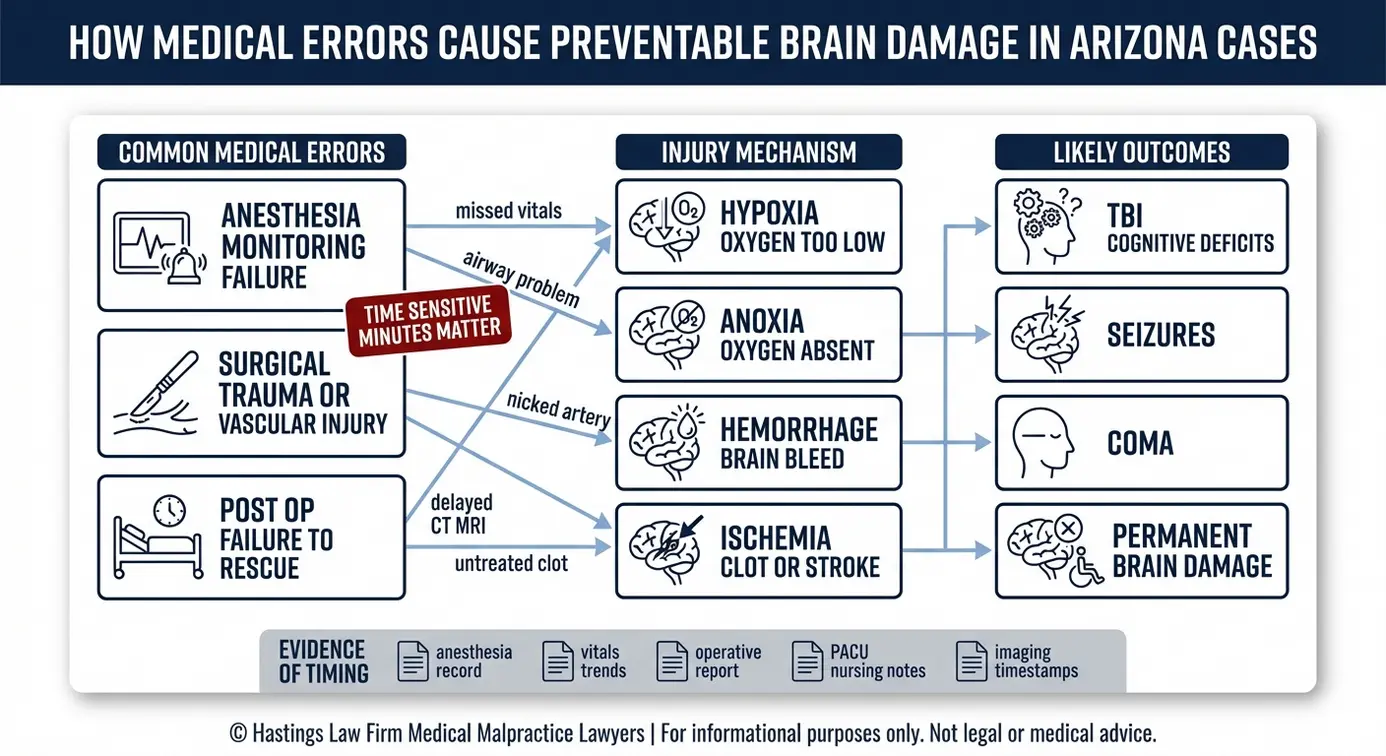
Brain injuries in a medical setting are often caused by oxygen deprivation, unmonitored strokes, or direct surgical trauma to the brain or its blood supply. These injuries often involve a failure to meet professional standards during treatment. Understanding the mechanism behind each type of injury helps explain why medical teams have such strict monitoring protocols, and why a failure to follow those protocols can be devastating.
Anesthesia Errors. One of the most common causes of brain injury from medical negligence is oxygen deprivation during or after anesthesia. Hypoxia, a condition where the brain receives reduced oxygen, and anoxia, a complete loss of oxygen to the brain, can cause irreversible damage within minutes. The American Society of Anesthesiologists publishes detailed standards requiring continuous monitoring of oxygen levels, heart rate, and breathing throughout any procedure.
When an anesthesia provider fails to detect and respond to dropping oxygen levels, the window for preventing permanent injury closes quickly. Strict adherence to these monitoring standards is the only way to ensure patient safety while they are unconscious and unable to advocate for themselves.
Surgical Trauma. Physical damage to brain tissue or surrounding blood vessels during surgery can cause brain bleeds, swelling, or direct cellular injury. A nicked artery or uncontrolled bleeding during a neurosurgical or spinal procedure may trigger a cascade of damage that extends far beyond the original surgical site. When surgical negligence occurs, such as a surgeon deviating from safety protocols during delicate dissection, the resulting hemorrhage or swelling can permanently compromise brain function.
Post-Operative Negligence. After surgery, patients remain at risk for strokes, blood clots, and brain bleeds. The failure to diagnose these complications in the recovery room, sometimes called a “failure to rescue,” is a recognized and preventable cause of brain damage. Delayed CT scans, ignored neurological changes, or understaffed recovery units can all contribute. An Arizona malpractice lawyer can investigate staffing logs and recovery room records to determine if the medical team failed to react in time.
| Type of Medical Error | Mechanism of Brain Injury | Common Clinical Setting |
|---|---|---|
| Anesthesia overdose or mismanagement | Hypoxia or anoxia from oxygen deprivation | Operating room, PACU |
| Surgical vascular damage | Brain bleed or hemorrhagic stroke | Neurosurgery, spinal surgery |
| Failure to treat post-op stroke | Ischemic brain damage from blood clot | Recovery room, ICU |
| Unmonitored seizure activity | Prolonged neuronal injury | Post-operative ward |
Cardiac Procedures and Secondary Brain Injury Risks
Heart surgeries such as bypass and valve repair carry a significant risk of secondary brain injury. During these procedures, patients are often placed on cardiopulmonary bypass (CPB), commonly known as a heart-lung machine, which temporarily takes over the function of the heart and lungs. A perfusionist, the specialist responsible for operating this machine, must carefully manage blood flow, pressure, and oxygenation throughout the surgery.
If perfusionist errors occur, such as allowing air bubbles into the line or failing to maintain proper pressure, the patient may suffer cardiac arrest or profound brain ischemia. If blood clots form and travel to the brain (embolism), the result can be a stroke or widespread oxygen deprivation. An Arizona malpractice lawyer experienced in these cases will examine perfusion records, bypass run times, and post-operative neurological assessments to identify where the breakdown occurred.
Proving Liability and The Standard of Care in Arizona
To prove liability, your legal team must demonstrate that the medical provider breached the accepted standard of care and that this breach directly caused the brain injury. Establishing legal responsibility requires a detailed review of medical protocols and specialist testimony. Arizona law requires establishing causation by connecting the specific error to the specific harm.
The standard of care is the level of treatment a reasonably competent medical professional would have provided under similar circumstances. A medical negligence lawyer in Arizona will work with qualified experts to define what that standard required at the moment the injury occurred, and then show how the provider fell short. Our founder, Tommy Hastings, is board-certified in personal injury trial law by the Texas Board of Legal Specialization and uses this expertise to lead our investigative process.
Under A.R.S. § 12-563, a patient must prove that the healthcare provider failed to exercise the degree of care, skill, and learning expected of a reasonable, prudent health care provider in the same or similar circumstances. This typically requires expert testimony from a specialist, such as a neurologist or neurosurgeon, to confirm the breach of duty found in the medical records. Our team’s in-house medical staff and national expert network allow us to identify the right expert early in the case to secure the required Affidavit of Merit.
An experienced brain injury attorney knows that failing to provide this specific expert corroboration can lead to a case dismissal. One concept we evaluate closely is failure to rescue, which refers to a provider’s inability to recognize and respond to a patient’s deteriorating condition in time. Tools like the Glasgow Coma Scale (GCS), a standardized scoring system used to assess a patient’s level of consciousness, can show whether warning signs were documented and acted on, or missed entirely.
Hospitals often defend brain injury cases by arguing the outcome was a “known complication” rather than negligence. Our team includes former defense attorneys who understand this strategy because they previously worked for the hospital systems they now challenge. We counter it by reconstructing the clinical timeline, reviewing nursing notes, and identifying gaps between what the records show and what the standard of care required.

The Hastings Law Firm Difference
Results matter, but what truly sets us apart is how we achieve them. Every verdict, every settlement, and every Arizona courtroom victory comes from one guiding promise: To treat each client’s fight for justice as if it were our own.
This balance of skill, experience, and empathy reflects our core philosophy that justice should not only compensate the injured, but also make healthcare safer nationwide.

Calculating Damages for a Lifetime of Care
Patients who suffer brain injuries from medical negligence can recover compensation for both economic losses, such as medical bills and lost wages, and non-economic damages like pain, suffering, and loss of enjoyment of life. Legal compensation aims to provide financial security for the patient’s long-term medical needs. Because brain injuries often require decades of ongoing care, accurately calculating these damages is one of the most important parts of the case.
An Arizona brain injury lawyer will typically work with a life care planner to project the full scope of future needs using a life care plan, a detailed, individualized document that estimates the cost of long-term future medical costs. This may include cognitive rehabilitation therapy (CRT), a specialized treatment aimed at restoring or compensating for impaired thinking and memory, as well as adaptive equipment, home modifications, and 24/7 attendant care when needed.
Recoverable damages in Arizona brain injury cases may include:
- Past and future medical expenses, including surgeries, hospital stays, and rehabilitation
- Lost income and diminished earning capacity
- Pain and suffering
- Emotional distress
- Loss of companionship and support
- Wrongful death damages when the injury proves fatal
One of Arizona’s strongest protections for injured patients is found in the Arizona Constitution, Article 2, Section 31, which prohibits any law that limits the amount of damages recoverable for personal injury or death. Unlike many states that cap non-economic damages in medical negligence compensation cases, Arizona allows a jury to award whatever amount it finds appropriate based on the evidence.
Settlement Finality vs. Lifelong Care Planning
A quick settlement may seem appealing, but it carries serious risk. Once a case is resolved, it cannot be reopened, even if medical needs increase significantly years later. A lawyer for brain injury cases will evaluate whether a structured settlement or a special needs trust may better protect the patient’s future. Long-term rehabilitation costs can escalate in ways that are difficult to predict, and the legal resolution must account for that reality.
Handling Claims Against Federal and State Entities
Claims against VA hospitals or military base clinics in Arizona follow a different legal path known as the Federal Tort Claims Act (FTCA). This federal process involves specific procedural rules that differ from state-level malpractice lawsuits. If the brain injury occurred at a federal facility, such as a military hospital, you do not sue the individual doctor. Instead, the claim is brought against the United States government, which creates unique challenges related to sovereign immunity.
Suing a VA hospital requires handling these complex federal immunities that do not exist in the private sector. Before filing a lawsuit, the FTCA requires a step called administrative exhaustion. This means you must first submit a formal administrative claim, typically using Standard Form 95, to the appropriate federal agency. The agency then has six months to respond before you can proceed to federal court.
According to the U.S. Department of Veterans Affairs, this process applies to all tort claims arising from VA medical care. The deadlines for federal claims are often shorter and less forgiving than those for private hospital cases. Unlike state court cases where timelines can sometimes be extended, federal deadlines are absolute. A claimant generally has two years to file the administrative claim, and failure to do so results in a complete loss of rights.
Contact the Arizona Hospital Malpractice Attorneys at Hastings Law Firm Today for Help
A brain injury changes a family’s life in ways that go far beyond the medical diagnosis. The cost of ongoing care, lost independence, and the emotional toll on everyone involved should not fall on the shoulders of the patient and their loved ones when a preventable medical error is to blame.
As dedicated Arizona brain injury lawyers, Hastings Law Firm is built for exactly these cases. Our team of attorneys, former defense counsel, and in-house medical professionals prepares every case as if it will go to trial, because that preparation is what drives fair results. We work on a contingency fee basis, which means you pay no attorney fees or costs unless we recover compensation for you.
If you or a family member suffered a brain injury due to medical negligence in Arizona, contact us today for a free, confidential case evaluation. Let us help you find the answers you deserve.
Frequently Asked Questions About Brain Injury From Medical Negligence in Arizona


This content was researched and written by the Hastings Law Firm editorial team, which includes attorneys, medical professionals, and experienced researchers. Our writing is informed by internal knowledge and practical experience, and we cross-check critical details against authoritative sources cited throughout. Every piece undergoes human-led fact-checking and legal review. Because legal and medical information can change, if you spot an error, please contact us. Learn more about our content standards and review process on our editorial policy page.

Tommy Hastings, founder of Hastings Law Firm, is a board-certified personal injury trial lawyer dedicated exclusively to healthcare injury cases. Since 2001, he has represented injured patients and families in litigation against major hospital systems, pharmaceutical companies, and negligent healthcare providers nationwide. He has handled numerous high-profile cases that have drawn national media attention and resulted in multi-million dollar recoveries. He draws on that experience in his writing, helping readers understand how these cases work and what options may be available to them.
