


Arizona Brachial Plexus Injury Lawyer
A brachial plexus injury during birth can leave a child with lasting arm weakness or paralysis and it often raises concerns about whether delivery care was handled safely. This topic involves how shoulder dystocia and other difficult deliveries can lead to nerve damage when excessive traction is used, and why accurate early evaluation matters for treatment and prognosis. It also addresses how compensation is described for long term care needs and how Arizona rules can affect options. If you or a loved one were harmed or worse due to brachial plexus birth injury malpractice in Arizona, contact Hastings Law Firm for a free, confidential case review.

Last Updated: September 24, 2026
Nationally Recognized Birth Injury Representation in Arizona
When your child has been harmed during delivery, the confusion and heartbreak can feel overwhelming. You may suspect that something went wrong, but getting clear answers from the medical team feels impossible. At Hastings Law Firm, we focus exclusively on medical malpractice, and we understand both the medical challenges and the emotional weight of these cases.
Our team includes in-house nurse consultants and former defense attorneys who know how hospitals and their insurers respond to birth injury claims. Our founder, Tommy Hastings, is a board-certified trial lawyer with over 20 years of experience in these specialized claims. We prepare every case from day one as though we are taking it to a jury. This level of preparation often makes the difference in securing full compensation for your child’s future.
If you need an Arizona Brachial Plexus Injury Lawyer, we offer a free, confidential case evaluation. There is no fee unless we recover compensation for your family.

Understanding Brachial Plexus Injuries and Medical Malpractice
A brachial plexus injury is a form of nerve damage affecting the network of nerves controlling the shoulder, arm, and hand, often caused by excessive traction during delivery. The brachial plexus, a bundle of nerves running from the spinal cord in the neck through the shoulder, controls all movement and sensation in the arm. When these nerves are stretched, compressed, or torn during birth, the result can range from temporary weakness to permanent paralysis.
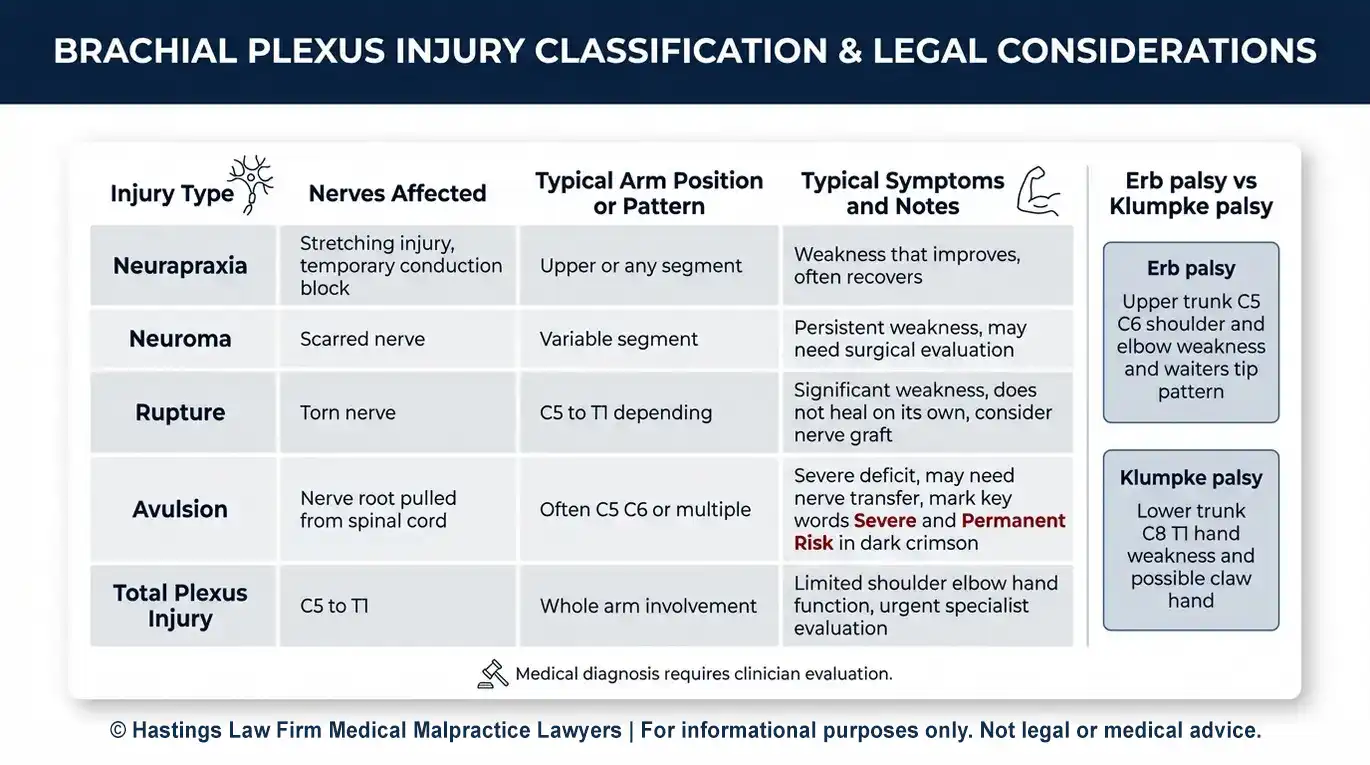
The severity of a brachial plexus injury depends on the type and extent of nerve damage:
| Injury Type | Nerves Affected | Typical Symptoms |
|---|---|---|
| Neuropraxia | Stretched but intact | Temporary weakness; often resolves within 3 months |
| Neuroma | Scar tissue formation on nerve | Partial recovery; some permanent weakness |
| Rupture | Nerve torn but not at spine | Significant weakness; may require surgery |
| Avulsion | Nerve root torn from spinal cord | Severe or total paralysis; surgical repair limited |
| Total Plexus Injury | All five nerve roots affected | Complete arm paralysis; worst prognosis |
Neuropraxia, the mildest form, occurs when the nerve is stretched but not torn. Most infants with neuropraxia recover fully within a few months. More severe injuries involve actual tearing of the nerve fibers. According to research published in PubMed Central, avulsion injuries, where the nerve root is pulled completely from the spinal cord, can cause lifelong neuropathic pain and permanent disability.
Erb’s Palsy affects the upper nerves (C5-C6) and is the most common type of brachial plexus birth injury. Children with Erb’s Palsy typically have weakness in the shoulder and upper arm. Klumpke’s Palsy affects the lower nerves (C8-T1) and causes weakness or paralysis in the hand and forearm, sometimes accompanied by a drooping eyelid on the affected side.
An experienced Arizona birth injury law firm can help determine whether the injury resulted from preventable medical errors and what level of compensation your child may need for lifetime care.
Distinguishing True Injury from Pseudo Paralysis
Families must distinguish between temporary pain and permanent nerve damage during a medical evaluation. Not every newborn with a limp arm has a brachial plexus injury. Pseudo-paralysis, a condition where the baby avoids moving the arm due to pain rather than nerve damage, can mimic the appearance of Erb’s Palsy. This often occurs when the infant has suffered a neonatal clavicle fracture, a broken collarbone that happened during delivery.
The distinction matters because treatment and prognosis differ significantly. A fractured clavicle heals on its own within weeks, while a true nerve avulsion may require multiple surgeries and years of therapy. Proper imaging and neurological testing shortly after birth can identify the actual cause of the limb’s immobility. When doctors fail to order appropriate diagnostic studies, families may not receive accurate information about their child’s condition or the care that caused it.
How Preventable Errors During Delivery Cause Nerve Damage
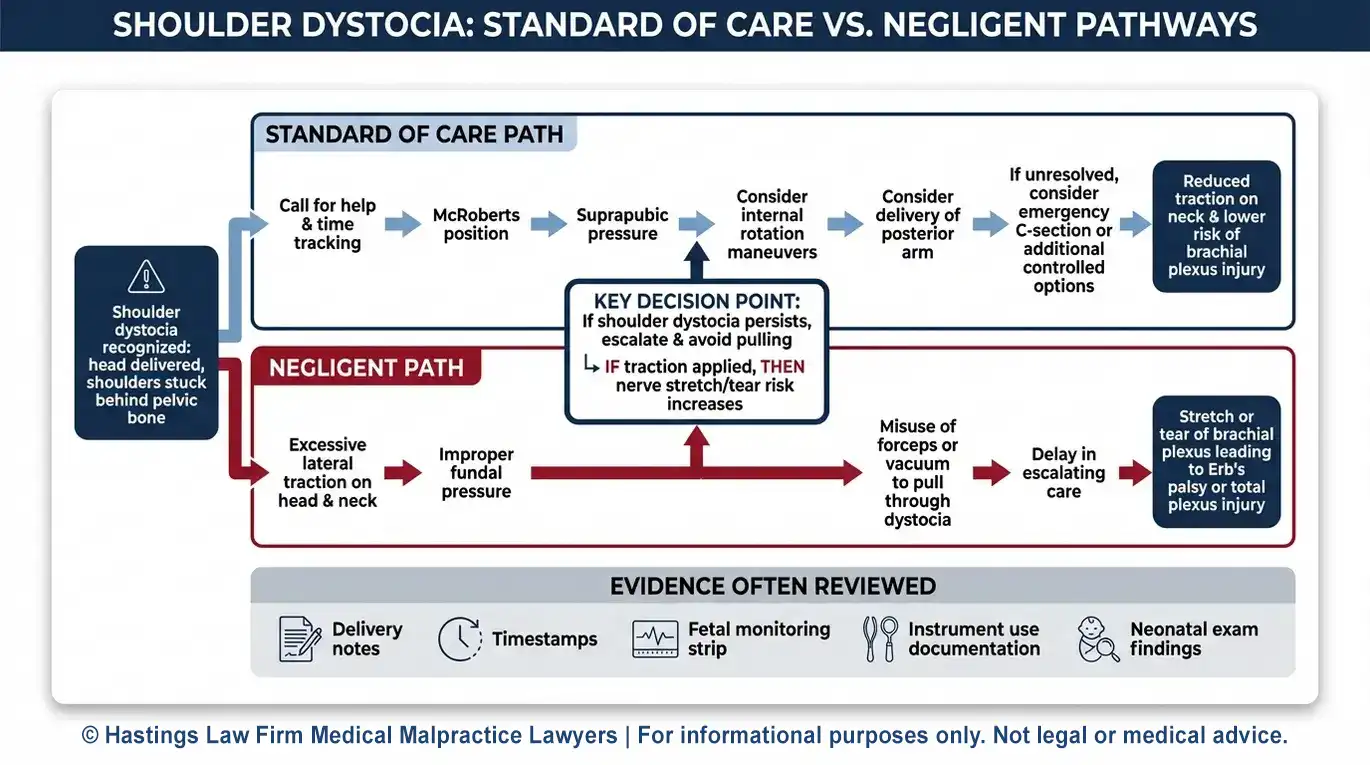
Most brachial plexus injuries occur when a physician applies excessive force or traction to a baby’s head while the shoulder is stuck behind the mother’s pelvic bone. These injuries frequently occur during a difficult delivery that requires intervention. This obstetric emergency, called shoulder dystocia, requires immediate and careful intervention. Shoulder dystocia happens when the baby’s head delivers but the anterior shoulder becomes lodged against the pubic bone, preventing the rest of the body from emerging.
When shoulder dystocia occurs, the clock is ticking. The baby’s oxygen supply through the umbilical cord may be compromised. Faced with this pressure, some doctors make the serious error of pulling harder on the baby’s head to free the shoulders. This excessive lateral traction, or sideways pulling force on the head and neck, stretches or tears the brachial plexus nerves, a risk also present during a breech delivery.
According to research on Shoulder Dystocia Prediction and Management published in PubMed Central, proper training and technique can prevent most delivery-related nerve injuries.
Maneuvers That May Cause Injury:
- Applying downward traction on the baby’s head when shoulders are impacted. This maneuver can place dangerous tension on the neck nerves.
- Excessive rotation of the head or neck. Turning the head too far can lead to nerve tears.
- Pulling with forceps or vacuum extractor while shoulders remain stuck. Mechanical tools add force that delicate nerves may not withstand.
- Fundal pressure (pushing on top of the uterus) without first repositioning the baby. Pushing from the top can wedge the shoulder tighter against the bone.
Accepted Maneuvers for Shoulder Dystocia:
- McRoberts maneuver (flexing the mother’s thighs toward her abdomen). This repositioning often creates the necessary space for a safe delivery.
- Suprapubic pressure (gentle pressure above the pubic bone to dislodge the shoulder). Manual pressure helps rotate the baby to clear the obstruction.
- Delivery of the posterior arm. Freeing the back arm reduces the width of the baby’s shoulders.
- Positioning the mother on all fours (Gaskin maneuver). Gravity and movement help the pelvic bones shift.
- Emergency C-section if other maneuvers fail. A surgical delivery avoids the physical trauma of a stuck labor.
An Arizona brachial plexus injury lawyer and a Phoenix medical malpractice lawyer both understand that proving negligence requires showing the physician chose improper techniques when safer options were available.
Proper Management of Shoulder Dystocia
Doctors must follow specific protocols to avoid injury when a baby is stuck during birth. Shoulder dystocia is a medical emergency where the baby’s shoulder becomes trapped against the mother’s pelvic bone. The medical standard of care requires that obstetricians recognize shoulder dystocia immediately and respond with specific, well-established maneuvers. The McRoberts maneuver, which involves sharply flexing the mother’s legs toward her chest, widens the pelvic outlet and flattens the lower spine. This simple repositioning resolves most cases of shoulder dystocia without applying any additional force to the baby.
Suprapubic pressure, where an assistant applies downward pressure just above the mother’s pubic bone, can help rotate and dislodge the stuck shoulder. These techniques should be attempted before any significant traction is applied to the infant.
When a doctor skips these steps or applies excessive pulling force, the deviation from the standard of care may constitute negligence. Under Arizona Revised Statutes § 12-542, families have two years to file a medical malpractice claim for injuries caused by such errors.
The Role of Pitocin and Hyperstimulation
Uterine hyperstimulation from induction drugs can increase the risk of a traumatic delivery for the infant. Pitocin, a synthetic form of the hormone oxytocin, is commonly used to induce or speed up labor. While it can be an appropriate medical tool, improper administration can cause uterine hyperstimulation, where contractions become too strong or too frequent. This can push the baby into the birth canal faster than the body is ready, increasing the risk of shoulder dystocia.
When hyperstimulation occurs, the medical team may feel rushed to complete delivery. That urgency can lead to poor decisions, including the use of excessive force. Medical records showing high Pitocin dosages combined with signs of hyperstimulation can be important evidence in establishing what went wrong during labor.
The Hastings Law Firm Difference
Results matter, but what truly sets us apart is how we achieve them. Every verdict, every settlement, and every Arizona courtroom victory comes from one guiding promise: To treat each client’s fight for justice as if it were our own.
This balance of skill, experience, and empathy reflects our core philosophy that justice should not only compensate the injured, but also make health care safer nationwide.

Recognizing the Risk Factors and Warning Signs of Shoulder Dystocia
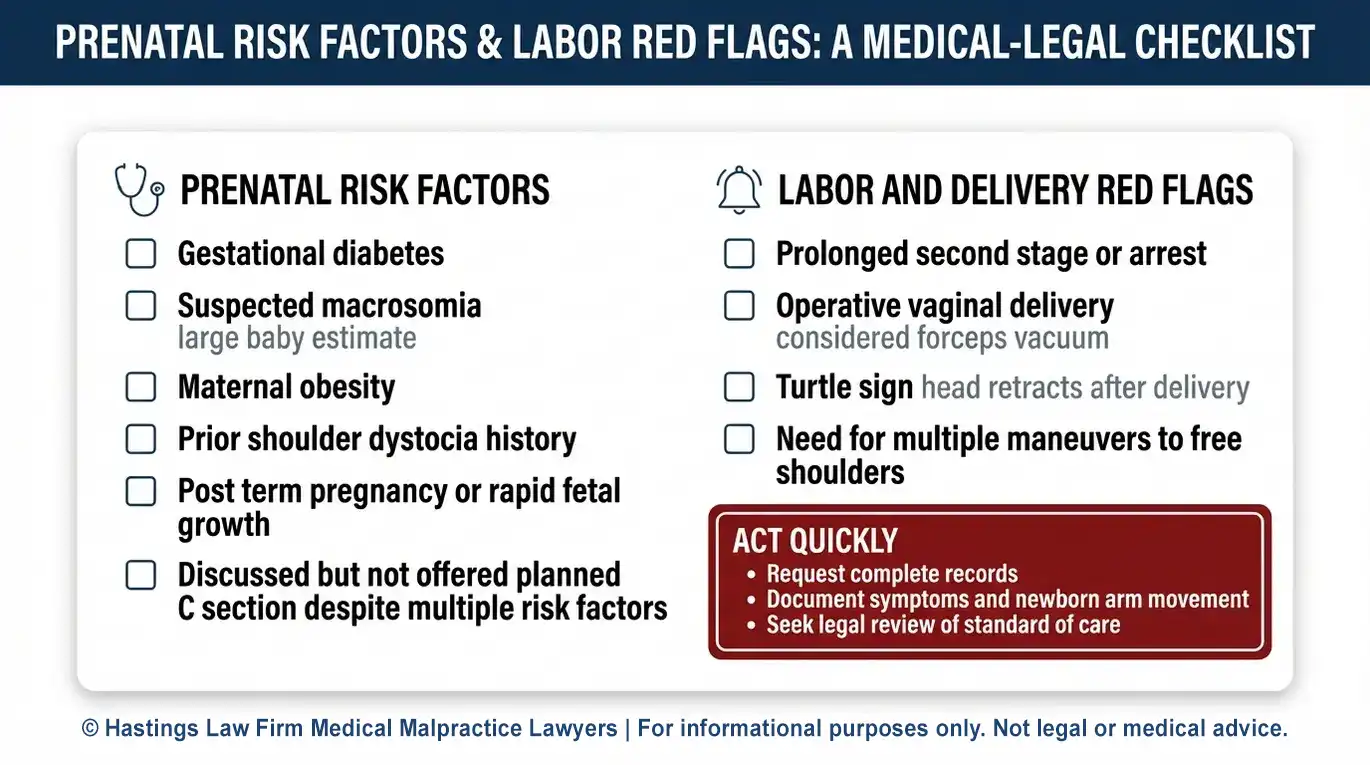
Doctors are required to identify risk factors such as gestational diabetes, maternal obesity, and a large fetus prior to delivery to prevent birth injuries. These warning signs often appear during routine prenatal care, giving physicians time to plan for a safer delivery.
Macrosomia, a medical term meaning an unusually large baby (typically over 8 pounds 13 ounces), significantly increases the risk of shoulder dystocia. According to the National Center for Biotechnology Information, macrosomia is more common in mothers with gestational diabetes, a condition marked by high blood sugar during pregnancy, because elevated blood sugar levels cause the baby to grow larger than normal.
Risk Factors That Should Prompt Extra Precautions:
- Gestational diabetes or pre-existing diabetes in the mother. High blood sugar levels often lead to larger fetal growth.
- Estimated fetal weight above 4,500 grams (approximately 9 pounds 15 ounces). Heavier infants have a statistically higher risk of birth trauma.
- Maternal obesity (BMI over 30). Higher BMI can complicate the delivery process.
- Previous delivery complicated by shoulder dystocia. A history of dystocia is a strong predictor for future labors.
- Prolonged labor or slow progression in the second stage. Slow progress may indicate the baby is physically obstructed.
- Post-term pregnancy (beyond 40 weeks). Babies continue to grow past their due date, increasing size.
- Excessive maternal weight gain during pregnancy. Significant gain can influence the baby’s birth weight.
When multiple risk factors are present, the standard of care may require offering a planned C-section rather than attempting vaginal delivery. Failure to discuss these options with the mother, or proceeding with vaginal delivery despite clear warning signs, can form the basis of a malpractice claim.
A brachial plexus injury lawyer in Arizona can review your prenatal records to determine whether your medical team identified these risks and responded appropriately.
Calculating Full Compensation for Lifetime Care Costs in Arizona
Compensation for birth injuries in Arizona includes coverage for past and future medical bills, physical therapy, pain and suffering, and loss of future earning capacity. Because brachial plexus injuries often require years of treatment and may cause permanent limitations, calculating fair compensation requires careful analysis of your child’s long-term needs.
Recoverable Damages in Arizona Birth Injury Cases:
Awards typically include economic damages for financial costs, non-economic damages for suffering, and potentially punitive damages in cases of gross negligence.
- Past Medical Expenses: Hospital bills, NICU stays, and imaging studies. This covers immediate stabilization and initial diagnostics.
- Future Medical Costs: Projected expenses for nerve grafts and nerve transfers. Many children require specialized care for years to come.
- Physical and Occupational Therapy: Ongoing rehabilitation to maximize arm function. Early intervention is essential for regaining limb function.
- Adaptive Equipment: Braces and specialized devices. These tools help children perform daily tasks independently.
- Pain and Suffering: Compensation for the physical discomfort and emotional distress. This compensates for the physical and mental toll on the child.
- Loss of Enjoyment of Life: Recognition that your child may be unable to participate in activities. This addresses the loss of normal childhood activities.
- Loss of Future Earning Capacity: The economic impact of permanent limitations on your child’s ability to work. A permanent injury can limit a child’s future career options.
An Arizona Brachial Plexus Injury Lawyer works with medical experts and life care planners to document the full scope of your child’s needs. Arizona birth injury compensation should account for every expense your family will face, not just the bills you have received so far.
Projecting Economic Loss for Infants
Experts use economic data to estimate the long-term financial impact of a birth injury on a child’s adult life. Calculating lost earning capacity for an infant following a birth injury presents unique challenges. Your child has no work history, no established career path, and decades of life ahead. Our firm works with vocational experts and economists who specialize in projecting lifetime earnings based on factors like education trends, regional employment data, and the specific functional limitations caused by the injury.
If your child will never have full use of their arm, certain careers may be closed to them. Others may require accommodations that limit advancement. These losses add up over a working lifetime and must be accounted for in any settlement or verdict.
Proving Liability and the Medical Standard of Care in Arizona Courts
Proving negligence requires establishing that the healthcare provider deviated from the accepted medical standard of care, confirmed by expert testimony. In Arizona birth injury cases, it is not enough to show that your child was injured during delivery. You must prove that the injury resulted from care that fell below what a reasonably competent physician would have provided under similar circumstances.
The burden of proof rests with the family filing the claim, meaning your legal team must build the case through evidence and expert opinions. This typically requires:
- Establishing the Standard of Care: A qualified medical expert must explain what a competent obstetrician should have done. This sets the baseline for what a competent physician would do.
- Proving the Breach: Experts then show how the treating physician failed to meet that standard. We analyze medical records and monitoring strips to identify failures.
- Connecting the Breach to the Injury: To establish causation, expert testimony must show the deviation directly caused the injury, confirming liability. In some cases, an Affidavit of Merit is also required to validate the claim initially.
Under Arizona Revised Statutes § 12-2604, expert witnesses in medical malpractice cases must generally be licensed health professionals who specialize in the same area as the defendant and were active in clinical practice or teaching during the year prior to the injury.
An Arizona Brachial Plexus Injury Lawyer understands how to assemble the right team of experts. A medical malpractice attorney in Phoenix with experience in birth injury cases will know which specialists provide the most credible testimony for shoulder dystocia and nerve injury cases.
The Statute of Limitations for Birth Injury Cases in Arizona
In Arizona, the standard statute of limitations for medical malpractice is two years, but specific tolling rules apply to minors allowing claims to be filed until the child reaches a certain age. Understanding these deadlines is essential to protecting your family’s rights. The general rule under A.R.S. § 12-542 gives injured patients two years from the date of injury to file a lawsuit. For adults, missing this deadline typically means losing the right to sue.
Arizona law recognizes that minors cannot advocate for themselves, so the statute of limitations is “tolled,” or paused, until the child turns 18. This means your child may have until their 20th birthday to file their own claim. A critical warning for parents: Your claims are separate from your child’s. As a parent, you may be entitled to recover the medical expenses you have paid and other losses. These parental claims are generally subject to the standard two-year deadline and do not benefit from the same tolling provisions.
Because evidence can degrade and witnesses’ memories fade over time, we recommend consulting an attorney familiar with Arizona birth injury laws as soon as possible. The discovery rule may extend the deadline if an injury is not immediately apparent, but relying on this exception is risky.
Contact the Arizona Birth Injury Attorneys at Hastings Law Firm Today for Help
A brachial plexus injury changes your child’s life and your family’s future. You deserve answers about what happened during delivery and whether proper care could have prevented the harm. At Hastings Law Firm, we dedicate our entire practice to medical malpractice cases, and our team has the medical knowledge and legal experience to investigate what went wrong.
We believe that holding negligent providers accountable helps protect other families from experiencing the same tragedy. Our firm operates on a contingency fee basis, which means you pay no attorney fees or costs unless we secure compensation for your child.
If your baby was diagnosed with Erb’s Palsy, Klumpke’s Palsy, or another brachial plexus injury, contact our Phoenix medical malpractice law firm today for a free, confidential evaluation. We can review the circumstances of your delivery and explain your legal options.
Frequently Asked Questions About Brachial Plexus Malpractice in Arizona


This content was researched and written by the Hastings Law Firm editorial team, which includes attorneys, medical professionals, and experienced researchers. Our writing is informed by internal knowledge and practical experience, and we cross-check critical details against authoritative sources cited throughout. Every piece undergoes human-led fact-checking and legal review. Because legal and medical information can change, if you spot an error, please contact us. Learn more about our content standards and review process on our editorial policy page.

Tommy Hastings, founder of Hastings Law Firm, is a board-certified personal injury trial lawyer (by the Texas Board of Legal Specialization) dedicated exclusively to healthcare injury cases. Since 2001, he has represented injured patients and families in litigation against major hospital systems, pharmaceutical companies, and negligent healthcare providers nationwide. He has handled numerous high-profile cases that have drawn national media attention and resulted in multi-million dollar recoveries.
