


Arizona Birthing Center Malpractice Lawyer
Birthing centers can offer a supportive setting for low risk deliveries, but they also have limits in staffing, monitoring, and emergency resources. When a midwife or facility fails to recognize warning signs, delays a needed hospital transfer, or provides inadequate postpartum care, the result can be serious injury to a mother or newborn with lasting physical, emotional, and financial consequences. Understanding how standards of care apply in out of hospital settings can help families make sense of what happened. If your child suffered harm due to birth center negligence in Arizona, contact Hastings Law Firm for a free, confidential case review.

Last Updated: July 27, 2026
Compassionate Arizona Medical Attorneys for Birth Center Negligence Claims
Choosing a birthing center for your delivery is a deeply personal decision, one rooted in trust that the care team will keep you and your baby safe. When that trust is broken by preventable errors during labor and delivery, the emotional and physical toll can be devastating. You may be searching for answers about what went wrong and whether the care you received fell below what you and your child deserved.
As an Arizona Birthing Center Malpractice Lawyer team that focuses exclusively on medical negligence, we understand both the medical details and the human weight of these cases. Our firm has the clinical insight and legal experience to investigate what happened, identify who is responsible, and pursue the accountability your family needs.
If you believe your child or you were harmed during a birthing center delivery, we welcome the chance to review what happened and explain your options in a free, confidential evaluation.

Understanding Negligence in Arizona Birthing Centers
Birthing center negligence occurs when a midwife, nurse, or facility fails to meet the accepted standard of care, whether by not properly monitoring fetal vitals, missing warning signs, or delaying a necessary hospital transfer, and that failure results in injury to the mother or child.
A freestanding birthing center, meaning an out-of-hospital facility designed for low-risk pregnancies, operates very differently from a traditional hospital labor and delivery unit. These centers are typically midwife-led, with a focus on natural birth and minimal medical intervention. While this model works well for many families, it also means the facility lacks the surgical teams, advanced monitoring equipment, and emergency OB/GYN resources available in a hospital.
The standard of care for midwives and out-of-hospital birth providers is not lower simply because the setting is less clinical. Under Arizona regulations governing outpatient treatment centers, birthing centers must meet specific licensing requirements for staffing, equipment, and safety protocols. A midwife is expected to recognize complications, respond appropriately, and act quickly when a situation exceeds the center’s capabilities.
Many birth injuries are preventable with proper monitoring and timely decision-making. When a provider misses or ignores signs of distress, the consequences for a newborn or mother can be severe and lifelong. As experienced malpractice attorneys in Arizona, we examine whether the care provided met the medical standard, and whether earlier action could have prevented the harm. A birth injury lawyer’s role in these cases begins with understanding exactly where the standard of care was breached.
Failure to Transfer: When Natural Birth Becomes a Medical Emergency
A “failure to transfer” occurs when birthing center staff identify, or should have identified, complications like fetal distress or prolonged labor but delay moving the patient to a hospital for an emergency C-section or advanced intervention. This is one of the most common and consequential forms of Arizona birth center malpractice.
An emergency cesarean section, a surgical delivery performed when the health of the mother or baby is at immediate risk, is not available at a freestanding birthing center. That means the decision to transfer is the single most important safety mechanism these facilities have. When a midwife hesitates or misjudges the severity of a complication, the delay can result in oxygen deprivation, a condition that may cause hypoxic-ischemic encephalopathy (HIE), which is brain damage resulting from insufficient oxygen and blood flow to the brain.
The Arizona Department of Health Services Emergency Medical Services and Trauma System outlines protocols for emergency response and transport. When those protocols are not followed, critical minutes are lost. For families seeking legal help for midwife negligence, proving the timeline of these decisions is essential.
Red flag transfer triggers that should prompt immediate action include:
- Non-reassuring fetal heart tones or persistent abnormal fetal heart rate patterns
- Meconium-stained amniotic fluid
- Arrested labor with no progress despite intervention
- Signs of maternal hemorrhage or rapidly dropping blood pressure
- Symptoms of preeclampsia such as severe headache, visual changes, or elevated blood pressure
- Umbilical cord prolapse
- Maternal fever suggesting possible infection
Birthing Center Capability Limits and Risks
Birthing centers do not have surgical suites or operating room capability, meaning no emergency C-section can be performed on-site. These facilities differ significantly from hospitals in their medical resources and also lack a neonatal intensive care unit (NICU), the specialized hospital unit equipped to stabilize and treat critically ill newborns. Because of these birthing center capability limits, when complications arise, every minute of delay between recognizing the emergency and arriving at a hospital increases the risk of permanent injury. A failure-to-transfer case will closely examine the gap between when the problem was identified and when the transfer actually occurred.

The Hastings Law Firm Difference
Results matter, but what truly sets us apart is how we achieve them. Every verdict, every settlement, and every Arizona courtroom victory comes from one guiding promise: To treat each client’s fight for justice as if it were our own.
This balance of skill, experience, and empathy reflects our core philosophy that justice should not only compensate the injured, but also make health care safer nationwide.

Common Forms of Malpractice in Midwife-Led Facilities
Beyond transfer failures, common malpractice in midwife-led settings includes improper fetal monitoring, failure to diagnose preeclampsia, mishandling physical delivery complications, and inadequate postpartum care that allows hemorrhage or infection to progress unchecked.
Monitoring Errors. In a hospital, continuous electronic fetal monitoring tracks the baby’s heart rate in real time. In many birthing centers, intermittent monitoring with a handheld doppler is the norm. If a midwife does not check fetal heart rate frequently enough, or misinterprets the readings, signs of distress can go undetected. According to AHRQ’s Patient Safety Network primer on Maternal Safety, consistent and competent monitoring is a foundational element of safe labor management.
Physical Trauma During Delivery. Shoulder dystocia, a dangerous complication where the baby’s shoulder becomes lodged behind the mother’s pubic bone, requires specific maneuvers to resolve safely. When a provider applies excessive traction or responds incorrectly, the result can be a brachial plexus injury, nerve damage in the shoulder and arm commonly known as Erb’s palsy. These injuries may cause partial or permanent loss of arm function.
Maternal Care Failures. A mother’s safety does not end at delivery. Postpartum hemorrhage and sepsis, a life-threatening infection, are among the leading causes of maternal harm. Missing early signs of excessive bleeding or failing to monitor temperature and vital signs after birth can turn a manageable complication into a medical crisis.
Birth injury claims in Arizona often involve a combination of these failures. Common injuries we evaluate include:
- Cerebral palsy caused by oxygen deprivation
- Hypoxic-ischemic encephalopathy (HIE)
- Brachial plexus injuries and Erb’s palsy
- Maternal organ damage from uncontrolled hemorrhage
- Infections progressing to sepsis
Analyzing Fetal Monitoring Strips for Evidence
When fetal monitoring strips, also called cardiotocography (CTG) recordings, are available, they provide some of the most objective evidence in a birth injury case. Fetal monitoring is a standard way to track a baby’s heart rate during labor, and late decelerations, which are drops in the baby’s heart rate that occur after a contraction peaks, can indicate the baby is not receiving adequate oxygen. Patterns showing minimal variability, meaning the heart rate stays unusually flat without the normal small fluctuations, may also suggest fetal compromise. As a midwife malpractice lawyer team, we work with obstetric experts who analyze these strips to determine whether the provider should have recognized distress and acted sooner to avoid a preventable injury.
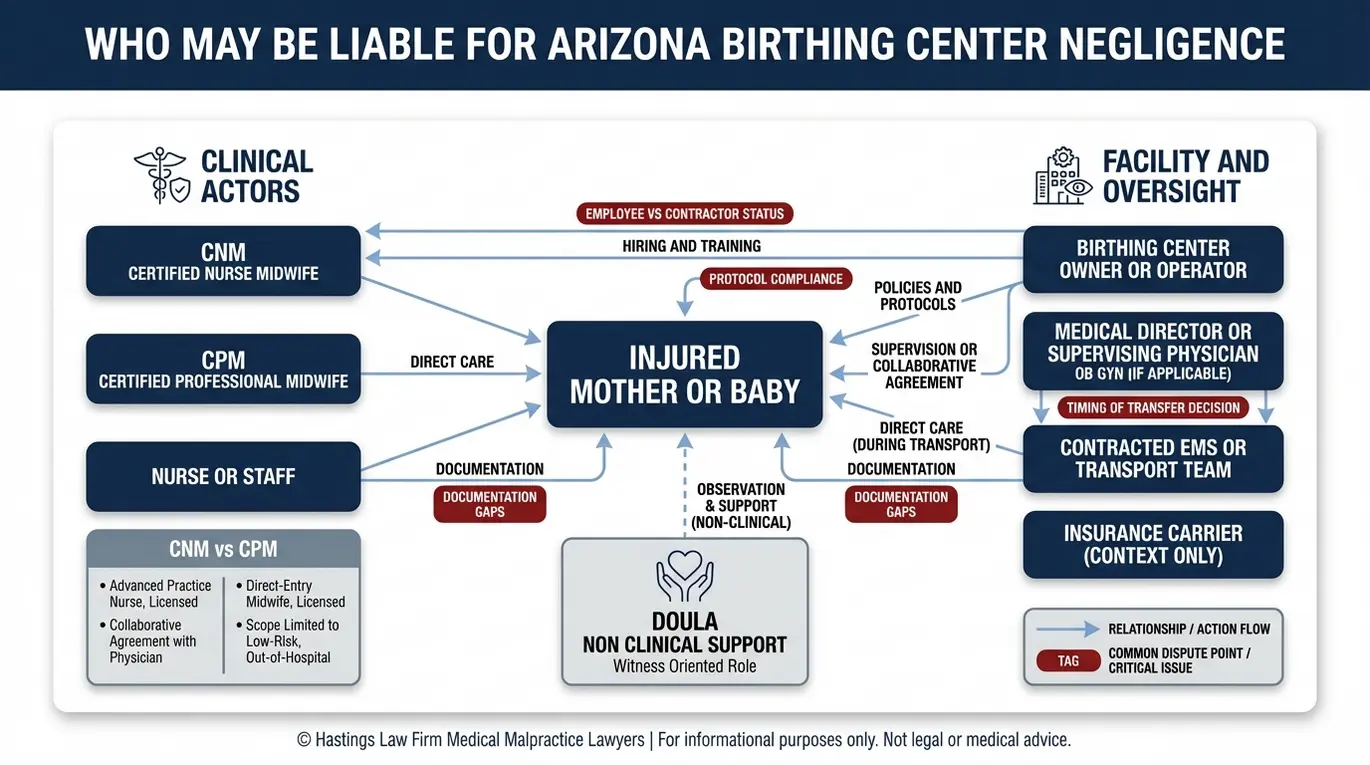
Who Is Liable? Midwives, Doulas, and Facility Owners
Liability can extend to the certified nurse-midwife for clinical errors, the birthing center owners for negligent staffing or protocols, and potentially supervising physicians if a collaborative practice agreement was breached.
Midwives. Arizona recognizes different categories of midwife licensure. A certified nurse-midwife (CNM) is an advanced practice registered nurse with graduate-level training in both nursing and midwifery. A certified professional midwife (CPM) holds a national credential but does not have a nursing degree. As outlined by the Arizona Department of Health Services Midwifery Provider Type Definitions, these distinctions affect scope of practice, insurance requirements, and supervisory obligations. When suing a birthing center, identifying the correct provider type is an important early step.
Facility Owners. The center itself may bear liability for birth injuries through negligent hiring, failure to maintain emergency equipment, lack of written transfer protocols, or vicarious liability for staff actions. In tragic cases, families may also pursue a claim for wrongful death.
Doulas. A doula provides emotional and physical support during labor but is not a licensed medical provider. Doulas generally do not carry medical malpractice liability.
| Provider | Role | Potential Liability |
|---|---|---|
| Certified Nurse-Midwife (CNM) | Licensed medical provider managing labor and delivery | Direct liability for clinical negligence |
| Certified Professional Midwife (CPM) | Credentialed birth attendant, non-nursing track | Direct liability; scope and insurance may vary |
| Supervising OB/GYN | Physician overseeing midwife under collaborative agreement | Liability if supervisory duties were breached |
| Birthing Center Owner/Operator | Manages facility, staffing, equipment, and protocols | Institutional liability for systemic failures |
| Doula | Non-medical support person | Generally no medical liability |
Liability Differences Between Doulas and Medical Providers
While doulas do not have the legal duties of a medical provider, their observations can be powerful evidence. Understanding the different roles in the delivery room is essential during an Arizona birth injury investigation. Doula liability is generally not a factor, but a doula who was present during labor may be able to testify about the timeline of events, the midwife’s actions and responses, and how long specific complications went unaddressed. Their witness testimony can help establish what happened in the delivery room when medical records are incomplete or disputed.
Compensation for Injuries Occurring at Birthing Centers
Families affected by birthing center negligence may recover economic damages for medical expenses and lifelong care costs, as well as non-economic damages for pain, suffering, and the loss of quality of life for a child living with a disability.
Immediate Costs. A birth injury often results in emergency hospitalization, NICU stays, surgeries, and early intervention therapies. These expenses can reach hundreds of thousands of dollars before a child’s first birthday. Families in Arizona may seek compensation for the full impact of a birth injury.
Future Costs. For children diagnosed with conditions like cerebral palsy, the financial reality extends across an entire lifetime. A Life Care Plan, developed by medical and economic experts, estimates the future care costs of 24/7 care, adaptive equipment, home modifications, specialized education, and ongoing therapy. Special Needs Trusts can be established to protect these funds while preserving the child’s eligibility for government benefits.
Non-Economic Damages. Compensation for birth injury also accounts for the pain and suffering endured by both the child and the family, mental anguish, physical impairment, and diminished quality of life.
| Damage Category | Examples |
|---|---|
| Economic Damages | NICU and hospital bills, surgeries, physical and occupational therapy, future medical care, Life Care Plan costs, lost earning capacity, home modifications |
| Non-Economic Damages | Pain and suffering, mental anguish, physical impairment, loss of enjoyment of life, parental emotional distress |
A settlement for midwife negligence must reflect not just what has already been spent, but what a child will need for the rest of their life.
Arizona Deadlines for Filing a Birth Injury Claim
The Arizona statute of limitations for medical malpractice is two years from the date of injury, but specific exceptions exist for minors and for cases where the injury was not immediately discoverable.
The two-year deadline applies to most adults. For minor children, the statute of limitations may be “tolled,” meaning the clock is paused until the minor reaches a certain age. This can provide additional time, but families should not rely on tolling alone. Evidence degrades over time. Medical records may be altered or lost, and the memories of key witnesses fade with each passing year.
Arizona also recognizes the discovery rule, which can extend the filing window if the injury or the negligence that caused it could not reasonably have been identified at the time of delivery. Determining when the clock started is a legal question that depends on the specific facts of your case.
Preserving your medical records early is an important protective step. Federal law gives individuals the right to access their health information. This is outlined by the U.S. Department of Health and Human Services guidance on individuals’ right under HIPAA to access their health information. Requesting complete copies of your birth records and your child’s records as soon as possible helps ensure nothing is lost.

How Our Arizona Medical Attorneys Prove Negligence
We use a thorough investigation process that includes securing all medical records, consulting with independent OB/GYN and midwifery experts, and reconstructing the delivery timeline minute by minute to determine whether the injury was preventable.
Led by founder Tommy Hastings, a board-certified trial lawyer with over 20 years of experience, our firm applies a structured approach to every investigation. Our process includes:
- Record collection and preservation. We obtain all maternal and neonatal records, including fetal monitoring data, nursing notes, transfer logs, and internal policies.
- Independent expert review. Our national network of expert witness OB/GYN specialists and certified midwives evaluates whether the care provided met the standard of care, or fell below it.
- Timeline reconstruction. We map every decision point from admission through delivery to identify exactly where delays or errors occurred.
- Causation analysis. Working with medical experts, we establish the link between the provider’s actions and the resulting injury to the mother or child.
Throughout this process, our in-house nurse consultants and patient advocates keep you informed and supported. We know these cases carry enormous emotional weight, and we treat every family as a partner, not just a case file.
Hiring a malpractice lawyer should not add financial stress. We work on a contingency fee basis, which means you pay no attorney fees or costs unless we secure a recovery for your family.
Contact the Arizona Birth Injury Attorneys at Hastings Law Firm Today for Help
No amount of money can undo a birth injury. But the right resources can secure your child’s future, covering the medical care, therapy, and support they will need for years to come. Accountability also matters. Learning the truth about what happened, and making sure it does not happen to another family, is something many of our clients tell us drives them forward.
Hastings Law Firm focuses exclusively on medical negligence. Our team includes former defense attorneys, in-house nurses, and board-certified patient advocates who understand both the medicine and the law behind these cases. We have the experience and clinical knowledge to investigate birthing center injuries thoroughly and pursue full accountability.
If your child was harmed during a birthing center delivery in Arizona, we are here to help. Contact us for a free, confidential case evaluation. There is no fee unless we win.
Frequently Asked Questions About Birthing Center Malpractice in Arizona


This content was researched and written by the Hastings Law Firm editorial team, which includes attorneys, medical professionals, and experienced researchers. Our writing is informed by internal knowledge and practical experience, and we cross-check critical details against authoritative sources cited throughout. Every piece undergoes human-led fact-checking and legal review. Because legal and medical information can change, if you spot an error, please contact us. Learn more about our content standards and review process on our editorial policy page.

Tommy Hastings, founder of Hastings Law Firm, is a board-certified personal injury trial lawyer dedicated exclusively to healthcare injury cases. Since 2001, he has represented injured patients and families in litigation against major hospital systems, pharmaceutical companies, and negligent healthcare providers nationwide. He has handled numerous high-profile cases that have drawn national media attention and resulted in multi-million dollar recoveries. He draws on that experience in his writing, helping readers understand how these cases work and what options may be available to them.
