


Arizona Birth Paralysis Lawyer
Birth related paralysis can leave families overwhelmed and searching for clear answers about what happened in the delivery room. This topic focuses on how medical negligence during labor and delivery can lead to lasting harm, including nerve injuries and brain injury tied to oxygen deprivation. It also highlights how diagnosis, prognosis, and documentation can shape accountability and long term support needs when a child faces permanent limitations. If you or a loved one were harmed or worse due to birth paralysis in Arizona, contact Hastings Law Firm for a free, confidential case review.

Last Updated: September 24, 2026
Trial Ready Advocacy for Arizona Families Facing Birth Injuries
When your child suffers paralysis during birth, the shock and heartbreak can feel overwhelming. You trusted the medical team to protect your baby, and now you may be searching for answers about what went wrong and whether it could have been prevented.
An Arizona birth paralysis lawyer can help you understand whether your child’s injury resulted from preventable medical errors. These cases require both legal expertise and deep medical knowledge to determine if the care your baby received fell below accepted standards.
At Hastings Law Firm, we focus exclusively on medical malpractice. Our team includes nurse consultants and former defense attorneys who understand how hospitals operate from the inside. We prepare every case as if it will go to trial, which positions families to pursue full accountability.
If you suspect negligence played a role in your child’s injury, we offer a free, confidential case evaluation. Contact us to learn what happened and explore your options.

How Medical Negligence Causes Infant Paralysis
Medical negligence causes infant paralysis when healthcare providers fail to meet the standard of care during labor and delivery. This can happen through excessive force, improper use of delivery instruments, or failure to respond appropriately to signs of fetal distress.
Under Arizona law, A.R.S. § 12-563 establishes the duty of care. It requires plaintiffs to prove that the healthcare provider did not exercise the degree of care and skill expected of a reasonably competent practitioner in the same field. Establishing causation is also critical; you must show that the failure to meet this standard directly resulted in the injury. For delivery room teams, this means following established protocols for managing complications.
One of the most common scenarios involves shoulder dystocia, a condition where the baby’s shoulder becomes lodged behind the mother’s pelvic bone after the head has emerged. When this happens, the delivery team must act quickly but carefully. Excessive downward traction on the infant’s head can stretch or tear the nerves controlling the arm and hand.
Infant paralysis attorneys examine whether the medical team used appropriate maneuvers to resolve the dystocia or used dangerous levels of force.
Other mechanisms of injury include:
- Improper use of forceps: Metal instruments applied to the baby’s head that can cause nerve damage if positioned incorrectly or used with excessive pressure.
- Vacuum extractor misuse: A vacuum extractor, also called a ventouse, uses suction to help guide the baby through the birth canal; improper application can cause trauma to the head, neck, and shoulders.
- Delayed C-section: Failure to recognize fetal distress and perform an emergency cesarean section can lead to oxygen deprivation and brain damage. When the medical team misses these critical warnings, the window for a safe delivery closes rapidly.
- Prolonged labor mismanagement: Allowing labor to continue too long without intervention when warning signs are present.
An Arizona birth paralysis lawyer reviews the delivery records, nursing notes, and fetal monitoring strips to reconstruct exactly what happened and identify where the standard of care may have been breached.
Types of Injuries Leading to Newborn Paralysis
Newborn paralysis typically manifests as brachial plexus injuries caused by nerve traction, or cerebral palsy caused by hypoxic ischemic encephalopathy (HIE) due to oxygen deprivation.
Understanding the type of injury your child sustained helps determine both the medical treatment path and the legal approach to your case. A birth paralysis lawyer in Arizona works with medical experts to identify the specific diagnosis and its likely cause.
Brachial Plexus Injuries (Erb’s Palsy)
The brachial plexus is a network of nerves originating in the neck and running through the shoulder that controls movement and sensation in the arm and hand. When these nerves are stretched, torn, or pulled from the spinal cord during delivery, the result can be partial or complete paralysis of the affected limb. Erb’s palsy, the most common form of neonatal brachial plexus palsy (NBPP), affects the upper nerves and typically presents as weakness or inability to move the shoulder and elbow.
According to a systematic review published in PubMed, evaluation methods for NBPP include clinical examination, imaging, and electrodiagnostic studies to determine injury severity and guide treatment decisions.
Hypoxic Ischemic Encephalopathy (HIE)
HIE, or hypoxic ischemic encephalopathy, occurs when the brain is deprived of adequate oxygen and blood flow. This can happen during prolonged labor, umbilical cord complications, or placental abruption. The resulting brain damage can lead to spastic paralysis, commonly diagnosed as cerebral palsy.
Facial Nerve Injury
Pressure from forceps or positioning during delivery can damage cranial nerve VII, affecting facial movement and potentially impacting swallowing and balance.
| Injury Type | Location of Damage | Primary Cause | Key Diagnostic Sign |
|---|---|---|---|
| Erb’s Palsy | Upper brachial plexus (C5-C6) | Shoulder traction during delivery | “Waiter’s tip” arm position |
| Total Plexus Palsy | Entire brachial plexus (C5-T1) | Severe traction or avulsion | Complete arm paralysis |
| HIE/Cerebral Palsy | Brain (motor cortex) | Oxygen deprivation | Spastic muscle tone, developmental delays |
| Facial Nerve Palsy | Cranial nerve VII | Forceps pressure | Asymmetric facial movement |
Understanding Nerve Avulsion vs. Rupture
The severity of a brachial plexus injury depends on the type of nerve damage sustained. A stretch injury, called neuropraxia, often heals on its own within months. A rupture occurs when the nerve is torn but remains attached to the spinal cord; this may require surgical grafting. An avulsion is the most severe form, where the nerve root is completely detached from the spine and cannot be reattached.
This distinction directly affects the legal damages calculation. A child with an avulsion injury faces permanent disability, lifelong treatment needs, and significantly reduced earning capacity. The prognosis shapes the entire compensation model.

The Hastings Law Firm Difference
Results matter, but what truly sets us apart is how we achieve them. Every verdict, every settlement, and every Arizona courtroom victory comes from one guiding promise: To treat each client’s fight for justice as if it were our own.
This balance of skill, experience, and empathy reflects our core philosophy that justice should not only compensate the injured, but also make health care safer nationwide.

Diagnosing the Injury and Long Term Prognosis
Diagnosis involves physical examination of reflexes and muscle tone, confirmed by imaging tools like MRI and electromyography (EMG) to assess the extent of nerve or brain damage.
Early diagnostic testing serves two purposes: guiding your child’s treatment plan and preserving evidence for a potential legal claim. An Arizona birth paralysis lawyer understands that the timing of these tests can help establish when the injury occurred and whether it was caused by events during delivery.
Magnetic resonance imaging (MRI) provides detailed pictures of soft tissues, including the brain and nerve structures. For suspected HIE cases, an MRI can reveal the pattern and timing of brain injury. CT scans may be used for initial assessment or to rule out other conditions.
Electromyography (EMG) is a specialized test that measures electrical activity in muscles and nerves. According to the NCBI Bookshelf resource on nerve conduction studies, EMG testing can determine whether nerve signals are reaching the muscles properly or if there is a disruption. This helps differentiate between a stretch injury that may heal and a complete severance requiring surgery.
At Hastings Law Firm, our in-house medical staff, including nurse consultants and Board Certified Patient Advocates, reviews these medical records as part of our case evaluation process. We utilize our medical-legal team, which includes former hospital nurses, to help interpret findings and identify gaps in medical documentation.
The prognosis for your child depends on the specific diagnosis, the severity of the injury, and how early treatment begins. Some children recover significant function; others face permanent limitations that require lifelong support.
Proving Fault in Arizona Birth Paralysis Claims
Proving fault requires establishing that a provider-patient relationship existed, the medical team breached the standard of care, and this breach directly caused your infant’s specific paralysis injury.
Medical malpractice cases in Arizona require proof of four legal elements. A birth paralysis attorney AZ families trust builds the case by documenting each one.
The Four Elements of Medical Malpractice
- Duty: The healthcare provider had a professional obligation to provide competent care to your child.
- Breach: The provider failed to meet the accepted standard of care.
- Causation: The breach directly caused the injury (not a pre-existing condition or unavoidable complication).
- Damages: Your child suffered measurable harm as a result.
Fetal Heart Monitoring as Key Evidence
Fetal heart rate monitoring, also called cardiotocography (CTG), continuously records the baby’s heart rate and the mother’s contractions throughout labor. These strips function like a “black box” for the delivery.
Medical experts review the monitoring strips to identify patterns that should have prompted intervention. Late decelerations, which are drops in the baby’s heart rate occurring after contractions, can indicate the baby is not receiving adequate oxygen. When these warning signs appear and the medical team fails to act, the strips become powerful evidence of negligence.
Under 45 CFR § 164.524, you have the right to access your medical records, including these monitoring strips.
Evidence Checklist for Birth Paralysis Cases:
- Complete labor and delivery records
- Fetal heart monitoring strips with timestamps
- Nursing notes documenting interventions and timing
- Operative reports if instruments were used
- Resuscitation records
- Neonatal intensive care unit (NICU) admission notes
Our firm maintains relationships with qualified expert witnesses across the country who can review the evidence, establish what the standard of care required, and testify to secure a favorable settlement or jury verdict.

Life Care Planning and Calculating Damages
Damages in birth paralysis cases cover past and future medical expenses, therapy costs, lost earning capacity, and compensation for pain, suffering, and diminished quality of life.
When a child faces permanent disability from a birth injury, the financial impact extends across their entire lifetime. An Arizona birth paralysis lawyer works with medical and economic experts to calculate the full scope of compensation needed.
Economic Damages
These are the measurable financial losses your family has incurred and will continue to face:
- Surgical interventions (nerve grafts, tendon transfers, orthopedic procedures)
- Physical therapy and occupational therapy (often multiple sessions per week for years)
- Speech therapy for children with swallowing difficulties
- Adaptive equipment (wheelchairs, braces, modified vehicles)
- Home modifications for accessibility
- 24-hour attendant care for severe cases
- Special education services
The Medical Expenditure Panel Survey provides data on healthcare costs that experts use when projecting future medical expenses.
Non-Economic Damages
Arizona law allows recovery for losses that cannot be easily measured in dollars, including physical pain, emotional suffering, disfigurement, and loss of enjoyment of life. For a child who may never throw a ball, play an instrument, or participate in activities their peers enjoy, these damages are substantial.
Life Care Planning
A life care plan is a comprehensive document prepared by medical and rehabilitation experts that projects all the care, equipment, and services your child will need from now through their life expectancy. This becomes the foundation for calculating damages at mediation or trial. This detailed projection ensures that funds are set aside to cover inflation-adjusted expenses for decades, protecting your child’s financial security.
As a newborn paralysis law firm, we understand that these cases require looking decades into the future. A jury verdict or settlement must account for inflation, changing medical needs, and the reality that your child will need support long after you are gone.
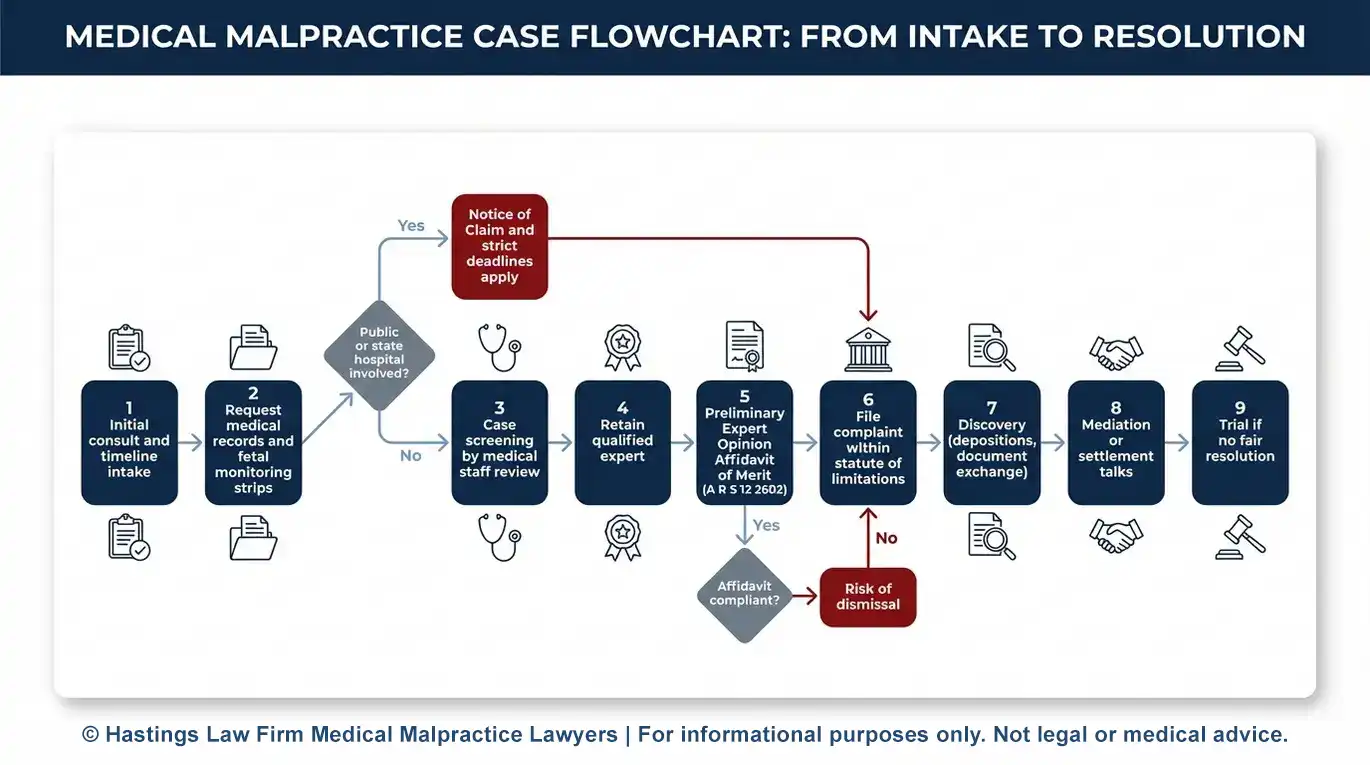
Filing a Birth Injury Lawsuit in Arizona
Filing a lawsuit involves gathering medical records, obtaining a required expert affidavit, and submitting a formal complaint within the statute of limitations.
An Arizona birth paralysis lawyer guides you through each stage of this process.
Step 1: Obtain Complete Medical Records
Before filing, your legal team must review all records related to prenatal care, labor and delivery, and your child’s subsequent treatment. Federal law protects your right to access these documents.
Step 2: Secure the Affidavit of Merit
Arizona requires a specific procedural step. Under A.R.S. § 12-2602, you must file an affidavit of merit from a qualified medical expert stating that the case has merit. This preliminary expert opinion must be submitted with your complaint or within a specific timeframe. Failure to comply can result in dismissal of your case.
Step 3: File the Complaint
The formal lawsuit is filed in the appropriate Arizona court. The complaint identifies the defendants (which may include individual doctors, nursing staff, and the hospital) and describes the alleged negligence.
Step 4: Notice of Claim for Public Entities
If your child was born at a public or state-run hospital, Arizona requires a specific procedural step called a formal notice of claim before filing a lawsuit. This notice has strict deadlines and specific content requirements.
Step 5: Discovery and Mediation
After filing, both sides exchange evidence through discovery, including depositions and document requests. Many cases proceed to mediation to attempt settlement before trial.
Statute of Limitations
Arizona generally requires medical malpractice claims to be filed within two years of the injury. Special rules apply for minors, which are discussed in the FAQ section below.
Contact the Arizona Birth Injury Attorneys at Hastings Law Firm Today for Help
Your child’s injury may have been preventable. Finding out the truth is the first step toward securing their future and helping ensure the same mistake does not happen to another family.
Hastings Law Firm represents families exclusively in medical malpractice cases. Our team includes former defense attorneys who know how hospitals and insurers approach these claims. We prepare every case from day one as if it will go to a jury.
We work on a contingency fee basis, which means you pay no attorney fees unless we recover compensation for your family. There is no financial risk in learning whether you have a case.
If your child suffered paralysis during birth, contact our Arizona birth paralysis attorneys for a free, confidential case evaluation. We will review your records, explain your options, and help you understand what happened. Call our Phoenix office or complete our online form to get started.
Frequently Asked Questions About Birth Paralysis in Arizona


This content was researched and written by the Hastings Law Firm editorial team, which includes attorneys, medical professionals, and experienced researchers. Our writing is informed by internal knowledge and practical experience, and we cross-check critical details against authoritative sources cited throughout. Every piece undergoes human-led fact-checking and legal review. Because legal and medical information can change, if you spot an error, please contact us. Learn more about our content standards and review process on our editorial policy page.

Tommy Hastings, founder of Hastings Law Firm, is a board-certified personal injury trial lawyer (by the Texas Board of Legal Specialization) dedicated exclusively to healthcare injury cases. Since 2001, he has represented injured patients and families in litigation against major hospital systems, pharmaceutical companies, and negligent healthcare providers nationwide. He has handled numerous high-profile cases that have drawn national media attention and resulted in multi-million dollar recoveries.
