


Arizona Arteriography Malpractice Lawyer
Written by: Hastings Law Firm | Reviewed by: Tommy Hastings | Updated: July 27, 2026
Arteriography and angiography are meant to diagnose vascular problems, but errors during catheter placement, imaging guidance, or contrast dye use can cause serious and lasting harm. Some complications are known risks, yet preventable mistakes can involve poor technique, missed contraindications, inadequate monitoring, or unnecessary procedures without clinical justification. These events can lead to internal bleeding, neurological injury, kidney damage, infection, disability, or fatal outcomes, and they often raise difficult questions about accountability and compensation. If you or a loved one were harmed or worse due to arteriography malpractice in Arizona, contact Hastings Law Firm for a free, confidential case review.
Trusted Arizona Medical Attorneys for Angiogram Negligence Claims
What You Should Know About Angiogram Complications Negligence Claims in Arizona:
- Recovery can depend on showing the injury came from a preventable error rather than a known risk disclosed through informed consent.
- Long term harm can follow angiography mistakes such as vessel perforation, air embolism, or failure to control bleeding.
- Severe outcomes can include stroke, kidney failure, disability, or death when complications are not prevented or managed appropriately.
- Liability can extend beyond the physician to a facility, nursing staff, or a device manufacturer when system failures or defective equipment contribute.
- Compensation can cover medical bills and lost wages as well as pain, suffering, and loss of quality of life.
- Financial recovery is not limited by a damages cap in Arizona for personal injury or wrongful death claims.
- Options can be lost if legal time limits are missed, including shorter requirements for claims involving public or government hospitals.
- Recovery can be reduced if comparative negligence is assigned to the patient under Arizona law.
- Case outcomes can turn on what medical records and imaging show about technique, monitoring, and documented indications for the procedure.

A Healthcare Focused Law Firm
When a diagnostic procedure meant to identify a problem causes new and serious harm, the experience can feel deeply disorienting. You trusted a medical team to guide a catheter safely through your blood vessels, and instead, you or someone you love may be dealing with injuries that should never have happened. That kind of outcome raises questions that deserve honest, informed answers.
At Hastings Law Firm, we focus exclusively on medical malpractice. Our legal team, which includes former defense attorneys and in-house medical professionals, understands how angiography procedures work, where errors happen, and how to determine whether the care you received fell below the accepted standard. As an experienced Arizona Arteriography Malpractice Lawyer team, we are prepared to review your case, explain your legal options, and help you understand what went wrong.
If you believe negligence played a role in your injury, contact us for a free, confidential case evaluation. There is no fee unless we recover compensation for you.
What Constitutes Malpractice in Arteriography Procedures
Medical malpractice in arteriography occurs when a physician, radiologist, or technician deviates from the accepted medical standard of care during the catheterization or imaging process, directly causing preventable injury to the patient. Arteriography, a diagnostic imaging procedure also called angiography or an angiogram, uses contrast dye and X-rays to visualize the inside of blood vessels. During the procedure, a doctor gains vascular access through catheterization, the process of threading a guidewire and catheter through an artery, typically at the groin or wrist, to reach the target area.
The standard of care refers to the level of treatment a reasonably competent medical professional would provide under similar circumstances. This includes reviewing the patient’s full medical history, selecting the correct access site, using proper technique during catheter insertion and manipulation, and monitoring the patient throughout the procedure.
One of the most important distinctions in these cases is the difference between a known risk and a preventable error. Every medical procedure carries some degree of inherent risk, and patients are typically informed of those risks through the informed consent process. Informed consent means your doctor explained the potential risks and you agreed to the treatment. When an injury results from a deviation in technique or judgment rather than an unavoidable complication, the consent form does not shield the provider from liability. As established in Matson v. Naifeh, Arizona courts recognize that a medical professional’s failure to meet the standard of care can form the basis of a negligence claim.
An Arizona Arteriography Malpractice Lawyer will look for specific examples of breach, including:
- Puncturing or perforating an artery during catheter insertion
- Using excessive contrast dye despite known kidney impairment
- Ignoring documented contraindications, which are medical reasons that make a specific treatment potentially harmful
- Failing to use fluoroscopic guidance properly; this uses real-time X-ray images to help the doctor see the catheter’s path
- Not obtaining or reviewing relevant imaging before the procedure
If any of these failures directly caused your injury, it may support a viable malpractice claim. Our Arizona arteriography malpractice lawyers work alongside qualified medical experts to evaluate every detail of what happened during the procedure.

Common Complications and Errors During Angiography
Common actionable errors include perforation of blood vessels, air embolisms resulting in stroke, failure to manage bleeding at the insertion site, and contrast dye toxicity leading to kidney failure. While any procedure involving catheterization carries risk, an Arizona Arteriography Malpractice Lawyer knows that the injuries below often point to preventable lapses in care rather than unavoidable outcomes.
Vascular Injuries
During an angiogram, dissection or perforation of the femoral or radial artery can occur when the catheter or guidewire is advanced with improper technique or without adequate imaging guidance. Artery damage of this kind may cause severe internal bleeding that requires emergency surgical repair. In some cases, the injury leads to long-term vascular complications or limb ischemia.
Neurological Injuries
In the context of angiography, strokes represent one of the most devastating outcomes of a poorly performed imaging procedure. An air embolism, which occurs when air enters the catheter system and travels to the brain, can cause immediate and permanent neurological damage. Plaque or blood clots dislodged during catheter manipulation can also block blood flow to the brain.
According to Cardiac Catheterization Risks and Complications published by the NCBI, these neurological events, though relatively infrequent, carry life-altering consequences when they do occur.
Contrast Dye Reactions
During vascular imaging, contrast medium, the iodinated dye injected to make blood vessels visible, can cause kidney damage or severe allergic reactions. Medical teams are expected to screen patients for renal insufficiency and allergy history before administering the dye. Renal insufficiency means the kidneys are not filtering waste from the blood properly. Failure to screen, or failure to respond appropriately when a reaction occurs, may constitute negligence under A.R.S. § 12-561, Arizona’s statutory framework for medical liability claims.
Other injuries that may indicate malpractice include:
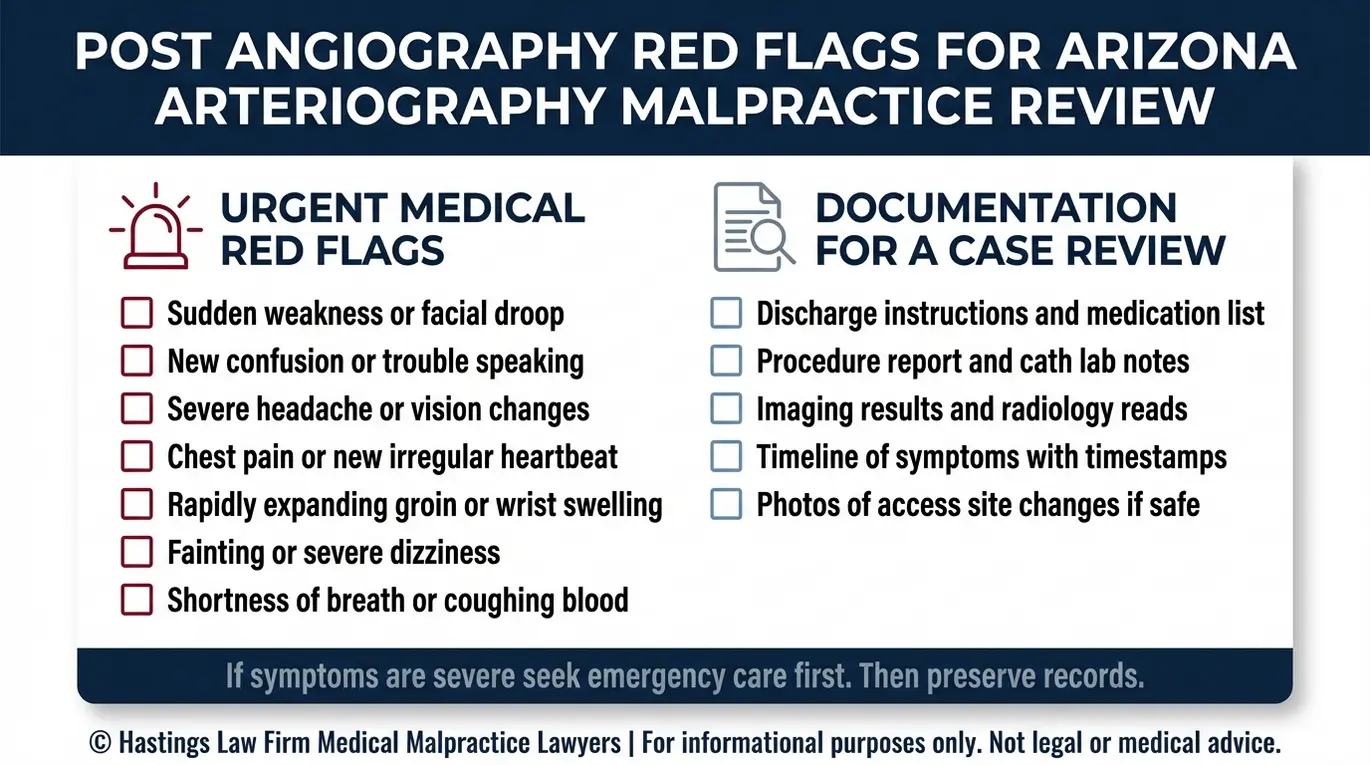
- Uncontrolled bleeding or hematoma at the catheter insertion site
- Blood clots forming during or after the procedure
- Cardiac arrhythmia caused by catheter contact with the heart wall
- Infection from non-sterile technique
If you suspect any of these complications resulted from negligence, consulting an Arizona Arteriography Malpractice Lawyer is the first step toward accountability.
Unnecessary Procedures and Financial Incentives
In arteriography cases, the concern is sometimes not how the procedure was performed but whether it should have been performed at all. Angioplasty and stent placement are sometimes performed during cardiac catheterization without sufficient clinical justification. When a doctor proceeds with an interventional procedure that the patient’s condition did not warrant, the resulting complications may form the basis of a malpractice claim.
An arteriography malpractice lawyer in Arizona can review the clinical records, imaging results, and documented indications to determine whether the procedure was medically necessary. Our team at Hastings Law Firm examines these cases closely, working with independent experts to evaluate whether the decision to intervene was supported by the evidence or driven by factors unrelated to patient care.
The Hastings Law Firm Difference
Results matter, but what truly sets us apart is how we achieve them. Every verdict, every settlement, and every Arizona courtroom victory comes from one guiding promise: To treat each client’s fight for justice as if it were our own.
This balance of skill, experience, and empathy reflects our core philosophy that justice should not only compensate the injured, but also make healthcare safer nationwide.

Types of Angiography and Specific Risks
Angiography is categorized by the body region targeted, including coronary (heart), cerebral (brain), and peripheral (limbs), each carrying unique risks of catheter-induced trauma and blockage. Understanding which type of procedure was performed is essential when evaluating whether negligence occurred, because the standard of care and the expected precautions differ depending on the anatomy involved.
| Type of Angiography | Body Region | Key Negligence Risks |
|---|---|---|
| Coronary Angiography | Heart and coronary arteries | Heart attack, arrhythmia from catheter contact with heart tissue, improper stent placement |
| Cerebral Angiography | Brain and neck vasculature | Stroke from dislodged clots or air bubbles, guidewire perforation of cerebral vessels |
| Peripheral Angiography | Limbs and extremities | Limb ischemia from arterial blockage, damage to vessels in the legs or arms |
Coronary angiography involves threading a catheter to the heart’s blood vessels. Even minor errors in catheter positioning can trigger arrhythmia or, in serious cases, a heart attack. The physician must carefully monitor catheter movement and respond immediately to changes in the patient’s cardiac rhythm.
Cerebral angiography, which images the blood vessels of the brain, carries an elevated risk of stroke. The catheter typically passes through the carotid or vertebral arteries in the neck, where dislodging even a small clot or introducing an air bubble can block blood flow to the brain.
This type of angiography demands precise technique and continuous neurological monitoring. A complication rate study published in PubMed highlights the distinct risk profiles associated with cerebral versus coronary procedures. Because the brain is so sensitive to oxygen deprivation, even momentary blockages can result in permanent deficits, making the timing of intervention critical.
Peripheral angiography focuses on the blood vessels supplying the arms and legs. Errors during these procedures can result in arterial blockage that limits blood flow to the extremities, potentially leading to tissue damage or the need for surgical intervention. An experienced Arizona Arteriography Malpractice Lawyer understands the nuances of each procedure type and can identify when a specific technique failure led to your injury.
Arizona arteriography malpractice lawyers at Hastings Law Firm evaluate the specific type of procedure performed, the anatomy involved, and the documented technique to determine whether the care met the expected standard. Our in-house medical staff assists in interpreting the clinical data unique to each category of angiography.
Proving Liability and Identifying Responsible Parties
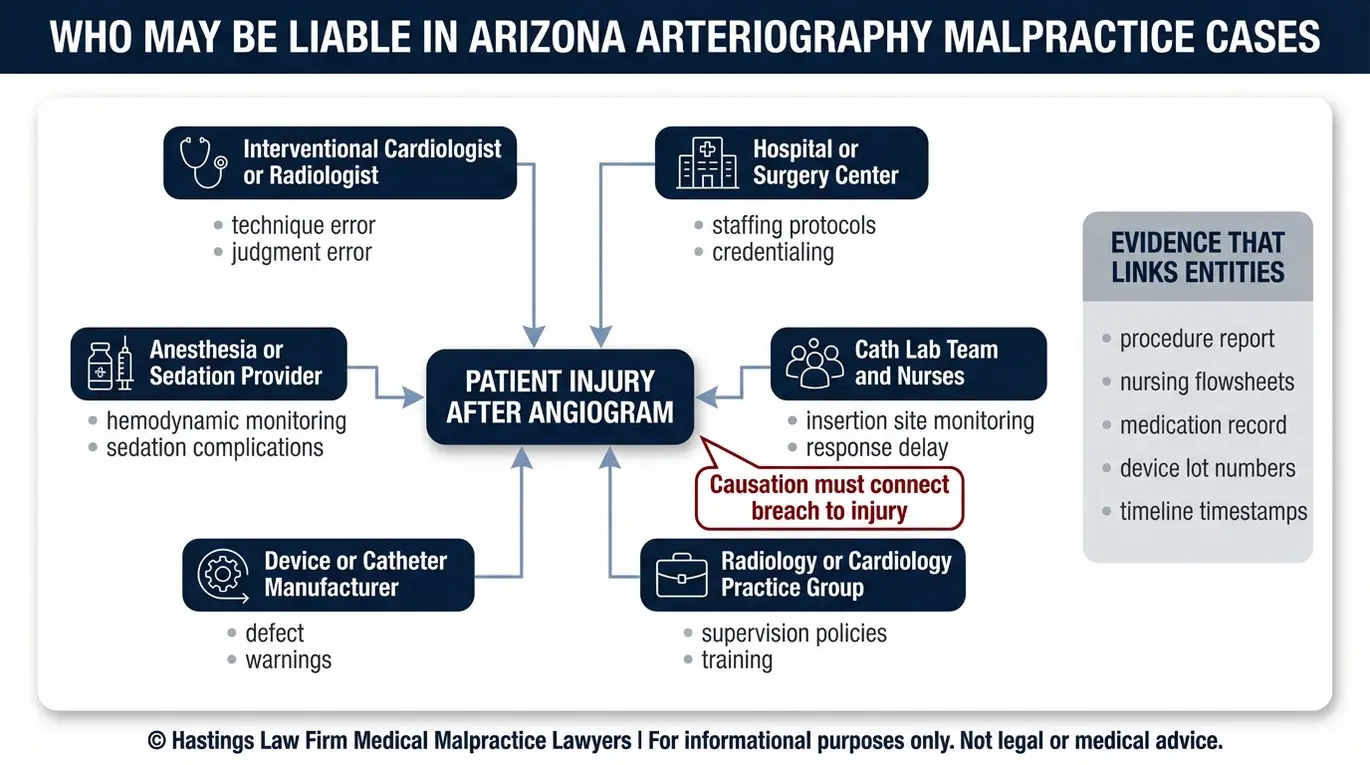
Liability for a botched angiogram may extend beyond the interventional radiologist or cardiologist to include the hospital for inadequate staffing, the device manufacturer for defective catheters, or nursing staff for post-procedure monitoring failures. Identifying every responsible party is a critical step in building a strong case.
Our firm is led by Tommy Hastings, who is Board Certified in Personal Injury Trial Law by the Texas Board of Legal Specialization. Our Arizona Arteriography Malpractice Lawyer team investigates each layer of the care process to determine where breakdowns occurred. The potentially liable parties in an angiography injury case may include:
- The physician: The interventional cardiologist, radiologist, or vascular surgeon who performed the procedure may be liable for errors in technique, judgment, or failure to respond to complications during the case.
- The facility: The hospital or outpatient surgery center may bear responsibility for system-level breakdowns in the catheterization lab, such as inadequate staffing, improper equipment maintenance, or failure to properly credential the physician performing the procedure. You can verify physician credentials through the Arizona Medical Board for MDs or the Arizona Osteopathic Board’s provider search for DOs.
- Nursing and monitoring staff: Post-procedure care is critical. Failure to monitor the catheter insertion site for hematoma, retroperitoneal bleeding (hemorrhaging into the space behind the abdominal cavity), or signs of arterial dissection (a tear in the artery wall) can turn a recoverable complication into a catastrophic injury.
- Device manufacturers: If a defective catheter, guidewire, or stent contributed to the injury, the manufacturer may be held liable under product liability principles.
Proving liability in these cases requires expert testimony from qualified medical professionals who can establish exactly how the care deviated from the standard and how that deviation caused the injury. At Hastings Law Firm, our national expert network includes radiologists, vascular surgeons, and interventional cardiologists who provide objective case reviews and credible testimony.
We also conduct a thorough review of all medical records, peer review documents, imaging studies, procedure logs, and post-operative notes. Because our team includes in-house nurses and patient advocates who understand hospital charting and protocols, we can identify inconsistencies and gaps in documentation that other firms might overlook.
Compensation Available in Arizona Angiogram Injury Claims
Victims of arteriography malpractice in Arizona may recover economic damages for medical bills and lost wages, as well as non-economic damages for pain, suffering, and loss of quality of life, with no state constitutional cap on the amount awardable.
The categories of compensation typically pursued in angiography malpractice claims include:
- Economic damages: Past and future medical costs, including emergency treatment, corrective surgeries, rehabilitation, and ongoing care. Lost income and diminished earning capacity are also recoverable.
- Non-economic damages: Pain and suffering, emotional distress, disfigurement, disability, and loss of consortium (the impact on the injured person’s relationship with their spouse or family).
- Wrongful death damages: If a patient dies as a result of negligence during or after an angiography procedure, surviving family members may file a wrongful death claim to recover funeral expenses, loss of financial support, and loss of companionship.
Arizona’s constitution explicitly prohibits the legislature from placing caps on personal injury or wrongful death damages. As outlined in the Arizona Constitution’s provisions on personal injury, juries have full authority to determine fair compensation based on the evidence presented, without arbitrary financial limits.
An experienced Arizona Arteriography Malpractice Lawyer can help calculate the full scope of your losses, including wrongful death damages if the negligence led to a loss of life. At Hastings Law Firm, we work with medical and economic experts to build a complete picture of how the injury has affected your life and your family’s financial security.
Contact the Arizona Healthcare Malpractice Attorneys at Hastings Law Firm Today for Help
If you or a loved one suffered a serious injury during an angiography procedure, you deserve clear answers about what happened and whether negligence was involved. Since 2005, Hastings Law Firm has focused exclusively on medical malpractice litigation. Our team of attorneys, former defense counsel, and in-house medical professionals has the experience and resources to evaluate your case thoroughly and honestly.
We offer a free, confidential case evaluation, and you pay no attorney fees or costs unless we secure a recovery on your behalf. As a dedicated Arizona Arteriography Malpractice Lawyer team, we are ready to review your medical records, consult with qualified experts, and help you understand your legal options.
Call us today or complete our online contact form to get started. Let us help you find the answers you deserve.
Frequently Asked Questions About Arteriography Malpractice in Arizona


This content was researched and written by the Hastings Law Firm editorial team, which includes attorneys, medical professionals, and experienced researchers. Our writing is informed by internal knowledge and practical experience, and we cross-check critical details against authoritative sources cited throughout. Every piece undergoes human-led fact-checking and legal review. Because legal and medical information can change, if you spot an error, please contact us. Learn more about our content standards and review process on our editorial policy page.

Tommy Hastings, founder of Hastings Law Firm, is a board-certified personal injury trial lawyer dedicated exclusively to healthcare injury cases. Since 2001, he has represented injured patients and families in litigation against major hospital systems, pharmaceutical companies, and negligent healthcare providers nationwide. He has handled numerous high-profile cases that have drawn national media attention and resulted in multi-million dollar recoveries. He draws on that experience in his writing, helping readers understand how these cases work and what options may be available to them.
