


Arizona Acupuncturist Malpractice Lawyer
Written by: Hastings Law Firm | Reviewed by: Tommy Hastings | Updated: July 27, 2026
Acupuncture is a recognized treatment in Arizona, and licensed practitioners are expected to follow enforceable safety standards. When an acupuncturist deviates from accepted guidelines, a patient can suffer serious harm from preventable errors rather than known risks. Negligent care can involve unsafe needle technique, poor infection control, or failing to recognize warning signs that require medical referral, leading to severe complications and lasting impacts. If you or a loved one were harmed or worse due to acupuncturist malpractice in Arizona, contact Hastings Law Firm for a free, confidential case review.

Top Rated Legal Representation for Acupuncture Injuries in Arizona
What You Should Know About Acupuncture Injury Claims in Arizona:
- Serious acupuncture injuries can be life threatening or permanent when needle depth or placement is negligent.
- Recovery options can be limited or lost when a filing deadline is missed under Arizona law.
- Compensation can be reduced when comparative negligence is alleged in Arizona.
- Liability can turn on whether harm came from a preventable error rather than an accepted side effect.
- Delayed diagnosis can worsen outcomes when an acupuncturist fails to refer a patient with red flag symptoms for urgent medical evaluation.
- Infections can have severe consequences when Clean Needle Technique is violated through poor disinfection or needle reuse.
- Proving responsibility can be difficult without expert testimony that explains what a prudent acupuncturist would have done.
- Documented losses can control whether compensation is available because damages must be shown with evidence.
- Treatment records and facility protocols can be central when sterilization failures are disputed.
- A signed consent waiver may not block accountability when the injury is tied to negligent care rather than disclosed risks.

A Healthcare Focused Law Firm
When you trust a healthcare provider with your well-being and walk away with an injury that should never have happened, the experience can leave you feeling confused and uncertain about what to do next. Acupuncture is a recognized form of treatment in Arizona, and the professionals who practice it are held to real, enforceable safety standards. When those standards are violated, you have a right to seek answers and hold the responsible party accountable.
If you or a loved one suffered a serious injury during acupuncture treatment, an Arizona acupuncturist malpractice lawyer at Hastings Law Firm can help you understand what went wrong. Our team includes in-house medical professionals who review the clinical details of your case from the very first conversation. Contact us for a free, confidential case evaluation to learn about your options.
What Constitutes Acupuncturist Malpractice in Arizona
Acupuncturist malpractice occurs when a licensed practitioner deviates from the accepted standard of care established by the National Certification Commission for Acupuncture and Oriental Medicine (NCCAOM), the credentialing body that sets professional benchmarks for acupuncturists nationwide, and Arizona state regulations, directly causing injury to a patient through negligent acts or omissions.
Like any licensed healthcare provider, an acupuncturist in Arizona has a legal duty of care to treat patients safely and competently within their defined scope of practice. This scope refers to the specific treatments and procedures their license authorizes them to perform. Professional negligence occurs when the practitioner fails to meet that duty and the failure results in harm. An Arizona acupuncture malpractice attorney can evaluate whether a practitioner’s conduct fell below these established standards.
Not every unfavorable outcome after treatment qualifies as malpractice. Some patients experience temporary soreness, minor bruising, or fatigue, which are known and accepted risks. A claim for professional negligence requires evidence of a preventable error that a reasonably competent acupuncturist would not have made under the same circumstances. Understanding this distinction is one of the first things a lawyer will assess during a case review.
Key concepts that shape liability in these cases include:
- Duty of care: The obligation created the moment a practitioner agrees to treat a patient.
- Breach: A specific failure to follow accepted safety protocols or clinical guidelines.
- Liability: Legal responsibility that attaches when a breach directly causes harm.
- Preventable error vs. known risk: The line between an accepted side effect and actionable negligence.
Commissions vs. Omissions in Alternative Medicine Liability
In acupuncture malpractice cases, the negligent act can take two distinct forms. In medical liability, these terms distinguish between an action taken and a required action that was missed. A commission is active harm, such as inserting a needle too deeply and puncturing a lung. An omission-based claim is the failure to act when action was required.
Failure to refer is a common omission-based claim against acupuncturists. If a patient presents with red-flag symptoms like sudden numbness, chest pain, or unexplained weight loss, the acupuncturist must recognize those signs. They have a responsibility to direct the patient to a physician for urgent medical evaluation.
Continuing to treat a potentially serious medical condition with acupuncture instead of making a timely referral can lead to a delayed diagnosis. This constitutes a breach of the practitioner’s duty. Both forms of negligence carry the same legal weight in a court of law.
Common Injuries Caused by Negligent Acupuncture Therapy
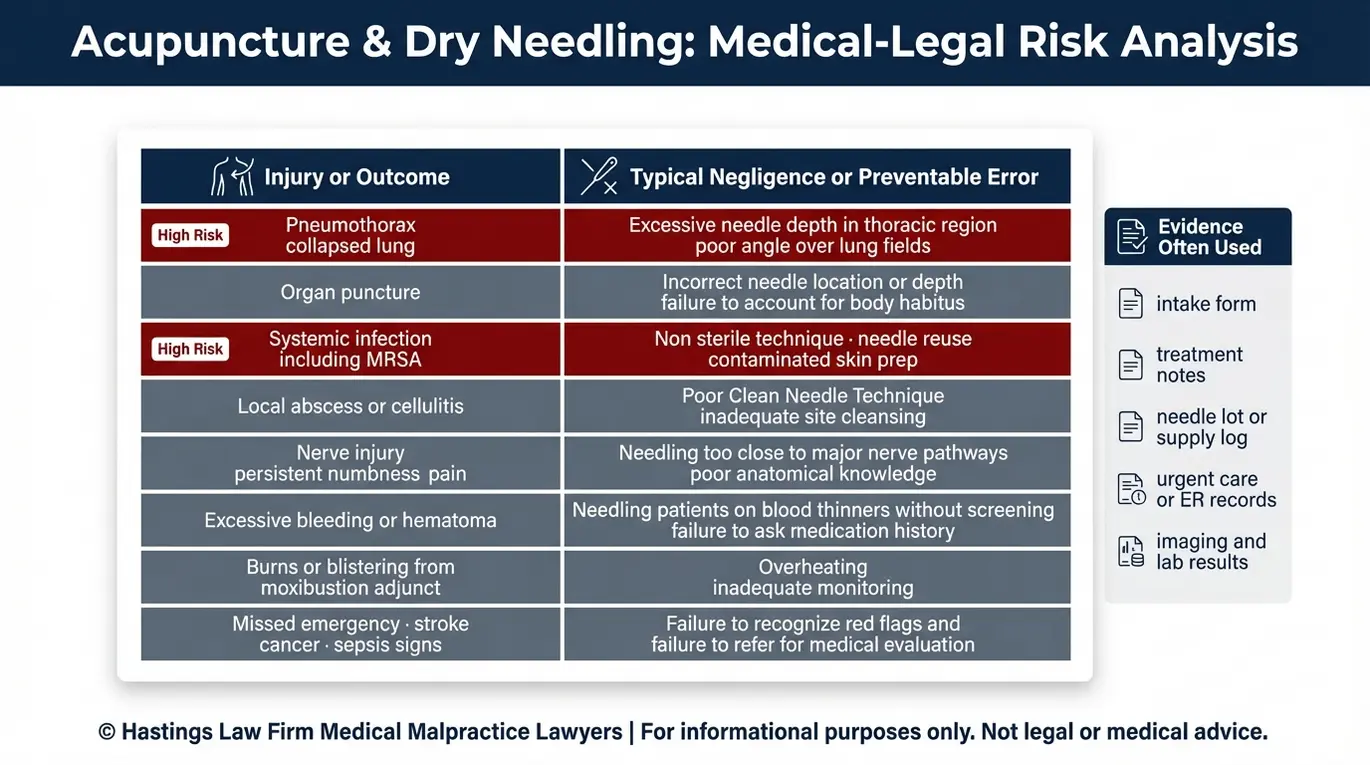
Negligent acupuncture can result in severe physical trauma, including pneumothorax (collapsed lung) from improper needle depth, nerve damage, organ puncture, and systemic infections like MRSA due to non-sterile techniques. When considering suing an acupuncturist, the nature and severity of these injuries often determine the strength and value of the claim.
Pneumothorax is one of the most well-documented serious injuries linked to acupuncture negligence. It occurs when a needle penetrates the pleural space, which is the thin area surrounding the lungs. This area is particularly vulnerable to overly deep chest needling. Even a small puncture can cause the lung to partially or fully collapse, requiring emergency hospitalization. A published case study in PubMed Central on acupuncture-induced pneumothorax documents how improper needling technique in the thoracic region can lead to this life-threatening condition.
Infections represent another category of preventable acupuncture injuries. Violations of Clean Needle Technique, such as reusing needles or failing to properly disinfect the treatment area, can introduce dangerous bacteria into the body. This can lead to localized abscesses, bloodborne infections like hepatitis, or antibiotic-resistant conditions such as MRSA. An acupuncture injury lawyer in Arizona will examine treatment records and facility protocols to identify where sterilization failures occurred.
Nerve damage can result from improper needle placement near major nerve pathways. Symptoms may include chronic pain, numbness, tingling, or loss of motor function in the affected area. These injuries can be permanent.
Missed diagnoses occur when an acupuncturist treats symptoms of a serious underlying condition, such as cancer or stroke, with needles instead of recognizing the need for an immediate medical referral. This delay can allow a treatable condition to progress to a critical stage.
| Injury Type | Typical Cause / Negligence |
|---|---|
| Pneumothorax (collapsed lung) | Needle inserted too deeply into the thoracic cavity |
| Infection (MRSA, hepatitis, abscess) | Failure to follow Clean Needle Technique; reuse of needles |
| Nerve damage | Improper needle placement near major nerve pathways |
| Organ puncture (visceral perforation) | Excessive needle depth in the abdominal or thoracic region |
| Missed or delayed diagnosis | Treating serious symptoms with acupuncture instead of referring to a physician |
The Hastings Law Firm Difference
Results matter, but what truly sets us apart is how we achieve them. Every verdict, every settlement, and every Arizona courtroom victory comes from one guiding promise: To treat each client’s fight for justice as if it were our own.
This balance of skill, experience, and empathy reflects our core philosophy that justice should not only compensate the injured, but also make healthcare safer nationwide.

Establishing the Standard of Care for Arizona Acupuncturists
The standard of care for acupuncturists is defined by the safety protocols set by the NCCAOM and Arizona licensing authorities, including mandatory Clean Needle Technique (CNT) certification, a formal training program that teaches safe needle handling, skin preparation, and infection prevention procedures.
The Arizona Acupuncture Board of Examiners, under A.R.S. § 32-3903, has the authority to establish licensing requirements and enforce professional standards. These regulations provide a specific baseline for safety that all practitioners must follow. These requirements include graduation from an accredited program, passing national certification exams, and maintaining compliance with continuing education standards. An Arizona acupuncturist malpractice lawyer uses these regulatory benchmarks as the foundation for establishing what a practitioner should have done.
The NCCAOM guidelines function as the primary benchmark for “reasonable care” in litigation. These guidelines address everything from patient assessment and treatment planning to needle safety and hygiene. The Clean Needle Technique Manual specifically requires the use of disposable filiform acupuncture needles, which are single-use sterile needles, along with proper skin disinfection and safe disposal practices.
In a malpractice case, the central question is whether a prudent acupuncturist would have made the same clinical decision under the same circumstances. A malpractice attorney for acupuncture cases works with qualified expert witnesses who can testify about what the Clean Needle Technique or other standards required.
This expert analysis is often the most important piece of evidence in building a viable claim. Juries rely on these professional insights to understand technical medical details. Without expert testimony clearly delineating the boundary between acceptable practice and negligence, it is difficult to prove that a violation occurred.
Proving Liability: The Four Elements of an Acupuncture Injury Claim
To win a claim, you must prove four distinct elements: that a provider-patient relationship existed (Duty), the provider violated safety standards (Breach), this violation was the direct cause of injury (Causation), and actual financial or physical losses occurred (Damages). Each element must be established by a preponderance of the evidence, meaning it is more likely than not that the negligence occurred and caused the harm.
An acupuncture malpractice lawsuit requires the following proof:
- Duty: A legal duty of care is established the moment a practitioner agrees to treat you. Once an acupuncturist begins a treatment session, they owe you the same level of professional care that any similarly trained and licensed acupuncturist would provide. This element is typically the simplest to prove through appointment records and billing documentation.
- Breach: The breach is the specific error or failure that fell below the accepted standard of care. Examples include reusing needles, inserting needles too deeply near important organs, or failing to obtain informed consent before treatment. A medical negligence attorney identifies the breach by analyzing treatment records against established NCCAOM protocols and licensing requirements.
- Causation: You must demonstrate a direct connection between the practitioner’s breach and your injury. For example, if you developed a MRSA infection, the evidence must show the infection came from the acupuncture treatment and not from another source. Our legal team also includes former hospital defense attorneys and nurses who previously worked for the systems we now challenge, giving us an inside look at how providers defend these claims.
- Damages: You must show real, quantifiable losses resulting from the injury. These include medical bills, lost wages, physical pain, and emotional distress. Without documented damages, there is no recoverable claim, even if negligence clearly occurred.
Working with a firm that has in-house medical staff and access to qualified experts can make a significant difference in the outcome. Our team works with medical experts who analyze timelines, lab results, and clinical records to establish these links.
Calculating Damages for Injuries Caused by Alternative Medicine
Patients harmed by acupuncture negligence are entitled to recover economic damages (medical bills, lost wages) and non-economic damages (pain and suffering, loss of enjoyment of life) to restore their financial security. The specific value of acupuncture injury compensation depends on the severity of the injury, the cost of treatment, and the long-term impact on your daily life.
Economic damages cover the measurable financial losses tied directly to the injury:
- Emergency room visits, hospitalization, and surgical procedures (such as chest tube placement for a pneumothorax)
- Prescription medications, including antibiotics for infections
- Follow-up care, physical therapy, and rehabilitation
- Lost wages and reduced earning capacity during recovery
- Future medical care for injuries that require ongoing treatment
Non-economic damages address the personal toll of the injury, which is harder to quantify but equally real:
- Physical pain and discomfort during treatment and recovery
- Emotional distress, anxiety, or depression resulting from the injury
- Loss of enjoyment of life when the injury limits your daily activities
- The psychological impact of being harmed by a trusted healthcare provider
Some acupuncture injuries carry lifelong consequences. Permanent nerve damage may require long-term pain management. Scarring from surgical intervention to treat a punctured organ can affect self-confidence and quality of life.
When we evaluate a potential settlement for acupuncture malpractice, we account for both current losses and the projected costs you will face. Our goal is to build a damages case that reflects the full scope of what you have experienced and what your recovery will require.
Arizona Statute of Limitations for Acupuncture Lawsuits
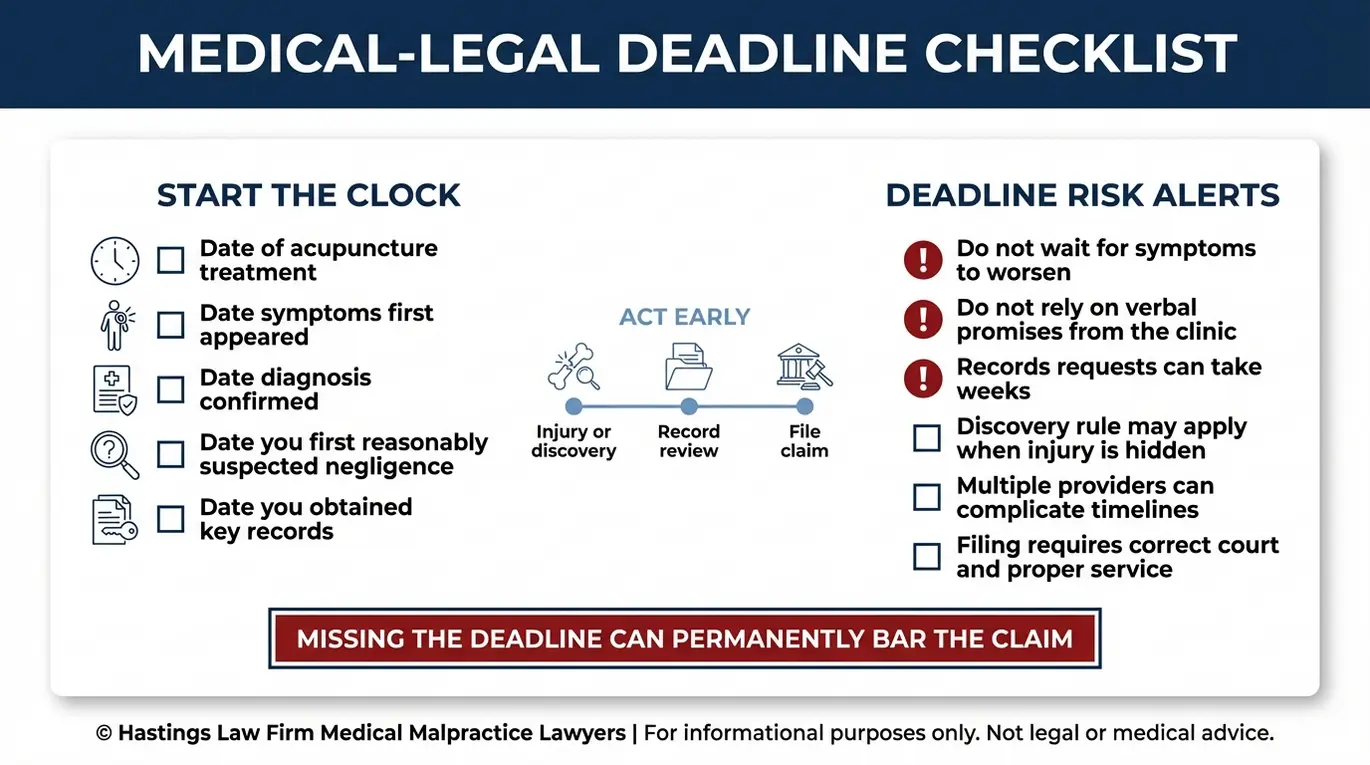
In Arizona, you generally have two years from the date of the injury, or the date the injury was discovered, to file a medical malpractice lawsuit. Missing this filing deadline can permanently bar you from recovering any compensation, regardless of how strong your case may be.
The standard filing deadline is set by A.R.S. § 12-542, which applies to personal injury claims including those against acupuncturists. The two-year clock typically begins on the date the injury occurred, which in many acupuncture cases is the date of the treatment itself. An Arizona acupuncturist malpractice lawyer can confirm the specific deadline that applies to your situation.
Arizona also recognizes a “discovery rule” that can adjust the starting point of the filing deadline. Some injuries caused by negligent acupuncture are not immediately apparent. For example, a patient who contracts hepatitis from contaminated needles may not develop symptoms or receive a diagnosis until months after treatment.
In those situations, the two-year period may begin on the date the patient knew or reasonably should have known about the injury and its potential connection to the acupuncture treatment. The Arizona Judicial Branch’s guidance on statutes of limitations provides general information about how these time limits work.
Do not wait to explore your legal options. Even when the discovery rule applies, Arizona courts interpret these deadlines strictly. Evidence can degrade, memories fade, and treatment records may become harder to obtain over time. If you believe you were injured by an acupuncturist, consulting with an attorney about the filing deadline for your acupuncture suit early protects your ability to pursue a claim.
Contact the Arizona Healthcare Malpractice Attorneys at Hastings Law Firm Today for Help
Acupuncture is classified as alternative medicine, but the injuries caused by negligent practitioners are anything but alternative. Punctured lungs, dangerous infections, and permanent nerve damage are serious medical events that deserve serious legal accountability.
At Hastings Law Firm, our Arizona acupuncturist malpractice lawyers work alongside in-house nurses and medical professionals to investigate exactly what happened during your treatment. Tommy Hastings, a board-certified trial lawyer, founded the firm to focus exclusively on medical negligence litigation. We prepare every case as if it will go to trial, which allows us to negotiate from a position of strength on your behalf.
We operate on a contingency fee basis, which means you pay no attorney fees or costs unless we recover compensation for you. If you or a loved one suffered an injury from acupuncture treatment, contact an Arizona acupuncturist malpractice lawyer at our firm for a free, confidential case evaluation. Let us help you find the answers you deserve.
Frequently Asked Questions About Acupuncturist Malpractice in Arizona


This content was researched and written by the Hastings Law Firm editorial team, which includes attorneys, medical professionals, and experienced researchers. Our writing is informed by internal knowledge and practical experience, and we cross-check critical details against authoritative sources cited throughout. Every piece undergoes human-led fact-checking and legal review. Because legal and medical information can change, if you spot an error, please contact us. Learn more about our content standards and review process on our editorial policy page.

Tommy Hastings, founder of Hastings Law Firm, is a board-certified personal injury trial lawyer dedicated exclusively to healthcare injury cases. Since 2001, he has represented injured patients and families in litigation against major hospital systems, pharmaceutical companies, and negligent healthcare providers nationwide. He has handled numerous high-profile cases that have drawn national media attention and resulted in multi-million dollar recoveries. He draws on that experience in his writing, helping readers understand how these cases work and what options may be available to them.
