


Arizona ABO Incompatibility Birth Injury Lawyer
ABO incompatibility and Rh factor disease can cause serious newborn complications when blood type risks are missed during pregnancy or rising bilirubin is not treated promptly after birth. The condition can progress from jaundice to permanent brain injury when monitoring, testing, communication, or timely treatment breaks down. Understanding how screening, follow up, and newborn care decisions affect outcomes can help families recognize when care may have fallen below accepted standards. If you or a loved one were harmed or worse due to ABO incompatibility birth injury in Arizona, contact Hastings Law Firm for a free, confidential case review.

Last Updated: September 24, 2026
Trusted Arizona Attorneys for Preventable Infant Blood Disorders
When your newborn develops complications from a blood type mismatch that should have been identified and managed during pregnancy or after delivery, the questions can feel overwhelming. You may be trying to understand if the jaundice was caught in time, if treatment was delayed, or if your child’s condition could have been prevented with proper monitoring.
At Hastings Law Firm, we focus exclusively on medical malpractice cases, including birth injuries caused by ABO incompatibility. Our founder, Tommy Hastings, is a board-certified trial lawyer and a 2025 inductee into the American Board of Trial Advocates who has dedicated his career to representing families affected by medical negligence. Our team includes in-house nurse consultants and former defense attorneys who understand how hospitals document care and how to identify gaps in that documentation. As your Arizona ABO incompatibility birth injury lawyer, we can review your child’s medical records, consult with qualified experts, and explain whether the care your family received met accepted medical standards.
If you have concerns about your newborn’s care, we offer a free, confidential case evaluation to help you understand your options.

Distinguishing Between ABO Incompatibility and Rh Factor Disease
ABO incompatibility occurs when a mother with Type O blood carries a fetus with Type A or B blood, causing maternal antibodies to attack fetal red blood cells, whereas Rh incompatibility involves the Rh protein factor. Both conditions fall under a category called hemolytic disease of the newborn (HDN), a condition where a mother’s immune system produces antibodies that destroy her baby’s red blood cells.
How ABO Incompatibility Develops
Every person’s blood contains antigens, which are proteins on the surface of red blood cells that identify them to the immune system. People with Type O blood naturally produce antibodies against Type A and Type B antigens. When a Type O mother carries a baby with Type A or Type B blood, her antibodies can cross the placenta and attack the baby’s red blood cells.
The biology behind this involves specific antibody classes. While people with Type A or Type B blood typically produce IgM antibodies that cannot cross the placenta, those with Type O blood produce IgG antibodies. These IgG antibodies are capable of passing through the placental barrier, entering the fetal circulation, and initiating the destruction of the baby’s red blood cells. This specific biological mechanism helps explain why ABO incompatibility is a distinct risk for Type O mothers.
This breakdown of red blood cells is called hemolytic anemia. The destroyed cells release bilirubin, a yellow pigment that the baby’s immature liver struggles to process. ABO incompatibility is relatively common, affecting roughly 15 to 25 percent of pregnancies, but most cases are mild. Although often less severe than Rh disease, ABO incompatibility remains a leading cause of severe jaundice and can still progress to critical levels if not monitored, making it a condition that requires vigilance from medical providers.
How Rh Incompatibility Differs
Rh incompatibility involves a different protein called the Rh factor. When an Rh-negative mother carries an Rh-positive baby, exposure to the baby’s blood can cause her immune system to develop antibodies against the Rh protein. This typically happens during delivery, miscarriage, or certain prenatal procedures.
The critical difference is timing. Rh disease rarely affects a first pregnancy because the mother usually has not yet developed antibodies. However, without preventive treatment, subsequent pregnancies face significantly higher risks of severe hemolytic disease of the fetus and newborn. Rh factor mismatch requires specific medical interventions to prevent future complications.
| Feature | ABO Incompatibility | Rh Incompatibility |
|---|---|---|
| Cause | Mother Type O; Baby Type A or B | Mother Rh-negative; Baby Rh-positive |
| Frequency | Common (15-25% of pregnancies) | Less common |
| First Pregnancy Risk | Yes, can affect first pregnancy | Rarely affects first pregnancy |
| Severity | Usually mild to moderate | Can be severe without prevention |
| Prevention | No specific prevention available | Rh immune globulin (RhoGAM) prevents sensitization |
| Typical Treatment | Phototherapy; rarely exchange transfusion | May require intrauterine transfusion in severe cases |

Medical Negligence Involving Maternal Antibody Screening and Treatment
Medical negligence occurs during the prenatal period if an OB/GYN fails to perform blood typing or antibody screening tests that would identify high-risk pregnancies requiring closer monitoring. These tests are part of routine prenatal testing and care designed to catch potential problems before they cause harm.
Standard Prenatal Screening Requirements
The standard of care, which represents the level of treatment a reasonably competent physician would provide, requires specific blood tests early in pregnancy:
- Blood type and Rh factor determination at the first prenatal visit
- Indirect Coombs test (antibody screen) to detect existing maternal antibodies
- Repeat antibody screening at 28 weeks for Rh-negative mothers
- Additional testing if sensitization events have occurred
The Indirect Coombs test identifies whether the mother has developed antibodies that could attack fetal red blood cells. Unlike the Direct Coombs test, which checks the infant’s blood after birth, this prenatal screening provides an early warning system for the obstetric team. If antibodies are present, the pregnancy requires closer monitoring to detect fetal anemia before it becomes dangerous.
Recognizing Sensitization Events
Certain events can trigger a mother’s immune system to produce antibodies against fetal blood. These sensitization events include previous miscarriage, ectopic pregnancy, amniocentesis, chorionic villus sampling, abdominal trauma during pregnancy, or prior blood transfusions.
When a patient’s history includes any of these events, the standard of care requires the physician to document the risk and adjust the monitoring plan accordingly. Proper history taking is the foundation of prenatal safety. A physician who rushes through the initial patient interview may miss critical details about prior pregnancies or trauma.
In the context of Rh sensitization, missing a history of a “silent” miscarriage or an undocumented bleed in a prior pregnancy can lead to a false sense of security. This may leave the current fetus unprotected against a mounting immune response. Failure to gather this history or act on it may constitute negligence. History taking is a fundamental duty for any obstetrician managing a pregnancy.
Prevention of Rh Sensitization
For Rh-negative mothers, Rho(D) immune globulin, commonly known by the brand name RhoGAM, is a medication that prevents the mother’s immune system from developing antibodies against Rh-positive blood. According to clinical guidelines, including research on Rho(D) immune globulin administration, this injection should be given at 28 weeks of pregnancy and again within 72 hours after delivery if the baby is Rh-positive.
Failure to administer RhoGAM when indicated can result in the mother becoming sensitized, leading to Rh incompatibility (Rh factor disease) in future pregnancies. Cases involving alloimmunization in Rh-negative pregnant women demonstrate the consequences when prevention protocols are not followed.
Advanced Monitoring for High-Risk Cases
When antibody screens are positive, physicians may use Middle cerebral artery Doppler ultrasound to detect fetal anemia without invasive procedures. This imaging technique measures blood flow in the baby’s brain and can indicate whether the fetus is becoming anemic. The Middle cerebral artery (MCA) Doppler assessment is particularly valuable because it is non-invasive.
By measuring the peak systolic velocity of blood flow in the fetal brain, specialists can infer the viscosity of the blood. Anemic blood flows faster and with less resistance. This allows physicians to time interventions, such as intrauterine blood transfusions, with greater precision. Failing to order this monitoring when the clinical picture calls for it can delay intervention until the baby has already suffered harm.
The Hastings Law Firm Difference
Results matter, but what truly sets us apart is how we achieve them. Every verdict, every settlement, and every Arizona courtroom victory comes from one guiding promise: To treat each client’s fight for justice as if it were our own.
This balance of skill, experience, and empathy reflects our core philosophy that justice should not only compensate the injured, but also make health care safer nationwide.

Failure to Properly Treat Newborn Jaundice and Incompatibility Symptoms
When a newborn suffers from ABO incompatibility, failure to treat rising bilirubin levels with phototherapy or exchange transfusions constitutes medical malpractice if it results in brain damage. The progression from visible jaundice to permanent neurological injury can happen quickly, which is why timely recognition and treatment are essential.
Understanding the Progression of Jaundice
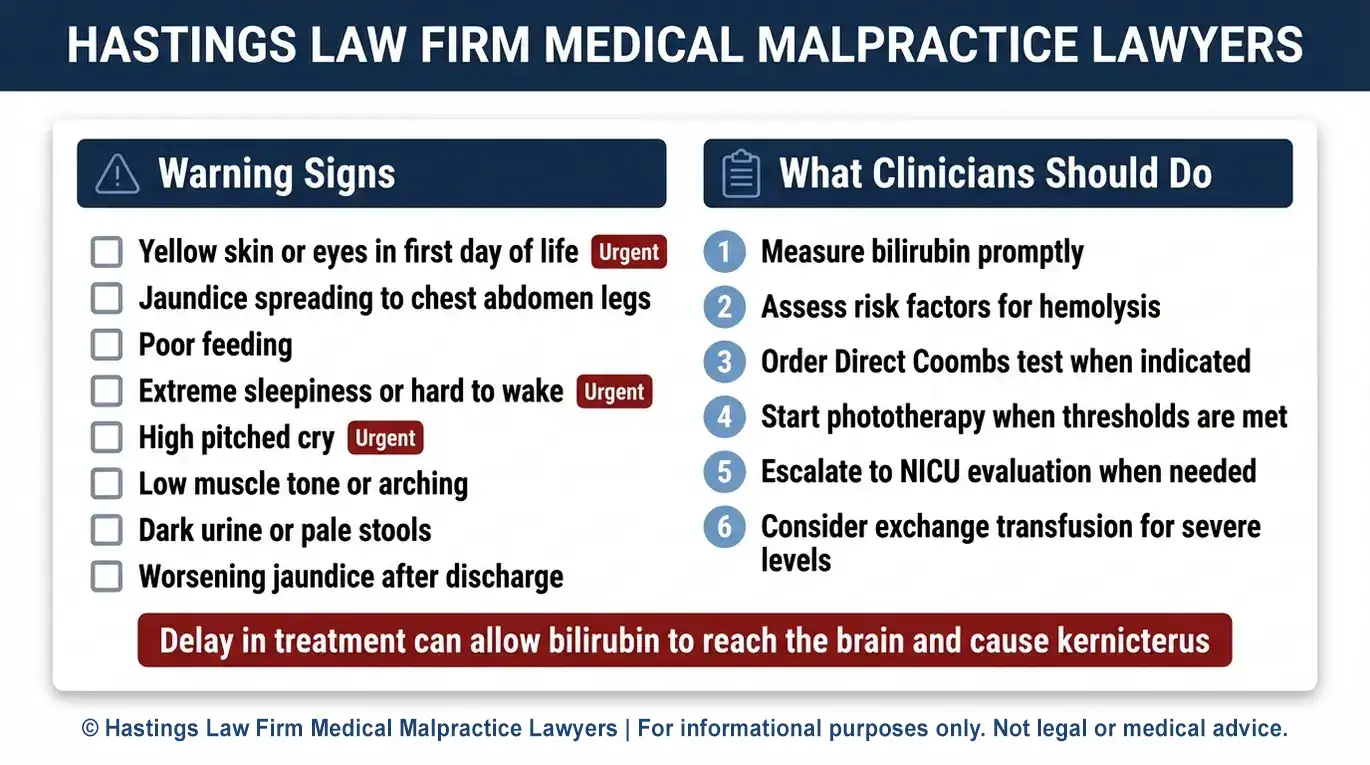
Jaundice, the yellowing of a baby’s skin and eyes, is common in newborns. However, jaundice that appears within the first 24 hours of life or rises rapidly is a warning sign that requires immediate evaluation.
In babies with ABO incompatibility, the destruction of red blood cells releases bilirubin faster than the baby’s liver can process it. This leads to hyperbilirubinemia, a condition where bilirubin levels in the blood become dangerously elevated. The Direct Coombs test, also called the direct antiglobulin test (DAT), can confirm whether antibodies are attached to the baby’s red blood cells, helping doctors determine whether hemolytic disease is the cause.
According to the American Academy of Pediatrics Clinical Practice Guideline, hospitals should follow specific protocols for monitoring and treating hyperbilirubinemia based on the baby’s age in hours and risk factors.
Warning Signs Requiring Immediate Medical Attention
Parents and medical staff should watch for these symptoms in newborns at risk for blood incompatibility complications:
- Jaundice appearing within the first 24 hours after birth
- Yellow coloring that spreads rapidly from the face to the chest, abdomen, and legs
- Difficulty feeding or poor sucking reflex
- High-pitched crying or unusual fussiness
- Extreme sleepiness or difficulty waking for feedings
- Arched back or neck (a sign of possible neurological involvement)
- Pale or grayish skin indicating anemia
Treatment Options and Timing
Phototherapy, which involves placing the baby under special blue lights, is the first-line treatment for elevated bilirubin. The light helps break down bilirubin in the skin so the baby can eliminate it. For most cases of ABO incompatibility, phototherapy is effective when started promptly. For severe cases, the infant may need to be admitted to the NICU (Neonatal Intensive Care Unit) for intensive monitoring and high-intensity phototherapy.
Exchange transfusion, a procedure where the baby’s blood is gradually replaced with donor blood, becomes necessary when bilirubin levels continue to rise despite phototherapy or reach dangerous thresholds. This procedure removes both the excess bilirubin and the maternal antibodies attacking the baby’s blood cells.
The Danger of Kernicterus
When bilirubin levels remain elevated for too long, the pigment can cross into the brain and damage the basal ganglia and brainstem. This condition, called kernicterus, causes permanent brain damage that affects movement, hearing, vision, and cognitive function. The damage often targets specific areas of the brain responsible for motor control and hearing.
Consequently, children with kernicterus often develop athetoid cerebral palsy, characterized by uncontrollable movements, and auditory neuropathy, a hearing disorder where the inner ear detects sound but the brain cannot process it. These life-altering consequences explain why “watch and wait” is not an acceptable strategy when bilirubin levels approach critical zones. Kernicterus is almost always preventable with appropriate monitoring and timely treatment.
Establishing Liability for Birth Injuries Caused by Blood Mismatches
To establish liability in an Arizona birth injury lawsuit, your lawyer must prove the medical provider owed a duty of care, breached that duty by failing to diagnose or treat the incompatibility, and directly caused the infant’s injury. This requires detailed analysis of medical records and testimony from qualified experts.
The Four Elements of Medical Malpractice
Every medical malpractice case in Arizona requires proof of four elements:
Duty of Care. The physician or hospital must have had a professional relationship with the patient that created an obligation to provide competent care. For prenatal and delivery care, this relationship is established when the OB/GYN accepts the patient.
Breach of Duty. The provider must have failed to meet the accepted standard of care. In ABO incompatibility cases, breaches may include failing to order appropriate blood tests during pregnancy, ignoring positive antibody screens, discharging a jaundiced newborn without proper follow-up, or delaying phototherapy, a treatment using specific wavelengths of light, when bilirubin levels exceeded safe thresholds.
Causation. The breach must have directly caused the injury. This is often the most contested element. Arizona ABO incompatibility birth injury attorneys must demonstrate that the child’s brain damage or other injury would not have occurred if the provider had followed proper protocols. Establishing causation often involves a “but-for” analysis.
We must show that but for the provider’s delay in ordering a bilirubin check or initiating treatment, the bilirubin would not have reached neurotoxic levels. This involves plotting the baby’s bilirubin levels on the Bhutani nomogram—a risk zone chart used worldwide—to demonstrate exactly when the medical team should have intervened to prevent the injury. Establishing causation is critical to proving a medical malpractice claim.
Damages. The child must have suffered actual harm. This includes physical injury, the need for ongoing medical care, and the impact on the child’s quality of life.
The Role of Expert Testimony
Arizona law requires expert testimony to establish both the standard of care and how the defendant deviated from it. Medical experts review the records and provide opinions on what a reasonably competent physician in the same specialty would have done under similar circumstances.
In blood incompatibility cases, experts typically examine the prenatal testing timeline, bilirubin monitoring logs, nursing notes documenting the baby’s condition, and the timing of treatment decisions. They compare what happened against published guidelines and accepted clinical practices.
Common Failures We Investigate
Our team examines medical records for specific patterns that may indicate negligence. These include gaps in bilirubin monitoring during the critical first days of life, discharge decisions made before bilirubin levels stabilized, failure to communicate abnormal test results between nursing staff and physicians, and delays in performing an exchange transfusion, a procedure that swaps the baby’s blood with donor blood, when it was clearly indicated.
We also review whether the hospital had appropriate protocols in place and whether staff followed them. Sometimes the failure is systemic rather than individual. Our thorough investigation of medical records helps identify where the care system failed the patient.

Recovering Damages for Lifetime Care in Arizona Birth Injury Cases
Families may recover economic damages for past and future medical expenses, as well as non-economic damages for pain, suffering, and loss of quality of life caused by the child’s injury. The goal of compensation is to provide the resources necessary to care for your child throughout their lifetime.
Economic Damages
Economic damages cover the measurable financial impact of the injury. In birth injury cases involving kernicterus, which is the permanent brain damage caused by untreated high bilirubin, these costs can be substantial:
- Past and future medical bills, including hospitalizations, surgeries, and specialist visits
- Physical therapy, occupational therapy, and speech therapy
- Medications and medical supplies
- Specialized medical equipment such as wheelchairs, communication devices, and mobility aids
- Home modifications to accommodate disability
- In-home nursing care or personal care assistance
- Special education services and tutoring
- Lost future earning capacity if the child will be unable to work as an adult
Non-Economic Damages
Non-economic damages address harm that cannot be measured with receipts or invoices. These include the child’s physical pain and emotional suffering, loss of enjoyment of life, and the inability to participate in normal childhood activities. Arizona does not cap non-economic damages in most medical malpractice cases, allowing juries to consider the full impact of the injury.
The Importance of a Life Care Plan
For children with permanent disabilities, calculating future damages requires a Life Care Plan. This document, prepared by medical and rehabilitation experts, projects the care the child will need over their expected lifetime. Creating this plan involves a multidisciplinary approach.
We consult with vocational economists to project medical inflation rates and rehabilitation specialists who determine the replacement schedules for prosthetics, wheelchairs, and communication aids. The plan must also account for architectural renovations to the family home and the potential cost of adapted vehicles. A Life Care Plan ensures every aspect of daily living is supported financially.
Arizona’s Approach to Damage Recovery
Unlike some states, Arizona does not impose caps on damages in medical malpractice cases involving birth injuries. This means juries can award the full amount necessary to compensate for both economic losses and the pain and suffering the child and family have experienced. Because these cases involve catastrophic injuries, the resulting compensation must last for decades.
Arizona law protects the rights of patients to seek full redress, recognizing that the financial burden of medical malpractice should fall on the negligent provider and their insurance carrier. At Hastings Law Firm, we are prepared to take the case to a jury to secure the resources your family needs.
Contact The Arizona Birth Injury Attorneys at Hastings Law Firm Today for Help
If your child suffered a preventable injury due to mismanaged blood incompatibility, our team can help you understand what happened and whether you have a case. Hastings Law Firm focuses exclusively on medical malpractice, and our Arizona office is prepared to investigate your family’s situation.
Our legal team includes in-house nurse consultants who review medical records and identify potential breaches in the standard of care. We also have former defense attorneys on staff who understand how hospitals and their insurers approach these cases. This insight into how the other side operates allows us to build stronger evidence early in the process.
As your Arizona birth injury lawyer for ABO incompatibility claims, we handle the investigation, expert consultations, and litigation so you can focus on your child. We work on a contingency fee basis, which means you pay no attorney fees unless we secure a recovery for your family. Our firm is dedicated to securing the resources needed for your child’s future care.
Contact us today for a free, confidential case evaluation. We can review your child’s records and help you find the answers you deserve.
Frequently Asked Questions About ABO Incompatibility Birth Injury in Arizona


This content was researched and written by the Hastings Law Firm editorial team, which includes attorneys, medical professionals, and experienced researchers. Our writing is informed by internal knowledge and practical experience, and we cross-check critical details against authoritative sources cited throughout. Every piece undergoes human-led fact-checking and legal review. Because legal and medical information can change, if you spot an error, please contact us. Learn more about our content standards and review process on our editorial policy page.

Tommy Hastings, founder of Hastings Law Firm, is a board-certified personal injury trial lawyer (by the Texas Board of Legal Specialization) dedicated exclusively to healthcare injury cases. Since 2001, he has represented injured patients and families in litigation against major hospital systems, pharmaceutical companies, and negligent healthcare providers nationwide. He has handled numerous high-profile cases that have drawn national media attention and resulted in multi-million dollar recoveries.
