


Arizona Abnormal Doppler Ultrasound Malpractice Lawyer
Written by: Hastings Law Firm | Reviewed by: Tommy Hastings | Updated: July 27, 2026
Fetal Doppler flow studies can provide critical warning signs when a pregnancy is high risk and a baby may not be getting enough oxygen and nutrients. When a Doppler ultrasound is missed, misread, performed poorly, or not communicated quickly, abnormal blood flow can go unaddressed and lead to permanent brain injury or worse. These cases often involve questions about whether the right test was ordered and whether urgent findings were acted on. If you or a loved one were harmed or worse due to abnormal Doppler ultrasound malpractice in Arizona, contact Hastings Law Firm for a free, confidential case review.

Trusted Arizona Birth Injury Attorneys for Fetal Diagnostic Errors
What You Should Know About Fetal Doppler Negligence Claims in Arizona:
- Permanent brain damage or fatal outcomes can result when abnormal Doppler findings are missed or ignored and oxygen deprivation is not addressed.
- Options for accountability can depend on whether the Doppler study was ordered when risk factors were present and whether abnormal results were treated as urgent.
- Responsibility can extend to multiple providers when performance, interpretation, or communication failures occur across the diagnostic workflow.
- Recovery limits are not imposed by damage caps in Arizona for personal injury and wrongful death claims.
- Case viability can be affected by time limits that apply to medical malpractice claims in Arizona.
- Disputes can focus on whether the scan was technically reliable when technique problems produced inaccurate measurements.
- Delayed intervention can follow when abnormal flow patterns are dismissed as artifact rather than treated as a serious warning sign.
- Critical results can be missed when imaging center workflow problems delay transmission of time sensitive findings to the ordering obstetrician.
- Proof challenges can increase when expert testimony is required and expert qualifications must match the defendant specialty.
- Liability theories can shift when a sonographer performance error is alleged but diagnosis authority rests with the interpreting radiologist or ordering physician.

A Healthcare Focused Law Firm
When something goes wrong during pregnancy or delivery, the weight of that experience can feel isolating. If you suspect that a fetal Doppler ultrasound, a specialized imaging study that measures blood flow between mother and baby, was missed, misread, or ignored, you are not alone in seeking answers.
These diagnostic tools exist to detect early warning signs of fetal distress. When providers fail to use them correctly or act on concerning findings, the consequences can be devastating and permanent. Understanding what happened, and whether it could have been prevented, is often the first step toward moving forward.
As an Arizona Abnormal Doppler Ultrasound Malpractice Lawyer, Hastings Law Firm focuses exclusively on complex birth injury cases involving diagnostic failures. Our medical-legal team includes in-house nursing professionals and former defense attorneys who know how to investigate these claims thoroughly. Tommy Hastings, our founder, is a board-certified trial lawyer who has dedicated his career to representing families affected by medical negligence. If your family is facing this situation, we can review your records and explain your options at no cost.
The Critical Role of Fetal Doppler Flow Studies in Prenatal Care
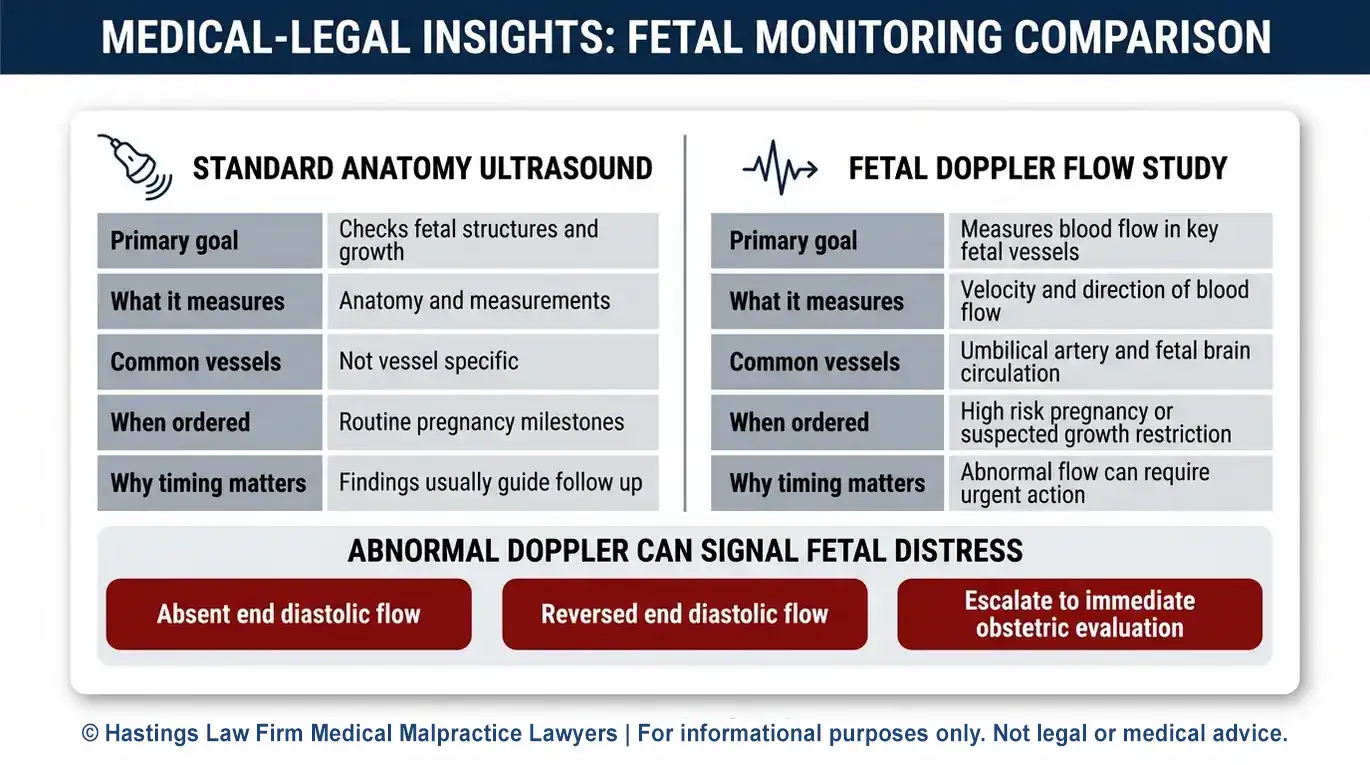
Fetal Doppler flow studies are specialized ultrasounds used to measure blood flow in the umbilical cord and fetal brain, providing critical data on whether a baby is receiving enough oxygen and nutrients. Unlike a standard fetal ultrasound or anatomy scan that captures images of fetal structures, a Doppler study analyzes the velocity and direction of blood moving through key vessels. This level of detail is a crucial component of high-risk prenatal care.
Ob-gyn providers typically order umbilical artery Doppler studies, which assess blood flow through the cord connecting baby to placenta, when a pregnancy is considered high-risk. Common indications include suspected fetal growth restriction (FGR), also called intrauterine growth restriction (IUGR), where the baby is not growing at the expected rate due to problems with nutrient delivery.
According to the American College of Obstetricians and Gynecologists Practice Bulletin Number 229 on fetal growth restriction, these studies are a cornerstone of antepartum fetal surveillance for at-risk pregnancies. The urgency behind abnormal results cannot be overstated. When Doppler findings show compromised blood flow, immediate intervention such as an emergency cesarean section may be the only way to prevent oxygen deprivation, stillbirth, or permanent brain injury.
An Arizona malpractice lawyer for Doppler errors examines whether providers followed the standard of care by ordering appropriate testing and responding to concerning findings within acceptable timeframes.
Common Forms of Doppler Ultrasound Malpractice
Malpractice can occur during the performance of the scan, the interpretation of the images, or the communication of urgent results to the attending obstetrician. Each stage of the diagnostic process carries distinct responsibilities, and even minor deviations can lead to a devastating misdiagnosis.
Performance Errors happen when the sonographer fails to capture accurate measurements. The angle of insonation, meaning the angle at which the ultrasound beam intersects the blood vessel, must fall within specific parameters to produce reliable data. According to the University of Washington Department of Radiology Umbilical Artery Doppler Protocol, technical errors at this stage can render the entire study unreliable.
Interpretation Errors, often classified as perception errors or radiology errors, occur when radiologists or obstetricians dismiss critical findings. Reversed end-diastolic flow (REDF), a pattern showing blood actually flowing backward during part of the cardiac cycle, represents a serious warning sign. Misreading this as artifact rather than pathology can delay lifesaving intervention.
Communication Errors involve breakdowns between imaging facilities and ordering physicians. Time-sensitive findings that sit in a queue rather than reaching the obstetrician immediately can mean the difference between a healthy delivery and tragedy.
| Error Type | Description | Potential Consequence |
|---|---|---|
| Performance | Incorrect vessel angle or incomplete imaging | Unreliable data leading to false reassurance |
| Interpretation | Dismissing abnormal flow patterns as artifact | Missed opportunity for timely intervention |
| Communication | Delayed transmission of critical results | Preventable oxygen deprivation |
A Doppler ultrasound malpractice attorney in Arizona evaluates each step of this workflow to identify where the standard of care may have been breached, ensuring that negligent providers are held accountable for failures that caused preventable harm.
Systemic Failures in Diagnostic Workflow
Beyond individual mistakes, systemic issues can contribute to diagnostic failures. High-volume reading environments in imaging centers may pressure staff to complete studies quickly, leaving less time for careful technique and review. Processing errors and workflow failures can occur when rushed protocols prioritize throughput over accuracy. These institutional factors often play a role in cases we investigate.
Our firm uses a trial-ready approach to investigate these systemic failures. By preparing every case for a jury from the start, we ensure that every administrative or clinical error is identified early in the process.

The Hastings Law Firm Difference
Results matter, but what truly sets us apart is how we achieve them. Every verdict, every settlement, and every Arizona courtroom victory comes from one guiding promise: To treat each client’s fight for justice as if it were our own.
This balance of skill, experience, and empathy reflects our core philosophy that justice should not only compensate the injured, but also make healthcare safer nationwide.

Injuries Caused by Failure to Act on Abnormal Doppler Findings
When abnormal blood flow is missed or ignored, the fetus may suffer from severe oxygen deprivation, leading to permanent brain damage or fatal outcomes. Placental insufficiency, where the placenta cannot deliver adequate oxygen and nutrients, progressively worsens without intervention, and delayed treatment can be catastrophic.
Research published in a Cochrane review on fetal and umbilical Doppler ultrasound confirms that proper use of these studies in high-risk pregnancies reduces perinatal death. When providers fail to act, the consequences of a preventable birth injury include:
- Hypoxic-Ischemic Encephalopathy (HIE): Brain damage caused by oxygen deprivation during the perinatal period
- Cerebral Palsy: Motor impairment resulting from prolonged fetal hypoxia, meaning insufficient oxygen reaching the baby’s brain
- Stillbirth or Neonatal Death: The most devastating outcome, potentially leading to a wrongful death claim when critical warning signs go unaddressed
An ultrasound malpractice lawyer investigates whether timely intervention could have prevented these injuries. We use an extensive national network of medical experts to review the timing and response of medical teams in these cases.

Proving Liability in Arizona Doppler Error Cases
Proving liability requires demonstrating that the medical provider deviated from the accepted standard of care and that this deviation directly caused the fetal injury. Arizona law establishes specific requirements for meeting this burden of proof in claims involving negligence.
The first question we examine is the “decision-to-order” framework: did the ordering physician fail to order a Doppler study despite clinical risk factors that warranted it? If testing was performed, we then analyze whether the study was technically adequate and properly interpreted to establish causation.
Arizona requires expert testimony in medical malpractice cases. Under Arizona Revised Statutes § 12-2604, expert witness qualifications mandate they must practice in the same specialty as the defendant. Additionally, A.R.S. § 12-2603 mandates that plaintiffs submit a preliminary expert opinion certifying that the standard of care was breached.
Multiple parties may share liability in these cases. The sonographer who performed the scan, the radiologist who interpreted it, and the ordering physician each have distinct professional duties. Our team works with qualified experts in radiology and maternal-fetal medicine to establish what each provider should have done differently.
An Arizona Doppler ultrasound error attorney helps families identify all potentially responsible parties and build the evidentiary foundation necessary to pursue accountability.
Contact The Arizona Birth Injury Attorneys at Hastings Law Firm Today for Help
If a missed warning sign on a Doppler ultrasound resulted in injury to your child, let us help you find the answers you deserve. Our firm includes in-house medical professionals who review records alongside attorneys with decades of trial experience. This combination allows us to identify breaches in care that other firms might miss.
Hastings Law Firm is dedicated to helping families find answers and secure the resources needed for their child’s future care. We prepare every case as if it will go to trial, which positions our clients for fair settlements or jury verdicts.
As an Arizona Abnormal Doppler Ultrasound Malpractice Lawyer, we offer free, confidential case evaluations. We work on a contingency fee basis, meaning you pay nothing unless we recover compensation for your family. Contact us today to discuss what happened and learn what options may be available to you.
Frequently Asked Questions About Abnormal Doppler Ultrasound Malpractice in Arizona


This content was researched and written by the Hastings Law Firm editorial team, which includes attorneys, medical professionals, and experienced researchers. Our writing is informed by internal knowledge and practical experience, and we cross-check critical details against authoritative sources cited throughout. Every piece undergoes human-led fact-checking and legal review. Because legal and medical information can change, if you spot an error, please contact us. Learn more about our content standards and review process on our editorial policy page.

Tommy Hastings, founder of Hastings Law Firm, is a board-certified personal injury trial lawyer dedicated exclusively to healthcare injury cases. Since 2001, he has represented injured patients and families in litigation against major hospital systems, pharmaceutical companies, and negligent healthcare providers nationwide. He has handled numerous high-profile cases that have drawn national media attention and resulted in multi-million dollar recoveries. He draws on that experience in his writing, helping readers understand how these cases work and what options may be available to them.
