


Should I File a Medical Malpractice Lawsuit in Texas?
Deciding whether to take legal action after harm from medical care is rarely simple. Patients and families can be left with new health problems, unexpected costs, and doubts about whether what happened was a known risk or something that should not have happened. Those questions often arrive while recovery, work, and family life still need attention. Understanding what makes a medical malpractice claim in Texas worth pursuing, and what stands in the way of one, helps a family decide with a clear view of what lies ahead.

Last Updated: octubre 22, 2026
What You Should Know Before Filing a Medical Malpractice Lawsuit in Texas:
- A medical malpractice lawsuit in Texas can be worth filing when the care fell below the accepted standard and more likely than not caused the harm, the losses are serious enough to justify a case, and there is still time to file.
- Texas Civil Practice and Remedies Code §74.301 limits non-economic damages to $250,000 combined against all physicians and other non-institutional providers, with separate limits for healthcare institutions. It does not cap economic losses, and a death case faces an additional inflation-adjusted limit under §74.303.
- The largest early cost is the medical expert review §74.351 requires, so the size of the losses against the cost of proving them shapes whether a case moves forward.
- Written notice with the required medical authorization goes to each defendant at least 60 days before suit, and qualifying notice can toll the filing deadline for 75 days.
- The expert report and each expert’s CV must be served within the ordinary 120-day deadline after each defendant’s original answer, unless extended. Without a report, the court must dismiss the claim against that defendant on its motion and award attorney fees and costs.
- The filing deadline is generally two years from the negligent act or the completion of the relevant treatment or hospitalization, not from discovery, with a ten-year outer limit.
- A Texas Medical Board complaint can lead to action on a physician’s license but does not compensate the patient, and filing one does not pause the lawsuit deadline.
- Requesting the medical and billing records and writing down dates, names and what happened protects the facts any review depends on.
Is a Medical Malpractice Lawsuit Worth It in Texas?
A medical malpractice lawsuit in Texas can be worth it when three things line up: the care fell below the accepted standard and more likely than not caused the harm, the losses are serious enough to justify a case, and there is still time to file. Capítulo 74 del Código de Prácticas y Recursos Civiles Texas governs these claims against physicians, hospitals, nurses, and other covered providers.
Patients and families who wonder whether they should file a medical malpractice lawsuit in Texas, or whether it is worth suing for medical malpractice at all, are trying to tell a bad outcome from a preventable one. Medicine carries risk, and a bad outcome is not always negligence. When an injury was preventable, the providers responsible should be held accountable.
Malpractice means a provider failed to give the care a reasonably careful provider in the same field would have given. A known surgical complication treated promptly is an accepted risk, while the same complication left unmonitored after the warning signs appeared can be a preventable harm. A case must prove duty, breach, proximate causation, and damages, each by a preponderance of the evidence, meaning more likely than not.
A claim can be brought against physicians, hospitals, nurses, and other healthcare providers. A hospital can answer for its own conduct, for its employees, and, through proven actual or ostensible agency, for a physician it does not employ, as our page on demandar a un hospital por negligencia médica en Texas explains. Whether a case is worth it in practice also depends on what it costs to prove and what Texas law allows a family to recover.
When Does a Medical Malpractice Claim Make Financial Sense in Texas?
A medical malpractice claim in Texas makes financial sense when the losses the law allows the patient or family to recover are large enough to outweigh the cost of proving the case. That cost includes the expert report required by Texas Civil Practice and Remedies Code §74.351, and the recovery is shaped by the damage caps in §74.301.
The losses in a case are the parts that can be documented, such as medical bills, future care, lost income or earning ability, and the loss of a loved one. Serious or lasting harm is what makes a case worth pursuing, and some lasting harm looks minor until the medical records are reviewed.
What a particular case is worth depends on the injury and the losses it caused, and our page of published Texas medical malpractice data collects the state’s figures.
How Do Texas Damage Caps Affect the Value of a Malpractice Claim?
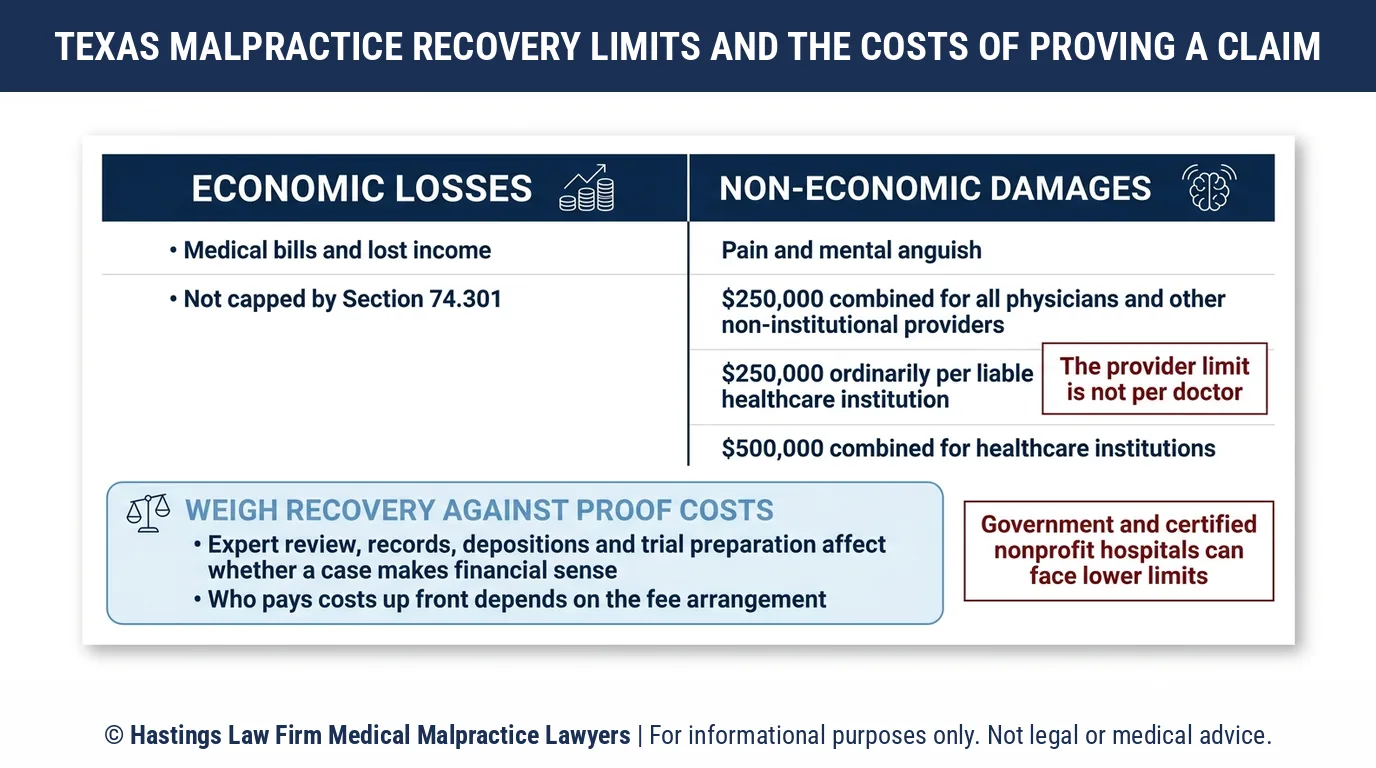
Texas Civil Practice and Remedies Code §74.301 limits non-economic damages, such as pain and mental anguish, to $250,000 combined against all physicians and other non-institutional providers, not $250,000 per doctor. Each liable healthcare institution ordinarily faces a separate $250,000 limit, with $500,000 for institutions combined. Economic losses such as medical bills and lost income are not capped by §74.301.
For a patient whose losses are mostly medical bills and lost income, those documented losses carry more weight in the decision. The ordinary combined ceiling reaches $750,000 only when the needed defendants are liable and the damages are proven, and family members do not multiply the caps. Government hospitals and certified nonprofit hospitals can face lower limits.
In a death case, §74.303 adds an inflation-adjusted limit on all damages, including exemplary (punitive) damages, apart from necessary medical, hospital, and custodial care, and it applies on top of §74.301. Our guides to Límites de indemnización por negligencia médica Texas y reclamaciones por muerte por negligencia cover both limits.
What Does It Cost to Bring a Medical Negligence Case in Texas?
The cost of bringing a medical negligence case in Texas depends on how much expert review, record gathering, and litigation the case needs, and the largest early cost is the medical expert review that Texas Civil Practice and Remedies Code §74.351 requires. Depositions and trial preparation add to that total, which is weighed against the losses the patient or family can recover.
Who pays those costs up front depends on the fee arrangement. A contingency fee ties the lawyer’s fee to the outcome, and Texas Government Code §82.065 requires the contract to be in writing and signed by the lawyer and the client. Texas sets no general statutory percentage for these fees.
Why Are Medical Malpractice Cases Hard to Bring in Texas?
Suing a doctor in Texas is hard because Chapter 74 of the Texas Civil Practice and Remedies Code adds requirements that ordinary injury claims do not face. A patient must send written notice before filing under §74.051, serve an early expert report under §74.351, and work within limits on what can be recovered.
Each requirement takes time to meet, which is why the decision to file should not wait. Pre-suit notice goes by certified mail to each proposed defendant at least 60 days before suit, with the medical authorization the statute requires.
The expert report fairly summarizes the standard of care, how the care fell short of it, and how that failure caused the harm. It is an early threshold, not the proof needed at trial. The report and each expert’s CV (a summary of qualifications) must be served within the ordinary 120-day deadline after each defendant’s original answer, subject to written extensions and the alternative deadlines in §74.353.
If no report is served, on that defendant’s motion the court must dismiss the claim against it with prejudice, so it cannot be refiled, and award attorney fees and costs. A court may grant one 30-day extension to cure a deficient report. Discovery, the exchange of evidence, is restricted until the report is served, with limited exceptions, and our page on demostrar la causalidad covers the report in depth.
Some care faces a higher bar. Qualifying emergency care in a hospital emergency department, an obstetrical unit, or a surgical suite right after emergency evaluation must meet a heightened standard under §74.153: willful and wanton negligence, proven by a preponderance of the evidence. The rule does not cover care after the patient is stabilized and receiving nonemergency treatment, as our page on emergency room malpractice explica.
Government hospitals add another layer. A claim against a government hospital must meet both Chapter 74 and immunity law, including a separate notice requirement under the Texas Ley de responsabilidad civil, generally within six months and shorter in some cities, that Chapter 74 notice does not automatically satisfy.
These rules make medical malpractice cases demanding, and lawyers who handle them meet them as part of building every case, which is why early contact matters.
How Long Do You Have to File a Medical Malpractice Lawsuit in Texas?
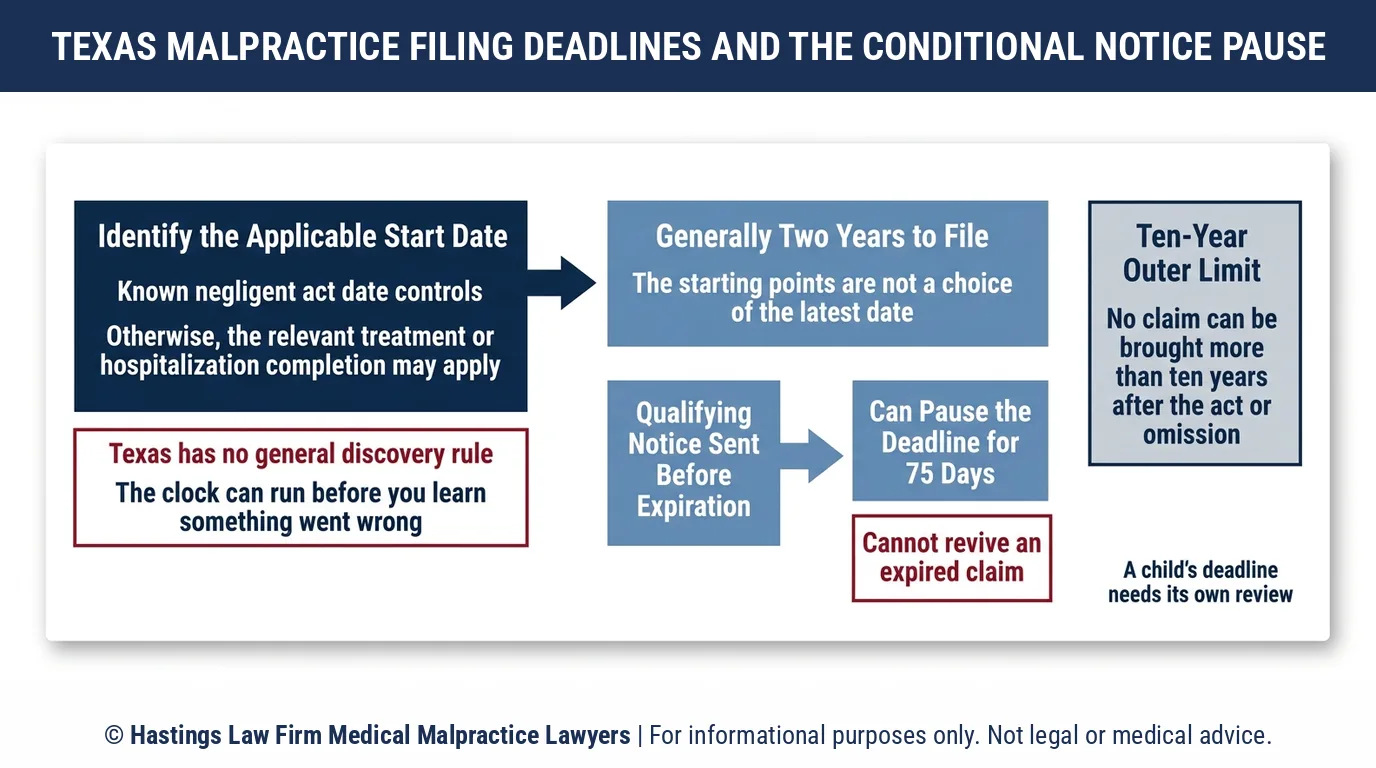
En Texas Código de Procedimiento Civil y Recursos, §74.251, a medical malpractice lawsuit generally must be filed within two years of the negligent act, or of the completion of the relevant treatment or hospitalization. These starting points are not a choice of the latest date. When the date of the negligent act is known, that date controls, and Texas has no general discovery rule for these claims.
Write down the date of the care, or the date treatment ended, because the clock can run before a patient learns anything went wrong. Qualifying pre-suit notice can toll, or pause, the deadline for 75 days if it goes out before the deadline expires, and it cannot revive an expired claim.
No claim can be brought more than ten years after the act or omission, and a child’s deadline needs its own review. Our Texas Guía sobre la prescripción en casos de negligencia médica covers the full rules.
What is the Timeline for a Texas Medical Malpractice Case?
No reliable average time exists for a Texas medical malpractice case, because every case is different and its length depends on the expert review, the number of defendants, and whether it settles. In national research in JAMA Medicina Interna in 2012, 10,056 claims closed from 2002 to 2005 by one nationwide insurer took a mean of 19.0 months from filing to closure, and 25.1 months when litigated.
Those figures are a historical national estimate, not a Texas average, and they do not predict how long it takes to sue for medical malpractice in Texas in any one case. A case moves through notice, filing, the expert report, discovery, mediation, and sometimes trial, and a settlement can come at any of those stages.
What Can You Do if a Lawyer Declines Your Texas Medical Malpractice Case?
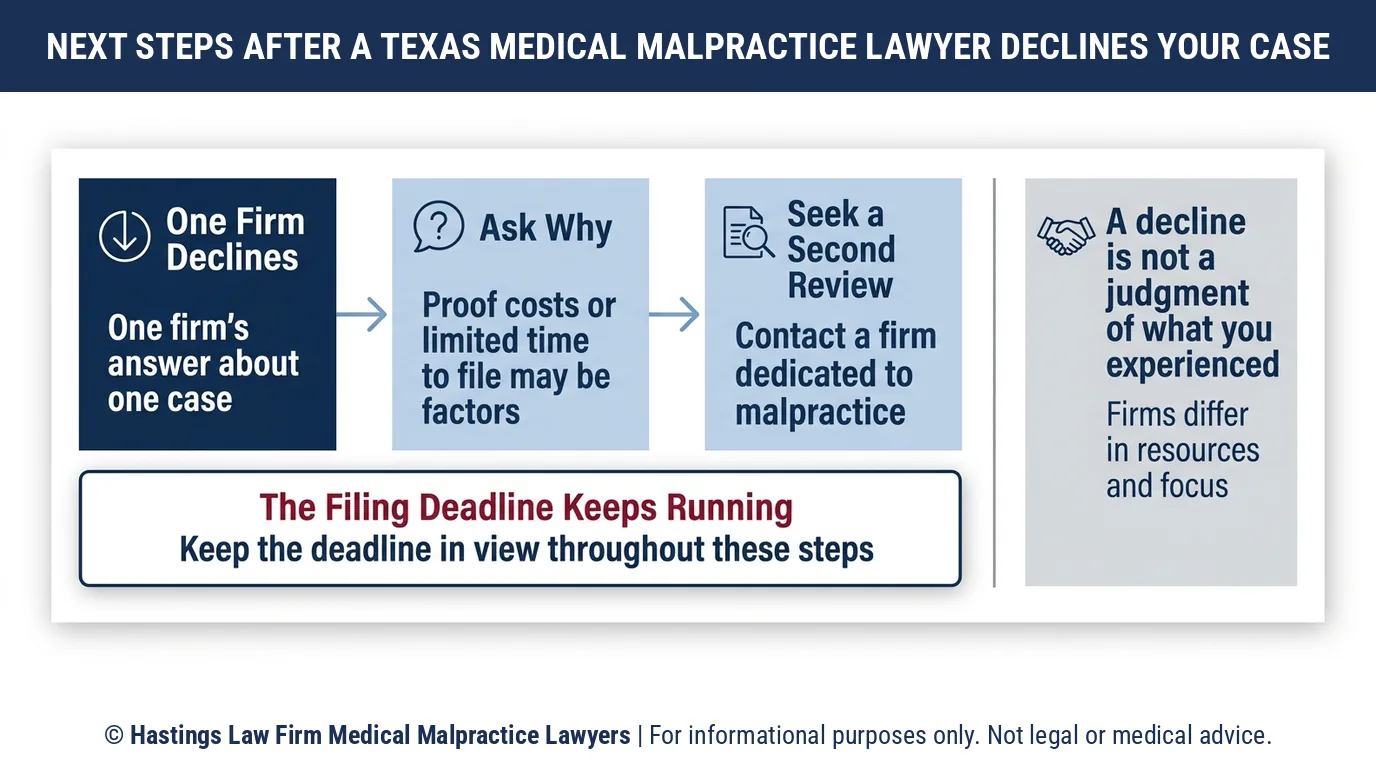
If a lawyer declines your Texas medical malpractice case, ask why it was declined, get a second review from a firm dedicated to medical malpractice, and keep the filing deadline in view. A decline is one firm’s answer about one case, and firms differ in their resources and their focus.
A firm may turn a case down because of what it would cost to prove or how little time is left to file. A decline is not a judgment of what you experienced, and the deadline keeps running after a no. Our page on why an attorney may not accept a medical malpractice case explains the reasons in full.
Can You File a Texas Medical Board Complaint Instead of a Malpractice Lawsuit?
A complaint about a doctor in Texas goes to the Texas Junta Médica, which reviews complaints about physicians and can discipline a license, but a complaint does not replace a malpractice lawsuit. The Texas Medical Board does not award money damages, so a complaint does not compensate the patient for medical bills, lost income, or other losses.
For accountability without a lawsuit, or alongside one, the Board reviews each complaint for jurisdiction and possible violations, can open an investigation, and can impose measures that include a reprimand, restrictions, suspension, or revocation of a license. Filing a complaint, online or on the Board’s written form, does not guarantee an investigation or discipline.
Filing a Texas Medical Board complaint does not itself pause the malpractice lawsuit deadline, so that deadline needs its own review. Complaints about a licensed hospital or other medical facility go to Texas Health and Human Services, and complaints about a nurse go to the Texas Board of Nursing under Texas Occupations Code §301.457.
A complaint and a lawsuit can both be pursued. The complaint addresses the provider’s license, and the claim addresses the patient’s losses. A claim may sometimes be resolved through negotiation before a lawsuit is filed.
The Hastings Law Firm Diferencia
Los resultados son importantes, pero lo que realmente nos distingue es cómo los logramos. Cada veredicto, cada acuerdo y cada victoria en la sala de audiencias se basa en una promesa que nos guía: Tratar la lucha de cada cliente por la justicia como si fuera la nuestra.
Este equilibrio de habilidades, experiencia y empatía refleja nuestra filosofía fundamental de que la justicia no solo debe compensar a los lesionados, sino también hacer que la atención médica sea más segura a nivel nacional.

What Steps Should You Take Before Filing a Medical Malpractice Lawsuit in Texas?
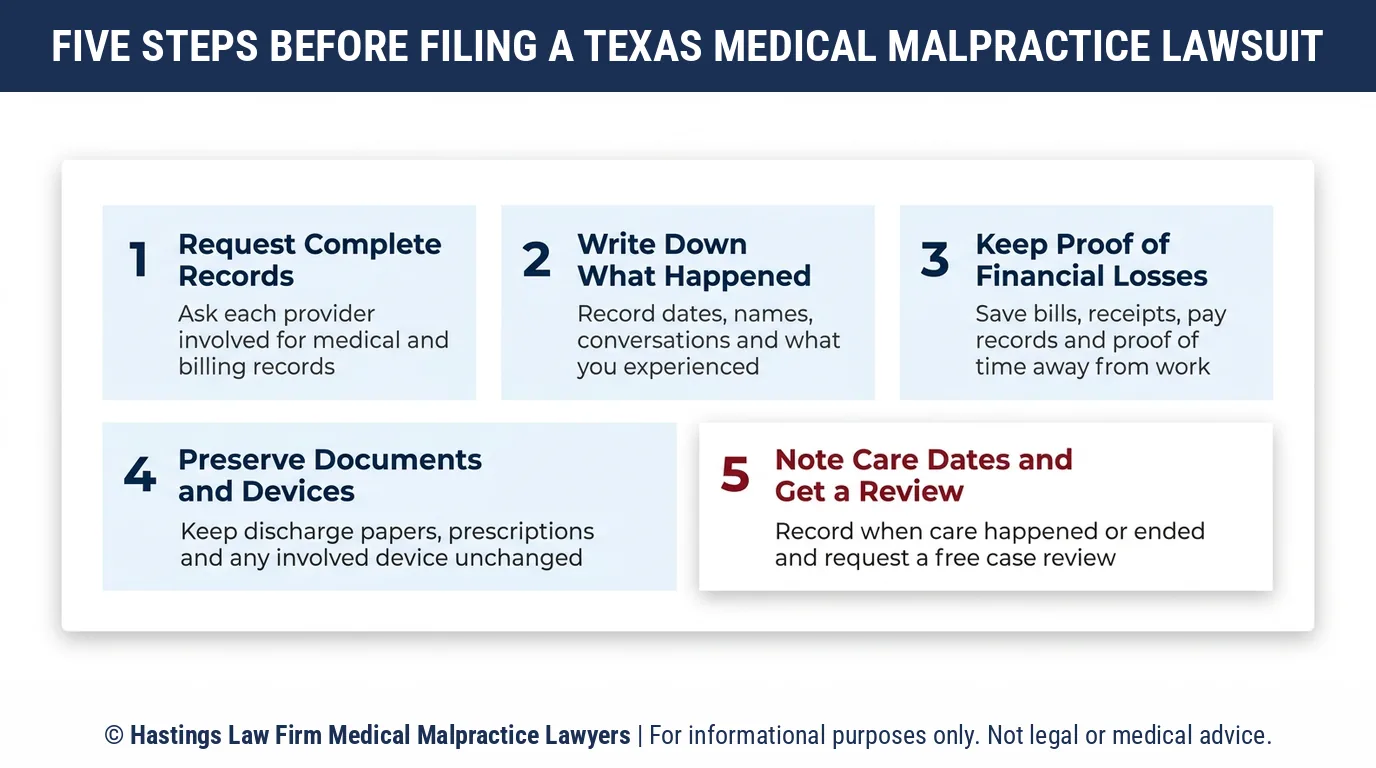
Before filing a medical malpractice lawsuit in Texas, request the medical and billing records from each provider involved, write down what happened while it is fresh, and keep every bill and document. These steps protect the facts that any review of a possible claim depends on.
Each step protects a different part of the decision:
- Request the complete medical records. Ask each provider involved for its medical and billing records. Federal law gives patients a right to access their health records, and response periods and limited copying fees depend on the request and the provider.
- Escribe lo que recuerdes. Dates, names, conversations, and what you experienced fade quickly, and informal notes made now keep them.
- Keep bills and proof of lost income. Receipts, pay records, and time away from work show the economic losses that weigh in the decision.
- Keep documents and devices as they are. Discharge papers, prescriptions, and any device involved should be kept unchanged.
- Note when the care happened or ended, and get a free case review. The filing deadline runs from those dates. Hastings Law Firm performs a free case review before you decide, and you can reach our intake team by phone or through our online contact form.
Talk to a Texas Medical Malpractice Attorney Before You Decide to File
You came here to find out whether what happened to you or someone you love could be a case. Our free, confidential case review is how we answer that question. We listen to what you experienced, request and review the medical records, and give you an honest answer about whether there is a claim.
Our Texas medical malpractice lawyers are experienced in helping injured patients and families across Texas weigh whether to bring a claim. We understand what a serious medical injury can mean for a family’s future care, its income, and the plans it had made.
Hastings Law Firm has been dedicated exclusively to medical malpractice since 2005. The firm advances the cost of the experts and of everything else it takes to build a medical malpractice claim, and works on a no-win, no-fee basis, so a family whose case is lost pays nothing. Our team is here for you. Contact us for a free, confidential case review.
Sources
- Texas Civil Practice and Remedies Code §74.001, defining a health care liability claim and covered providers | Texas Legislatura
- Texas Civil Practice and Remedies Code §74.301, limits on non-economic damages | Texas Legislatura
- Texas Government Code §82.065, written and signed contingency fee contracts | Texas Legislatura
- Texas Civil Practice and Remedies Code §74.051, pre-suit notice and its 75-day tolling | Texas Legislatura
- Texas Civil Practice and Remedies Code §74.351, expert report deadline, cure and dismissal | Texas Legislatura
- Texas Civil Practice and Remedies Code §74.153, willful and wanton standard for emergency care | Texas Legislatura
- Texas Civil Practice and Remedies Code §101.101, notice of claims against government units | Texas Legislatura
- Texas Civil Practice and Remedies Code §74.251, two-year filing deadline and ten-year limit | Texas Legislatura
- Study of malpractice claim outcomes and time to close claims, 2002 to 2005 | JAMA Medicina Interna
- How to file a complaint about a Texas physician and what the Board can do | Texas Junta Médica
- Texas Occupations Code §301.457, filing a complaint against a nurse | Texas Legislatura
- Resolving patient harm through communication, including financial settlement before litigation | Agencia de Investigación y Calidad Sanitarias
- A patient’s right to inspect and receive copies of medical records | Departamento de Salud y Servicios Humanos de los Estados Unidos

Este contenido ha sido investigado y escrito por el equipo editorial del bufete de abogados Hastings, que incluye abogados, profesionales médicos e investigadores experimentados. Nuestra redacción se basa en el conocimiento interno y la experiencia práctica, y cotejamos los detalles críticos con las fuentes autorizadas citadas a lo largo del texto. Cada artículo se somete a una comprobación de los hechos y a una revisión jurídica. Dado que la información jurídica y médica puede cambiar, si detecta un error, por favor Contacto. Obtenga más información sobre nuestras normas de contenido y el proceso de revisión en nuestro política editorial página.

Tommy Hastings, fundador de Hastings Law Firm, es un abogado especializado en casos de lesiones personales (por la Texas Junta de Especialización Jurídica) dedicado exclusivamente a casos de lesiones relacionadas con la atención sanitaria. Desde 2001, ha representado a pacientes y familias lesionados en litigios contra importantes sistemas hospitalarios, compañías farmacéuticas y proveedores de atención sanitaria negligentes en todo el país. Ha manejado numerosos casos de alto perfil que han atraído la atención de los medios de comunicación nacionales y han dado como resultado recuperaciones de varios millones de dólares.
