


Can You Sue a State Hospital in Texas?
Harm during care at a public hospital can leave a patient and family facing further treatment, lost income, and questions about whether anyone can be held responsible. A family may not realize the hospital it relied on is run by a county district or a state university until it starts looking for answers. That ownership changes which rules apply, how quickly action is required, and what a claim can recover. Understanding how claims against government hospitals in Texas work helps a family act before an early deadline passes.
Last Updated: octubre 22, 2026
What You Should Know About Suing a State Hospital in Texas:
- A state or other government hospital in Texas can be sued for medical malpractice only where the Texas Tort Claims Act waives its governmental immunity.
- Government hospitals include county hospital district hospitals such as Ben Taub, Parkland, and John Peter Smith, and state university hospitals such as Clements University Hospital and MD Anderson. Ownership, not the name, decides.
- The waiver covers injury or death caused by a condition or use of tangible personal or real property. A negligent diagnosis or a failure to pass on information does not automatically qualify.
- Chapter 74 still applies to a claim against a public hospital, including pre-suit notice and the expert report, but Chapter 74 does not itself waive immunity.
- Written notice of the claim is generally due within six months after the incident under §101.101, and a city’s charter or ordinance can set a shorter period.
- Recovery from a hospital district is ordinarily capped at $100,000 per person and $300,000 per occurrence, and claims against the state or a city at $250,000 and $500,000. Punitive damages are not available.
- Suing the government-employed doctor or nurse personally is generally not a reliable workaround, because §101.106 can require dismissal unless the hospital is substituted.
Can You Sue a State Hospital in Texas for Medical Malpractice?
You can sue a state hospital in Texas for medical malpractice only where the Texas Tort Claims Act (Texas Capítulo 101 del Código de Prácticas Civiles y Recurso Judicial) waives the hospital’s governmental immunity. The §101.021 waiver is narrow and is not a general waiver for all medical negligence by government employees.
Governmental immunity means a government unit cannot be sued unless a statute waives it, whether the hospital belongs to the state, a hospital district, or a city. Suing a government hospital in Texas, or trying to sue the state of Texas over hospital care, depends on the waiver, a notice deadline, lower damage caps, and the usual malpractice rules.
Which Hospitals in Texas Are Government Hospitals?
Government hospitals in Texas include county hospital district hospitals such as Ben Taub in Houston, Parkland in Dallas, and John Peter Smith in Fort Worth, and state university hospitals such as William P. Clements Jr. University Hospital in Dallas. Ownership by a governmental unit under the Texas Tort Claims Act, not the hospital’s name, decides whether a hospital is public.
En Texas Health and Safety Code §§285.071 and 285.072, a company managing a hospital for a hospital district can sometimes count as a governmental unit, so a privately run hospital may still be treated as public for some claims.
A nonprofit or for-profit hospital is not a government hospital, even one treating public patients, and a claim against a private hospital follows different rules.
Government Hospitals in Houston, Dallas and Fort Worth
- Houston
- Hospital Ben Taub: Harris County Hospital District, doing business as Harris Health
- Lyndon B. Johnson Hospital: Harris County Hospital District, doing business as Harris Health
- Centro Oncológico MD Anderson de la Universidad de Texas: a state agency within the University of Texas System
- Dallas
- Hospital Parkland Memorial: Dallas County Hospital District, doing business as Parkland Health
- Hospital Universitario William P. Clements Jr.: Centro Médico UT Southwestern, a state institution within the University of Texas System
- Zale Lipshy University Hospital Pavilion: UT Southwestern Medical Center, a state institution
- Fort Worth
- Hospital John Peter Smith: Tarrant County Hospital District, doing business as Red de Salud JPS
What Malpractice Claims Does the Texas Tort Claims Act Allow Against a Public Hospital?
The Texas Tort Claims Act allows a medical malpractice claim against a government hospital when a condition or use of tangible personal or real property caused the personal injury or death, under §101.021(2), and a private person would be liable. A negligent diagnosis, a failure to pass on information, or a failure to use property does not automatically qualify.
Tangible property means physical things, such as medical equipment, a device, or a drug as used in treatment. The property’s use must cause the harm, and simply encountering equipment during care is not enough, although a medical decision can itself involve a covered use of property.
The Act also excludes certain discretionary decisions (§101.056) and intentional wrongs (§101.057). Its waiver covers death as well as injury, and a family’s claim then follows Texas wrongful death law.
Does Chapter 74 Apply to a Medical Malpractice Claim Against a Government Hospital in Texas?
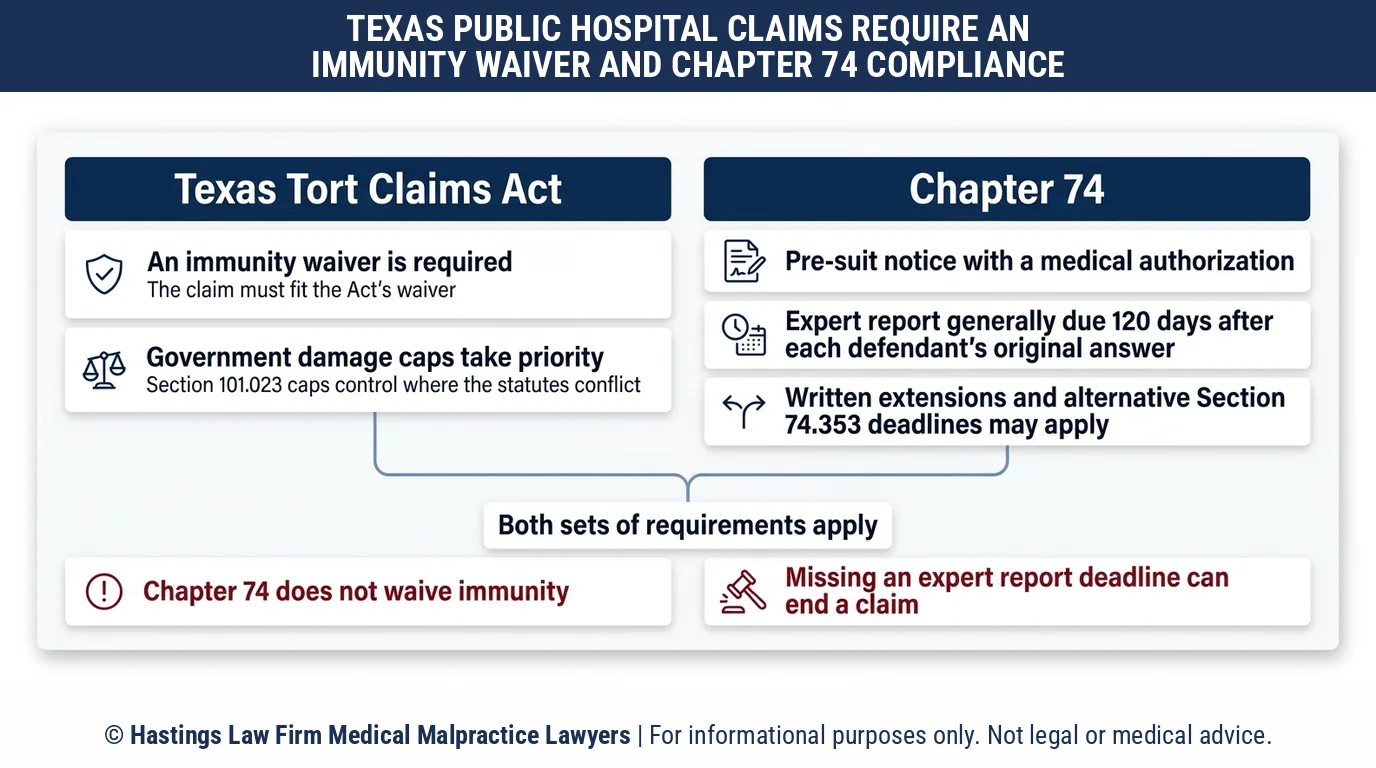
Capítulo 74 del Código de Prácticas y Recursos Civiles Texas applies to a medical malpractice claim against a government hospital in Texas, because §74.001 includes public hospitals in its definitions. A claim that qualifies as a health care liability claim, the statute’s term, stays subject to Chapter 74, but §74.003 says Chapter 74 does not itself waive immunity.
The Tort Claims Act waiver is still needed, and where the statutes conflict, §74.002(b) gives its caps in §101.023 priority. Chapter 74 also requires pre-suit notice with a medical authorization y an expert report, served by the ordinary 120-day deadline after each defendant’s original answer, subject to written extensions and the alternative deadlines in §74.353. Missing either can end a claim.
What is the Deadline to Give Notice of a Claim Against a Texas Public Hospital?
Written notice of a claim against a government hospital in Texas is generally due within six months after the incident under §101.101(a) of the Texas Tort Claims Act, subject to exceptions, and a city’s charter or ordinance can set a shorter period. Actual notice counts only where the hospital was subjectively aware of its alleged fault, as the Texas Supreme Court held in Worsdale v. City of Killeen.
The notice describes the injury, the time and place, and the incident. Knowing a patient was hurt is not awareness of fault, and a medical record alone does not necessarily show it. The two-year limitations period is a separate deadline, and Chapter 74’s pre-suit notice does not automatically satisfy this one.
How Much Can You Recover From a Government Hospital in Texas?
A claim against a Texas hospital district is ordinarily limited to $100,000 per person and $300,000 per occurrence for bodily injury or death, and claims against the state or a city are limited to $250,000 and $500,000, under §101.023 of the Texas Tort Claims Act. Under §101.024, punitive damages are not available against a government unit.
These caps limit all damages for the injury or death, not only non-economic damages, and qualifying mental anguish damages count within them. Where Chapter 74’s own Límites de indemnización por negligencia médica Texas conflict, the §101.023 caps control. Who pays depends on the liable entity’s funding or insurance arrangement, not a single statewide fund.
Can You Sue the Doctor or Nurse Personally at a Texas Public Hospital?
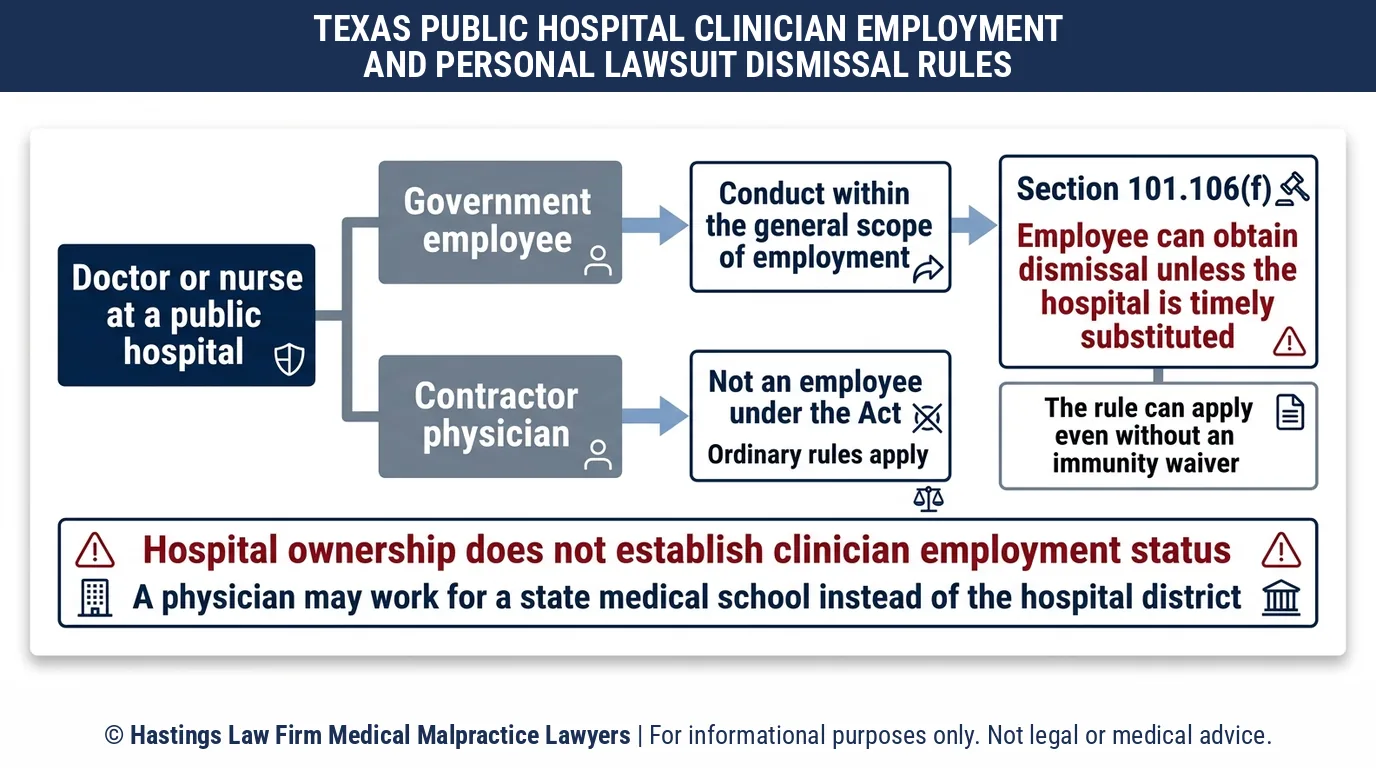
Suing a government-employed doctor or nurse at a Texas public hospital is generally not a reliable workaround, because §101.106 of the Texas Tort Claims Act makes the choice of whom to sue potentially binding. Under §101.106(f), an employee sued over conduct within the general scope of employment can obtain dismissal unless the hospital is timely substituted, a rule the Texas Supreme Court read broadly in Franka v. Velasquez.
That rule reaches claims that could have been brought against the hospital, even without a waiver. A contractor physician is not an employee under the Act and faces the ordinary rules.
Ownership does not prove any clinician’s status, and a physician there may work for a state medical school instead of the hospital district.
How Hard is It to Win a Lawsuit Against a Government Hospital in Texas?
Winning a lawsuit against a government hospital in Texas is hard, because the claim must fit the narrow Texas Tort Claims Act waiver in Chapter 101, meet a notice deadline that can be short, stay within the Act’s damage caps, and meet the expert report requirements of the Texas Medical Liability Act. Claims can still succeed where the facts fit the waiver and every deadline is met.
Even then, the claim must prove that, more likely than not, the negligent care was a substantial factor without which the harm would not have happened (Bustamante v. Ponte).
The Hastings Law Firm Diferencia
Los resultados son importantes, pero lo que realmente nos distingue es cómo los logramos. Cada veredicto, cada acuerdo y cada victoria en la sala de audiencias se basa en una promesa que nos guía: Tratar la lucha de cada cliente por la justicia como si fuera la nuestra.
Este equilibrio de habilidades, experiencia y empatía refleja nuestra filosofía fundamental de que la justicia no solo debe compensar a los lesionados, sino también hacer que la atención médica sea más segura a nivel nacional.

What Should You Do After Being Harmed at a Public Hospital in Texas?
After being harmed at a public hospital in Texas, find out who owns it, write down the dates of care, request the records, and speak with a lawyer promptly, because the notice period for a claim against a government hospital can be short.
- Ownership. Bills, consent forms, and badges can show who runs the hospital and employed each provider.
- Records. You generally may request copies of your medical and billing records from HIPAA-covered providers.
- Copies. Keep everything exchanged with the hospital.
Talk to a Texas Hospital Malpractice Attorney About Your Case
If negligent care at a hospital harmed you or someone you love, our team is here for you. We listen to what happened, review the medical records, and give you an honest answer about whether you have a claim.
Our medical malpractice lawyers are experienced in handling hospital malpractice claims across Texas. We understand what a hospital injury can mean for a family, from further treatment and additional recovery time to lost income.
Hastings Law Firm has been dedicated exclusively to medical malpractice since 2005, and our Texas abogados de negligencia hospitalaria work on a no-win, no-fee basis, so if we do not win the case, you pay nothing. Contact us now for a free, confidential case review.
Sources
- Texas Tort Claims Act, Chapter 101: waiver, caps, notice and employee rules | Texas Legislatura
- Chapter 74 definitions, immunity, priority and expert report rules for healthcare claims | Texas Legislatura
- Health and Safety Code §§285.071 and 285.072 on hospital district management contractors | Texas Legislatura
- Texas Supreme Court opinion on what actual notice to a government unit requires | Tribunal Supremo de Texas
- Texas Supreme Court opinion on suing government employees under §101.106(f) | OpenJurist
- Texas Supreme Court opinion on proving causation in a medical malpractice case | Justia
- History of the Harris County Hospital District and its hospitals | Harris Health
- Dallas County Hospital District, doing business as Parkland Health, 2025 financial statements | Parkland Health
- JPS Health Network and the Tarrant County Hospital District | Red de Salud JPS
- UT Southwestern request describing its state-owned and operated hospitals | Centro Médico UT Southwestern
- MD Anderson statement of its status as a Texas state agency | The University of Texas MD Anderson Cancer Center
- Patients’ federal right to get copies of their medical and billing records | Departamento de Salud y Servicios Humanos de los Estados Unidos

Este contenido ha sido investigado y escrito por el equipo editorial del bufete de abogados Hastings, que incluye abogados, profesionales médicos e investigadores experimentados. Nuestra redacción se basa en el conocimiento interno y la experiencia práctica, y cotejamos los detalles críticos con las fuentes autorizadas citadas a lo largo del texto. Cada artículo se somete a una comprobación de los hechos y a una revisión jurídica. Dado que la información jurídica y médica puede cambiar, si detecta un error, por favor Contacto. Obtenga más información sobre nuestras normas de contenido y el proceso de revisión en nuestro política editorial página.

Tommy Hastings, fundador de Hastings Law Firm, es un abogado especializado en casos de lesiones personales (por la Texas Junta de Especialización Jurídica) dedicado exclusivamente a casos de lesiones relacionadas con la atención sanitaria. Desde 2001, ha representado a pacientes y familias lesionados en litigios contra importantes sistemas hospitalarios, compañías farmacéuticas y proveedores de atención sanitaria negligentes en todo el país. Ha manejado numerosos casos de alto perfil que han atraído la atención de los medios de comunicación nacionales y han dado como resultado recuperaciones de varios millones de dólares.
