


How Do You Sue for Medical Malpractice in Texas?
Deciding to pursue a claim after harm from medical care can feel like stepping into a process with no map. Patients and families may already be managing ongoing treatment, lost income, and grief, and the legal steps ahead can seem long and hard to picture. Each stage has a purpose, and much of the work happens out of the family’s sight. Knowing how a medical malpractice lawsuit in Texas moves from the first records request to a final resolution makes each stage easier to anticipate and less overwhelming.

Last Updated: octubre 22, 2026
What You Should Know About the Texas Medical Malpractice Lawsuit Process:
- A Texas medical malpractice lawsuit runs from records and expert review through pre-suit notice, filing, the expert report, discovery, and mediation, to trial, appeal, and payment.
- Written notice with the statutory medical authorization must go to each proposed defendant at least 60 days before suit, and qualifying notice tolls the filing deadline for 75 days.
- A defendant generally must answer by 10 a.m. on the Monday after 20 days from service, and each original answer starts that defendant’s own expert report clock.
- The expert report and CV are ordinarily due 120 days after each defendant’s original answer, not after filing, and missing it can lead to dismissal with prejudice and a fee award.
- Discovery follows a Rule 190 plan, and Chapter 74 restricts most of it until the expert report is served.
- A settlement offer can come at any stage, and the patient, not the lawyer, decides whether to accept it.
- A district-court civil jury ordinarily has 12 members, and the patient must prove the case by a preponderance of the evidence.
- A notice of appeal is ordinarily due 30 days after the judgment is signed, and payment after a settlement depends on its terms and any liens.
- A Texas malpractice lawsuit has no set or typical length. Court time standards set an 18-month goal for civil jury cases, not a promise.
What Are the Steps in a Medical Malpractice Lawsuit in Texas?
The Texas medical malpractice lawsuit process runs from gathering the medical records and expert review of the care, through pre-suit notice, filing, the expert report, discovery, and mediation, to trial, appeal, and payment. Texas Código de Procedimiento Civil y de Recursos Capítulo 74 adds two steps of its own, pre-suit notice with a medical authorization and an expert report ordinarily due 120 days after each defendant’s original answer.
Very little of the medical malpractice lawsuit process in Texas is in the family’s hands once a suit is filed, because statutes and the court set the pace. The steps before filing are where preparation counts, and the attorney carries them.
The medical malpractice lawsuit timeline that follows shows how long each step of a Texas case takes. Where no rule sets a time, it names what drives the time instead, and every case is different.
| Paso | How long it takes | What sets the time |
|---|---|---|
| Records requested | 15 business days for a physician; HIPAA generally 30 days, plus one 30-day extension | Occupations Code §159.006; HIPAA |
| Revisión de expertos | The records and the expert’s availability | No rule |
| Notificación previa a la demanda | At least 60 days before filing | §74.051 |
| Filing and service | Answer due 10 a.m. on the Monday after 20 days from service | Rule 99 |
| Expert report and CV served | Ordinarily 120 days after each defendant’s original answer | §74.351 |
| Descubrimiento | The discovery plan and court orders | Rule 190 |
| Mediation and settlement | Any stage | No rule |
| Trial | The court’s docket | The court |
| Appeal | Notice ordinarily due 30 days after judgment is signed | Appellate Rule 26.1 |
| Payment | The settlement terms, liens, and any appeal | No universal rule |
Chapter 74 calls these cases health care liability claims, and it covers qualifying claims against physicians, hospitals, nurses, and other covered providers. Texas has no general pre-suit merits panel, and no physician’s certificate of merit is filed with the petition. Chapter 74 tests a claim early in a different way, through the expert report served after each defendant answers.
How Does a Medical Malpractice Case Begin in Texas?
A Texas medical malpractice case begins with a conversation about the care, covering what happened, when it happened, and who provided it, followed by a request for the complete medical records. Under Texas Occupations Code §159.006, a physician has 15 business days after a qualifying request to provide records, and the federal HIPAA right of access generally allows 30 days, with one qualifying 30-day extension.
That first conversation is about listening. The goal is to understand what you experienced and gather what is needed to request the records, not to put you through a test. A family member may make the first call for a patient who cannot. When the patient has died, the legally authorized personal representative can exercise the right to the records, and a family relationship alone is not enough under the federal access rules.
The records include the charts, imaging, nursing notes, monitoring strips, and billing from the relevant care. A review needs a complete set from every provider involved, because a gap in one chart can hide what happened in another.
How long the records take depends on the number of providers, whether imaging has to be copied, and whether follow-up requests are needed. Starting early matters for another reason too. The filing deadline runs from the care itself, meaning the negligent act or the treatment or hospital stay the statute names, not from when the harm was discovered, so an early start protects the time the later steps need.
Who Reviews the Medical Records Before a Texas Malpractice Lawsuit is Filed?
Before a Texas medical malpractice lawsuit is filed, attorneys and medical professionals review the medical records, and a qualified medical expert then reviews the relevant care to judge whether it met the standard and whether a failure caused the harm. Expert review comes early because Texas Civil Practice and Remedies Code §74.351 requires an expert report after each defendant answers, and §§74.401 to 74.403 set the expert’s qualifications.
Sections 74.401 to 74.403 set separate qualifications for an expert on the standard of care and an expert on causation, built on relevant practice, knowledge, training, and experience.
Medicine carries risk, and a bad outcome is not always negligence. Some reviews find that the care met the standard, and that answer has value too, because it gives a family a straight answer about what happened. When the review finds that an injury was preventable, the providers responsible should be held accountable.
Anyone who wants to sue a doctor for medical malpractice in Texas needs that expert support in place before suit. The report comes due on a deadline that runs from each defendant’s answer, so the expert’s opinion has to be ready before that clock starts. The length of the review depends on the volume of records, the number of providers involved, and finding an expert qualified in the right field of medicine.
What is the Pre-Suit Notice Letter in a Texas Medical Negligence Claim?
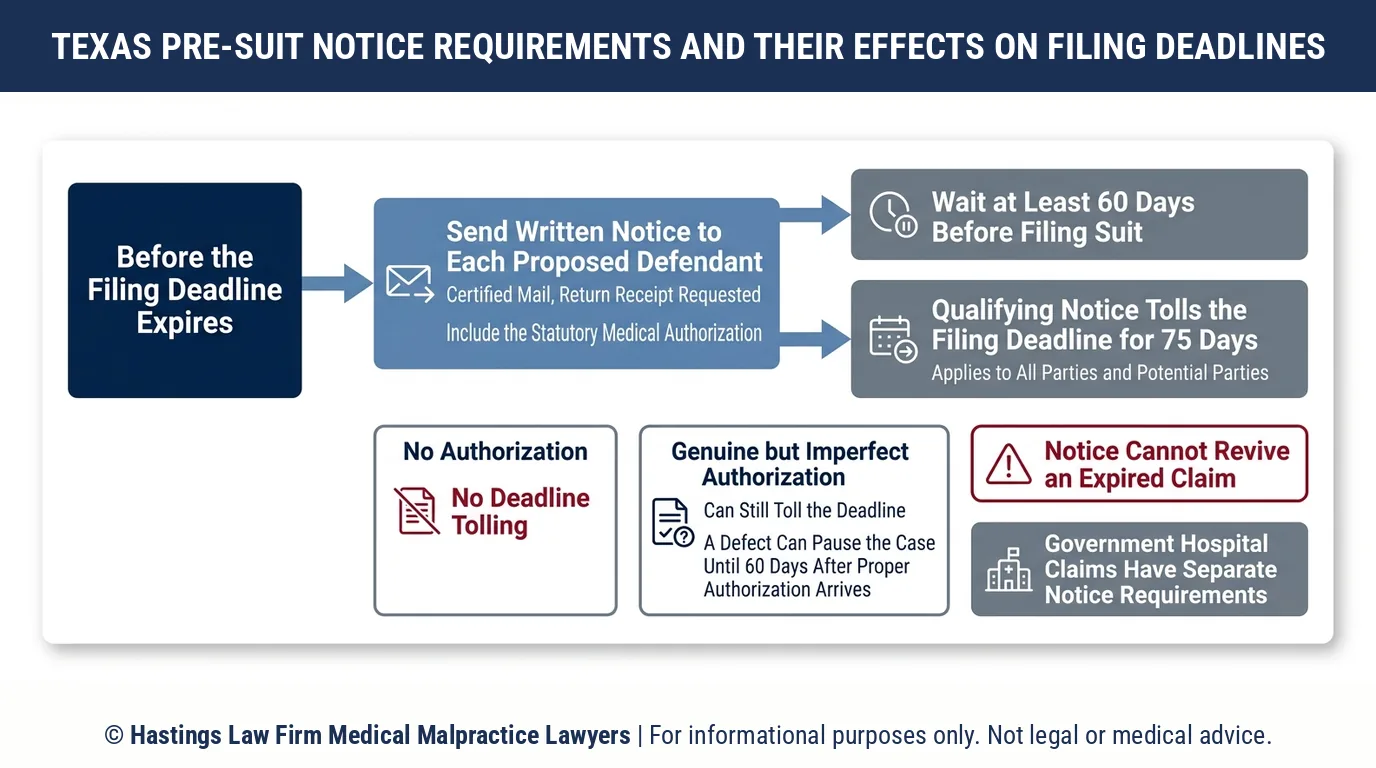
The pre-suit notice in a Texas medical malpractice case is written notice of the claim, sent by certified mail, return receipt requested, to each proposed defendant at least 60 days before the lawsuit is filed. Under Texas Código de Procedimiento Civil y Recursos, §74.051 and §74.052, the notice must be accompanied by the statutory medical authorization.
The notice also helps the patient. When it qualifies and includes the authorization, it tolls, or pauses, the filing deadline for 75 days for all parties and potential parties. Notice cannot revive a claim whose deadline has already passed, so it has to go out before the deadline runs.
The authorization is where mistakes carry weight. The Texas Supreme Court’s decision in Hampton v. Thome separates a notice sent with no authorization, which does not toll the deadline, from a genuine authorization that is incomplete or has errors, which can still toll it. Under §74.052, a defect can lead to abatement, meaning the case is paused until 60 days after a proper authorization is received.
The case cannot be filed until the 60 days have run, and the family can keep gathering records during that time. A claim against a government hospital also has its own notice requirement under the Texas Tort Claims Act, generally six months and sometimes shorter under a city charter or ordinance. Chapter 74 notice does not automatically satisfy it, and Chapter 74 still applies to the claim.
How tolling works alongside the outer time limits and the rules for children is covered in our guide to the Texas medical malpractice filing deadline.
How Do You File a Medical Malpractice Lawsuit in Texas?
To file a medical malpractice lawsuit in Texas, the attorney files a petition in a Texas trial court after the 60-day pre-suit notice period required by Chapter 74 ends, naming each provider believed responsible. Under §74.053 of Texas Civil Practice and Remedies Code Chapter 74, the petition cannot state a specific damages amount, while the Texas Rules of Civil Procedure require it to state a general category of relief.
A Texas Supreme Court order of October 2, 2026 moved the Rule 47 dividing line between those categories from $250,000 to $325,000. Attorneys generally file electronically.
The patient brings the claim. For a child, a parent may act as the child’s next friend under Rule 44. When the patient has died, the spouse, children, or parents bring the wrongful death claim after a loved one’s death, and the estate’s representative brings the survival claim for the patient’s own losses.
The petition names every responsible party. That can include a hospital, which can answer for its own conduct, for its employees, and for a physician who is not its employee through proven actual agency or ostensible agency, meaning the hospital led the patient to reasonably believe the physician acted for it. Our guide to suing a hospital in Texas explains those routes. A signed arbitration agreement can move a case out of court, and whether one is enforceable depends on state and federal arbitration law.
Which Texas Court and County Hear a Malpractice Case?
A Texas medical malpractice case is heard in a civil trial court, such as a district court or a statutory county court. Under Texas Civil Practice and Remedies Code §15.002, the proper county for the lawsuit is generally where all or a substantial part of the events happened, where an individual defendant lived when the claim arose, or where an entity defendant has its principal Texas office.
Texas has no separate malpractice court. The patient’s home county is a fallback under §15.002, not a free choice, and a claim against a government unit is filed in a county where the claim arose, under §101.102.
The county matters to the family because it decides where hearings and trial take place and which court’s schedule the case joins. A busy docket can push back the date a case reaches trial.
How Long Does a Healthcare Provider Have to Answer a Texas Malpractice Lawsuit?
A healthcare provider sued for medical malpractice in Texas generally must file an answer by 10 a.m. on the Monday after 20 days have passed since it was served, under Texas Rule of Civil Procedure 99. The answer clock starts only when the citation and petition are formally served by an authorized person using an authorized method, and mailing a demand letter is not service.
Service is governed by Rules 99, 103, and 106, which allow personal service, qualifying certified or registered mail, and court-authorized substituted service, each with its own requirements.
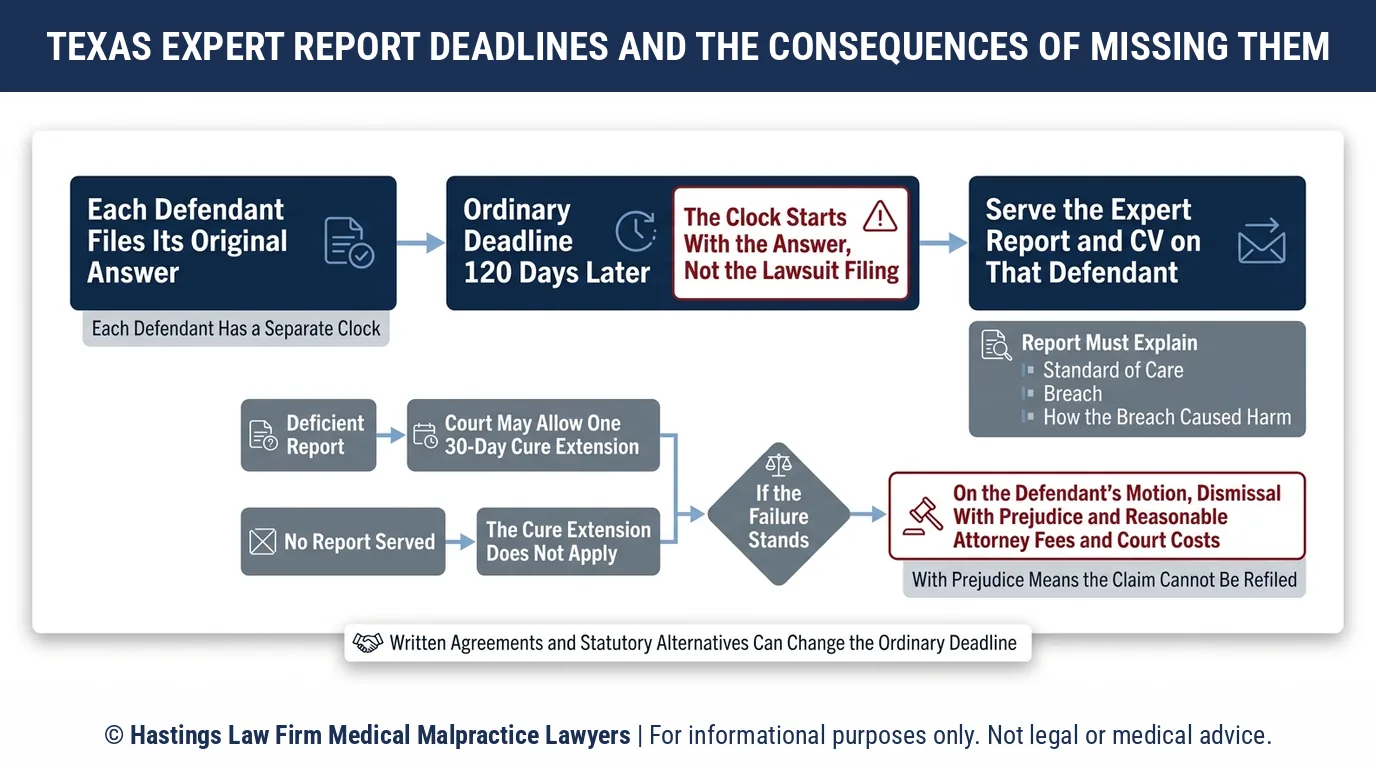
The answer date matters to the patient because each defendant’s original answer starts that defendant’s own 120-day expert report clock. A case against several providers runs several clocks at once, which is why the early months of a lawsuit move quickly.
When is the Expert Report Due in a Texas Medical Malpractice Case?
The expert report in a Texas medical malpractice case is ordinarily due 120 days after each defendant files its original answer, not 120 days after the lawsuit is filed, under Texas Civil Practice and Remedies Code §74.351. The report and each expert’s curriculum vitae must be served on every defendant, and the report fairly summarizes the standard of care, how it was breached, and how the breach caused the harm.
A curriculum vitae, or CV, is the expert’s professional résumé. The report is a preliminary showing, not proof of the case at trial. The 120 days is the ordinary deadline rather than the only one. The parties can extend it by written agreement, and §74.353 supplies alternative deadlines after a timely motion asking the court whether the claim requires a report.
A defendant must file objections within 21 days of the later of report service or its answer, or the objections are waived. The court may grant one 30-day extension to cure a deficient report, which does not help a patient who served no report at all. If the failure stands, on the defendant’s motion the court must dismiss the claim against that defendant with prejudice, meaning it cannot be refiled, and award that defendant its reasonable attorney fees and court costs.
Discovery is restricted until the report and CV are served. The exceptions are certain written discovery about the patient’s care, depositions on written questions, discovery from people who are not parties, and no more than two depositions in total for the patient’s side. Certain rulings on the report can also be appealed before final judgment, which can delay trial.
The report’s role in proving causation in a Texas malpractice case is covered in its own guide. A deadline that strict is manageable when the expert review happened before the suit was filed.
What Happens During Discovery in a Texas Medical Negligence Lawsuit?
Discovery in a Texas medical malpractice lawsuit is the stage where each side exchanges records and information and questions witnesses under oath, under a discovery plan set by Texas Rule of Civil Procedure 190. Chapter 74 of the Texas Civil Practice and Remedies Code restricts discovery until the expert report and the expert’s CV are served, and the ordinary discovery limits still apply afterward.
En Rule 190, Level 2 is the default plan unless Level 1 applies or the court orders a Level 3 plan. The plan and the court’s orders set the deadlines that discovery follows.
Discovery has several parts, and they do not run in one required order:
- Written discovery: written questions and requests for documents that the other side must answer.
- Deposiciones: questioning under oath of the patient, the providers, and the experts.
- Expert disclosures: each side discloses its experts by the deadlines the plan sets.
The deposition is the part that asks the most of the patient personally. It is a session where the defense attorney asks questions about the care and the injury, and your attorney prepares you beforehand and is with you throughout. Ordinary limits cap depositions at 50 hours per side overall and six hours of questioning per side for each witness, and court orders can change those limits.
Under a Level 2 plan, discovery ordinarily ends at the earlier of nine months after initial disclosures are due or 30 days before trial, though orders can change that as well. What makes discovery longer is the number of witnesses and experts and the work of scheduling them.
When Do Settlement Offers Come in a Texas Medical Malpractice Case?
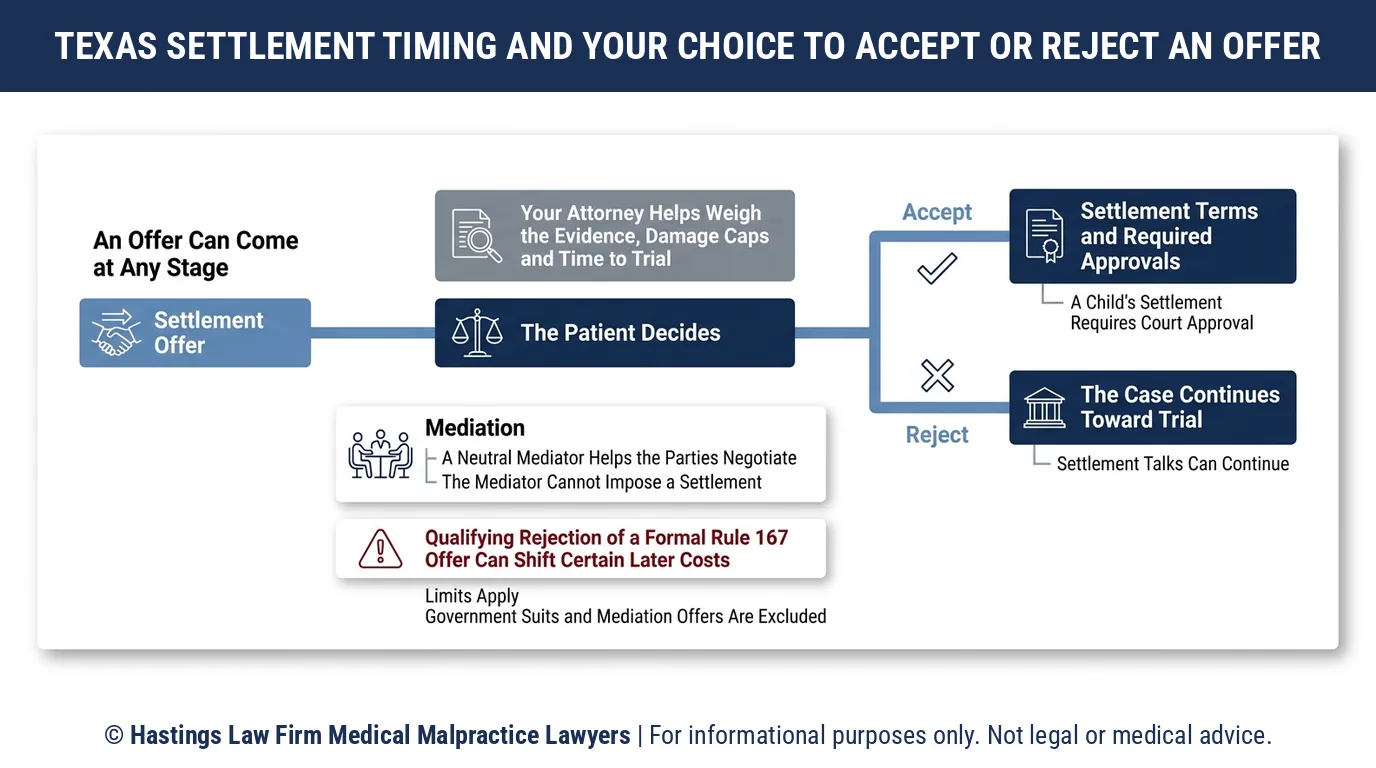
A settlement offer in a Texas medical malpractice case can come at any stage of the case, and no rule requires an offer to be made at any particular time before trial. Texas Civil Practice and Remedies Code Chapter 154 lets a court refer a qualifying pending case to mediation, where a neutral mediator helps the parties work toward an agreement but cannot impose a decision on either side.
There is no set answer to how long it takes to settle a medical malpractice lawsuit. Timing depends on what each side can weigh, such as the expert report and the depositions, and on whether the court refers the case to mediation.
En Chapter 154, a court can refer a qualifying case after consulting the parties and giving notice. A party has 10 days after notice to object, and a reasonable objection prevents the referral. On the day of mediation, your attorney prepares you and is with you through it, and no one can make you accept an offer.
What Happens if You Reject a Settlement Offer in a Texas Malpractice Lawsuit?
When a patient rejects a settlement offer in a Texas medical malpractice lawsuit, the case continues toward trial, and settlement talks can continue. The patient makes that decision, and Texas Disciplinary Rules of Professional Conduct Rule 1.02 requires the lawyer to follow it, subject to approvals the law requires, such as court approval of a child’s settlement.
Rejecting a formal offer made under Rule 167 of the Texas Rules of Civil Procedure can have cost consequences, because a qualifying rejection can shift certain later costs, including attorney and expert fees, subject to limits. The rule can apply to private malpractice claims once it is formally invoked, but not to suits involving the government or to offers made in mediation.
Your attorney helps you weigh an offer against the evidence, the damage caps, and the time to trial, and the choice under Rule 1.02 stays yours.
What Happens at a Medical Malpractice Trial in Texas?
At a medical malpractice trial in Texas, a jury hears the evidence, including medical expert testimony, and decides whether the patient proved that the provider breached the standard of care and that the breach caused the harm. A district-court civil jury ordinarily has 12 members, and under the Texas Rules of Civil Procedure ordinarily the same 10 jurors must agree on the verdict.
The 12-member jury comes from Texas Government Code §62.201, and the 10-juror rule has exceptions. Each side presents its witnesses and evidence, and the medical experts explain to the jury what the care required and whether it was met.
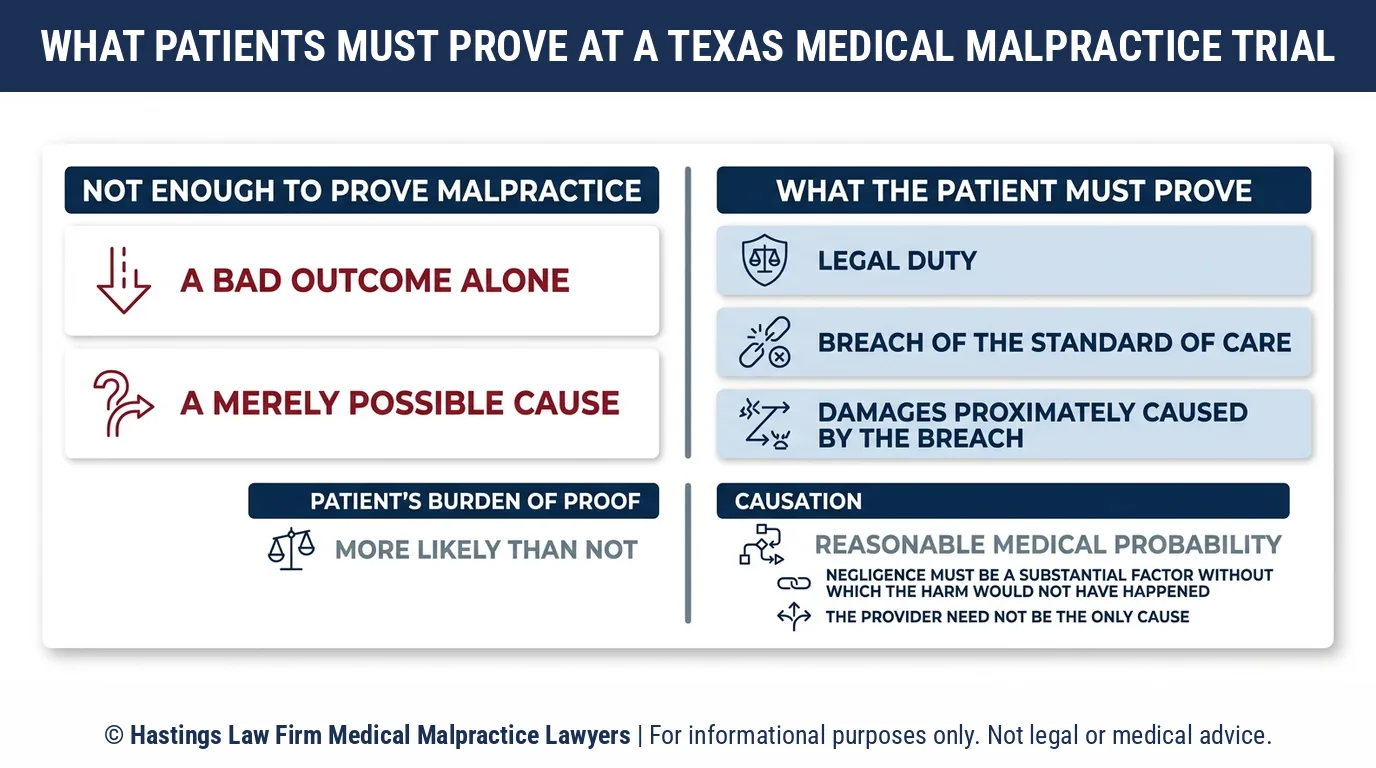
The patient carries the burden of proof by a preponderance of the evidence, meaning more likely than not. The Texas Supreme Court’s decision in Windrum v. Kareh names what must be shown: a legal duty, a breach of that duty, and damages proximately caused by the breach. Causation must be shown in reasonable medical probability, where the negligence was a substantial factor without which the harm would not have happened, and the provider does not have to be the only cause.
A bad outcome alone does not prove negligence, and a possible cause is not enough. After a verdict, the court applies any damage caps to the award. Chapter 74 ordinarily limits non-economic damages, some certified nonprofit hospitals can have lower limits, and in a death case the separate wrongful death cap can apply as well. Our guide to how Texas damage caps apply explica cada límite.
Trial dates can move as the court’s docket allows. How long a trial lasts depends on the number of experts and defendants, and every case is different.
Can a Jury Verdict in a Texas Malpractice Case Be Appealed?
Either side can appeal a medical malpractice verdict in Texas. Under Texas Rule of Appellate Procedure 26.1, the notice of appeal is ordinarily due 30 days after the judgment is signed, or 90 days after certain timely post-trial filings, and Rule 26.3 allows a limited 15-day extension.
An appeal goes to a Texas court of appeals. After that court rules, a party may ask the Texas Supreme Court to hear the case through a petition for review, ordinarily due 45 days after the court of appeals’ judgment or its last ruling on qualifying rehearing motions, with an extension request allowed within 15 days afterward under Rule 53.7. The Supreme Court decides for itself whether to take the case.
An appeal reviews the existing trial record and the law, and no new evidence is presented. The standard of review depends on the issue, and not every error leads to reversal.
During an appeal, the losing side can delay collection of the judgment through an agreement, a bond, a deposit, or other authorized security under Rule 24. Under Texas Civil Practice and Remedies Code §52.006, that security is ordinarily capped at the lesser of 50% of the paying side’s net worth or $25 million. Post-judgment interest ordinarily keeps running under Finance Code Chapter 304 until the judgment is paid, with exceptions.
No published source gives a reliable length for a malpractice appeal. The time depends on the size of the record, the briefing, and the court’s docket, and every case is different.
How Long Does It Take to Get Paid After a Texas Medical Malpractice Settlement or Verdict?
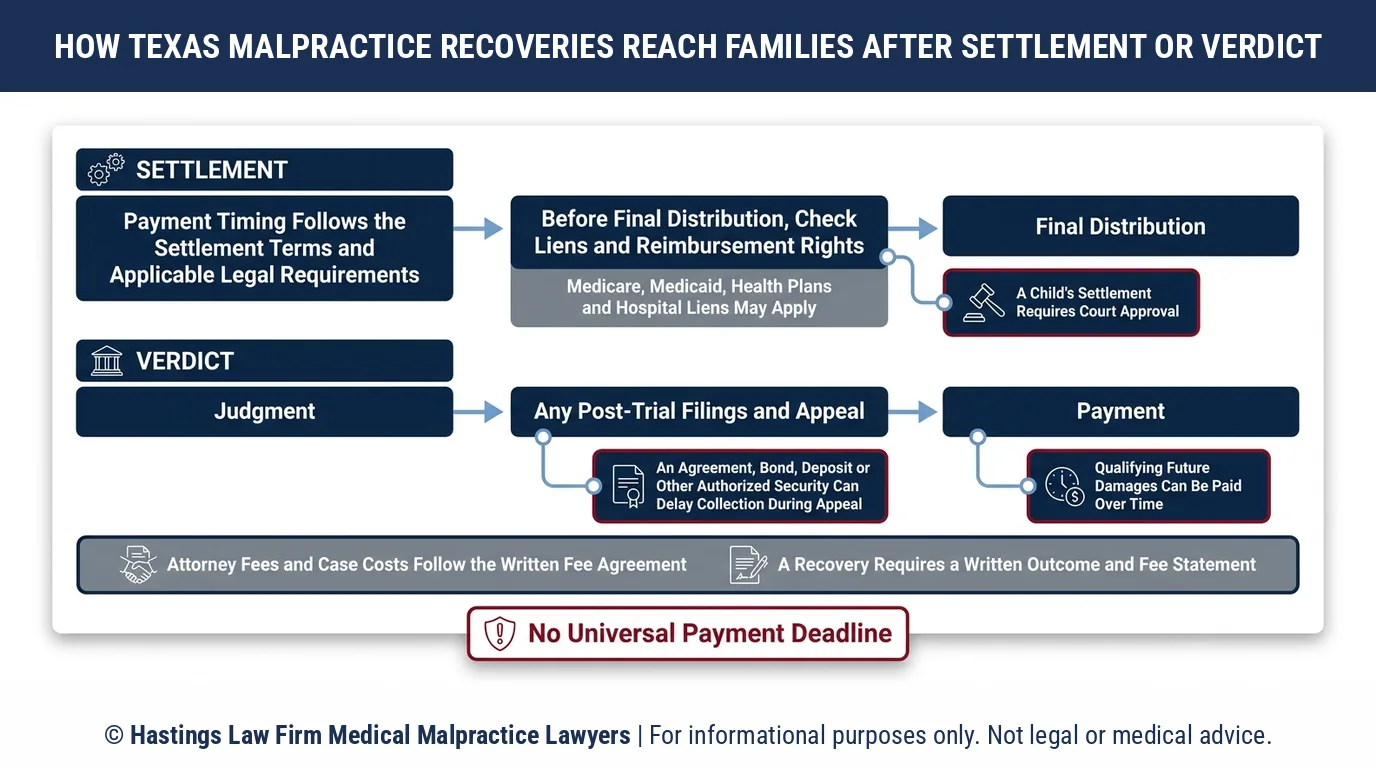
Payment after a Texas medical malpractice settlement has no fixed timeline, because the terms of the settlement agreement, and any legal requirements that apply to it, set when payment is made. After a verdict, payment comes after the judgment and any appeal, and under Texas Civil Practice and Remedies Code §74.503, qualifying awards of future damages can be paid over time.
A settlement moves through a few steps before the money reaches the family. Before final distribution, the attorney checks for reimbursement rights and liens that may apply, such as Medicare, Medicaid, health plans, and hospital liens. When there is a recovery, the disciplinary rules require a written statement showing the outcome and how the fee was calculated.
A child’s settlement needs court approval, which adds a procedural step. Whether the court appoints a guardian ad litem, a person who looks out for the child’s interests in the settlement, depends on the conditions in Rule 173.2.
After a verdict, the path runs through the judgment, any post-trial filings, and any appeal or security that delays collection, with interest ordinarily running in the meantime. Periodic payments apply when future damages have a present value of at least $100,000. On a qualifying request, §74.503 requires periodic payment of future medical, healthcare, or custodial services and allows it for other future damages.
Attorney fees and case costs come out of the recovery as the written fee agreement sets them. Texas requires a contingency fee agreement to be in writing and to explain how the fee and expenses are calculated.
How Long Does a Medical Malpractice Lawsuit Take in Texas?
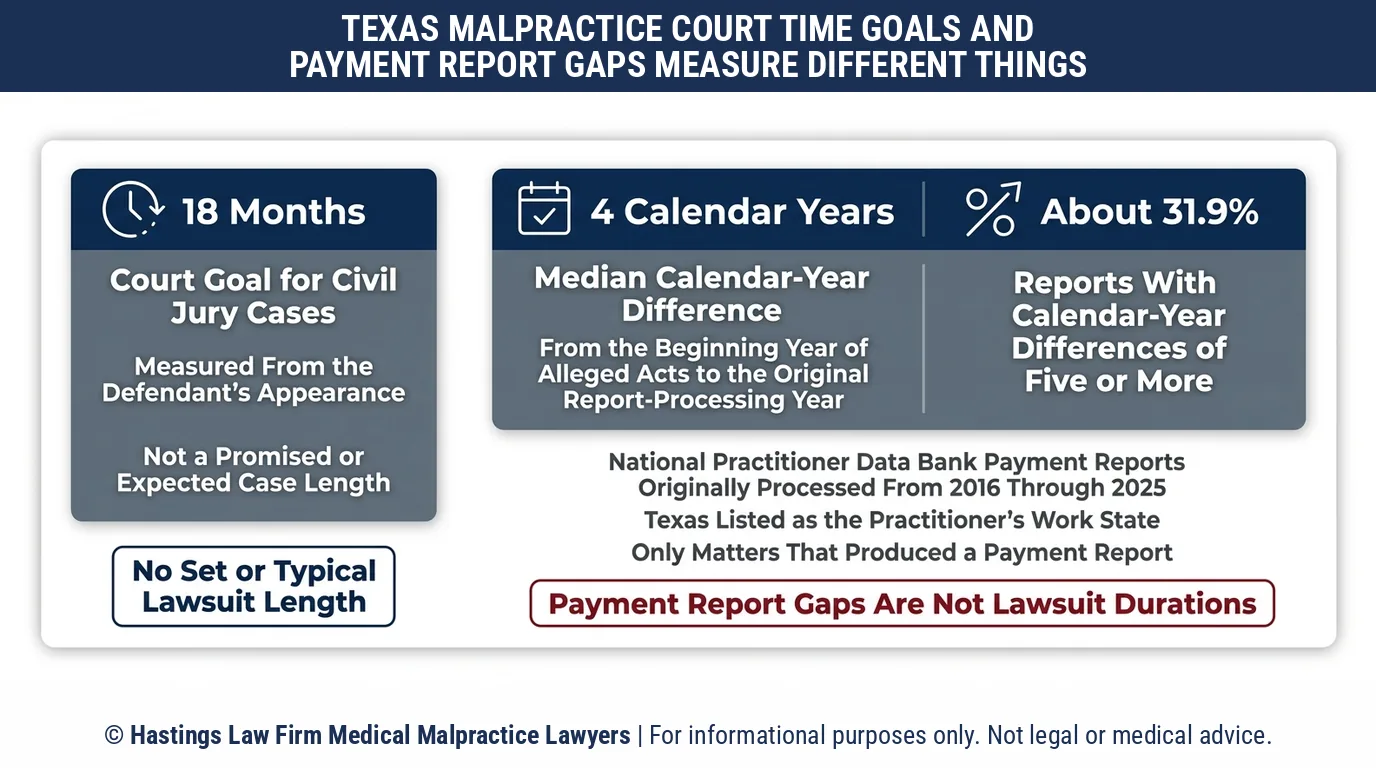
A medical malpractice lawsuit in Texas has no set or typical length, because each case moves at the pace of its own records, expert review, notice period, expert report, discovery, and court schedule. Texas Rule of Judicial Administration 6.1 sets a goal, so far as reasonably possible, of resolving civil jury cases such as medical malpractice lawsuits within 18 months of the defendant’s appearance.
En Rule 6.1 time standards are goals for the courts, not a promise and not an expected length for any one case. Their clock starts at appearance in the lawsuit, not at the injury, and complex cases and special circumstances can run past them. Every case is different.
Several things can lengthen a case:
- Several defendants, each with its own expert report clock.
- A challenge to the expert report, and an appeal of a ruling on it before final judgment.
- A busy docket, where trial settings are reset.
- An appeal after the verdict.
Thorough work before filing can keep the later steps on track, and a settlement at mediation can end the case well before trial.
Federal data offer a different measure of time, one that is not the length of a case. The figures come from Hastings Law Firm’s analysis of the Archivo de datos de uso público del National Practitioner Data Bank, published by the Health Resources and Services Administration of the U.S. Department of Health and Human Services. The June 30, 2026 release contains payment reports received through June 30, 2026, and we last updated the figures on October 21, 2026.
Among National Practitioner Data Bank malpractice payment reports originally processed from 2016 through 2025 that listed Texas as the practitioner’s work state, the median difference between the beginning year of the alleged acts and the original report-processing year was four calendar years, and about 31.9% had differences of five years or more. That gap runs from the year the alleged acts began to the year the payment report was processed, so it is not the length of a lawsuit, and it covers only matters that produced a payment report.
Starting early helps because the filing deadline keeps running from the care, and notice must go out at least 60 days before a suit is filed.
The Hastings Law Firm Diferencia
Los resultados son importantes, pero lo que realmente nos distingue es cómo los logramos. Cada veredicto, cada acuerdo y cada victoria en la sala de audiencias se basa en una promesa que nos guía: Tratar la lucha de cada cliente por la justicia como si fuera la nuestra.
Este equilibrio de habilidades, experiencia y empatía refleja nuestra filosofía fundamental de que la justicia no solo debe compensar a los lesionados, sino también hacer que la atención médica sea más segura a nivel nacional.

What Should You Do First if You Are Considering a Malpractice Lawsuit in Texas?
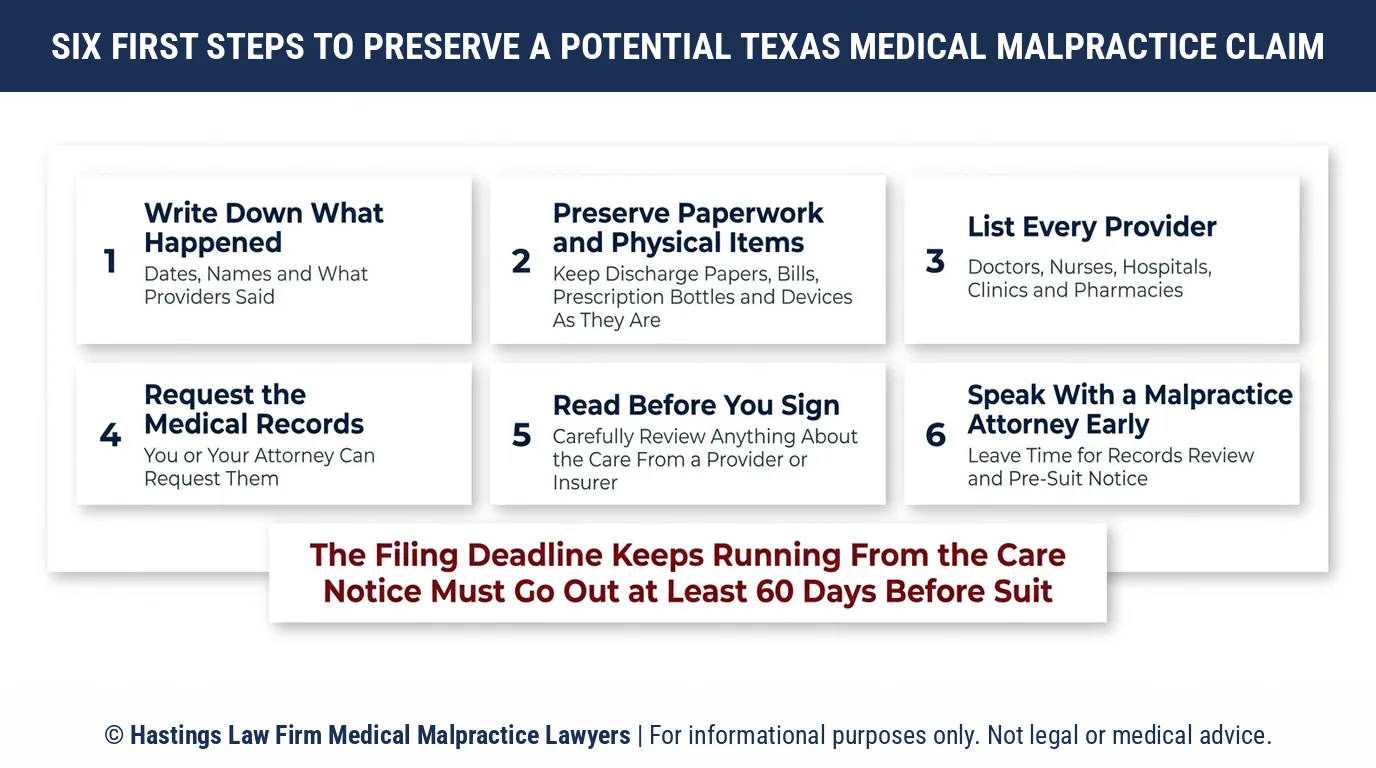
The first thing to do when considering a medical malpractice lawsuit in Texas is to write down what happened and keep every document from the care while the details are fresh. The next steps are listing every provider who treated the patient, requesting the medical records, and speaking with a medical malpractice attorney early, because the two-year Texas filing deadline for malpractice claims keeps running from the care.
The attorney carries the procedure. The family’s job in the first weeks is to preserve what they have.
- Write it down. Note dates, names, and what each provider said, as soon as you can. Memories fade, and these details help the review.
- Keep the paperwork and anything physical. Discharge papers, bills, prescription bottles, and any device involved should be kept exactly as they are.
- List every provider. Include each doctor, nurse, hospital, clinic, and pharmacy involved in the care, so the records request misses no one.
- Request the records, or let an attorney do it. The records are the foundation of the review, and an attorney can request them for you.
- Read before you sign. If a provider or an insurer asks you to sign anything about the care, read it carefully first.
- Speak with a medical malpractice attorney early. Notice must go out at least 60 days before a lawsuit is filed, while the filing deadline keeps running. You can reach our intake team by phone or through our online contact form, and we request the medical records at no cost to you.
Talk to a Texas Medical Malpractice Attorney About Your Case
If you are trying to find out whether what happened to you or someone you love is a claim, a free, confidential case review is where the answer starts. We listen to what you experienced, request and review the medical records, and give you an honest answer about whether there is a claim.
Our medical malpractice lawyers are experienced in guiding Texas families through every stage of a medical malpractice lawsuit, from the first records request to trial. We understand what that process asks of a family, from the months of waiting to the deposition and the decision about an offer, and we explain each step as it comes. Once we take a case, our board-certified patient advocates keep you informed whenever something noteworthy happens.
En medical malpractice attorneys at Hastings Law Firm have been dedicated exclusively to medical malpractice since 2005. Hastings Law Firm advances the cost of the experts and of everything else it takes to build a medical malpractice claim, and we work on a no-win, no-fee basis, so if we do not win the case, you pay nothing. Our team is here for you. Contact us now for a free, confidential case review.
Sources
- Chapter 74, Texas’s medical liability law, including notice and expert report rules | Texas Legislatura
- Chapter 74 expert qualifications, §§74.401 to 74.403, and periodic payments under §74.503 | Texas Legislatura
- Occupations Code §159.006, a physician’s deadline to provide medical records | Texas Legislatura
- Federal answers on patients’ and representatives’ right to access health records | Departamento de Salud y Servicios Humanos de los Estados Unidos
- Supreme Court opinion on missing versus imperfect medical authorizations with pre-suit notice | Tribunal Supremo de Texas
- Final order amending Rule 47’s relief categories, effective October 2, 2026 | Tribunal Supremo de Texas
- Civil Practice and Remedies Code §15.002, the general rule for choosing the county | Texas Legislatura
- Texas Rules of Civil Procedure on service, answers, discovery plans and formal offers | Texas Poder Judicial
- Chapter 154 rules on court referral to mediation and the mediator’s role | Texas Legislatura
- Disciplinary Rule 1.02, the client’s right to decide whether to settle | Texas Poder Judicial
- Government Code §62.201, the number of jurors in a district court | Texas Legislatura
- Supreme Court opinion stating the elements a malpractice plaintiff must prove | Tribunal Supremo de Texas
- Appellate rules on appeal deadlines, suspending judgments and petitions for review | Texas Poder Judicial
- Civil Practice and Remedies Code §52.006, limits on security during an appeal | Texas Legislatura
- Judicial Administration Rule 6.1, the courts’ time standards for civil cases | Texas Poder Judicial
- National Practitioner Data Bank Public Use Data File and its documentation | Health Resources and Services Administration

Este contenido ha sido investigado y escrito por el equipo editorial del bufete de abogados Hastings, que incluye abogados, profesionales médicos e investigadores experimentados. Nuestra redacción se basa en el conocimiento interno y la experiencia práctica, y cotejamos los detalles críticos con las fuentes autorizadas citadas a lo largo del texto. Cada artículo se somete a una comprobación de los hechos y a una revisión jurídica. Dado que la información jurídica y médica puede cambiar, si detecta un error, por favor Contacto. Obtenga más información sobre nuestras normas de contenido y el proceso de revisión en nuestro política editorial página.

Tommy Hastings, fundador de Hastings Law Firm, es un abogado especializado en casos de lesiones personales (por la Texas Junta de Especialización Jurídica) dedicado exclusivamente a casos de lesiones relacionadas con la atención sanitaria. Desde 2001, ha representado a pacientes y familias lesionados en litigios contra importantes sistemas hospitalarios, compañías farmacéuticas y proveedores de atención sanitaria negligentes en todo el país. Ha manejado numerosos casos de alto perfil que han atraído la atención de los medios de comunicación nacionales y han dado como resultado recuperaciones de varios millones de dólares.
