


Who Can File a Medical Malpractice Wrongful Death Lawsuit in Arizona?
The death of someone you love after medical care that went wrong leaves a family grieving, searching for answers, and often unsure what comes next. Questions about who in the family is allowed to act tend to arrive while relatives are still coming to terms with the loss. Several people may feel equally close to the person who died, and each may wonder whether the decision is theirs to make. Understanding who the law allows to bring a wrongful death claim after medical malpractice in Arizona is often the first step toward deciding together how the family moves forward.

Last Updated: noviembre 4, 2026
What You Should Know About Filing a Medical Malpractice Wrongful Death Lawsuit in Arizona:
- Under A.R.S. 12-612, an Arizona wrongful death lawsuit over medical negligence can be filed by the surviving spouse, a child, a parent or guardian, or the personal representative of the person who died, and siblings, grandparents, grandchildren, and unmarried partners are not on that list.
- Arizona allows one medical malpractice wrongful death lawsuit for the whole family, and any one eligible person can start it without every survivor’s permission, but settling another survivor’s claim requires that survivor’s consent.
- Each survivor’s share of an Arizona medical negligence death recovery follows that person’s own damages rather than an equal split or the will, and money recovered for the family is protected from the deceased person’s debts.
- Adult children can bring an Arizona wrongful death claim for a parent’s death from medical malpractice, and parents can bring one for an adult child’s death, because the law sets no age limit.
- When no spouse, child, or parent survives, a personal representative appointed in an Arizona probate case brings the medical malpractice death claim for the estate, and the recovery becomes an estate asset.
- A death caused by medical negligence is a medical malpractice action under A.R.S. 12-561, so an Arizona family must prove the provider fell below the accepted standard of care and that this failure caused the death, and must meet the state’s expert certification rules.
- Parents can bring an Arizona wrongful death claim for a viable stillborn baby lost to medical malpractice, as the Arizona Supreme Court held in Summerfield v. Superior Court.
- An Arizona medical malpractice wrongful death lawsuit generally must be filed within two years of the death under A.R.S. 12-542, and a claim against a public hospital needs a notice of claim within 180 days and a lawsuit within one year.
- Arizona has no damage caps on a wrongful death award for medical negligence, because the Arizona Constitution bars any law limiting the amount of damages for causing a death.
Who Has the Right to Bring a Medical Malpractice Wrongful Death Claim in Arizona?
The people who can file a medical malpractice wrongful death lawsuit in Arizona are the surviving spouse, a child, a parent or guardian, and the personal representative of the person who died. Arizona’s wrongful death statute, Section 12-612 of the Arizona Revised Statutes, says the lawsuit is brought on behalf of the surviving spouse, children, and parents, or on behalf of the estate if none of them survive.
In Arizona wrongful death medical malpractice cases, the right to sue belongs to the same people the statute names, not to whoever was closest to the patient or spent the most time at the bedside. The family members who share in a recovery, called beneficiaries, come only from that list, and the list is closed. Siblings, grandparents, and grandchildren are not wrongful death beneficiaries, and a stepchild, stepparent, fiancé, or unmarried partner does not qualify through that relationship alone. A sibling may still serve as the appointed personal representative without receiving a personal share of the recovery.
Among the people who do qualify, any one can start the case for the whole family, and filing does not require every other survivor’s permission. When a child dies, either parent may bring the claim, and a guardian may bring it for the death of a ward. Knowing the list early lets a family decide together who will act for everyone.
Can Each Family Member File Their Own Medical Negligence Death Case in Arizona?
No, each family member cannot file a separate wrongful death case over medical negligence in Arizona. A 2002 decision of the Arizona Supreme Court, Wilmot v. Wilmot, held that Arizona allows one wrongful death action, with one plaintiff and one judgment, for all of the eligible survivors. The surviving spouse, children, and parents share that single case.
The person who files represents every beneficiary and holds any recovery in trust for them. That person owes the others fiduciary duties, which means protecting their interests and keeping them informed about the case and any settlement offers. Settling another survivor’s claim requires that survivor’s consent, so filing first does not give anyone control over the rest of the family’s claims.
When one of the beneficiaries is still a minor, a settlement of that child’s claim needs a court’s approval as well as consent, and the child’s recovery must be protected. That protection does not always mean a permanent conservator to manage the money, since a court can authorize other protective arrangements.
Each survivor’s share of a recovery, the child’s included, is set in proportion to that survivor’s damages under A.R.S. 12-612, rather than split equally or according to the will. If the case goes to trial, each participating beneficiary’s damages are decided separately. Money recovered for the surviving family is also protected from the deceased person’s debts.
Can Adult Children Sue for a Parent’s Death From Medical Malpractice in Arizona?
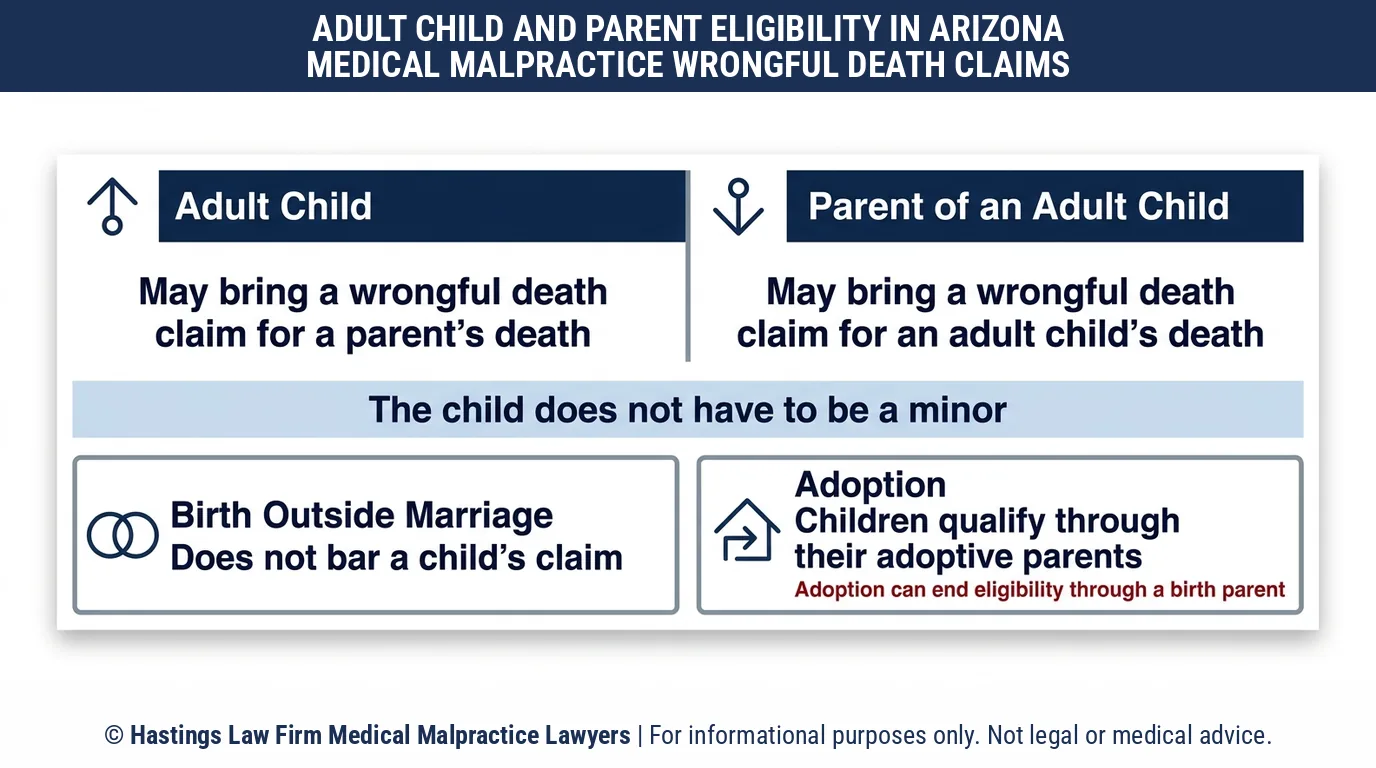
Yes, adult children can sue for wrongful death after medical malpractice in Arizona, and parents can sue for an adult child’s death from negligent care, because Arizona’s wrongful death law does not require the child to be a minor. A 1986 decision of the Arizona Supreme Court, Howard Frank, M.D., P.C. v. Superior Court, confirmed that recovery for losing a child’s companionship has no arbitrary age limit.
The legal parent-child relationship decides who counts, not age. Birth outside marriage does not bar a child’s claim, and adopted children qualify through their adoptive parents, though adoption can end eligibility through a birth parent. A child who is still a minor when a parent dies can also have more time to bring a claim of their own.
Who Files an Arizona Medical Malpractice Death Claim if No Spouse, Child, or Parent Survives?
The personal representative of the person who died files the Arizona medical negligence wrongful death claim when no spouse, child, or parent survives, bringing it on behalf of the estate under A.R.S. 12-612. Any amount recovered becomes an asset of the estate, and unlike money recovered for surviving family members, it is not protected from the deceased person’s debts.
The estate’s personal representative can be a sibling or another relative, but no relative takes on the role automatically. The appointment happens in probate, and the person appointed acts under letters, the court papers that give that authority. Arizona sets a priority order among applicants in A.R.S. 14-3203, beginning with the person the will names and including the deceased person’s heirs. Applicants must be at least 18, anyone who is not a licensed professional fiduciary completes court training before letters issue, and a bond may be required unless it is waived.
Once appointed, the personal representative can also pursue the patient’s own claim, called a survival claim, for medical bills, income lost before death, and other proven economic losses. Arizona law does not allow the patient’s pain and suffering to be recovered in that claim. The survival claim belongs to the estate and stands apart from the family’s wrongful death claim, though the same loss is not paid twice.
Can a Family File a Wrongful Death Lawsuit for Medical Malpractice in Arizona?
Yes, a family can file a wrongful death lawsuit for medical malpractice in Arizona. Under A.R.S. 12-561 y A.R.S. 12-611, a licensed health care provider can be held liable for a death caused by negligence the patient could have sued over had they lived, and the family’s claim is treated as a medical malpractice action.
Because the family’s claim rests on a wrong the patient could have sued over, what happened to the patient’s own claim can affect it. If the patient settled with the providers and released them before dying, that release can prevent a later wrongful death lawsuit against them, and an earlier final judgment on the patient’s claim can also matter. A missed filing deadline on the patient’s own injury claim does not by itself bar the family’s wrongful death claim.
A family’s medical malpractice death claim can follow many kinds of loss, from a mother’s death related to childbirth to the death of a nursing home resident. Whatever the loss, calling the case wrongful death does not change what has to be proved. Under A.R.S. 12-563, the family must show both that the provider fell below the accepted standard of care and that this failure caused the death. That second part, proving causation after a medical error, connects what went wrong in the care to the loss itself.
Arizona’s expert rules apply to a death claim just as they do to an injury claim. Under A.R.S. 12-2603, the person bringing the claim must certify whether expert testimony is needed to prove it and, when it is, serve a declaración jurada preliminar de opinión pericial early in the case. A claim against a provider can be dismissed if a required affidavit is not served.
A family can also sue a hospital for a death caused by negligent care, because Arizona law treats a hospital as a licensed health care provider and the same malpractice rules apply to it. A hospital can be held responsible for the negligence of its employed staff, and sometimes for an independent contractor physician when the hospital’s own conduct led the patient to reasonably believe that doctor was its employee or agent. Hospital malpractice claims in Arizona carry their own notice rules when the hospital is public.
Can Parents Bring a Medical Malpractice Wrongful Death Claim for a Stillborn Baby in Arizona?
Yes, parents can bring a wrongful death claim for a stillborn baby lost to medical malpractice in Arizona when the baby was viable. A 1985 decision of the Arizona Supreme Court, Summerfield v. Superior Court, held that a stillborn, viable fetus is a person under the state’s wrongful death statutes and allowed the parents’ claim arising from alleged medical malpractice to go forward.
A baby who dies after birth is a child under the wrongful death statute, so either parent may bring that claim, just as for an older child. Families facing the death of an infant after medical care work through the same questions of who files and what the claim must prove.
How Long Does a Family Have to File a Medical Malpractice Wrongful Death Lawsuit in Arizona?
A medical malpractice wrongful death lawsuit in Arizona generally must be filed within two years of the date of death under A.R.S. 12-542, even when the medical care at issue took place earlier. A child’s own claim for a parent’s death can have its deadline paused while the child is a minor, though that pause does not extend the deadline for adult family members.
En deadlines are shorter when the claim is against a public hospital. The family must file a notificación de reclamación, a formal written claim to the public entity, within 180 days, and the notice must state a specific amount for which the claim can be settled. The lawsuit itself must be filed within one year, and both periods are measured from when the family knew or should have known what caused the harm.
What Damages Can a Family Recover in an Arizona Medical Malpractice Wrongful Death Claim?
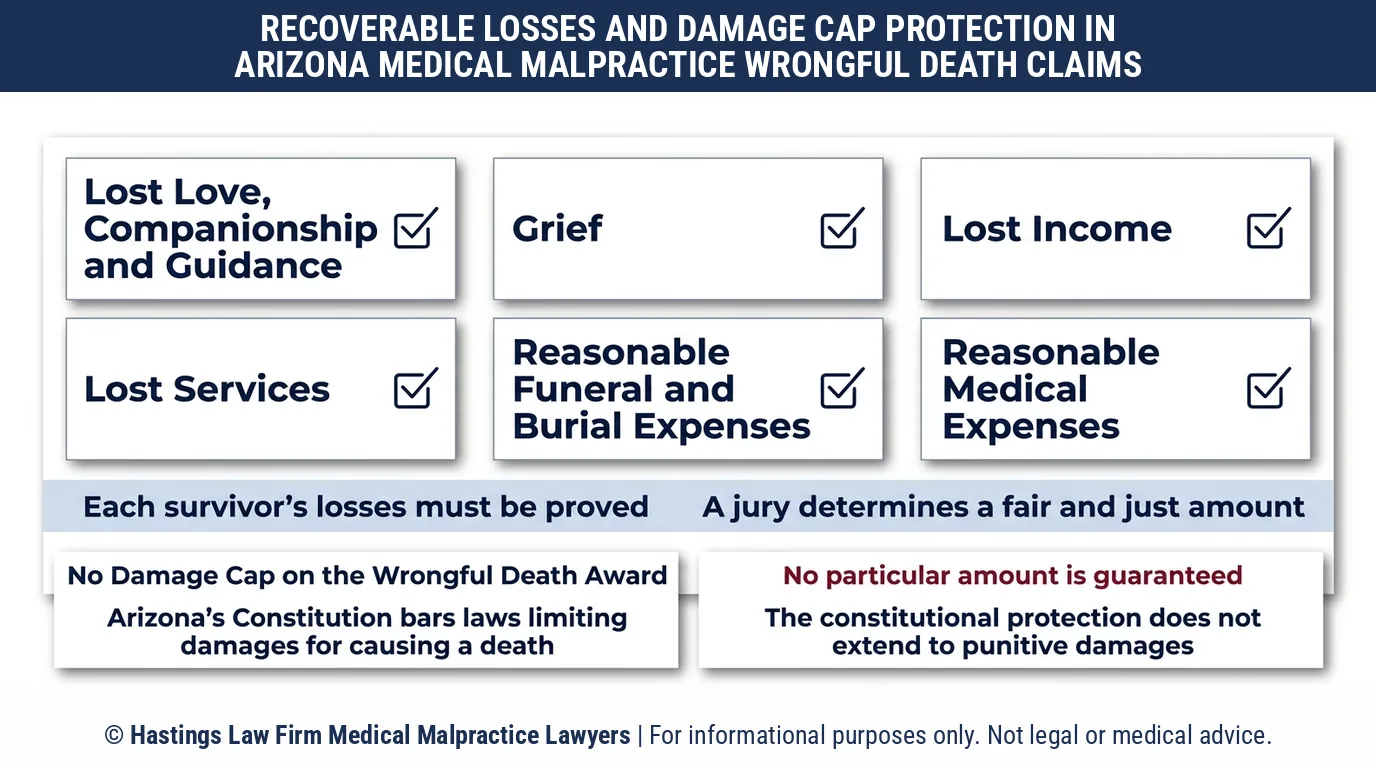
In an Arizona wrongful death claim for medical malpractice, a family can recover damages for the losses the death caused each surviving family member, in the amount a jury finds fair and just under A.R.S. 12-613. Those losses can include the lost love, companionship, and guidance of the person who died, the family’s grief, lost income and services, and reasonable funeral, burial, and medical expenses, when the evidence proves them.
Arizona has no damage caps on that award, because Arizona Constitution Article 2, Section 31 bars any law limiting the amount of damages for causing a death. That protection does not guarantee any particular amount, and it does not extend to punitive damages.
Lo que distingue a Hastings Law Firm
Los resultados importan, pero lo que realmente nos distingue es cómo los logramos. Cada veredicto, cada acuerdo y cada victoria en los tribunales nace de una promesa que nos guía: Tratar la lucha de cada cliente por la justicia como si fuera nuestra.
Este equilibrio de habilidad, experiencia y empatía refleja nuestra filosofía fundamental: la justicia no solo debe indemnizar a los lesionados, sino también hacer que la atención médica sea más segura en todo el país.

What Should a Family Do After a Death From Medical Negligence in Arizona?
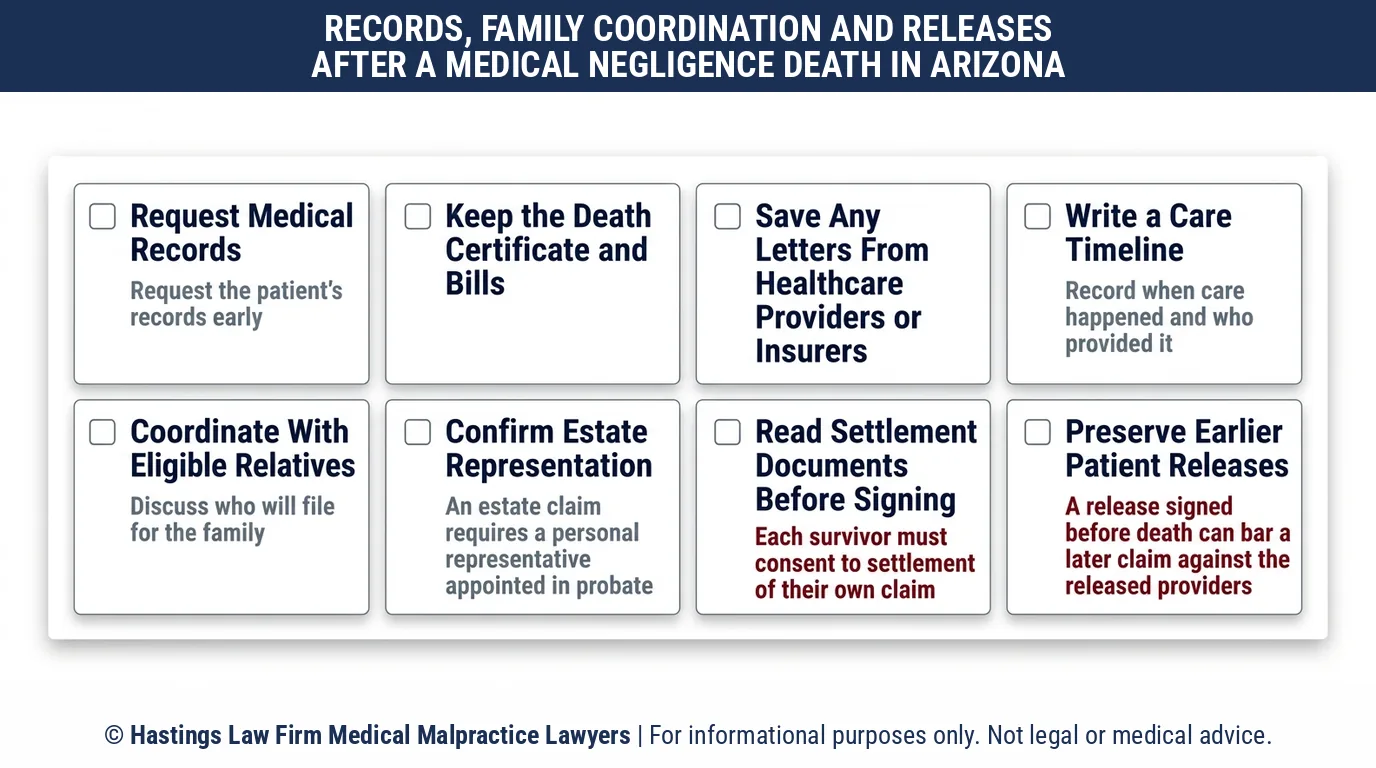
The first steps after a death from medical negligence in Arizona are to request the patient’s medical records, keep the death certificate, the bills, and any letters from the healthcare providers or insurers, and write down when the care happened and who provided it. The family members eligible to bring a wrongful death claim should then talk together about who will file it.
Whoever files will need those records, and they take time to arrive. Arizona sets a 30-calendar-day response period for a written records request made for litigation under A.R.S. 12-2293, while the two-year filing period runs from the death. Requesting the records early protects the time the family has left.
The estate’s claim takes time as well, because a personal representative must be appointed in probate before acting for the estate. Any settlement or release deserves a careful read before anyone in the family signs it, since no one may settle another survivor’s claim without that person’s consent. A release the patient signed before dying matters too, because it can bar the family’s later claim against the providers it released, so it belongs with the records the family gathers.
Talk to an Arizona Medical Malpractice Wrongful Death Attorney About Your Family’s Case
When you contact Hastings Law Firm after losing someone you loved, a member of our intake team listens to what your family experienced, and we request the medical records at no cost to you. Our attorneys and medical professionals review those records, and once that review is complete, we give you an honest answer about whether there is a claim and who in the family can bring it.
Nuestros abogados de negligencia médica de Arizona are experienced in handling wrongful death claims that arise from medical errors for families across the state. We understand what losing a spouse, parent, or child to medical negligence means for a family, from the lost income and care to the grief that follows. Hastings Law Firm has been dedicated exclusively to medical malpractice since 2005.
We handle these cases on a contingency fee, which means there is no fee unless we win, and we advance the cost of experts and everything else it takes to build the claim. Our team is here for you. Contact us now for a free, confidential case review.
Fuentes
- A.R.S. 12-612, sobre quién puede presentar una demanda por muerte injustificada en Arizona | Legislatura del Estado de Arizona
- Wilmot v. Wilmot, Arizona Supreme Court opinion on one wrongful death action | Suprema Corte de Arizona
- Howard Frank v. Superior Court, opinion on wrongful death without age limits | Justia
- A.R.S. 14-3203, priority and qualifications for appointment as personal representative | Legislatura del Estado de Arizona
- A.R.S. 12-611, liability for a death caused by wrongful act or neglect | Legislatura del Estado de Arizona
- A.R.S. 12-561, medical malpractice action defined to include an action for death | Legislatura del Estado de Arizona
- Summerfield v. Superior Court, Arizona Supreme Court opinion on a stillborn, viable fetus | Justia
- A.R.S. 12-542, two-year deadline for a wrongful death action from the death | Legislatura del Estado de Arizona
- A.R.S. 12-821.01, notice of claim rules for claims against Arizona public entities | Legislatura del Estado de Arizona
- A.R.S. 12-613, how Arizona measures wrongful death damages | Legislatura del Estado de Arizona
- Arizona Constitution Article 2, Section 31, barring laws that limit damages for a death | Legislatura del Estado de Arizona
- A.R.S. 12-2293, response periods for medical records requests in Arizona | Legislatura del Estado de Arizona

Este contenido fue investigado y redactado por el equipo editorial de Hastings Law Firm, integrado por abogados, profesionales de la salud e investigadores con experiencia. Nuestros textos se basan en conocimiento interno y experiencia práctica, y verificamos los datos clave con las fuentes autorizadas que citamos a lo largo del texto. Cada contenido pasa por una verificación de hechos y una revisión legal dirigidas por personas. Como la información legal y médica puede cambiar, si encuentra un error, por favor comuníquese con nosotros. Conozca más sobre nuestros estándares de contenido y nuestro proceso de revisión en nuestra página de política editorial .

Tommy Hastings, fundador de Hastings Law Firm, es un abogado litigante en lesiones personales certificado por la Junta (por la Texas Board of Legal Specialization) dedicado exclusivamente a casos de lesiones relacionadas con la atención médica. Desde 2001, ha representado a pacientes lesionados y a sus familias en litigios contra grandes sistemas hospitalarios, compañías farmacéuticas y proveedores de atención médica negligentes en todo el país. Ha manejado numerosos casos de alto perfil que han atraído la atención de los medios nacionales y han dado lugar a indemnizaciones multimillonarias.
